On this page
Last Updated on September 26, 2026 by Muhammad Toqeer
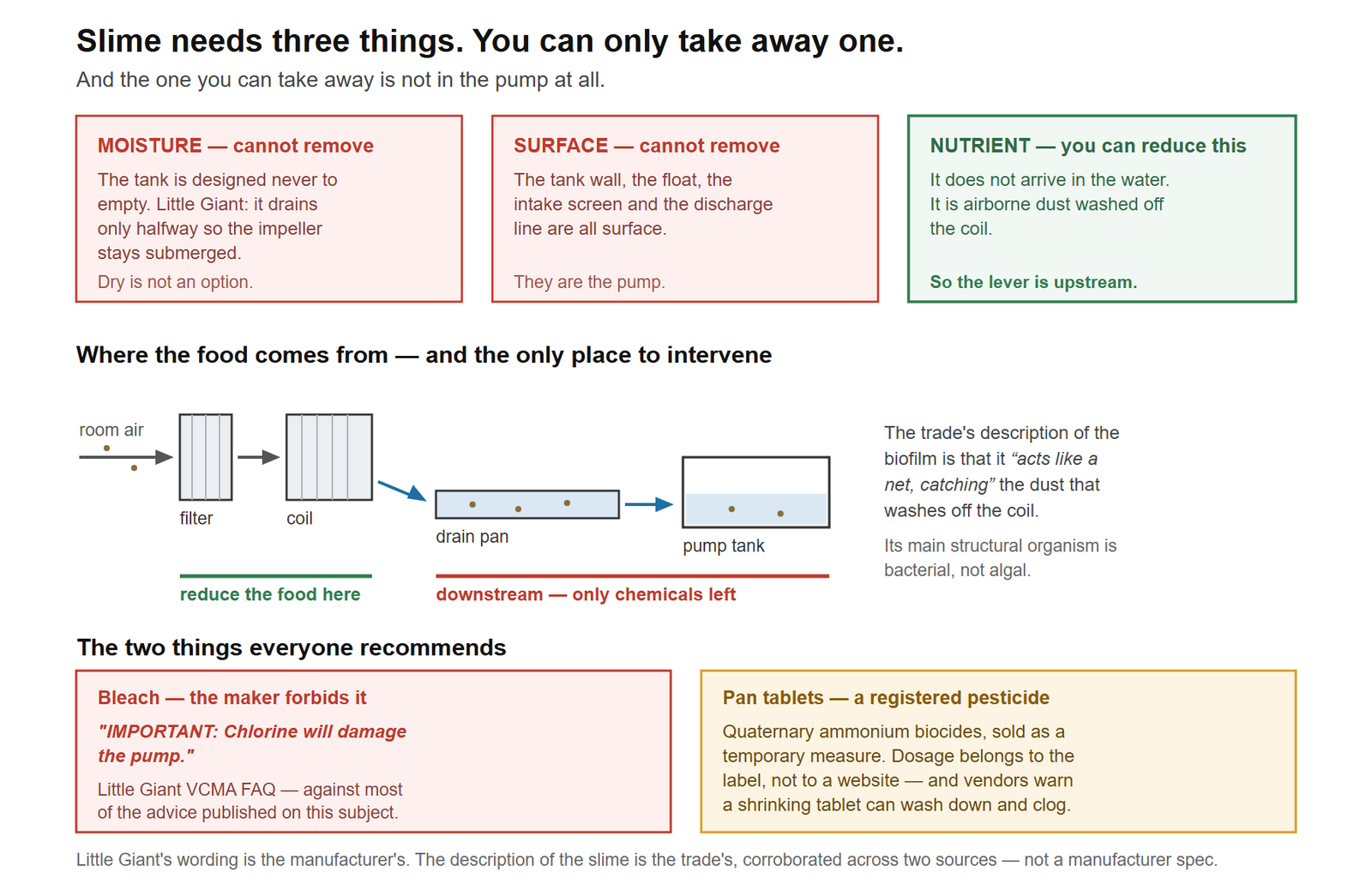
Biological growth needs three things: moisture, a surface to sit on, and something to eat. In a condensate pump the first two are fixed by the pump’s own design and cannot be taken away. The only one you can reduce is the food — and it does not arrive in the water. It blows in on the air and washes off the coil.
Which means the useful work is upstream of the pump entirely, and most of the advice you will find is aimed at the wrong end.
First, it is not really algae
Algae is the word everyone uses, including the people selling the treatments. The trade’s own description is more careful:
“This slime is actually a combination of algae, fungi, airborne dust, and a highly adaptable bacterial mass.”
The part that matters is which of those builds the structure. It is the bacteria — zoogloea, which “secrete a sticky, gelatinous polymer” that anchors the whole mass to a smooth plastic wall.
Why that is not pedantry: algae needs light and bacteria do not. A sealed tank in a dark basement is a poor home for algae and an excellent one for a bacterial biofilm. So every instinct borrowed from a green pond — block the light, keep it in the dark — buys you nothing here. The tank was already dark.
It also explains the texture. Pond algae is stringy and green. What comes out of a condensate tank is a grey or white gel that clings, because a polymer is holding it there.
You cannot dry it out, and that is deliberate
The obvious move is to stop leaving water in the tank. You cannot, and the reason is the manufacturer’s:
“It is normal for the Little Giant VCMA pump to only drain halfway. It ensures the pump does not run dry, and the impeller will remain submerged.”
The tank is built to hold water permanently so the impeller is never spinning in air. The feature that stops the pump destroying itself is the feature that guarantees a permanently wet surface. There is no setting, no adjustment and no technique that changes it.
The surface is no better. The tank wall, the float, the intake screen and the inside of the discharge line are all smooth wet plastic, and they are the pump — you cannot subtract them either.
That leaves one variable.
The food is upstream, on the air
Condensate is not clean water. It is the moisture that was in the air, and it carries whatever the air was carrying with it — dust, pollen, fibres, cooking grease, whatever got past the filter.
Sauermann names the contaminants from the manufacturer’s side: “biofilm, lacquers, aerosols or even dust in the condensate.” Every item on that list arrives through the air handler, not through the pump.
And the biofilm is not passive about it. The trade’s description is that it “acts like a net, catching” the dust washed off the evaporator coil — so the film that is already there makes the next layer grow faster. That is why a tank that has been left too long gets worse quickly rather than steadily, and it is the honest answer to a line in the clogged-line article: if it clogs again within a season, something is feeding it.
So the three things that actually reduce the load:
- Change the filter on schedule, and use one that suits the system. Every particle the filter catches is a particle that never reaches the coil, the pan or the tank.
- Keep the coil clean. The coil is where the dust and the water meet. A dirty coil is a nutrient dispenser with a water supply attached.
- Keep the pan and the line flowing. Standing water anywhere in the path is another culture site feeding the one downstream — which is why the cleaning job is the whole path, not the tank.
None of that is exciting, and all of it works on the only variable that is actually available.
The two things everyone recommends
Both are worth knowing about honestly, because both have a problem.
Bleach. It is the single most common recommendation on this subject — flush the line with it, put a capful in the pan. The pump’s manufacturer says otherwise, in capitals:
“IMPORTANT: Chlorine will damage the pump.”
That is Little Giant’s own wording, and it is a stated consequence rather than a caution. One of the contractor sources on this subject agrees against the rest of them, saying plainly that it is not safe to put bleach down a condensate line. Use the 50/50 water-and-vinegar mixture Little Giant does specify instead.
Pan tablets and strips. These are the products the search results are mostly selling, and they are quaternary ammonium biocides — registered pesticides. Two honest points about them.
The first is that the dose belongs to the label. This site will not tell you how many tablets to put in a pan, because that instruction is legally the manufacturer’s and it varies by product and by system size.
The second is a failure mode the vendors describe themselves: as a loose tablet shrinks, it can be carried along in the water and clog the drain. The treatment bought to prevent a blockage becomes one. That is the argument the encapsulated designs are built on, and it is a commercial argument — but it is mechanically plausible, and the trade discusses these pads failing often enough to have threads about it.
They are also sold as a temporary measure, typically replaced every few months. A tablet is not a substitute for the interval.
What actually works
Put plainly, because the honest answer is duller than the marketed one:
- The cleaning interval is the prevention. Little Giant’s own figure is once a year, twice if it builds slime. That is not maintenance you do instead of prevention — for this component it is the prevention.
- Filter and coil discipline reduces how fast it comes back, because that is where the food comes from.
- Vinegar, not chlorine, when you do clean it.
- Nothing you pour in will keep a permanently wet plastic tank sterile. The water is staying, the surface is staying, and a biocide is a delay rather than a cure.
If the tank is stained through, cracked, or the film survives a proper clean, you are past prevention — the buying guide covers what replaces it.
When this needs a pro
Cleaning an evaporator coil is not a homeowner job on most systems. It means opening the air handler, and the coil fins bend if you look at them wrong. Filter changes are yours; the coil is a service call.
If the growth is heavy enough to smell, sort out which smell it is first — musty is biofilm and this article applies, sulfur is not coming from the pump at all.
If you are putting any registered biocide into a system, follow the product label rather than any website, including this one.
And if the pan itself is holding standing water, that is a slope or a blockage problem in the pan, not a growth problem — the condensate pumps guide sets out what the arrangement should look like.
FAQ
What causes algae in a condensate pump?
Mostly it is not algae. The slime is a mixed growth whose main structural organism is bacterial, and it needs moisture, a surface and nutrient. The nutrient is airborne dust and particulate washed off the evaporator coil into the condensate.
Can I put bleach in my condensate pump to stop algae?
Little Giant says no, in its own words: “IMPORTANT: Chlorine will damage the pump.” A 50/50 water and vinegar mixture is what the manufacturer specifies instead.
Do condensate pan tablets work?
They slow growth for a period and are sold as a temporary measure needing replacement every few months. They are registered biocides, so the dose must come from the product label — and vendors themselves warn that a loose tablet can shrink, wash into the drain and clog it.
Why does the slime keep coming back after I clean it?
Because two of the three things it needs cannot be removed. The tank is designed to stay part-full so the impeller never runs dry, and the tank and line are the surface. Only the food supply can be reduced, and that is upstream at the filter and coil.
Does keeping the pump in the dark stop algae?
No. It is already dark in there, and the organism that builds the slime is bacterial rather than photosynthetic. Light is not part of this problem in either direction.


