On this page
Last Updated on September 16, 2026 by Muhammad Toqeer
Put it on the floor if the floor is an option. Not because a wall is wrong, but because of something nobody mentions: the decibel figure you were sold is measured on a pump suspended in mid-air, touching nothing. Bolt it to a stud wall and you have thrown away the only vibration isolation the pump came with, and handed the noise to a large flat surface.
Both mountings work. They cost different things, and the cost is almost entirely acoustic.
The number on the box describes a pump hanging in a lab
Sauermann publishes among the quietest mini-pumps on the market and is unusually straight about what their own figure means:
“these acoustic tests are performed in a controlled lab environment. And they only measure the sound generated by the pump, which is suspended during the test and, therefore, isolated from its surroundings. Consequently, these lab measurements make no allowance for the vibration of objects and structures that the pump touches or is affixed to in real-world situations.”
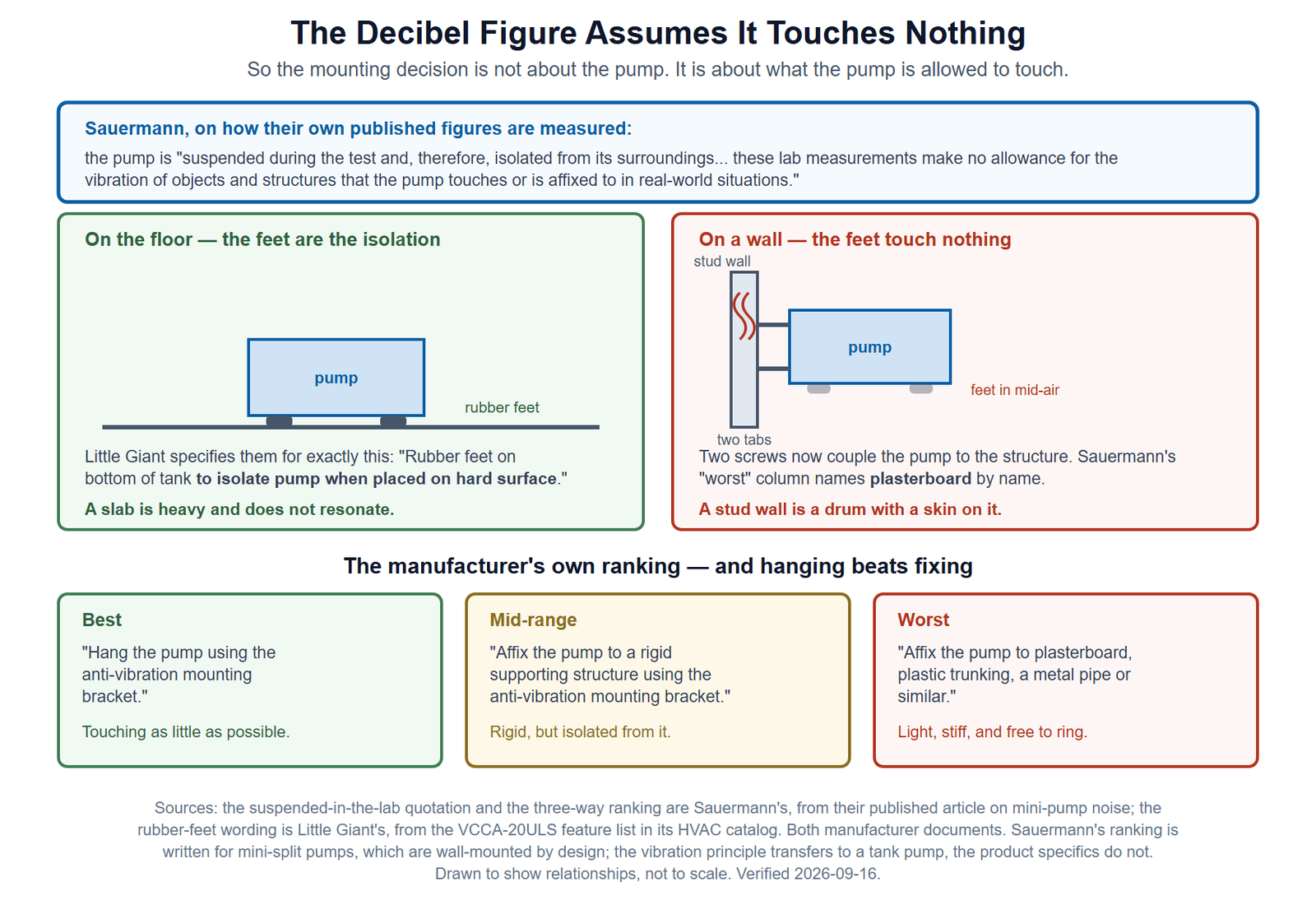
Read that again with a wall in mind. A figure like 20 dB(A) is a property of the pump in isolation. It is not a prediction about your bedroom. Everything the pump is screwed to is outside the measurement, and in a house that is most of what you actually hear.
So the mounting question is not “which is quieter”. It is what are you letting the pump touch.
The manufacturers answer it in their hardware
You do not have to take anyone’s word for the trade-off, because it is visible in what comes in the box.
Floor pumps have rubber feet, and the manufacturer says what they are for. Little Giant’s VCCA feature list: “Rubber feet on bottom of tank to isolate pump when placed on hard surface.” Note the condition — placed on. Those feet do their job under one circumstance, and that circumstance is a pump standing on something.
Wall-mount it and the feet are in mid-air. They are not a feature any more; they are a moulding.
And the pump that is designed to be wall-mounted carries different hardware. The Little Giant EC-1-DV is a mini-split pump, which lives on a wall by definition. Its feature list includes “Elastomeric mounting grommets on pump housing bracket” and “Elastomeric passive vibration isolator used to dampen pump vibration” — purpose-made isolation built into the bracket.
That is the manufacturer replacing, in hardware, exactly what the feet can no longer do. When you wall-mount a tank pump using the two slots on the ends of its tank, nobody has replaced it for you. Those are two screw slots in a plastic moulding. There is nothing resilient in that path at all.
One-minute test: before you drill, press your palm flat on the wall where the pump would go and knock it with your other hand. If it sounds hollow, that is the surface you are about to bolt a vibrating motor to.
Hanging beats fixing, which is not what people assume
Sauermann publishes a straight ranking of mounting methods. The order is worth sitting with:
| What they say | |
|---|---|
| Best | “Hang the pump using the anti-vibration mounting bracket.” |
| Mid-range | “Affix the pump to a rigid supporting structure using the anti-vibration mounting bracket, ideally on the insulating foam surrounding the refrigeration circuit.” |
| Worst | “Affix the pump to plasterboard, plastic trunking, a metal pipe or similar. Affix the pump without its anti-vibration mounting bracket.” |
Two things there run against instinct.
Hanging is the best method, not the most solid one. A careful installer’s instinct is that a firmer fixing is a better job. For vibration it is the reverse: the less rigidly the pump is tied to the building, the less of its movement the building gets. A hung pump is closer to the lab condition than a screwed one.
Plasterboard is named in the worst column, alongside plastic trunking and a metal pipe. That is a description of a normal interior stud wall. Drywall over a stud cavity is light, stiff and free to move — it is a drum with a skin on it, and it is very good at turning a small mechanical buzz into a sound the whole room can hear.
By contrast, a concrete basement slab is heavy, damped and effectively immovable. It is the best surface in the house for this, and it happens to be the one the rubber feet were designed for.
The cable and the tubing are vibration paths too
This one is genuinely absent everywhere else, and it explains the installs where someone did everything right and it still hums.
From the same ranking, on the power cable and discharge tubing — best practice is “Wrap the cable and tubing in insulating foam. Keep the tubing well away from other surfaces,” and the worst case is leaving them “exposed… and place them near a wall or ceiling.”
The pump can be beautifully isolated and still be connected to the structure by a taut length of vinyl tubing stapled to a joist. Vibration travels down it and gets into the building somewhere else entirely, which is why the noise sometimes seems to come from a different part of the room than the pump.
One-minute test: with the pump running, rest a finger on the discharge tubing a foot away from the outlet. If you can feel it buzzing, the tubing is carrying the vibration, not just the water.
So when is a wall the right answer?
Often, and for reasons that have nothing to do with noise.
When the floor is not available or not sensible — no clear space beside the equipment, a floor that gets wet or swept, a location where a floor pump would be kicked. A wall gets it out of the way.
When the height works in your favour — as long as the inlet still sits below the drain outlet, which is the constraint that overrules all of this and is covered in where to install a condensate pump and, for the specific above-the-furnace case, in what you should actually measure from.
When the pump is built for it. A mini-split pump is a wall product with isolation designed into its bracket, and mounting it on a wall costs nothing acoustically because that is the intended case — the mini-split buying guide covers which models carry what.
What to do if you must wall-mount a tank pump in a quiet room: put something resilient in the path. A strip of dense foam or a rubber pad between the tank tabs and the wall, and do not overtighten the screws — crushing the pad flat converts it back into a rigid connection. Pick a stud rather than a bay if you can, because the stud is stiffer and moves less than the drywall spanning between them.
One thing that is not about noise
Worth a line, because it decides some installs on its own.
A VCMA-20 weighs about five pounds empty and holds half a gallon. Water is a little over eight pounds a gallon, so a full tank adds roughly four more — call it nine pounds, hanging off two slots in a plastic tank. That is not much, but it is nine pounds of something containing water, above whatever is below it. Into a stud, or into proper drywall anchors, not into plasterboard on its own.
When this needs a pro
If the pump is in a bedroom wall and noise is the actual complaint, the fix may not be the mounting at all. Abrupt on/off cycling is a characteristic of fixed-speed pumps with mechanical float switches, and no amount of foam changes it — that is a product choice.
If the vibration has started recently on an install that used to be quiet, look for a cause rather than damping it. Loosening components and a pump working harder than it should both show up as new noise, and a pump that runs but moves no water is where that leads.
And never solve a noise problem by removing the safety switch wiring to stop the equipment cycling. For the background on what these pumps are doing and why they cycle at all, the condensate pumps guide has it.
FAQ
Is it better to mount a condensate pump on the wall or the floor?
The floor, where the floor is an option and quiet matters. A pump standing on a hard surface is isolated by its own rubber feet, which the manufacturer specifies for exactly that. Wall-mounting puts those feet in mid-air and couples the pump directly to the structure through two screws.
Why is my wall-mounted condensate pump so loud?
Most likely the wall rather than the pump. Sauermann’s own ranking puts fixing a pump to plasterboard in the worst category, alongside plastic trunking and a metal pipe — a stud wall is light and free to resonate. The published decibel figure is measured on a pump suspended in a lab, touching nothing, so it never included your wall.
Does a condensate pump need anti-vibration pads?
On a wall, something resilient in the path is worth doing — a dense foam strip or rubber pad between the mounting tabs and the surface, with the screws snug rather than crushed tight. On a concrete floor the rubber feet already are the pads.
Can I hang a condensate pump instead of screwing it to a wall?
Sauermann ranks hanging on an anti-vibration bracket as the best method, ahead of fixing it to a rigid structure. Less rigid contact means less vibration handed to the building. Whatever you do, the inlet still has to sit below the equipment’s drain outlet.
How much does a condensate pump weigh when it’s full?
A VCMA-20 is about five pounds empty with a half-gallon tank, so roughly nine pounds full. Fix it to a stud or proper anchors rather than to plasterboard alone.


