On this page
Last Updated on October 14, 2026 by Muhammad Toqeer
A booster pump raises pressure. It cannot push more water through a pipe than that pipe will pass. Those are two different faults, they feel identical at the shower, and fitting a pump to the wrong one can make the symptom worse. Two readings from a pressure gauge tell you which you have.
And if it is the pressure one, the pump is not a plug-in appliance. It sits on the utility’s water, and the code has things to say about that.
First, the reading that decides everything
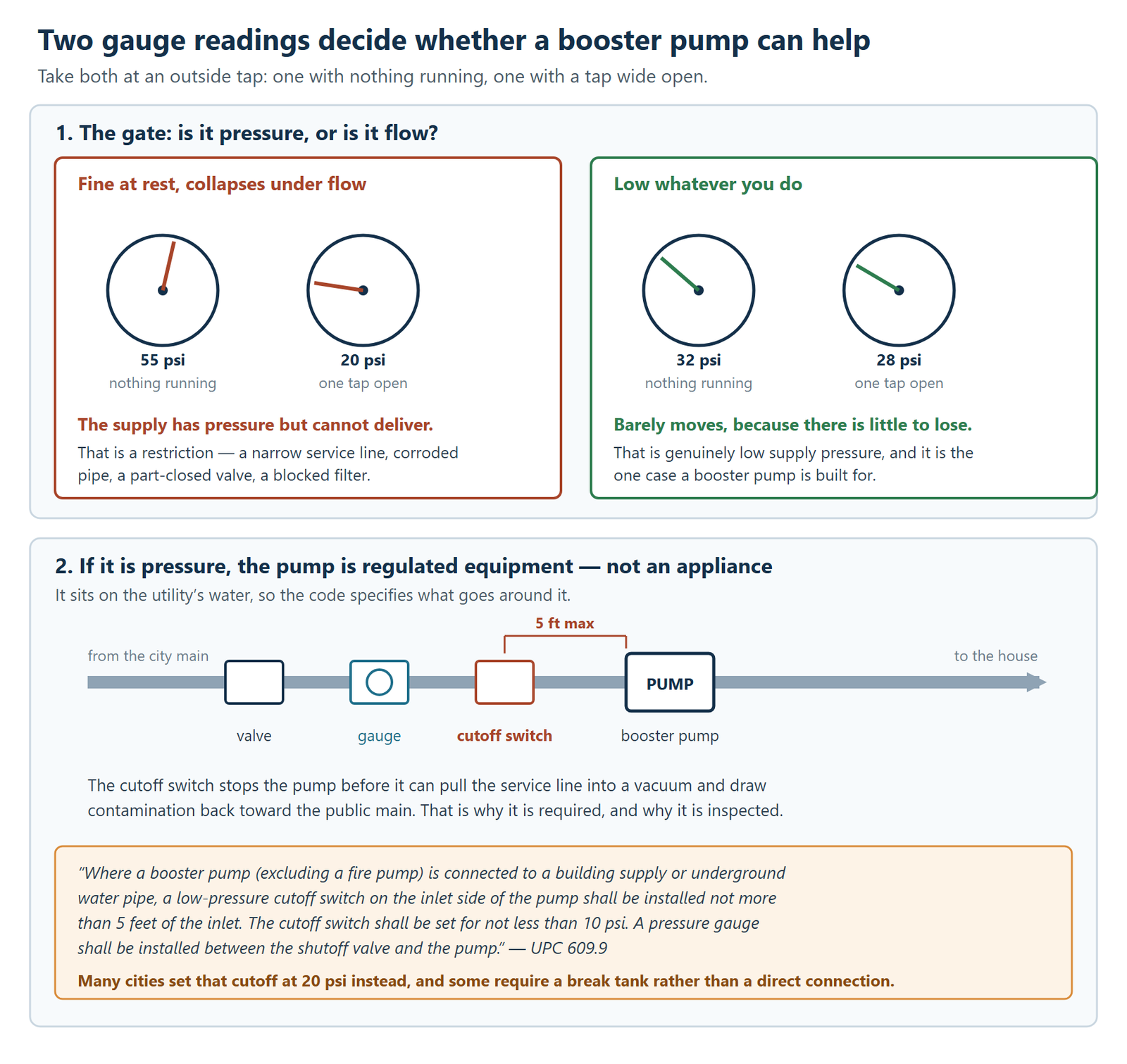
Screw a pressure gauge onto an outside tap and take two readings.
One with nothing in the house running. That is static pressure — what the supply can hold when nobody is asking it for anything.
One with a tap wide open somewhere else. That is what you actually get when water is moving.
Now read the gap between them:
| Static | Under flow | What it is | Does a booster help? |
|---|---|---|---|
| 55 psi | 20 psi | Restriction | No |
| 32 psi | 28 psi | Low supply pressure | Yes |
A big drop means the pressure exists but cannot get through. Somewhere between the main and your tap there is a narrow service line, a corroded galvanised run, a partly closed valve, or a clogged whole-house filter. Fitting a pump upstream of a restriction does not widen it.
A small drop from an already-low number is the opposite. There is not much pressure to begin with, and not much is being lost on the way. That is the case a booster pump is built for.
Why the wrong one makes things worse
A booster pump can only move what arrives at its inlet. Put one downstream of a restriction and you starve it — the pump pulls harder than the supply can feed it, inlet pressure falls, and the pump cavitates.
That failure mode is exactly what the code’s required cutoff switch exists to prevent. More on that below, because it is the part of this subject nobody writes about.
What a booster pump actually is
A motor spinning an impeller, raising the pressure of water passing through it. The interesting part is what surrounds the impeller, because that is what differs between products.
Constant-speed with a tank. The pump runs flat out or not at all. A pressure tank holds a cushion so small draws do not start the motor, and a pressure switch turns it on at a cut-in and off at a cut-out. Mechanically this is the same arrangement as a well system, which is why the tank’s air pre-charge matters here for the same reasons it does there.
Variable-speed, constant-pressure. The pump changes speed to hold an outlet pressure regardless of how many taps are open. Usually no separate tank is needed.
A worked example of the second kind, from the manufacturer’s published data — the Grundfos SCALA2 3-45:
- Flow 0 to 22 US GPM; rated flow 13.2 GPM
- Head 0 to 147 feet; rated head 88.6 feet
- Factory-set outlet pressure 3 bar, which is 44 psi, adjustable
- Maximum inlet pressure 6 bar
- 1-inch NPT inlet and outlet
- Self-priming, with the pressure switch and tank built in
Note that last point, because it changes how this silo’s troubleshooting works. On an integrated pump there is no separate tank to check the pre-charge on and no external switch to adjust. The diagnosis is different from a well system’s even though the job looks the same.
The three constraints nobody mentions
This is where every other page on this subject stops short, and it is the part that decides whether your installation is legal.
1. A low-pressure cutoff is required, and its position is specified
From the UPC:
“Where a booster pump (excluding a fire pump) is connected to a building supply or underground water pipe, a low-pressure cutoff switch on the inlet side of the pump shall be installed not more than 5 feet (1524 mm) of the inlet. The cutoff switch shall be set for not less than 10 psi (69 kPa). A pressure gauge shall be installed between the shutoff valve and the pump.”
Four requirements in one sentence: a cutoff switch, on the inlet side, within five feet of the inlet, set no lower than 10 psi — plus a pressure gauge between the shutoff valve and the pump.
The reason is public health, not pump protection. A booster pumping against a weak service line can pull that line into negative pressure. A cross-connection anywhere on a street under vacuum can then draw contamination back toward the public main. The cutoff stops the pump before it gets there.
2. Your city may set that threshold higher
The code’s 10 psi is a floor, and municipalities commonly raise it. Springfield, Nebraska and Moline, Illinois both require the cutoff to shut the pump down when suction-side pressure drops to 20 psi or less — double the model-code figure. Ohio’s state rule sits at 10 psi for pumps not used for fire suppression.
Some of those jurisdictions also require the cutoff to be kept in working order and certified annually to the water utility.
3. Some cities do not allow a direct connection at all
Houston’s amendments require an atmospheric break tank with an air gap between the city supply and the pump where city pressure is insufficient. The pump draws from the tank; the tank fills from the main across a physical air gap. No direct connection exists to backsiphon through.
If you are in a jurisdiction like that, the answer to “can I fit a booster pump” is not a pump — it is a tank and a pump, which is a larger job than most people are expecting.
The takeaway on all three: ask the water utility before you buy anything. It is a free phone call and it determines what you are allowed to install.
There is also a ceiling
You cannot simply turn a booster up until the shower feels right. IPC 604.8:
“Where water pressure within a building exceeds 80 psi (552 kPa) static, an approved water pressure-reducing valve conforming to ASSE 1003 or CSA B356 with strainer shall be installed to reduce the pressure in the building water distribution piping to not greater than 80 psi (552 kPa) static.”
80 psi static is the legal limit, and it is a sensible one — sustained high pressure is hard on supply lines, valve seats and appliance inlet hoses.
The code also has something to say about aiming at the average rather than the worst case. IPC 604.6: “Where street water main pressures fluctuate, the building water distribution system shall be designed for the minimum pressure available.” Size for the bad afternoon, not the good morning.
If you are on a well, this is the wrong page
Everything above assumes municipal supply. A well system already has a pump, a tank and a switch, and low pressure on a well is a different diagnosis with a different cause list — the pump, the tank’s pre-charge, the switch settings, or the well itself.
Start with the well-side causes instead. Adding a second pump to a well system that is already struggling usually treats a symptom of something upstream.
When this needs a pro
The connection to the service line. It is the utility’s water up to the meter and a cross-connection risk beyond it. This is permit and inspection work in most places.
Anything involving the cutoff switch or a backflow device. These are the parts that exist to protect the public supply, and they are exactly the parts an unpermitted installation leaves out.
A house where the static pressure is fine and the flow is not. That is a pipe or service-line problem, and diagnosing which needs someone who can look at the whole run.
And if one is already fitted and cycling on and off, check whether it has a separate tank before anything else — without one, the usual advice does not apply and the cause is on the inlet.
And if it runs steadily but the pressure never rises, there is a published ceiling on how much a booster can add — outlet minus inlet is capped, so a weak inlet limits the outlet whatever you dial in.
And if it will not start at all, the indicator lights separate three different problems before any tool comes out — including one the pump has already diagnosed for you.
And none of it gets found unless somebody looks. The manual calls the pump maintenance-free and then lists three annual jobs — plus a winterizing procedure, and an instruction to check it is not blocked before power goes back on.
And if it is the pressure one, the size you need comes out of two numbers — the gap between your reading and your target, and what the house draws at once. Both are smaller than most people expect.
And when it comes to choosing one, six models that are still in production — two of the most widely recommended have been discontinued and are still on sale.
And before any of that, where it is going to stand. The maker says put it on a small stand in a drip tray — it has ventilation holes low on its body that must not be flooded, and two temperature limits lower than most people expect.
And if the one you already have is loud, noise does not appear on the maker’s fault chart at all — it is handled as a mounting problem, and one tap test tells you whether that is your case or the inlet is.
And if there is water underneath it, the shaft seal is lubricated by the water it pumps and is meant to leak a little — the maker’s stated normal outcome is that it evaporates and you never see it, so visible water is the symptom rather than leakage itself.
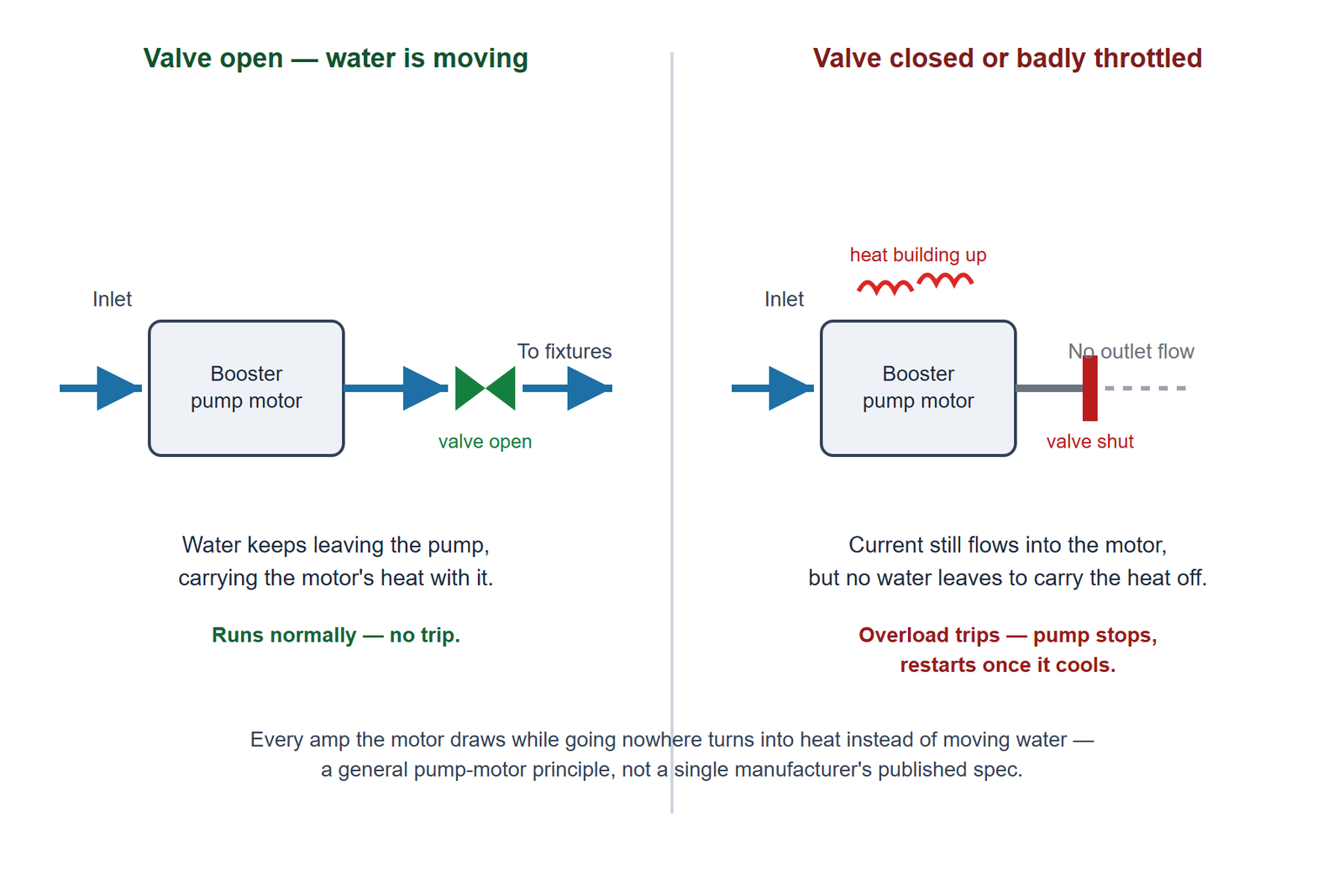
And if it stops and restarts once it cools, that is the overload rather than a fault. Water leaving the pump is what carries the motor’s heat away — so a shut or badly throttled outlet turns every amp it draws into heat instead of flow.
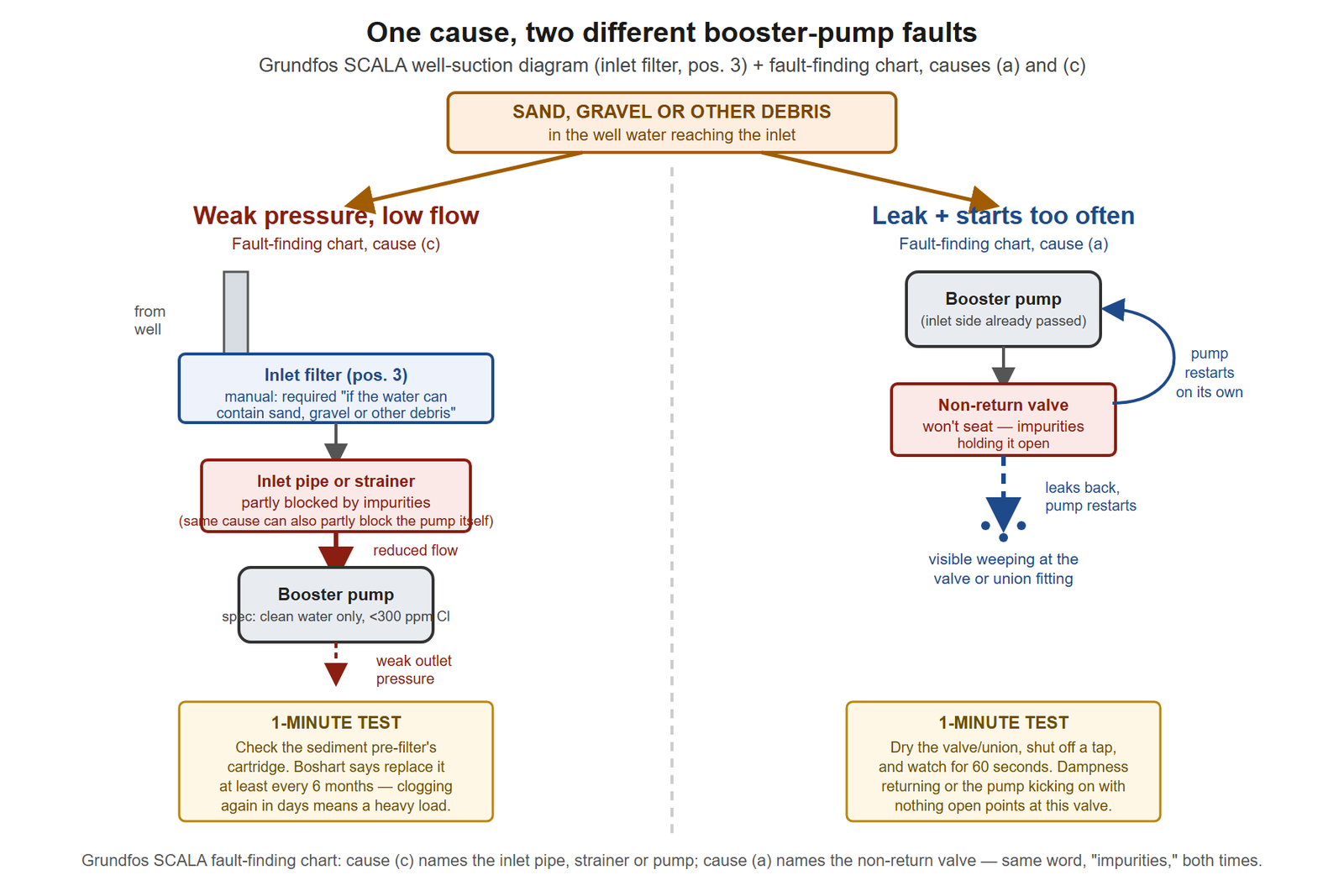
And on well water, grit reaches the booster before anything else does. The same impurities produce two different published faults — weak pressure from a blocked inlet, and a leak with restarts from a non-return valve that will not seat.
And if a reverse osmosis system under the sink is slow, the maker publishes what low pressure actually costs you — at 40 psi the tank fills about half, and the pressure is lost a second time on the way back out.
And if the question is a tankless water heater that will not fire, that turns on a distinction worth getting right — the heater is switched by flow and a booster adds pressure, so it helps when the supply is the limit and does nothing when the fixture is.
And if it runs with every tap in the house shut, the maker lists three causes and only the first is a repair — a leak, an appliance drawing water by design, or a temperature below freezing point.
And if it stops because the pressure is too high, one of the three published causes is not the pump at all — the maker names a water heater and defective safety equipment as examples, and marks all three causes for automatic reset, so the event can clear itself before anyone sees it.
And if there is a water softener on the same supply, it is allowed to take 15 psi and that comes off the booster’s ceiling, not just its supply — because the outlet is capped at inlet plus 58 psi, and the softener has a published minimum of its own.
What you can usefully do yourself: take the two gauge readings, write both numbers down, and call the water utility to ask what they require for a booster pump on your street. Those three things are most of the decision, and none of them needs a tool more complicated than a gauge.
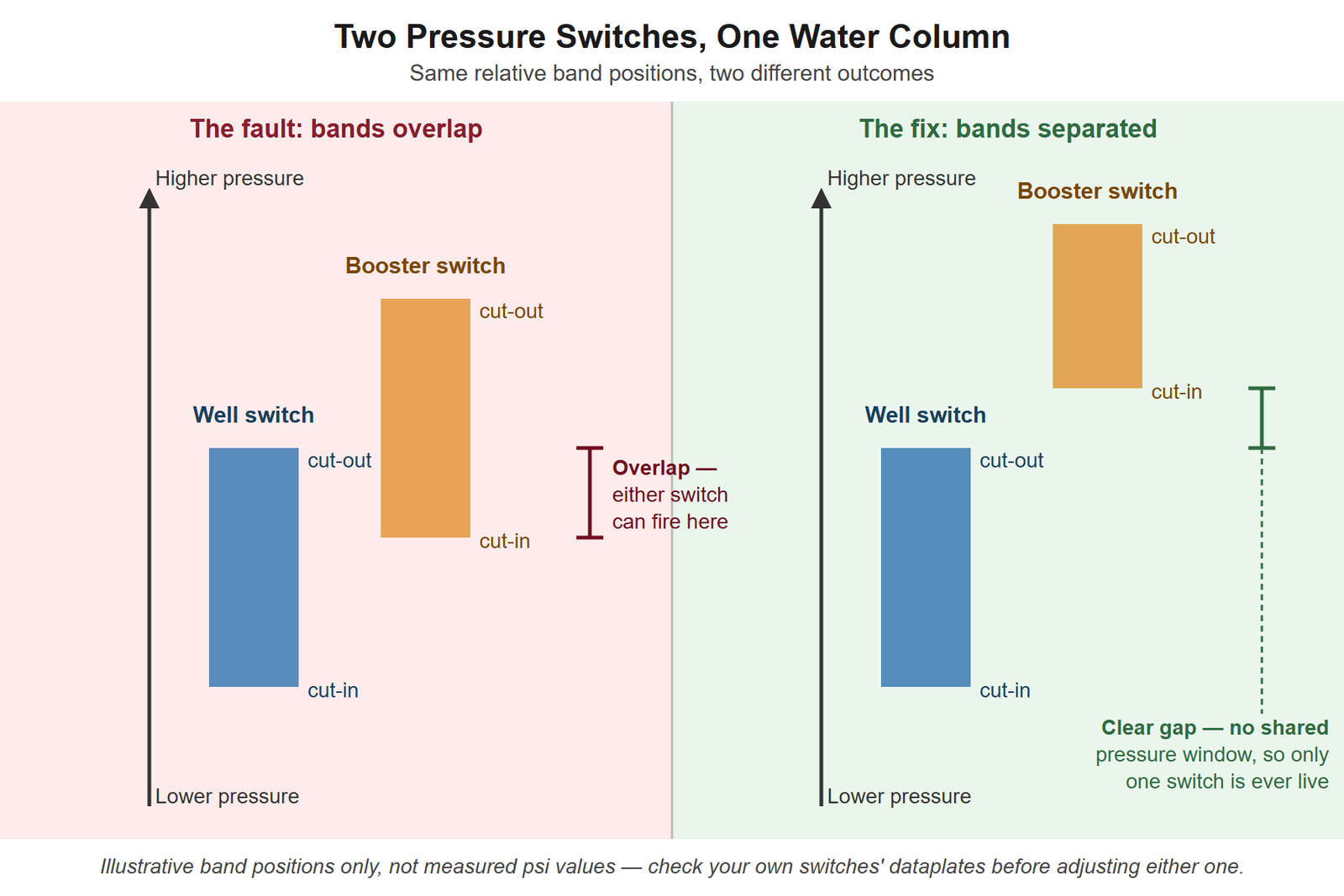
And on a well, a booster adds a second pressure switch to one water column. If the two switching bands overlap, either one can fire and the pair hunts — the fix is a clear gap between them so only one is ever live.
FAQ
Will a booster pump fix low water pressure?
Only if the pressure is genuinely low. Take a static reading and a reading under flow. If a good static reading collapses when one tap opens, the problem is a restriction and a booster pump will not fix it.
What is a normal water pressure for a house?
Codes cap building pressure at 80 psi static and require a pressure-reducing valve above that. Most homes sit comfortably between roughly 40 and 60 psi, and a booster is usually being considered below that range.
Is it legal to install a booster pump on city water?
Usually, but with conditions. The UPC requires a low-pressure cutoff switch within five feet of the pump inlet set at no less than 10 psi, plus a pressure gauge. Many cities raise the cutoff to 20 psi, and some require a break tank instead of a direct connection. Ask your utility first.
Why does a booster pump need a low-pressure cutoff?
To stop it pulling the service line into negative pressure. A street main under vacuum can draw contamination back through any cross-connection, so the cutoff is a public-health requirement rather than a pump feature.
Do I need a pressure tank with a booster pump?
With a constant-speed pump, yes — the tank stops the motor starting for every small draw. Variable-speed constant-pressure pumps often have the tank and switch built in and need nothing separate.
Can a booster pump increase flow rate as well as pressure?
Not past what the supply pipe can deliver. It raises the pressure of the water reaching it, but a narrow or blocked service line still limits how much water there is to boost.