On this page
Last Updated on September 29, 2026 by Muhammad Toqeer
Look at the pump before you look for a cause. If there is a separate pressure tank beside it, the causes are the same ones a well system has and they are well documented. If there is no tank — and on most boosters sold today there is not — none of that advice applies, and the answer is almost certainly on the inlet side, not inside the pump.
Two of the three causes below can only happen on city water. A well pump is physically incapable of them.
Which pump do you actually have?
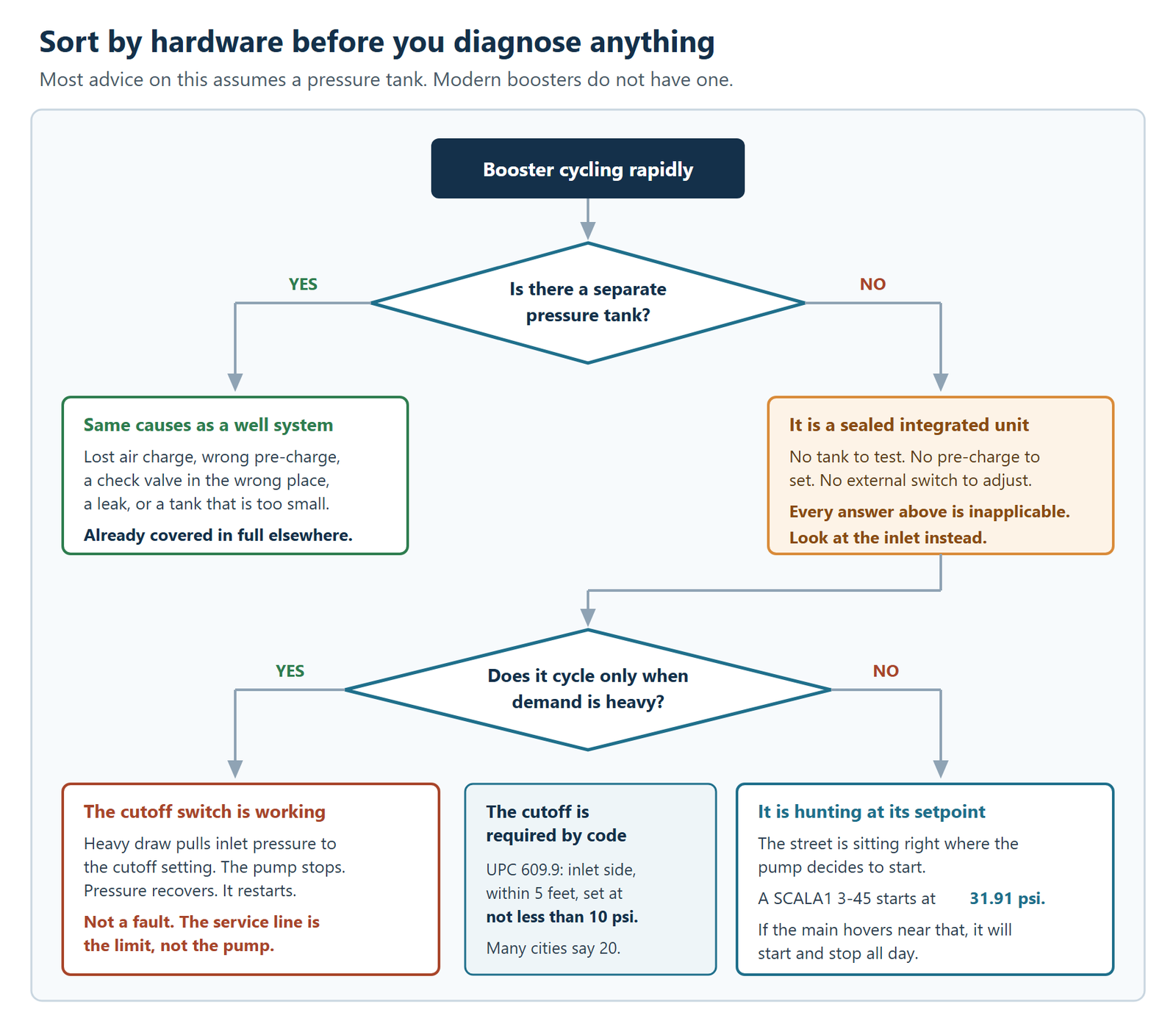
Is there a pressure tank next to it? A steel or composite vessel, usually blue, with a tyre-style valve under a cap on top.
If yes, you have the classic arrangement — pump, tank, pressure switch — and cycling has the classic cause list: the tank has lost its air, the pre-charge was never right, a check valve is in the wrong place, something is leaking, or the tank is too small for the pump.
That list is identical on a well, and it is already written up properly with the test for each cause. Start there; nothing on this page improves on it.
If there is no tank, keep reading. You have the pump the rest of the internet is not writing about.
The sealed unit changes the whole diagnosis
The modern domestic booster is one body. Grundfos describes the SCALA2 as packing “pump, motor, tank, sensor, drive and non-return valve into one compact unit.”
Read that list again and notice what it does to the standard advice. There is no tank to test, because the tank is inside a sealed housing. There is no pre-charge to set. There is no external pressure switch to adjust, because the switch is a sensor wired to a drive.
So the five causes above are not merely unlikely. They are undiagnosable and unfixable on this pump — and every page telling you to check your tank’s pre-charge is describing a machine you do not own.
What is left is the water arriving at the inlet, and that is where both remaining causes live.
Cause 1 — the cutoff switch is doing exactly what it was fitted to do
One-minute test: does it only cycle when the house is busy? Two showers, the washing machine, someone filling a sink. If the cycling tracks demand and disappears when the house is quiet, this is your cause.
Here is the mechanism. Your booster is required to have a low-pressure cutoff on its inlet, along with a gauge and, in some cities, a break tank. From the UPC:
“…a low-pressure cutoff switch on the inlet side of the pump shall be installed not more than 5 feet (1524 mm) of the inlet. The cutoff switch shall be set for not less than 10 psi (69 kPa).”
Many cities set it higher — Springfield, Nebraska and Moline, Illinois both require 20 psi, and Ohio’s state rule sits at 10 psi for pumps not used for fire suppression.
Now put a heavy draw on an undersized or partly restricted service line. Inlet pressure falls. It reaches the cutoff setting. The switch stops the pump. With the pump stopped, the line recovers, pressure climbs back, and the pump restarts. Demand is still there, so it falls again.
That is a cycle, and nothing has failed. The device is protecting the public main from being pulled into a vacuum, which is precisely why the code requires it.
What it tells you is that the service line, not the pump, is the limit. Fitting a bigger pump makes it worse — a bigger pump pulls the inlet down faster.
Cause 2 — the pump is hunting around its own start pressure
One-minute test: does it cycle at quiet times too, with nothing running?
Every booster has a start pressure, and unlike a well pump it does not control what arrives at its inlet. Street pressure moves through the day.
Grundfos publishes the SCALA1 3-45’s start pressure as 31.91 psi.
So picture a street sitting at about 32 psi. The pump sees pressure at its start point and runs. Running lifts the pressure past the setpoint, so it stops. The street pulls it straight back down, and it runs again.
The pump is not faulty. It has been installed on a supply that sits exactly where it makes its decision, and it will do this until either the street moves or the setpoint does.
This cause cannot exist on a well system, which is why no well-pump article mentions it. A well pump’s inlet is a well.
The fix is usually a setpoint change rather than a part, and on a sealed unit that is a service call rather than a screwdriver — but knowing which of the two causes you have is what stops you replacing a working pump.
What about a leak?
It is on the list for a tanked system and it stays on the list here, with one difference: on a sealed unit with no tank, even a small continuous draw will start the pump, because there is no stored volume to absorb it.
Check the obvious things — a running toilet, a dripping outside tap, an irrigation valve not seating. Shut the main stop and watch whether the pump still starts.
Some controllers handle this deliberately. Davey’s BT series is specified with “adaptive cut-in pressure” and “constant flow with loss of prime protection and auto-retry technology”, which changes how the pump responds to a small continuous demand.
When this needs a pro
Anything inside a sealed unit. There are no user-serviceable parts and no mechanical fallback.
Any change to the cutoff switch setting. It is a code-required device protecting the public water supply, and in several jurisdictions its setting has to be certified to the utility.
A service line that cannot support the pump. If the cutoff is tripping under normal household demand, the pipe between the main and the house is the problem, and that is a utility conversation before it is a plumbing one.
What you can do yourself: note whether the cycling tracks demand or happens when the house is quiet, and check whether there is a tank beside the pump. Those two observations select the cause, and both take under a minute.
And if the pump turns out to be wrong for the supply, the published start pressures and inlet limits differ between models — which is worth checking against your street pressure before a replacement goes in.
FAQ
Why does my booster pump keep turning on and off?
Check whether there is a separate pressure tank. With a tank, the causes are the same as a well system’s. Without one, the pump is a sealed unit and the cause is almost always on the inlet — either the low-pressure cutoff tripping under demand, or the pump hunting because street pressure sits at its start point.
Is short cycling bad for a booster pump?
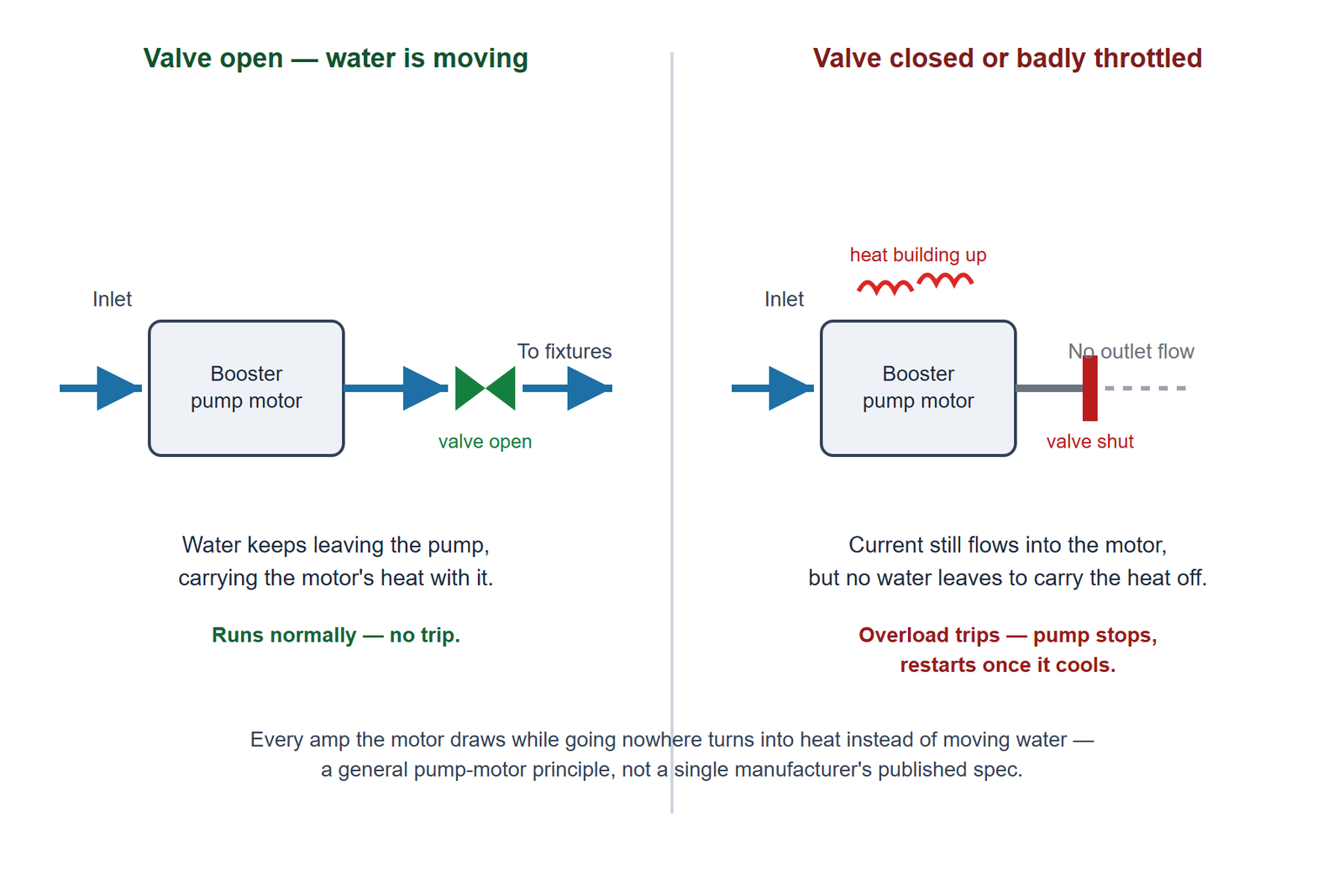
Yes. Every start draws high current and heats the motor, and the wear happens at startup rather than during running. A pump cycling every few seconds is doing far more damage than one running continuously.
Why does my booster pump only cycle when we use a lot of water?
That is the low-pressure cutoff working. Heavy demand drags inlet pressure down to the cutoff setting, the pump stops, the line recovers and it restarts. It means the service line is the limiting factor, not the pump.
Can a booster pump short cycle without a pressure tank?
Yes, and it is common. Integrated boosters have no external tank at all, so a small continuous draw or a supply pressure sitting at the pump’s start point will cycle it with nothing to absorb the demand.
What pressure does a booster pump turn on at?
It varies by model and is published. A Grundfos SCALA1 3-45 starts at 31.91 psi, for example. If your street pressure sits near your pump’s figure, the pump will start and stop repeatedly without anything being wrong with it.
Should I replace my booster pump if it is cycling?
Not until you know which cause you have. If the cutoff is tripping under demand, a bigger pump makes it worse by pulling the inlet down faster. If it is hunting at its setpoint, the pump is working correctly and the setting is the issue.