On this page
Last Updated on October 3, 2026 by Muhammad Toqeer
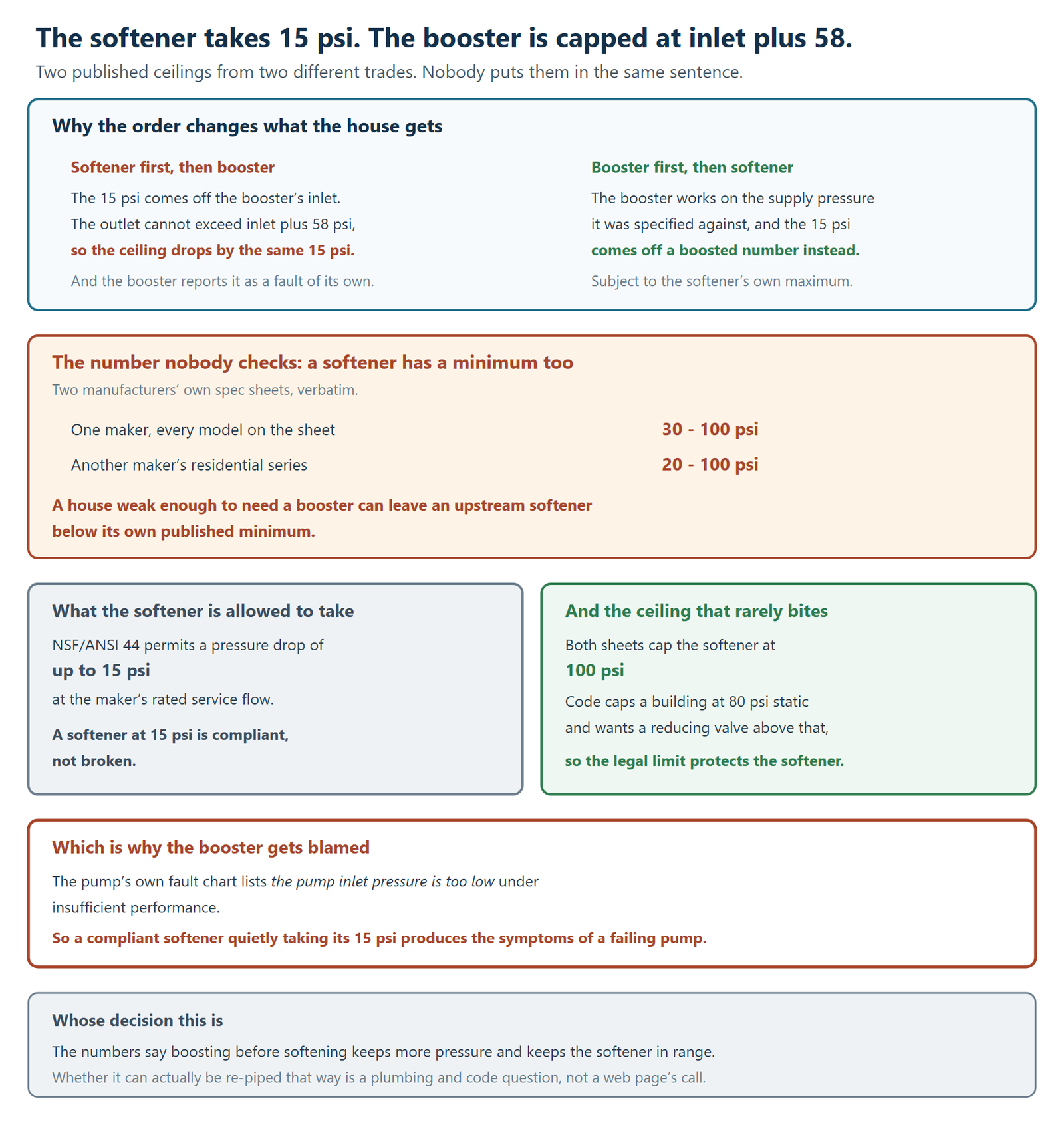
If the softener sits upstream of the booster, it is taking pressure off your ceiling, not just off your supply. A compliant softener is permitted to drop up to 15 psi, and a booster’s outlet is capped at inlet plus 58 psi — so 15 psi lost before the pump is 15 psi the house can never get back.
And there is a number on the softener’s own spec sheet that almost nobody checks: its minimum. Two manufacturers publish 30–100 psi and 20–100 psi working pressure. A house weak enough to need a booster can leave an upstream softener below its own published minimum.
Which is also why the booster gets blamed. Low inlet pressure is a named fault on the pump’s chart, so a softener quietly taking its permitted drop produces exactly the symptoms of a failing pump.
Two ceilings from two different trades
From the softener side, the governing standard is NSF/ANSI 44, and this site has already published what it permits:
The pressure drop of a water softener must not exceed 15 psi at the manufacturer’s rated service flow.
From the booster side, the manufacturer’s own limit:
“The difference between the outlet pressure and the inlet pressure must not exceed 4 bar (58 psi). Example: If the required outlet pressure is 5 bar (73 psi), the minimum inlet pressure must be 1 bar (14.5 psi).”
Those two sentences live in different industries and they multiply. The 58 psi cap is why a booster cannot simply be turned up — the outlet is tied to whatever arrives at the inlet.
So anything that lowers the inlet lowers the ceiling by the same amount. A softener upstream is precisely such a thing, and it is allowed to be.
One-minute arithmetic: take your static supply pressure, subtract up to 15 for a softener sitting before the pump, then add at most 58. That is the best your house can do — and the subtraction happened before the addition, which is the whole point.
The number nobody checks: a softener has a minimum
This is the finding that matters most, because it inverts the usual worry.
Everyone asks whether a booster will over-pressure a softener. Almost nobody asks whether the supply is strong enough to run one at all.
Water-Right’s certified softener spec sheet, verbatim, across every model on it:
Working Pressure (PSI) 30-100
with Min. to Max. Operating Temperature (ºF) 33-100.
Master Water’s MP/MCA residential series manual, verbatim:
Working Pressure (psi) 20 to 100
Now put that against the reason anyone buys a booster. People fit these because they measured something in the thirties and wanted more.
A house sitting at 30 psi static, with a softener upstream, is at or below one maker’s published minimum before the booster has done anything. The softener will be blamed for poor softening or for regenerating badly, and it will be operating outside its specification rather than failing.
One-minute check: find the softener’s model number and look up its working pressure range. Both numbers matter, and the bottom one is the one your house is more likely to breach.
And the ceiling at the other end rarely bites
The opposite worry — a booster pushing a softener past its maximum — turns out to be mostly handled already.
Both spec sheets read cap the softener at 100 psi. And code caps a building at 80 psi static and requires a pressure-reducing valve above that.
So the legal limit on the building sits comfortably below the softener’s limit, and a compliant installation protects it without anyone planning for that.
Two honest caveats. Only two manufacturers’ sheets were read here and both said 100; the wider market is not uniform, so check the figure for the softener you actually own. And 80 psi is a static limit — it is not a promise about what happens at the moment a pump cuts in.
Which is why the booster gets the blame
The pump’s own fault chart lists this under insufficient performance:
“The pump inlet pressure is too low“ — “Check the inlet conditions of the pump.”
A softener taking its permitted 15 psi is an inlet condition.
So the symptom pattern is the classic one for a failing booster: it runs, it works harder than it should, the setpoint is never reached, and the pressure at the fixtures is disappointing. Every one of those points at the pump, and the pump is fine.
And the softener is fine too. This site has already made that point in the well context — a softener dropping 15 psi is a compliant softener at its limit, not a broken one. Two correct components, one disappointing shower.
Pro note: this is why a pressure reading taken at one point proves very little on a house with treatment equipment in it. The useful measurement is a pair — before the softener and after it, under flow — and that pair is what tells a plumber which of the two is responsible.
So which order is better?
On the published numbers, boosting before softening is the stronger arrangement, for two reasons that both come from the figures above.
The booster sees the supply pressure it was specified against, rather than a supply already reduced by up to 15 psi — so its 58 psi of available boost is applied to a bigger number.
And the softener stays inside its working range at the bottom end, because it is now fed by a boosted supply rather than a weak one.
The softener’s 15 psi still happens. It is just subtracted from a larger figure, so more of it survives to the fixtures.
What has to be checked before anyone does this: the softener’s published maximum against the boosted pressure, and the local code position on where treatment equipment may sit relative to a booster on the potable supply.
And a caution worth stating plainly: this page is not telling you to re-pipe anything. Whether that order is achievable in your house, and whether it is permitted where you live, is a question for the person doing the work. The numbers are here so you can ask it properly.
What this does not change
It does not make the booster a solution to hard water, and it does not make the softener a cause of low city pressure. Each is doing its own job.
It does not mean a softener is the wrong thing to own on a boosted supply. It means the two have to be specified against each other rather than independently.
And it does not mean a bigger booster fixes it. The 58 psi cap is a property of the machine, not of its size — the specs that genuinely separate these pumps are a different question entirely, and none of them removes the inlet dependency.
When this needs a pro
Any change to the order of equipment on the potable supply. It is code-inspected work with cross-connection implications, and on a booster there are already placement rules about the low-pressure cutoff and the gauge.
Measuring pressure either side of the softener under flow. Two readings taken properly settle the argument; two readings taken badly start a new one.
Deciding whether the softener is undersized rather than misplaced. A softener at its rated service flow and a softener beyond it are different conversations, and that needs the house’s actual demand.
Anything involving the booster’s setpoint. The 58 psi cap and the 80 psi static limit both constrain it, and neither is a dial to experiment with.
What you can do yourself: read the softener’s working pressure range off its label or manual, take a static pressure reading, and note whether the softener is before or after the pump. Three facts, one gauge — and they tell a plumber in one sentence what is actually going on.
FAQ
Should a water softener go before or after a booster pump?
On the published numbers, after — boosting first means the pump works on the supply pressure it was specified against, and the softener’s permitted 15 psi drop is subtracted from a boosted figure rather than a weak one. Whether that order is achievable and permitted in your house is a question for a plumber.
Does a water softener reduce water pressure?
It is allowed to. NSF/ANSI 44 permits a pressure drop of up to 15 psi at the manufacturer’s rated service flow. A softener taking that much is compliant rather than faulty — but on a boosted system that 15 psi comes off the booster’s ceiling as well as its supply.
Can a booster pump damage a water softener?
Usually not, because the limits line up favourably. Both manufacturer spec sheets read here cap the softener at 100 psi, while code caps a building at 80 psi static and requires a pressure-reducing valve above that. Check your own softener’s figure, since the market is not uniform.
Why does my booster pump seem weak since the softener was fitted?
Because the softener is an inlet condition, and the pump’s own fault chart lists “the pump inlet pressure is too low” under insufficient performance. A booster’s outlet cannot exceed its inlet plus 58 psi, so a softener upstream lowers the achievable pressure by whatever it takes.
Does a water softener need a minimum water pressure?
Yes, and it is published. One manufacturer specifies 30–100 psi across its range, another 20–100 psi for its residential series. On a supply weak enough to justify a booster, a softener installed upstream can sit below its own minimum.
Will a bigger booster pump fix low pressure after a softener?
No. The outlet-minus-inlet cap of 58 psi is a property of how these pumps work rather than of their size, so a larger unit does not escape the inlet dependency. The fix is on the inlet side — the supply, the softener’s drop, or the order of the two.