On this page
- Two working pressure switches can still fight each other
- Confirm it's the overlap, not a single switch, in about a minute
- Why doesn't either pump's own fault list cover this?
- Raise the well switch's cutout clear of the booster's cut-in
- Or skip the switch: a constant-pressure Grundfos SCALA2 has no band at all
- Replacing parts here is a guess, not a diagnosis
- Stop before the new cutout exceeds the tank's pressure rating
- Well pump booster pump hunting is two switches, each correct on its own
Last Updated on October 13, 2026 by umar bwn
Two different faults produce the exact same pattern: the booster cycles on and off in a fast, regular rhythm that tracks the well pump’s own refill cycle, not any fixture actually running in the house. One is a single bad switch or a waterlogged tank — well pump short cycling and booster pump cycling on this site both cover that version, and the fixes are inside one device. The other is two switches, each correctly set and each mechanically sound, whose pressure bands overlap on the same water column. That’s what well pump booster pump hunting actually looks like, and replacing parts on either pump won’t touch it.
Two working pressure switches can still fight each other
A pressure switch doesn’t react to one number — it reacts to a range. It closes at the lower pressure (cut-in) and opens at the higher one (cut-out), and the gap between the two is the differential. A well system’s switch and tank handle that swing for the well pump. A booster’s switch and tank do the same job downstream, for the booster. Normally those two ranges never meet: the booster only sees pressure the well system has already delivered, and it starts and stops well inside its own band.
The trouble starts when the two bands sit close enough to touch. If the well system’s cut-out — the point where the well pump shuts off because it’s made enough pressure — lands inside or right at the edge of the booster’s cut-in, then every time the well pump finishes a cycle, it’s handing the booster a pressure swing that crosses the booster’s own trigger point. The booster reacts, draws the pressure back down, and that drop can be enough to drag the well system’s pressure back toward its own cut-in. Each pump is just doing exactly what its switch tells it to. Neither switch is broken. They’re reacting to each other.
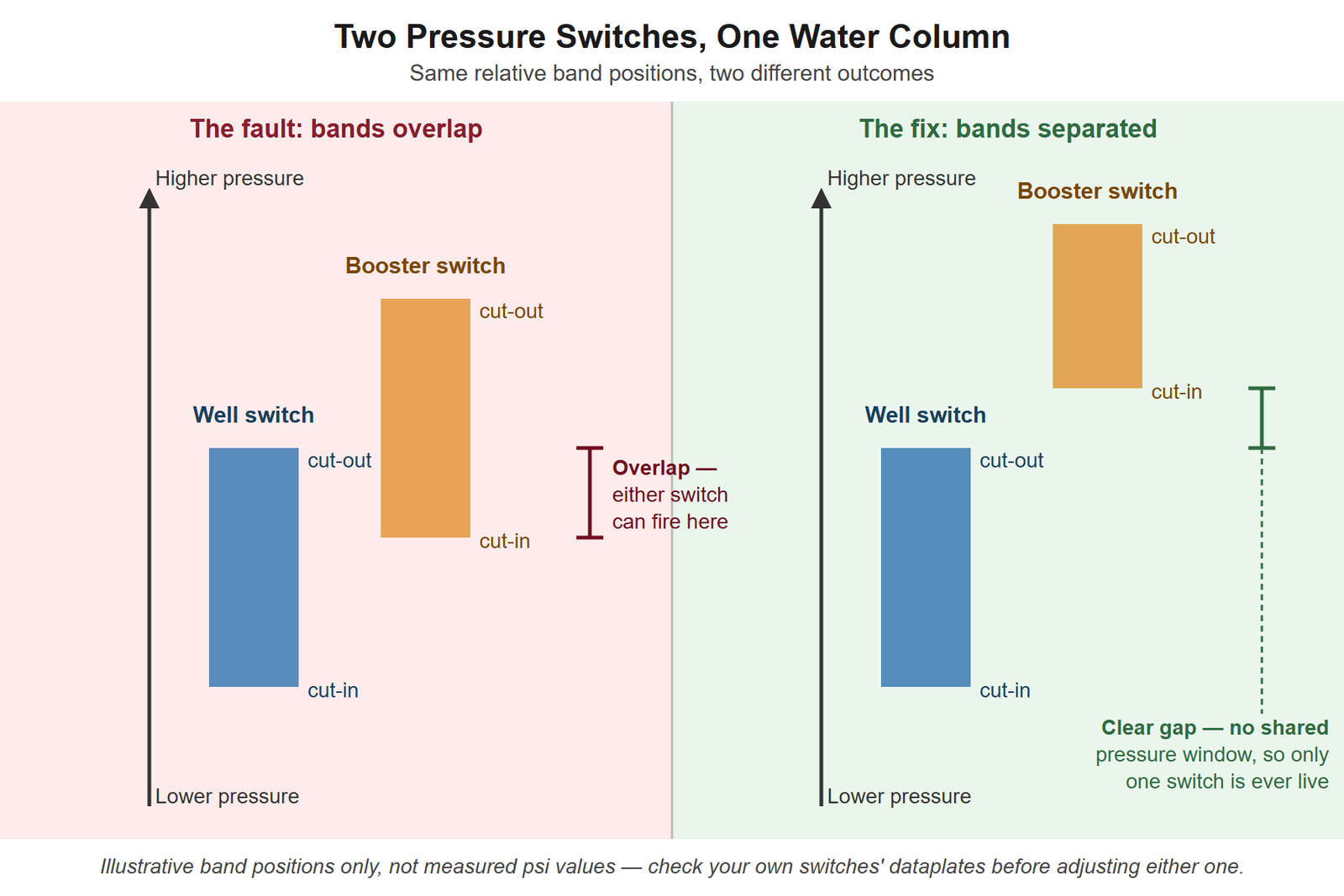
Picture a well system’s switch set to start the well pump at some lower pressure and stop it at some higher one, and a booster downstream set to start somewhat below where the well system stops and to stop somewhat above it. The exact cut-in and cut-out numbers vary by installation — read them off your own switches’ tags or the pressure gauge, not off a generic chart — but the shape of the problem doesn’t: wherever the two bands cross, the two pumps can trade triggers back and forth faster than either tank was sized to smooth out.
Confirm it’s the overlap, not a single switch, in about a minute
Shut off every fixture in the house — no tap running, no icemaker filling, nothing. Then watch the booster. If it sits still, the fault needed a draw to trigger it and you’re looking at ordinary short-cycling at one end or the other: check the well tank’s air charge first, then the booster’s own tank. But if the booster keeps cycling on a short, regular interval with nothing drawing anywhere downstream, time that interval against how long the well system’s own tank takes to fill and dump. A hunting pattern that tracks the well system’s refill rate rather than any real water use is the overlap signature — the booster is reacting to the well pump’s cycle, not to a leak and not to its own undersized tank.
This is the test neither single-device article can give you, because neither one has a second switch to check the timing against. If you’ve already ruled out a phantom draw and a weak booster tank and the pump is still hunting on no load, this is very likely what’s left.
Why doesn’t either pump’s own fault list cover this?
It isn’t an oversight — it’s a scope problem. A booster manufacturer’s fault list covers the booster: its own overpressure trips, its own low-suction alarms, its own noise. Booster pump running but no pressure increase covers the booster’s documented ceiling on what it can add over whatever pressure shows up at its inlet — but that’s still a statement about the booster reacting to a number the well system hands it, not about the well system’s own switch cycling in sync with the booster’s. A plumber servicing the booster alone sees a switch and tank that test out fine in isolation. A well driller servicing the wellhead alone sees the same. Neither one is wrong about their half of the system — neither one is looking at both switches at once.
Adding a booster pump to a well system is the one article on this site that already treats a well-plus-booster setup as a single combination, but it’s answering a different question: the code-driven inlet-cutoff requirement on city water that a private well was never built to have. It doesn’t touch what happens when two independently-set switches end up watching the same hydraulic line. That’s a second, purely mechanical failure mode the code question never raises — and it’s exactly why well pump booster pump hunting gets misdiagnosed as a parts problem on both ends of the system.
Raise the well switch’s cutout clear of the booster’s cut-in
The direct fix is separation: move the well system’s cut-out pressure, the booster’s cut-in pressure, or both, until there’s a clean gap between the two bands that neither pump’s own swing can cross. Usually that means raising the well switch’s cut-out a few pounds, since the well system is normally set at the lower end of the two ranges — but check both switches’ actual settings first, because which one has room to move depends on what’s already dialed in on your system, not on a rule that says it’s always the well side.
Adjust one switch at a time, not both, so you can tell which change actually closed the gap. After each adjustment, run the same no-draw test from above before touching the other switch.
Or skip the switch: a constant-pressure Grundfos SCALA2 has no band at all
Sometimes there isn’t room to separate the bands — the booster needs its cut-in close to where the well system naturally settles, or the well tank’s pressure rating caps how far the cut-out can go. In that case the fix isn’t adjustment, it’s a different kind of control. A fixed pressure switch can only ever have a band. A constant-pressure booster — a Grundfos SCALA2 is the model line this site has already sourced manufacturer material from — controls output with a flow sensor and a variable-speed drive instead of a mechanical switch, so there’s no fixed cut-in pressure for the well system’s cut-out to land on top of. It isn’t a tighter band; it’s not a band at all.
Best booster pumps for low city pressure covers the models worth buying when replacing the booster, rather than re-tuning two switches against each other, is genuinely the simpler fix.
Replacing parts here is a guess, not a diagnosis
This is the part worth saying plainly: if the one-minute test above points at the overlap, swapping the booster’s pressure switch, its capacitor, or the whole unit won’t fix it, because nothing in the booster is actually broken. Re-pressurizing or replacing the well tank won’t fix it either, for the same reason. Both of those are the right moves for the single-device faults this site already covers — they’re just not this fault. An overlap fault needs both switches’ settings looked at together, not either device replaced in isolation.
Stop before the new cutout exceeds the tank’s pressure rating
Adjusting a pressure switch’s range nut means opening a panel that’s live at line voltage with the pump circuit on, which is exactly the kind of job how to adjust a well pump pressure switch on this site walks through doing safely with the power off. But raising the cut-out to separate the bands does something an ordinary switch adjustment doesn’t: it raises the system’s working pressure above whatever it’s run at before. Before you dial it up, confirm the well pressure tank’s rated working pressure has headroom above the new cutout, and if the house still has older galvanized supply lines or fittings of unknown age, have a licensed well or pump contractor confirm the whole run can take the higher pressure before you commit to it. A hunting pump is an annoyance. A tank or a joint rated for less than you just set it to is a failure waiting on a trigger.
Well pump booster pump hunting is two switches, each correct on its own
When a well pump and a booster start cycling together, the instinct is to ask which one is broken. On this fault, that’s the wrong question — the useful one is whether the two switches’ bands are even allowed to touch. A well driller checking the wellhead and a plumber checking the booster can each confirm their half works perfectly and both be right, because the fault was never inside either device. It’s in the six inches of pipe between them, where one switch’s cut-out and the other’s cut-in happen to land in the same place.