On this page
Last Updated on October 2, 2026 by Muhammad Toqeer
The sentence in the manual is “the pump is maintenance-free, but…” — and what follows the “but” is an annual schedule nobody repeats.
Three jobs a year, all of them simple, plus a winterizing procedure most owners do not know exists and a restart instruction that matters more than any of it.
You will need: a stiff brush, a soft brush, warm water, and about twenty minutes. No chemicals of any kind.
What the manual actually asks for
Grundfos’s own wording, which is worth reading twice:
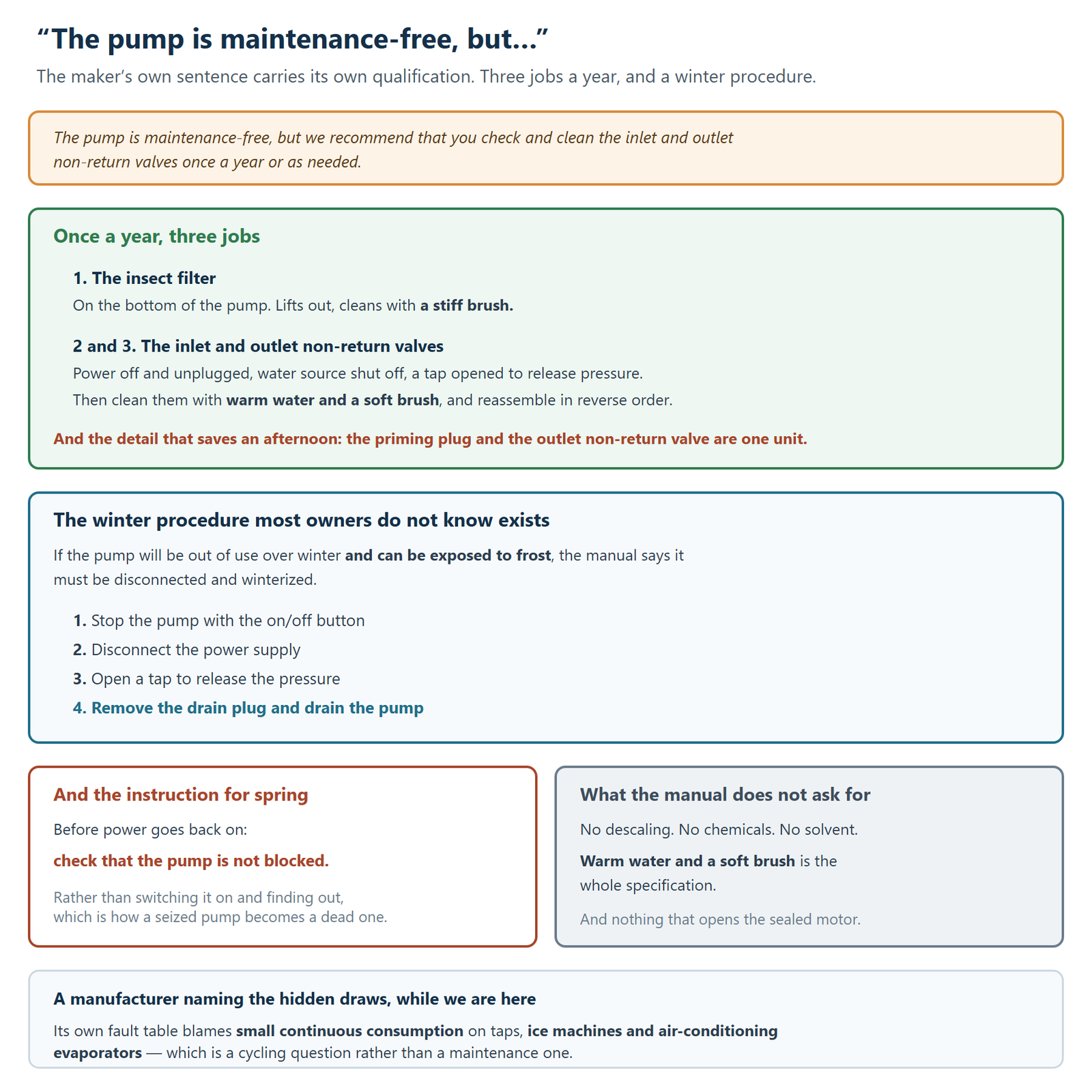
“The pump is maintenance-free, but we recommend that you check and clean the inlet and outlet non-return valves once a year or as needed.”
Maintenance-free, but. These are sealed units sold on the promise that there is nothing to do, and the manual then names three things to do.
None of them is difficult. They are simply never mentioned anywhere else, because the assumption is that a sealed pump has no serviceable parts.
Job one: the insect filter
Yes, really.
“The pump has an insect filter to prevent insects from nesting in the pump. The filter is placed on the bottom and can easily be removed and cleaned with a stiff brush.”
Clean it once a year, or as needed.
It sits on the bottom of the unit. It lifts out, and a stiff brush is the whole procedure.
This matters most on an outdoor or garage installation, and it explains a class of “it just stopped working” that no electrical test will find — which is why it appears as a cause on the page about a pump that will not start.
Jobs two and three: the inlet and outlet non-return valves
Same interval, once a year, and the safety sequence comes first.
1. Turn off the power supply and disconnect the power plug.
2. Shut off the water source.
3. Open a tap to release the pressure in the pipe system.
Do not skip the third step. The pump holds pressure, and a valve body opened under it will let you know.
Then, for the inlet valve: unscrew the union nut holding the inlet connection, pull the connection out, and pull out the valve.
For the outlet valve, there is a detail that saves an afternoon:
“The plug and non-return valve are one unit.”
The priming plug is how you reach the outlet non-return valve — they come out together. If you are looking for a separate access point, there is not one.
Then clean both the same way:
“Clean the non-return valve with warm water and a soft brush.”
Warm water and a soft brush. That is the entire cleaning specification, and the next section explains what it rules out.
Reassemble in reverse order.
What the manual does not ask for
No descaling. No chemicals. No solvent. No bleach.
Warm water and a soft brush is the whole method, and that is a specification rather than an omission — the same discipline this site applies to condensate pumps, where the makers call for warm water and most articles reach for bleach anyway.
And nothing that opens the sealed motor. The owner-serviceable parts on this machine are the insect filter, the two non-return valves, the priming plug and the drain plug. That is the list.
The winter procedure most owners do not know exists
If the pump will be out of use over winter and can be exposed to frost, the manual does not treat this as optional — it says the pump must be disconnected from the power supply and winterized.
The steps, in the manual’s own order:
1. Stop the pump using the on/off button.
2. Disconnect the power supply.
3. Open a tap to release the pressure in the pump.
4. Remove the drain plug and drain the pump.
That fourth step is the point of the exercise. Water left inside a pump body through a freeze is how a sealed unit becomes a cracked one, and no amount of insulation around the outside changes what is in the volute.
This applies to seasonal properties, unheated garages and outbuildings — anywhere the pump will sit idle somewhere that gets cold.
And the instruction for spring, which matters most
“Startup after the winter: Check that the pump is not blocked.”
Before the power goes back on, not after.
A pump that has stood all winter can be seized, and the way most people discover that is by switching it on. The manual asks you to check first, and the deblocking procedure is in the same document.
That single instruction is the difference between a stiff pump and a dead one.
One thing this is not
If the pump is cycling rather than needing service, that is a different question — and the manufacturer’s own fault table is unusually specific about it, blaming “small continuous consumption” and naming taps, ice machines and air-conditioning evaporators as the hidden draws.
Cycling has its own causes and its own article, and none of them is fixed by cleaning a valve.
When this needs a pro
Anything electrical. The manufacturer requires an authorised electrician for the connection, and these pumps live in damp places.
Any work on the inlet side beyond the union, because the low-pressure cutoff and its position are code requirements rather than fittings to be moved.
A pump that is blocked and does not free up. The deblocking procedure has a limit, and past it the unit is a service job.
Anything involving the sealed motor, which has no owner-serviceable parts at all.
What you can do yourself: all three annual jobs and the winterizing sequence. They need a brush and a bucket, and the only genuine hazard is pressure, which step three removes.
And if the pump turns out not to be up to the house rather than out of condition, the comparison worth reading puts boost and flow side by side.
FAQ
Do booster pumps need maintenance?
The manual calls the pump maintenance-free and then recommends checking and cleaning the inlet and outlet non-return valves once a year, plus cleaning the insect filter annually. Three jobs, all of them simple, and none of them mentioned anywhere else.
How do I clean a booster pump’s non-return valves?
Power off and unplugged, water source shut off, and a tap opened to release the pressure first. Then remove the valves and clean them with warm water and a soft brush, reassembling in reverse order. The priming plug and the outlet valve come out as one unit.
Can I use descaler or chemicals on a booster pump?
The manual specifies warm water and a soft brush and nothing else. No descaling, solvent or bleach appears anywhere in its cleaning instructions.
How do I winterize a booster pump?
If it will be idle over winter somewhere it can freeze, the manual requires it: stop the pump with the on/off button, disconnect the power supply, open a tap to release pressure, then remove the drain plug and drain the pump.
What should I check before restarting a booster pump in spring?
That it is not blocked — before the power goes back on. A pump that has stood all winter can be seized, and the manual gives a deblocking procedure precisely so that it is not discovered by switching it on.
Does a booster pump really have an insect filter?
It does, and the manufacturer says to clean it once a year. It sits on the bottom of the pump, lifts out, and cleans with a stiff brush — and on an outdoor or garage installation it is worth looking at before anything else.