On this page
Last Updated on October 14, 2026 by umar bwn
A booster pump overheating and shutting off is almost always one of three causes: a closed or throttled valve downstream, demand that’s run the pump past its duty cycle, or a hot, poorly-ventilated space around it — a motor-heat problem, not the rapid cycling or overpressure fault this same pump also has. Whether it clears itself or needs the reset button pressed once the cause is gone depends on which of those three it is, and that’s worth knowing before you touch anything.
None of those three is a dying motor. All three are also things a wrench alone won’t fix, because the motor isn’t the thing that’s actually broken — something around it is denying it what it needs to cool itself.
Tell it apart from rapid cycling and an overpressure trip first
This symptom gets confused with two other faults on this exact pump, and the mix-up sends people chasing the wrong thing.
If the pump is starting and stopping every few seconds, hunting around a pressure band with no real gap between attempts, that’s not heat — that’s booster pump cycling, almost always a tank that’s lost its air charge or hunting at the published start pressure. One cause gets repeated online that doesn’t actually belong on this page: a waterlogged pressure tank. A tank that’s lost its air cushion produces that rapid, repeated short-cycling, not a single sustained trip followed by a real cooldown. If your pump is restarting every few seconds, that’s the tank-side fault, not this one.
If the pump stops because something elsewhere in the house pushed pressure up past what the pump is rated to handle — a water heater’s thermal expansion, a failed pressure-reducing valve — that’s booster pump stopping on system overpressure, a different fault entirely and one the pump’s own documentation lists as a separate, auto-resetting alarm. Overpressure is a pressure reading past a ceiling, and that alarm clears itself. What this article covers is heat building up in the motor because it isn’t getting rid of it fast enough — a different physical quantity, triggered by a different condition, and one that doesn’t always clear on its own the same way; which of the three causes below it is decides whether you’ll need to press anything.
What the Grundfos SCALA2’s own fault chart says about a booster pump overheating and shutting off
On a Grundfos SCALA2 — the constant-pressure booster this site keeps coming back to because its documentation is unusually specific — there’s an alarm worth knowing about before going further: “The maximum runtime has been exceeded.” Elsewhere on this site that alarm gets used only as a leakage cross-check — the manual pairs it with “check the installation for leakage.” But a continuously running pump that’s going nowhere is exactly what trips a maximum-runtime alarm, leak or no leak. If you’ve seen that alarm and there’s no visible water anywhere, that’s the clue pointing at the causes below rather than at a leak.
Read the fault-finding chart in the SCALA2’s own manual and the two faults behave differently, which matters for what you should expect to see. The maximum-runtime alarm is marked “automatic reset: no” — once you’ve fixed the cause, you clear it yourself by pressing the pump’s reset button, it will not quietly clear on its own. The chart lists a second, separate fault that does clear itself: “the maximum temperature has been exceeded and the pump is running at reduced performance,” marked “automatic reset: yes,” with the remedy listed as checking cooling conditions and protecting the pump from direct sunlight or nearby heat sources. That second one is the fault that actually matches a pump quietly slowing down and picking back up without anyone touching it, and it points at cause three below, not at a closed valve. Other booster pump brands document this less precisely, but the underlying physics — denied flow turns motor current into heat with nowhere to go — doesn’t change with the nameplate.
The three below are ordered by what you can rule out fastest without opening anything, not by which happens most often — this session’s research didn’t turn up forum-level data on relative frequency for this specific pump, so that’s stated plainly rather than guessed at.
A closed or throttled valve downstream
If something between the pump’s outlet and the fixtures is shut — a manual isolation valve left closed after work on the line, an irrigation zone valve that’s stuck, a gate valve someone closed and forgot — the pump has nowhere to push water. It keeps drawing current and trying to do its job, but none of that electrical energy leaves as moving water, so it has to leave as heat instead, building up in the motor until the overload trips.
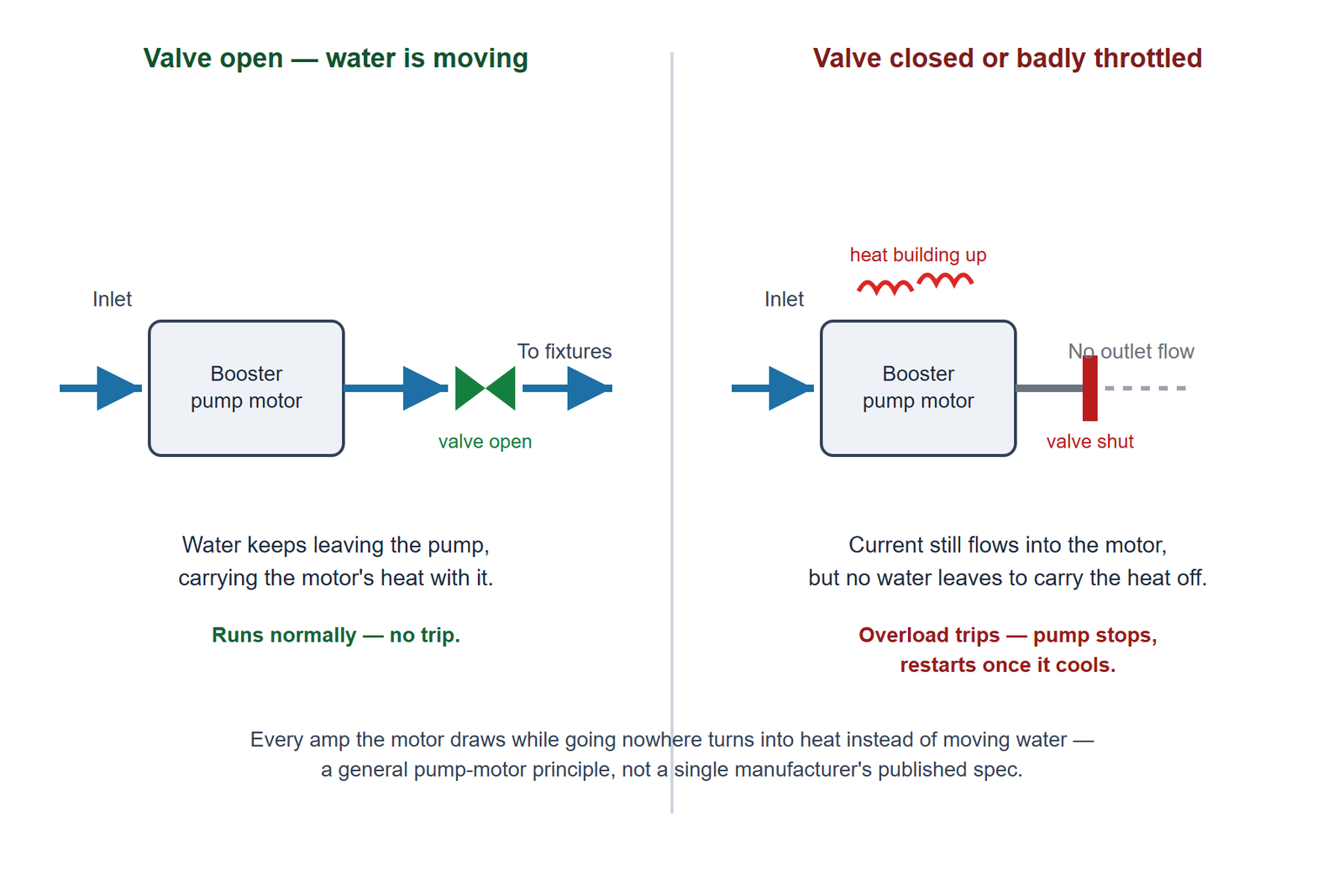
One-minute test: walk the discharge line from the pump to the first fixture and check every valve on the way — the main isolation valve, any irrigation or zone valves, anything closed for work recently. A valve even partway closed is enough to starve the flow without stopping it outright, which is why this gets missed: the pump isn’t dead-headed against a fully sealed line, just against enough restriction to deny it the flow it needs.
Fix: open the valve. If nothing’s closed and you still suspect restriction, check for a kinked or crushed section of pipe between the pump and the point where flow is supposed to go — same effect as a closed valve, different cause.
Demand that keeps it running past its duty cycle
Even with the valve wide open, a pump that’s asked to run continuously for longer than its duty cycle assumes — filling a large tank, running several high-flow fixtures or a long irrigation cycle back to back, or chasing a slow leak that never lets the system reach its setpoint — can generate heat faster than the flow through it carries away, especially if that demand is sustained for an unusually long stretch without a break.
One-minute test: think back to what was running right before it tripped, and for how long. A single short burst of use isn’t this. A tap, a zone, or a fixture that had been open and drawing for an extended stretch — long enough that you’d stopped thinking about it — points here instead of at a blockage.
Fix: if it was a one-off (filling a pool, a long irrigation run), there’s nothing to repair — just give the pump a real rest between long draws rather than restarting it immediately. If a slow leak somewhere is what’s keeping the pump running nearly all the time, every day, that’s the actual fix: find and stop the leak, not the trip itself.
If what’s driving this isn’t an occasional long draw but what the house normally asks of the pump every day — if it’s working flat-out just to keep up with ordinary demand rather than tripping on the odd long cycle — that’s not a maintenance question anymore. The pump is undersized for the job, and no amount of cooldown time fixes that permanently. Best booster pumps for low city pressure covers what a correctly sized unit looks like for a house pulling more flow than this one was ever rated to supply continuously.
An enclosed utility room that’s already at its ceiling
This one has nothing to do with the plumbing. This pump’s own published operating limits are lower than most people assume — the same limits this site’s siting guide covers as an installation clearance, not a running-fault diagnosis: maximum liquid temperature of 45°C (113°F), and maximum ambient temperature of 45°C on the 115V and 208–230V versions, 55°C on the 200–240V 50/60Hz version. A tight, unventilated utility closet in July can sit close to that ceiling on ambient heat alone, before anything downstream is wrong at all — and this is the one cause the manual’s own fault chart confirms actually does clear itself: the reduced-performance alarm above is built to auto-reset once the pump cools back down.
There’s a second way the same room causes the same trip: this pump has ventilation holes low on its body, and the manual is specific about why — it instructs installing the pump on a small stand “to prevent the ventilation holes from being flooded,” naming a drip tray directly as the thing that floods them. Standing water in a drip tray, or condensation pooling around the base from nearby cold pipework, blocks the same holes the pump uses to shed heat to the room — a tidy-looking installation quietly starving its own motor of airflow.
One-minute test: check the room temperature where the pump sits, especially if it’s run on a hot day or in a space that gets direct sun or sits near a furnace or water heater. Then look at the base of the pump itself — are the ventilation holes clear, or sitting in standing water or built-up condensation?
Fix: improve ventilation to the space, relocate the pump out of direct heat if that’s practical, or clear and properly drain whatever’s pooling around the base. None of this is a pump repair.
Don’t bypass the overload protection yourself
If you’ve ruled out the valve, the demand, and the room, and the pump is still tripping, the next step is confirming actual motor condition — amp draw, insulation resistance — and that’s mains-powered diagnostic work on a hardwired or cord-connected appliance, not a DIY step. Resist any temptation to defeat or override the thermal protection to “just keep it running” — that protection exists specifically to stop a motor from cooking itself, and running past it risks a fire hazard on top of the pump itself. If the cause isn’t one of the three above, call a licensed electrician or plumber rather than working inside the unit.
Most of this costs nothing to fix — the valve, the schedule, or the room, not the pump
A booster pump overheating and shutting off, with a real cooldown before anything happens next, is rarely the motor’s fault. Open a closed valve, let the duty cycle rest between long draws or find the leak that’s keeping it running, or fix the airflow around it, and the trips stop — because the pump was protecting itself correctly the whole time, not failing. You may still need to press the reset button once the cause is actually gone; only the heat-soaked-room cause is built to clear itself without you touching anything. The one exception is a house that’s simply asking more of the pump every single day than it was ever sized to deliver, and that’s the one case on this list where a bigger pump, not a fix, is the actual answer.