On this page
Last Updated on October 8, 2026 by Muhammad Toqeer
Everything written about this tells you an RO system needs about 40 psi. Almost nothing tells you what you get at 40.
The manufacturer does, and it publishes it as a table:
“Input 40 psi –> tank fills 1.9 gallon ( about 50% full )”
Half a tank. Not a slightly slower system — half the water, from a tank sold as four gallons.
And that is only the first of two losses. The pressure drops again on the way back out, and the second table is the one nobody quotes.
The three symptoms, as the maker lists them
**From APEC Water Systems’ own owner’s manual for a four-stage reverse osmosis system, under the heading Insufficient Water Pressure – Problems with Non-Pump RO Systems:**
“The 3 most common problems caused by low input water pressure:”
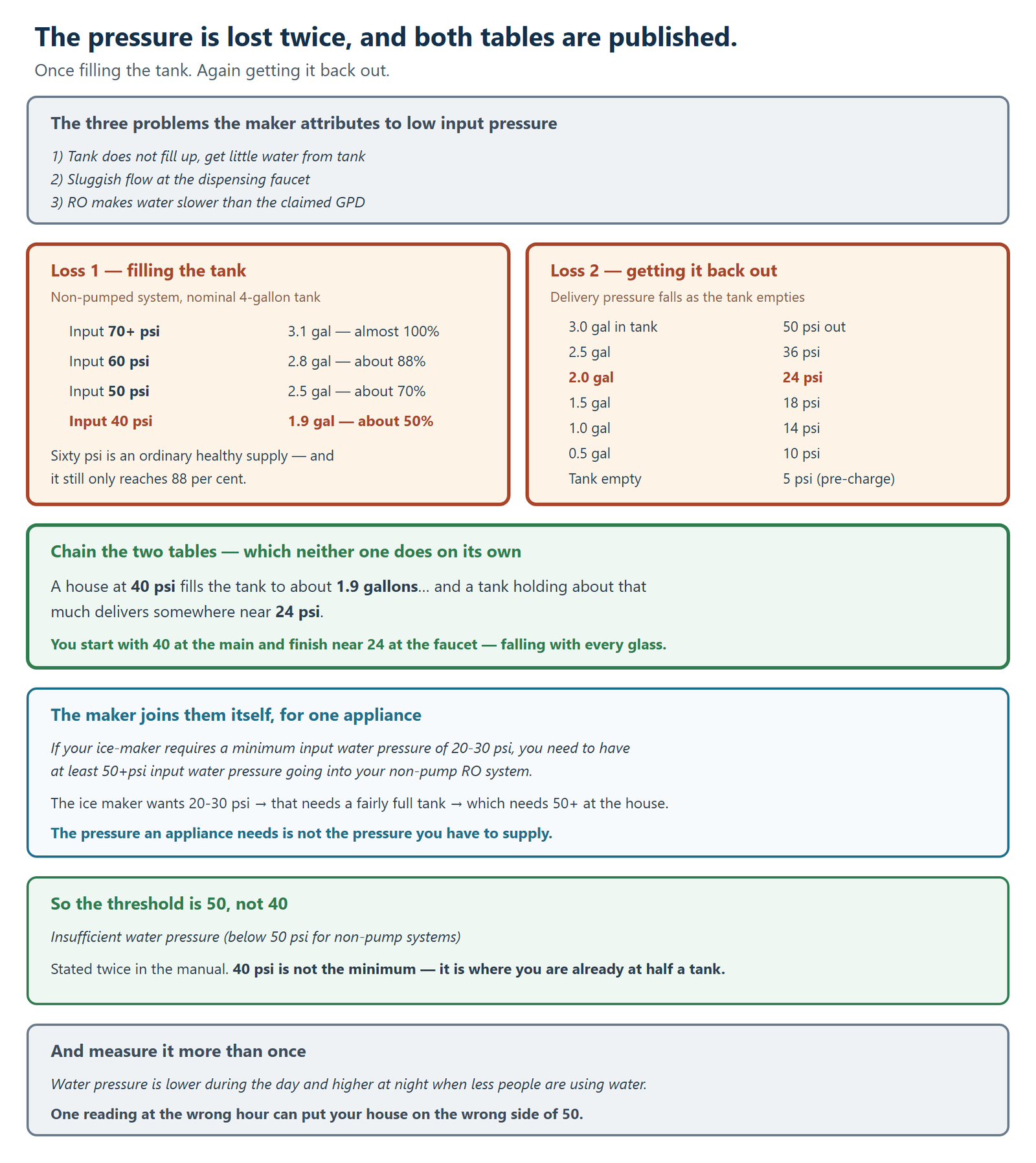
“1) Tank does not fill up, get little water from tank” “2) Sluggish flow at the dispensing faucet” “3) RO makes water slower than the claimed GPD”
And the instruction that follows:
“If you experience these problems, Please check your input water pressure as the first step. This will often solve the above listed problems.”
Three symptoms, one first step. If your RO system is slow, the manufacturer’s own advice is to put a gauge on a tap before touching the system.
The first loss: filling the tank
This is the table, verbatim, for a non-pumped system with a nominally four-gallon tank:
| Input pressure | Tank fills to |
|---|---|
| 70+ psi | “3.1 gallon ( almost 100% full )” |
| 60 psi | “2.8 gallon ( about 88% full )” |
| 50 psi | “2.5 gallon ( about 70% full )” |
| 40 psi | “1.9 gallon ( about 50% full )” |
“So, if your input water pressure is low, the tank will not fill up to full.”
Read the 60 psi row. Sixty psi is a perfectly ordinary, healthy domestic supply — and it still only gets you to 88%.
And the manual is honest about the tank’s nominal size too: “4-gal refers to tank’s total volume (air space & bladder). At 80-90 psi, tank bladder’s capacity is around 3.2 gallons.” So “four gallons” was never four gallons of water.
The second loss: getting it back out
Here is the half that nobody quotes. The same manual publishes delivery pressure against how full the tank is:
| Water in tank | Delivery pressure |
|---|---|
| 3.0 gallon | 50 psi |
| 2.5 gallon | 36 psi |
| 2.0 gallon | 24 psi |
| 1.5 gallon | 18 psi |
| 1.0 gallon | 14 psi |
| 0.5 gallon | 10 psi |
| Tank empty | 5 psi (pre-charged pressure) |
Now chain the two tables, which neither one does on its own.
A house at 40 psi fills the tank to about 1.9 gallons. A tank holding about 1.9 gallons sits between the 24 psi and 18 psi rows.
You started with 40 psi at the main and you are getting something near 24 at the faucet — and it falls further with every glass you draw, because the tank is emptying as you use it.
That is why the complaint is so often “it was fine, then it went weak.” It is not degrading. It is the second table, happening in real time.
The appliance that exposes it
The manufacturer joins the two tables itself, for one case:
“If your ice-maker requires a minimum input water pressure of 20-30 psi, you need to have at least 50+psi input water pressure going into your non-pump RO system. If your water pressure is under 50 psi, the tank will not fill up enough, and the delivery pressure to your ice-maker may be sluggish and unstable.”
Work backwards through that and it is a four-step chain. The ice maker wants 20–30 psi. That needs a reasonably full tank. A reasonably full tank needs 50+ psi at the house. So an appliance asking for 20–30 psi requires 50+ at the main.
It is the clearest published example of a principle worth carrying around: the pressure an appliance needs is not the pressure you have to supply.
The threshold is 50, not 40
This is where the manufacturer and the internet part company.
Every result currently ranking for this says 40 psi is the minimum. The manual’s own troubleshooting says:
“Insufficient water pressure (below 50 psi for non-pump systems) –> Increase house water pressure or add an appropriate pump to system.”
Fifty. Stated there, and stated again in the ice-maker section.
So 40 psi is not the minimum. Forty psi is the point at which you are already down to half a tank — and the figure repeated across the search results is the bottom of the range rather than a target.
How the maker says to measure it
Before concluding anything, this takes five minutes:
“Get a water pressure gauge that adapts onto your sink or garden faucet (from hardware store), attach gauge onto faucet, turn water on to FULL, then take a reading.”
And the part that matters more than the gauge:
“For some areas, water pressure is lower during the day and higher at night when less people are using water. So to get an accurate average, take several measurements at different times of the day and average them out.”
One reading at the wrong hour can put your house on the wrong side of 50. If you are deciding whether to fit a pump on the strength of a number, take the number more than once.
Measuring the gap between what you have and what you want is the whole of this decision — and it is the step most people skip on their way to buying something.
Cold water is on the same remedy line
One more cause worth knowing, from the same troubleshooting table:
“Low water temperature (below 77 ºF) –> Increase house water pressure or add pump to compensate for low (cold) water temperature.”
Cold feed water slows an RO membrane down, and the manufacturer’s answer to it is the same answer as for low pressure: more pressure, or a pump.
Which is worth knowing in winter, when the incoming main is at its coldest and the system that was adequate in August suddenly is not.
So does a booster pump fix it?
Often, and the manufacturer names a pump as its own remedy twice — “add an appropriate pump to system” and, for delivery pressure specifically, a permeate pump.
But two limits belong on the same page.
A booster adds a bounded amount rather than creating pressure — so what you can reach depends on what arrives at its inlet.
And this is a different problem from the one a tankless heater has. There, a threshold of flow switches an appliance on; here, pressure fills a vessel over two hours. Same instinct, different physics, and the two should not be reasoned about interchangeably.
No product is recommended here. APEC names the component; no specific pump was verified at a manufacturer for this page, so none is named.
When this needs a pro
Fitting any pump into a drinking-water system. It is a potable supply feeding something you drink, and it is plumbed and powered.
Deciding between raising house pressure and adding a pump at the RO. Those solve different problems — one helps the whole house, the other helps one appliance — and the choice is a whole-house question.
Anything inside the RO system. Membranes, the tank and its pre-charge are the system manufacturer’s territory, not this site’s.
And a house measuring well under 50 psi at every hour of the day. That is a supply question before it is an appliance question, and it may involve the utility.
What you can do yourself: buy a gauge, read the pressure at the kitchen tap at three different times of day, and average them. Then compare that average with what a pump could realistically add. One tool, three readings — and they tell you whether you have an RO problem or a house problem.
FAQ
What water pressure does a reverse osmosis system need?
This manufacturer’s troubleshooting puts insufficient pressure at below 50 psi for non-pump systems, and its ice-maker section independently says you need at least 50+ psi. The widely repeated figure of 40 psi is the point at which its own table shows the tank filling only about half.
Why is my RO system so slow?
The manufacturer lists three problems caused by low input pressure — the tank not filling, sluggish flow at the faucet, and water made slower than the claimed GPD — and says to check your input pressure as the first step.
How full will my RO tank get at low pressure?
Per the published table for a non-pumped system: 70+ psi fills 3.1 gallons, 60 psi fills 2.8, 50 psi fills 2.5, and 40 psi fills 1.9 — about half of a nominally four-gallon tank.
Why does the water get weaker as I use it?
Because delivery pressure depends on how full the tank is. The published figures fall from 50 psi at 3.0 gallons to 24 psi at 2.0 gallons and 14 psi at 1.0 gallon, so the flow weakens as the tank empties rather than staying constant.
Will a booster pump fix a slow RO system?
The manufacturer names adding an appropriate pump as its own remedy for insufficient pressure. Whether it is the right answer depends on your measured pressure, and a booster adds a bounded amount rather than creating pressure from nothing.
Does cold water affect a reverse osmosis system?
Yes. The same troubleshooting table lists water temperature below 77 °F as a cause of a tank taking a long time to fill, with the remedy being to increase house pressure or add a pump to compensate for the cold.