On this page
Last Updated on October 1, 2026 by Muhammad Toqeer
A booster pump adds a bounded amount of pressure. It does not create pressure. Grundfos publishes the limit plainly: “The difference between the outlet pressure and the inlet pressure must not exceed 4 bar (58 psi).”
So if your inlet is weak and your setpoint is ambitious, the pump will run continuously and never arrive — and that is not a fault, it is arithmetic.
Check the inlet gauge before you check anything else. The reading there sets the ceiling on everything downstream.
The ceiling, and the manufacturer’s own worked example
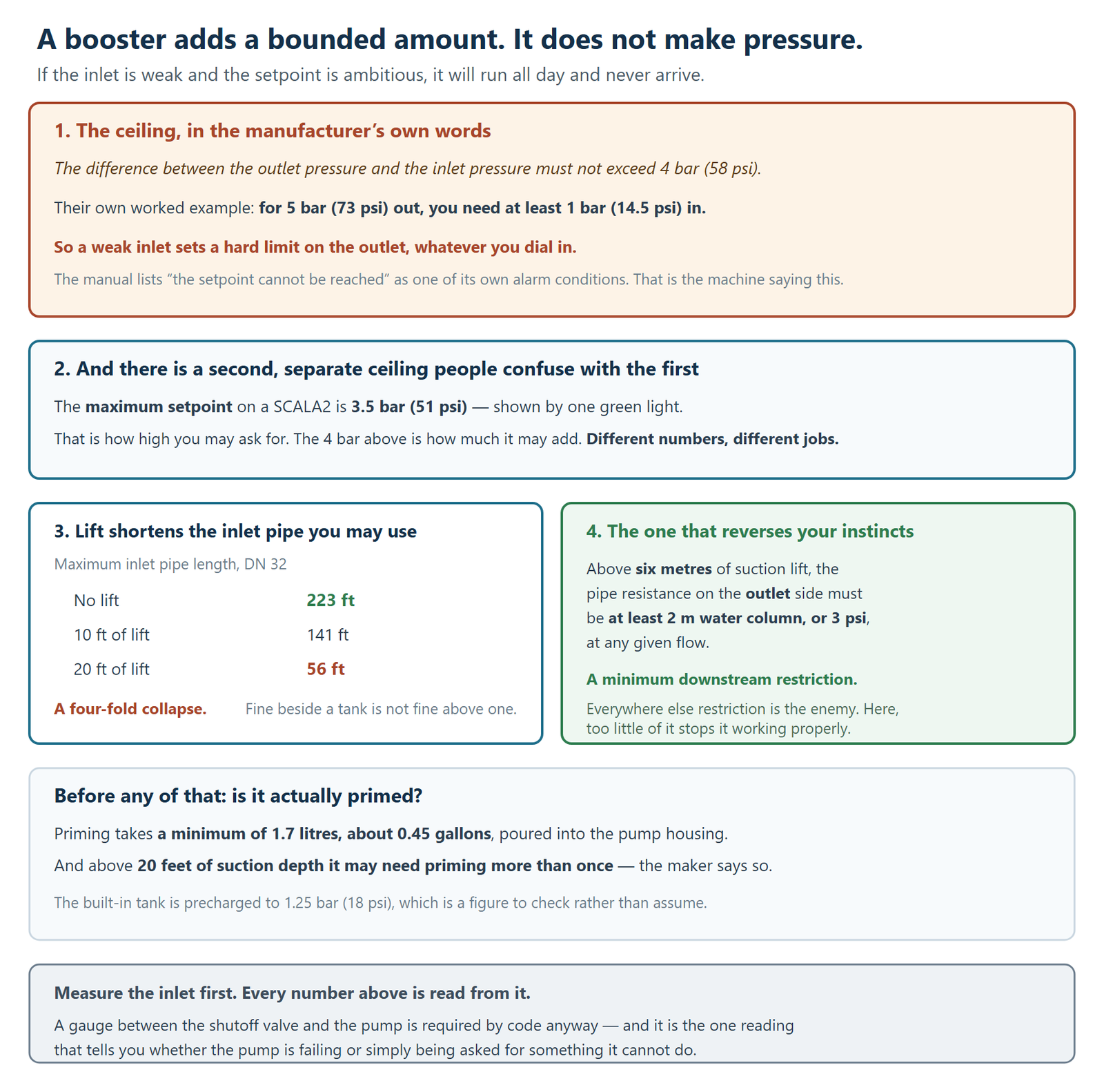
Four bar is 58 psi. That is the most a SCALA-class booster will add to whatever arrives at its inlet.
Grundfos works the example out for you:
“Example: If the required outlet pressure is 5 bar (73 psi), the minimum inlet pressure must be 1 bar (14.5 psi).”
Turn that around and it becomes a diagnosis. If your inlet sits at 10 psi, the most you will ever see downstream is about 68 psi — and if you have asked the pump for more than that, it will run, and run, and the gauge will sit where it sits.
The pump knows. The manual lists “the setpoint cannot be reached” among its own alarm conditions. It is reporting the arithmetic rather than a failure.
The second ceiling, which gets confused with the first
There are two different limits and they are routinely conflated — including by pages that quote one as the other.
How much it can add: 4 bar (58 psi). The difference figure above.
How high you can ask it to go: 3.5 bar (51 psi) on a SCALA2, which is the maximum setpoint, displayed by the indicator lights — “a pump set to 3 bar (44 psi) indicated by two green lights and a pump set to 3.5 bar (51 psi) indicated by one green light.”
Different numbers doing different jobs. One is the dial’s top end; the other is the gap it can bridge.
If it is on a suction lift, two more limits apply
Both of these turn a working installation into a non-working one without anything breaking.
The inlet pipe gets shorter as the lift gets higher
From the manual’s own table, maximum inlet pipe length on DN 32 pipe:
| Suction lift | Maximum inlet pipe |
|---|---|
| No lift | 223 ft |
| 10 ft | 141 ft |
| 20 ft | 56 ft |
A four-fold collapse. A suction line that worked perfectly when the pump sat beside the tank becomes far too long once the pump has to lift as well.
One-minute test: pace the run from the water source to the pump, and note whether the pump is above the water level or beside it. Two facts, and they decide whether your installation is inside that table.
Above six metres of lift, it needs more downstream resistance
This one reverses the instinct everyone has.
“In case of suction lift of more than six metres, the pipe resistance on the outlet side must be at least two metres water column or 3 PSI at any given flow in order to obtain optimum operation.”
A minimum restriction on the outlet. Everywhere else in plumbing, resistance is the thing you try to remove — here, too little of it stops the pump operating properly on a deep lift.
Which means an installation discharging into something wide open can behave worse than one feeding a normal house.
Before any of that: is it primed?
The dull answer, and it is right often enough to check first.
Priming takes a minimum of 1.7 litres — about 0.45 gallons — poured into the pump housing. Not a splash.
And Grundfos is explicit that once may not be enough: “If the suction depth exceeds 6 m (20 ft), it may be necessary to prime the pump more than once.”
The maker’s own fault list for a pump that will not perform reads: dry running or water shortage, the inlet pipe blocked by impurities, air in the inlet pipe or the pump, leakage in the system, and the maximum runtime exceeded.
One-minute test: listen. A primed pump moving water sounds different from one turning air, and a pump that runs for a few seconds and stops is telling you it has found no water.
And the built-in tank has a precharge of its own — 1.25 bar (18 psi) — which is a figure to check rather than assume.
What this is not
It is not the same as a pump that keeps starting and stopping. That has its own causes, and the first of them is the low-pressure cutoff doing precisely what it was fitted to do. A pump that runs steadily and achieves nothing is a different symptom.
It is not necessarily the wrong pump, either. If the house needs more flow than the model can deliver, the pressure will sag whenever demand rises — which looks similar at the tap and is a sizing question rather than a fault.
And it is not something to fix by turning it up. Code caps a building’s static pressure at 80 psi, and the ceiling above means the dial cannot reach past your inlet anyway.
What to do, in order
1. Read the inlet gauge. It is required to be there — code puts a pressure gauge between the shutoff valve and the pump — and it is the number everything else depends on.
2. Add 58 psi to it. That is your realistic maximum outlet. If your setpoint is above that figure, lower the setpoint; the pump is not going to get there.
3. Check the prime, properly, with the volume the manual specifies.
4. If it is on a suction lift, check the inlet pipe length against the table and check whether the outlet has the minimum resistance the manual requires.
5. Only then start suspecting the pump. And if it genuinely cannot do the job your house needs, the comparison worth reading is the one that puts flow and boost side by side rather than horsepower.
When this needs a pro
Anything on the inlet side, because that is where the code requirements live — the low-pressure cutoff, its position, and its setting.
Anything electrical. These are sealed units and the remedies the manual offers stop at priming, cleaning the inlet and checking the source.
A pump that trips its own alarms repeatedly. The restart behaviour is deliberate — three restarts within the first sixty seconds, then a further set, then the cycle repeating after 24 hours — and a unit cycling through that is reporting a condition rather than being stubborn.
Any change to the setpoint on a building you do not own, since the 80 psi static limit applies to the building rather than to the appliance.
What you can do yourself: read the inlet gauge, read the outlet gauge, and subtract. One subtraction, and it tells you whether you have a broken pump or an impossible request.
FAQ
Why is my booster pump running but the pressure is not increasing?
Most often because the increase it can deliver is capped. Grundfos limits outlet minus inlet to 4 bar, or 58 psi, so a weak inlet sets a hard ceiling on the outlet no matter what setpoint is selected.
How much pressure can a booster pump add?
On a SCALA-class pump, a maximum of 4 bar (58 psi) above whatever arrives at the inlet. That is separate from the maximum setpoint, which on a SCALA2 is 3.5 bar (51 psi) — the two figures are different limits and are easily confused.
Does a booster pump work if the inlet pressure is zero?
It can draw on a suction lift, but the limits tighten sharply. Maximum inlet pipe length on DN 32 falls from 223 feet with no lift to 56 feet at 20 feet of lift, and above six metres of lift the outlet needs a minimum resistance of 3 psi at any flow.
How much water does it take to prime a booster pump?
A minimum of 1.7 litres, about 0.45 gallons, into the pump housing. Grundfos also notes that above 20 feet of suction depth it may be necessary to prime more than once.
Is a booster pump running constantly a problem?
It depends which symptom you have. Running steadily without reaching the setpoint usually means the setpoint is beyond the inlet plus the pump’s ceiling. Starting and stopping repeatedly is a different fault with different causes.
Can I just turn the booster pump up?
Not past the ceiling. The outlet cannot exceed the inlet plus 58 psi, so if the setpoint is already above that the dial does nothing. Building static pressure is also capped at 80 psi by code.