On this page
Last Updated on October 7, 2026 by Muhammad Toqeer
Sometimes. And the honest answer turns on a distinction nobody writing about this makes:
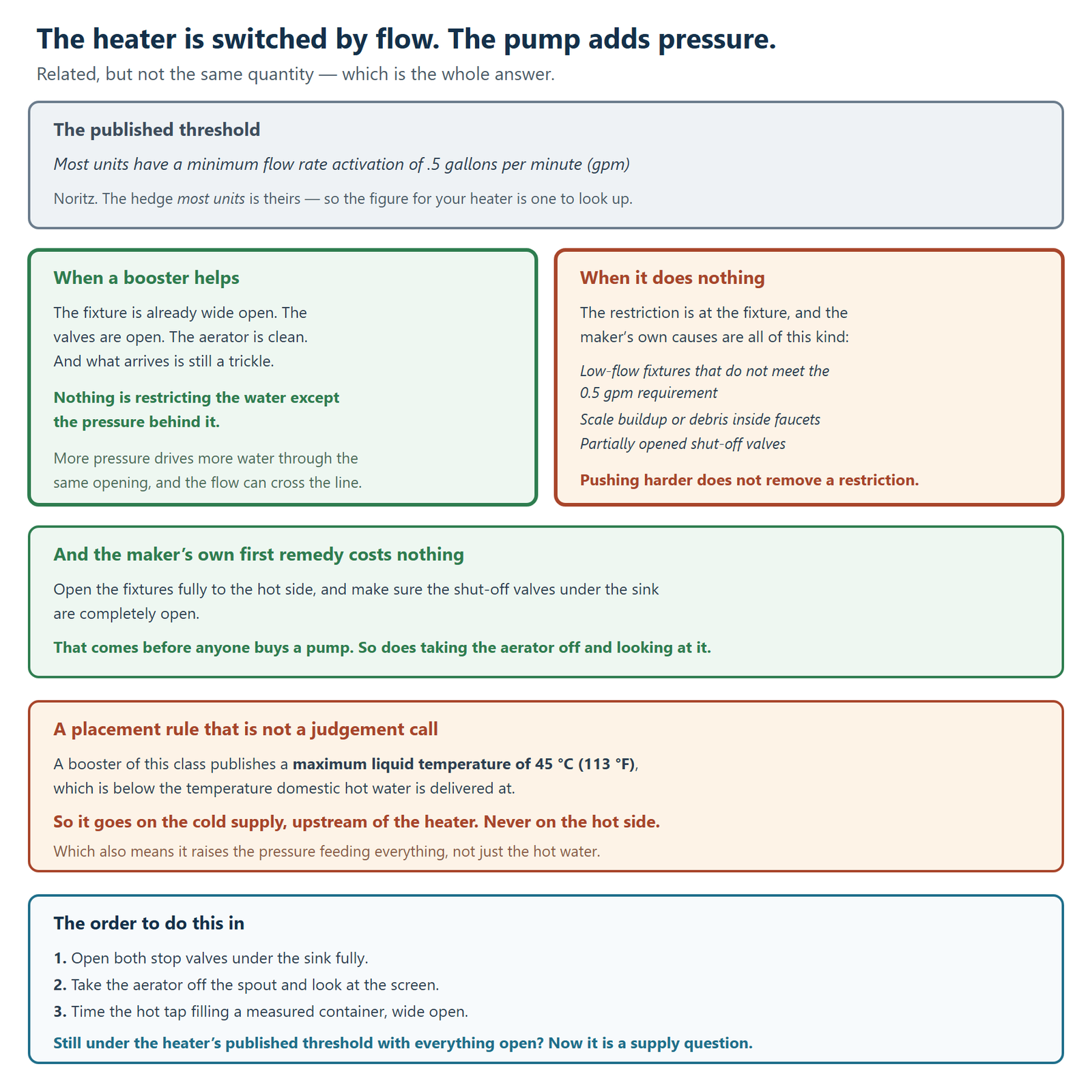
**A tankless heater is switched on by flow. A booster pump adds pressure.**
Those are related, but they are not the same quantity — which is why a booster fixes this problem in one house and does nothing at all in the next one.
The threshold is published. Noritz, a tankless manufacturer, states it plainly:
“Most units have a minimum flow rate activation of .5 gallons per minute (gpm)”
Below that, the unit does not fire. Not weakly — at all. And the manufacturer’s own first three causes have nothing to do with your water supply.
What the heater is actually waiting for
A tankless heater has no stored hot water, so it has to know when you want some. It detects that by sensing water moving through it.
Below a certain rate, it does not light. From Noritz’s own support documentation:
“Most units have a minimum flow rate activation of .5 gallons per minute (gpm)”
**Note the hedge — “most units” — and keep it. That is the manufacturer’s wording, and it means the figure for your heater is a thing to look up rather than assume. This page is not going to turn it into a universal number**, because the figures quoted elsewhere online for this spread from a tenth of a gallon to a gallon and a half, and a range that wide is no figure at all.
What matters is that a threshold exists, and that below it the heater is not misbehaving. It is doing what it was built to do.
The manufacturer’s own first answers are free
This is the part worth reading before you buy anything.
When some fixtures get hot water and one does not, Noritz lists the causes as:
Low-flow fixtures that do not meet the 0.5 gpm requirement.
Scale buildup or debris inside the faucet restricting flow.
Partially opened shut-off valves under the sink limiting flow.
And its own first remedy is to open fixtures fully to the hot side and make sure the stop valves underneath are all the way open.
All three causes sit at the fixture. None of them is a water-supply problem, and none of them is improved by a pump.
One-minute check, and do this first: go under the sink and turn both stop valves fully counter-clockwise. Then take the aerator off the end of the spout and look at it. A screen packed with scale is the single most common restriction in a house, and it is a two-minute fix with no parts.
So when does a booster actually help?
Here is the distinction the whole question rests on.
A booster helps when the fixture is already wide open and the supply is the limit. The tap is fully on, the valves are open, the aerator is clean — and what arrives is still a trickle. In that case there is nothing restricting the water except the pressure behind it, and raising the pressure drives more water through the same opening. The flow goes up, and it can cross the threshold.
A booster does not help when the restriction is at the fixture. A faucet rated below the activation threshold is going to pass its rated amount whether you push it at 40 psi or 70. A blocked aerator is a blocked aerator. A half-closed stop valve is a half-closed stop valve.
Pushing harder on a restriction does not remove it. That is the whole answer, and it is why the same pump is a fix in one house and a wasted afternoon in another.
And if the measurement does say the supply is the limit, choosing the pump is its own exercise — sized to the gap you measured rather than to the biggest number on the box.
Which is also why this site keeps saying to measure before buying — the gap between what you have and what you want is the specification, and without it you are guessing.
And there is a hard placement rule
This one is not a judgement call.
A booster of this class publishes a maximum liquid temperature of 45 °C (113 °F) — and domestic hot water is delivered well above that.
So the pump goes on the cold supply, upstream of the heater. Never on the hot side.
The temperature limits and what they rule out are set out in full in the placement article, including the recirculation loops and mixing-valve crossovers that can send warm water back through a pump that was never rated for it.
Which has a consequence worth stating: boosting the cold supply raises the pressure feeding everything, not just the heater. That is usually what you wanted anyway, but it is not a hot-water-only fix and it should not be sold to you as one.
What a booster can and cannot add
One more limit, because it bounds the whole exercise.
A booster adds a capped amount of pressure rather than creating it — on a SCALA-class pump the outlet cannot exceed the inlet by more than 58 psi, and the maximum setpoint is lower still.
So if the inlet is very weak, the outlet is bounded too. A pump cannot turn a failing service line into a strong one, and a house whose supply is genuinely inadequate has a supply problem rather than a pump problem.
When this needs a pro
Fitting the pump. It is a plumbed, electrically connected device on a potable supply, and it needs the right position on the cold side.
Deciding whether your heater’s threshold is being met. That is a flow measurement at the fixture against the heater’s own published figure, and both halves need to be right.
Anything inside the water heater. Not this site’s subject, and a gas appliance is not a place to experiment.
And working out whether the supply itself is the problem. If the whole house is weak rather than one tap, the question is about the service line and the utility before it is about a pump.
What you can do yourself: open the stop valves fully, clean the aerator, and then time how long the hot tap takes to fill a measured container. Three steps, no parts — and if the flow is still under the heater’s published threshold with everything wide open, you have the measurement that tells a plumber exactly what to quote for.
FAQ
Will a booster pump make my tankless water heater turn on?
Only if the thing that is short is supply pressure. A tankless heater is switched by flow, and the manufacturer Noritz publishes that most units activate at 0.5 gpm. If the fixture is wide open and the supply is weak, more pressure gives more flow and a booster can help. If the restriction is at the fixture, it will not.
What is the minimum flow rate for a tankless water heater?
Noritz states that most units have a minimum flow rate activation of 0.5 gallons per minute. The wording “most units” is the manufacturer’s own, so the figure for a specific heater is something to look up rather than assume.
Why does one tap get hot water and another does not?
The manufacturer lists three causes, and all three are at the fixture: a low-flow fixture that does not meet the activation requirement, scale or debris inside the faucet, or a partially opened shut-off valve under the sink. Its first remedy is to open everything fully.
Can a booster pump go on the hot water side?
No, not a pump of this class. The published maximum liquid temperature is 45 °C (113 °F), which is below the temperature domestic hot water is delivered at. The pump belongs on the cold supply, upstream of the heater.
Is low pressure the same as low flow?
No, and the difference is the whole question. Pressure is the force behind the water; flow is how much actually moves. Raising pressure increases flow through an unrestricted opening, but it does not increase flow through a fixture that is itself the restriction.
How much pressure can a booster pump add?
Less than people expect. On a SCALA-class pump the outlet cannot exceed the inlet pressure by more than 58 psi, so a very weak inlet puts a ceiling on the outlet no matter what is selected.