On this page
Last Updated on October 3, 2026 by Muhammad Toqeer
Find out where the water starts before you decide anything. A booster pump’s shaft seal is lubricated by the water it pumps, which means the manufacturer expects a certain amount of leakage from it by design — and expects it to evaporate before you ever notice.
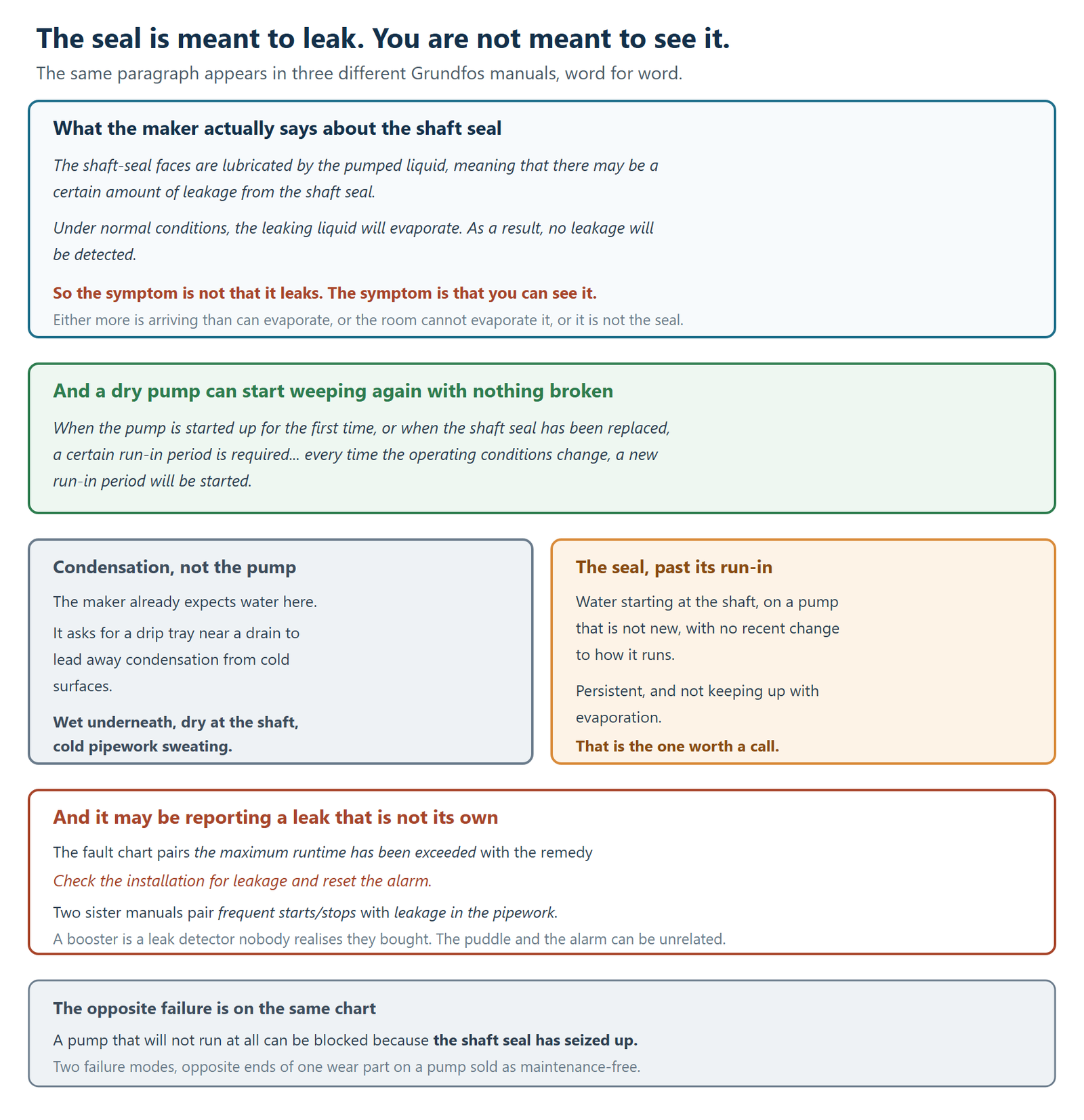
So the symptom is not that it leaks. The symptom is that you can see it.
And there is a second possibility the maker plans for, which is that the water under the pump is not from the pump at all. It asks for a drip tray near a drain specifically to deal with condensation off cold pipework, which means a perfectly healthy booster in a cool utility room will put water on the floor.
What the manufacturer says about the seal
Verbatim, from the installation and operating instructions:
“The shaft-seal faces are lubricated by the pumped liquid, meaning that there may be a certain amount of leakage from the shaft seal.”
“Under normal conditions, the leaking liquid will evaporate. As a result, no leakage will be detected.“
That is not a disclaimer buried in a warranty. It is the manufacturer describing how the part works: the seal faces run wet because water is what keeps them from destroying each other.
And it is not one manual’s quirk. The same paragraph appears word for word in three different Grundfos installation manuals covering three different product families — a SCALA, a CM Booster, and a third. That is the company’s standard position on the component, not a note about one model.
One-minute check: look at where the water starts, not where it collects. Water that appears at the shaft, between the motor and the pump body, is seal leakage. Water that is simply underneath, with a dry shaft, is almost certainly something else.
The sentence that explains a pump that was fine last month
This is the part nobody writes down, and it is in all three manuals:
“When the pump is started up for the first time, or when the shaft seal has been replaced, a certain run-in period is required before the leakage is reduced to an acceptable level. The time required for this depends on the operating conditions, that is, every time the operating conditions change, a new run-in period will be started.”
Read the last clause carefully. A run-in is not a one-off event at installation. Any change in how the pump operates starts a new one.
So a pump that has been bone dry for two years can begin weeping after a setpoint change, a plumbing alteration upstream, a shift in supply pressure, or a return to service after a winter shutdown — with nothing broken and nothing to fix.
One-minute observation: has anything changed recently? A new setpoint, work on the plumbing, the pump brought back after being drained for winter, a different supply pressure since the utility did something in the street. If yes, and the weeping is slight, the manufacturer’s own answer is to let it run in.
Is it condensation instead?
This is the first thing to rule out, and the manufacturer has already told you to expect it.
The maker’s own installation drawing puts the pump on a small stand inside a drip tray, near a drain — not for seal leakage, but “to lead away possible condensation from cold surfaces.”
A booster carries cold mains water through a warm, often humid room. The body and the pipework sweat, the condensate runs down, and it collects under the pump exactly where seal leakage would.
How to tell them apart, by looking:
Condensation wets the outside of the body and the pipework evenly, is worse in humid weather, worse in summer, and leaves the shaft area itself dry. There will usually be beads on cold pipe either side of the pump too.
Seal leakage starts in one place — the joint between motor and pump body — and tracks down from there. The pipework around it is dry.
Pro note: if it is condensation, the fix is environmental rather than mechanical, and that page covers it. Nothing about the pump needs attention — but a pump standing in its own condensate is the failure the drip tray exists to prevent, because the ventilation holes sit low on the body.
When visible water does mean something
**Go back to the maker’s stated normal outcome: no leakage will be detected.**
That is the test. The design assumption is that evaporation keeps pace with the seal. Standing water means it is not keeping pace, and there are only three reasons for that.
More is arriving than before. The seal is past its run-in and wearing — the ordinary end-of-life for the part.
The room cannot evaporate it. Cool, humid, unventilated. Which also means the pump has been sitting damp, and damp is the condition that shortens everything about it.
It is not the seal. A fitting, a union, a flexible hose connection, or the non-return valve housing.
The case worth calling someone about is a persistent leak starting at the shaft, on a pump that is not new, with no recent change in operating conditions, that is not reducing. That is a seal at the end of its life, and on a sealed unit it is a service job rather than a part you fit.
The leak it may be reporting is not its own
This one catches people, and it is worth knowing before you start looking for a puddle to match an alarm.
From the fault chart, verbatim:
“The maximum runtime has been exceeded” — “Check the installation for leakage and reset the alarm.”
**And “Leakage in the system” is a named condition on the pump’s own status indicator**, sitting alongside power failure, dry running and blockage.
The two sister manuals say the same thing in their own fault tables:
“Frequent starts/stops. a) Leakage in the pipework. Check and repair the pipework.”
So a booster pump is a leak detector that nobody realises they bought. It knows how long it has run and how often it has started, and both of those go wrong when something in the house is losing water.
Which means the water on the floor and the alarm on the panel can be two completely unrelated problems — and a pump starting repeatedly with no tap open is its own diagnosis, not a symptom of the thing dripping underneath it.
The opposite failure, on the same chart
Worth knowing because it explains why a sealed, maintenance-free pump still has a wear item.
“The pump is blocked, e.g. the shaft seal has seized up“
A seal that stops leaking altogether is not the goal either. It is listed as a cause of a pump that will not run at all, with the remedy being the restart-after-standstill procedure.
Two failure modes, opposite ends of one component — and both of them are the reason the manuals treat the seal as a serviced part rather than something an owner adjusts.
When this needs a pro
Anything that involves opening the pump. These are sealed units. The owner-serviceable parts the manuals name are the insect filter and the non-return valves, and the shaft seal is not among them.
A persistent leak at the shaft on a pump past its run-in. That is a seal replacement, which the manuals route to service — and which starts a fresh run-in period afterwards, by the manufacturer’s own wording.
Any leak at a fitting, union or flexible hose. It is live potable plumbing under boosted pressure.
An alarm about runtime or repeated starting. The remedy is literally “check the installation for leakage”, and finding a hidden leak in a house is a trade skill.
What you can do yourself: look at where the water starts, feel whether the pipework either side is sweating, and work out whether anything about the installation changed recently. Three observations, no tools — and they separate “nothing is wrong” from “this needs a service visit” before anyone is called.
And if it does turn out to be a seal at the end of its life on an older unit, the published specs that actually separate these pumps are a different question — and where the replacement is allowed to sit is governed by code as well as by the maker.
FAQ
Is it normal for a booster pump to leak a little water?
Yes, by design. The manufacturer states that the shaft-seal faces are lubricated by the pumped liquid, so there may be a certain amount of leakage from the shaft seal. It also states that under normal conditions the liquid evaporates and no leakage is detected — so visible water is the thing to investigate, not leakage itself.
Why has my booster pump started leaking after years of being dry?
Possibly a new run-in period. The manuals say a run-in is required when the pump first starts or after a seal replacement, and that every time the operating conditions change a new run-in period begins. A setpoint change, plumbing work or a return to service after winter can all restart it.
How do I tell condensation from a leaking seal?
Look at where the water starts. Condensation wets the body and the pipework evenly, is worse in humid weather, and leaves the shaft dry, usually with beads on cold pipe either side. Seal leakage starts at the joint between motor and pump body and tracks down from there, with dry pipework around it.
Why does the maker want a drip tray under a booster pump?
For condensation from cold surfaces, not for seal leakage. The installation drawing puts the pump on a small stand inside a drip tray near a drain, because the pump has ventilation holes low on its body that must not be flooded.
My booster pump is alarming about a leak — is the pump leaking?
Not necessarily. The fault chart pairs an exceeded maximum runtime with the remedy “check the installation for leakage”, and sister manuals pair frequent starts and stops with leakage in the pipework. The pump is reporting water being lost somewhere in the system, which may have nothing to do with any puddle beneath it.
Can I replace the shaft seal myself?
The manuals route seal work to service, and these are sealed units whose owner-serviceable parts are the insect filter and the non-return valves. Worth knowing too: a replaced seal starts a fresh run-in period, so some leakage afterwards is expected rather than a sign the work failed.