On this page
Last Updated on October 2, 2026 by Muhammad Toqeer
Open a tap while it is making the noise and ask one question: is the pressure still what it was? Normal pressure and a loud pump is a mounting problem. Weak pressure and a loud pump is an inlet problem. They have nothing in common except the sound, and they go to different trades.
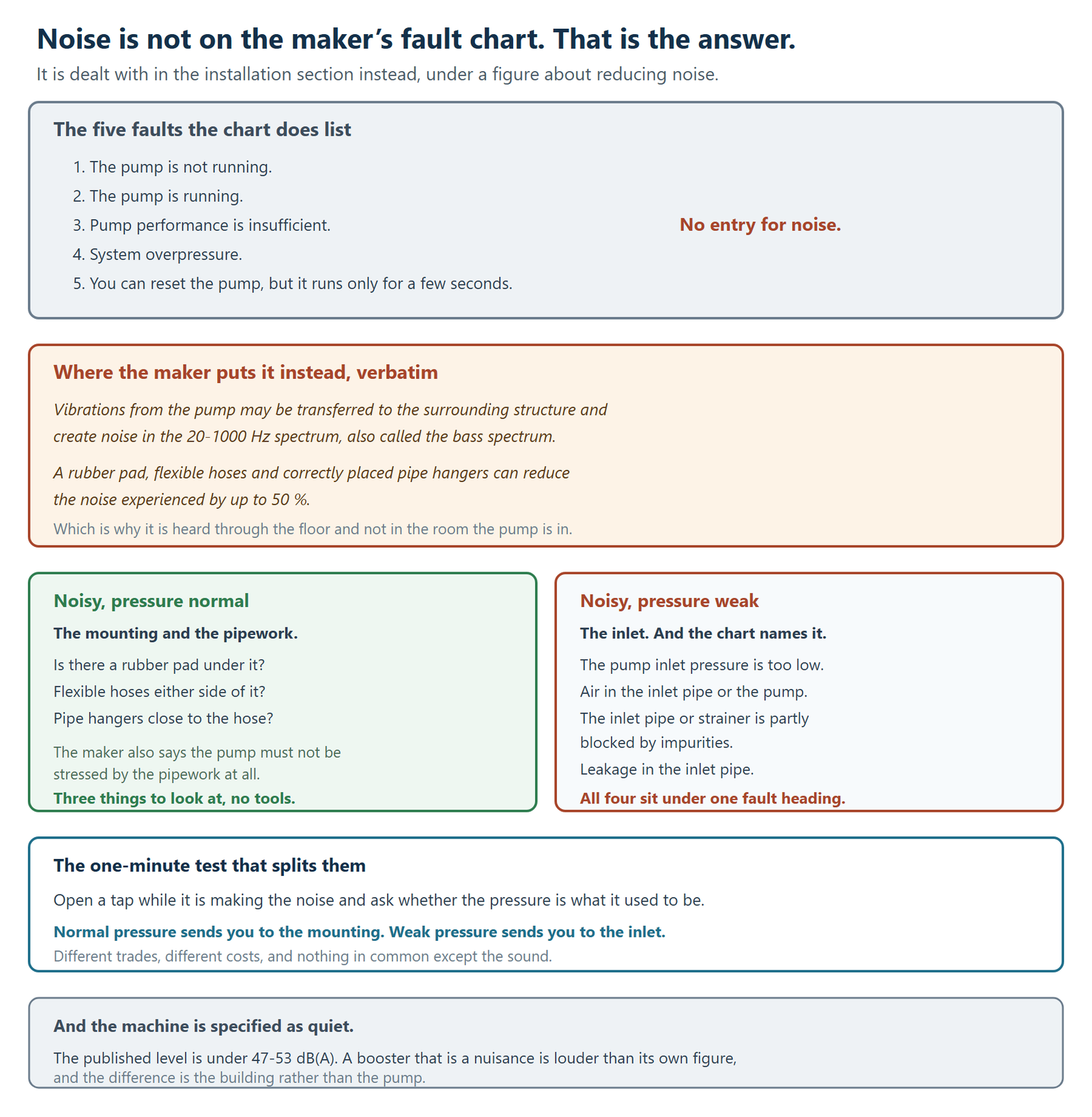
The reason that split is the right one comes from the manufacturer. Its fault-finding chart lists five faults, and noise is not one of them.
It appears somewhere else entirely — in the installation section, under a figure captioned “How to reduce noise in the installation.” The maker does not treat a noisy booster pump as a pump problem at all.
What the fault chart does and does not contain
The five headings, in the manufacturer’s own numbering:
- The pump is not running.
- The pump is running. (when nothing is calling for water)
- Pump performance is insufficient.
- System overpressure.
- You can reset the pump, but it runs only for a few seconds.
That is the complete list. Every cause and every remedy in the document hangs off one of those five.
A pump that runs, makes pressure, and is loud fits none of them — which is not an omission. It is the manufacturer saying the noise is not coming from the machine.
So where it does appear, and what it says
In the installation section, verbatim:
“Vibrations from the pump may be transferred to the surrounding structure and create noise in the 20-1000 Hz spectrum, also called the bass spectrum. Correct installation using a vibration-damping rubber pad, flexible hoses and correctly placed pipe hangers for rigid pipes can reduce the noise experienced by up to 50 %.”
“Place pipe hangers for the rigid pipes close to the connection of the flexible hose.”
Two things in that are worth slowing down for.
The bass spectrum explains the complaint people actually make. Almost nobody says “it is loud in the utility room.” They say they hear it through the floor, that it is worse in the bedroom above than next to the pump, that it is a hum rather than a whine. Low frequencies travel through structure rather than air — so the room the pump is standing in is often the worst place to judge it from.
And “up to 50 %” is a published figure for three specific measures, not a general reassurance. A rubber pad, flexible hoses, and hangers placed close to where the hose meets the rigid pipe.
Which is why the machine’s own noise rating matters
The pump is specified as quiet. Its published level is under 47–53 dB(A), which is a figure that belongs in the decision about where it goes.
So a booster that has become a nuisance is louder than its own published figure, and the extra is not coming from the impeller. It is coming from what the pump is bolted to, and what is bolted to the pump.
One-minute observation: stand next to it, then go and stand in the room where it bothers you. If it is worse away from the pump, the structure is carrying it, and no amount of work on the pump will change that.
Noisy with normal pressure: three things to look at
All three are visible without a tool, and all three are the manufacturer’s.
Is there a vibration-damping rubber pad under it? Not a scrap of carpet, not a paving slab. The maker names a rubber pad as one of the three measures.
Are there flexible hoses on the inlet and outlet? The pump ships with flexible connections to make this possible. A pump plumbed in rigid both sides is coupled straight to the house’s pipework, which is a continuous path for vibration to anywhere the pipe runs.
Are the pipe hangers close to where the flexible hose meets the rigid pipe? That is the maker’s specific instruction, and it is the one most often missed — a hanger far from the connection leaves a span of rigid pipe free to be driven by the pump.
And one more line from the same document:
“Make sure that the pump is not stressed by the pipework.”
Reading the installation section as a whole — the maker also asks for the pump to be fastened to a solid horizontal foundation through its base plate — a pump screwed straight down to a timber floor and connected in rigid pipe has satisfied the foundation instruction and ignored every noise instruction. That is a tidy installation that is also a loudspeaker. That conclusion is this page’s reading of two sections, not a sentence the manufacturer wrote.
Noisy with weak pressure: the chart does cover this one
Here the noise is a symptom of something the manufacturer does list — under fault 3, “Pump performance is insufficient.”
Its named causes, verbatim:
“The pump inlet pressure is too low” — Check the inlet conditions of the pump.
“Air in the inlet pipe or the pump” — Prime the inlet pipe and the pump. Check the inlet conditions of the pump.
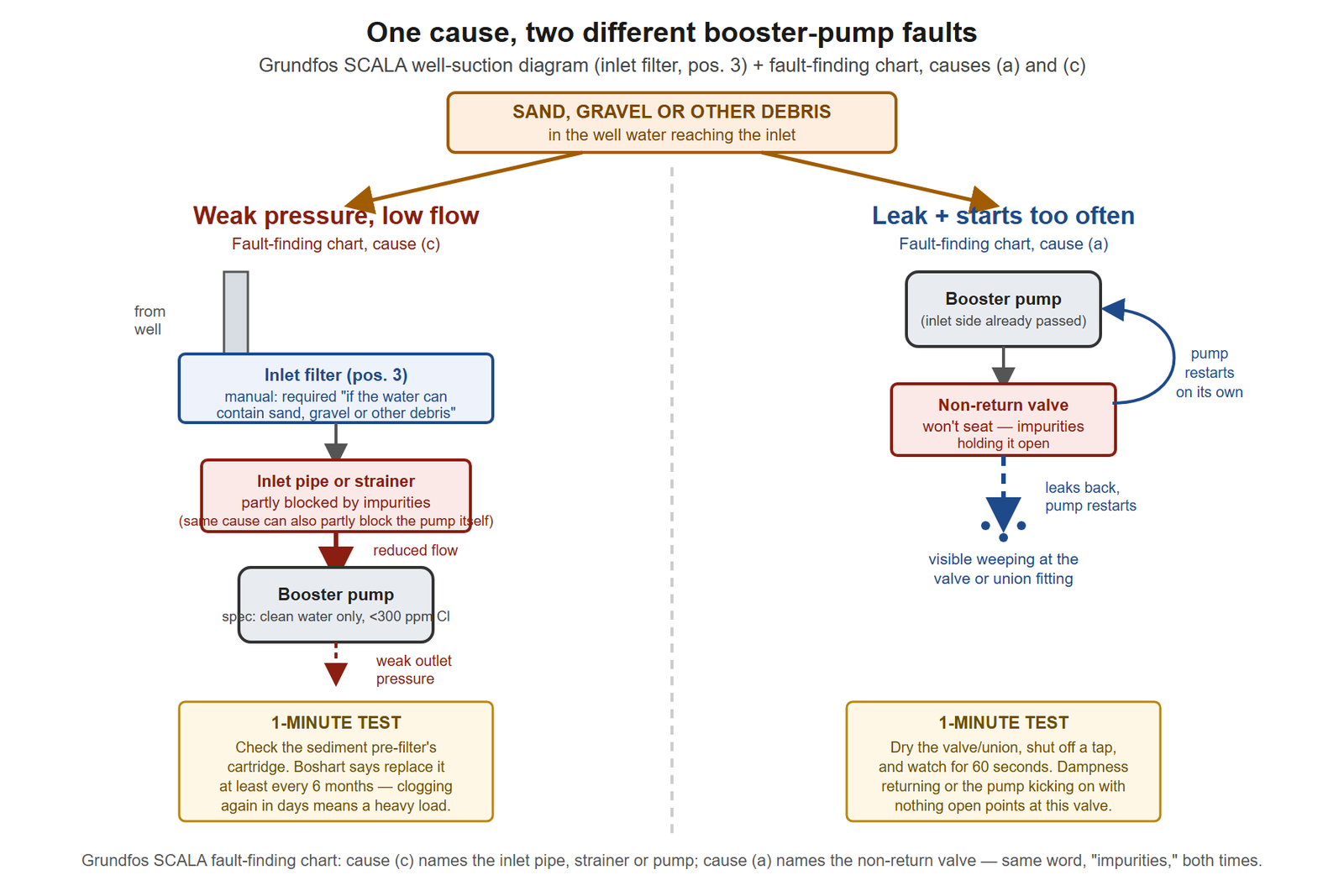
“The inlet pipe, the inlet strainer or the pump is partly blocked by impurities” — Clean the inlet pipe or the pump.
“Leakage in the inlet pipe” — Repair the inlet pipe.
Every one of those is on the suction side, and every one of them makes noise — a pump pulling against a restriction, or working on a mixture of water and air, does not sound like a pump moving water.
And the inlet is where this silo’s other published ceiling lives. There is a cap on how much pressure a booster can add, measured from the inlet, so an inlet problem shows up as noise and as weak delivery at the same time — which is exactly why the tap test separates the two cases.
One-minute observation: does the noise change as the tap runs, or stay constant? A noise that rises and falls while the flow is steady points at the suction side. A constant one, with the pressure fine, points back at the mounting.
What this is not
It is not a maintenance interval you have missed. The manual calls the pump maintenance-free and then lists three jobs, and none of them is about noise.
It is not usually a sign the pump is failing. The machine has current- and temperature-dependent motor protection built in, and a pump in trouble tends to show up on the chart’s five headings rather than only in the ear.
And it is not a reason to replace the pump until the mounting has been looked at. If you do end up replacing it, the published noise figure is one of the specs worth shopping on — but a new pump on the same rigid pipework and the same bare floor will transmit the same bass into the same structure.
When this needs a pro
Fitting any of the three measures. Flexible hoses and pipe hangers are pipework on the potable supply, which is a plumber’s job and, in the case of a booster, a code-inspected one.
Anything on the inlet side. Priming, clearing a strainer, finding a leak on the suction line — all of it is work on live plumbing, and the fault that caused it matters more than the noise.
A noise that arrived suddenly, rather than being there since the day it was fitted. A new noise on an installation that was quiet is a change in the machine or in the supply, and both deserve a look.
What you can do yourself: run the tap test, listen from the room that bothers you as well as next to the pump, and look for the pad, the hoses and the hangers. Four observations, no tools — and they decide whether you are calling a plumber about the pipework or about the water.
FAQ
Why is my booster pump so loud?
Usually because vibration is being carried into the building rather than because the pump is faulty. The maker publishes the noise as being in the 20–1000 Hz bass spectrum and says a rubber pad, flexible hoses and correctly placed pipe hangers can reduce the noise experienced by up to 50 per cent.
Is a noisy booster pump a sign it is failing?
Not on its own. The manufacturer’s fault-finding chart lists five faults and noise is not one of them — it is handled in the installation section instead. Noise that comes with weak pressure is different: that points at the inlet, which the chart does cover.
How loud should a booster pump be?
The published level for this class of pump is under 47–53 dB(A). That is quiet but not silent, and it is the figure to judge against: a pump that has become a nuisance is louder than its own specification, and the difference is the mounting rather than the machine.
Why do I hear the booster pump upstairs but not in the room it is in?
Because low-frequency noise travels through structure rather than air. The maker names the 20–1000 Hz bass spectrum specifically, and vibration coupled into joists and pipework can be louder several rooms away than it is beside the pump.
Can air in the pipes make a booster pump noisy?
Yes, and the manufacturer lists it — “air in the inlet pipe or the pump” sits under the fault heading for insufficient performance, with priming as the remedy. That is the branch to follow if the pressure is weak as well as the pump being loud.
Will a rubber mat under the pump fix the noise?
A vibration-damping pad is one of the three measures the maker names, and the published 50 per cent figure is for all three together — pad, flexible hoses and correctly placed hangers. A pad alone, under a pump still plumbed in rigid pipe both sides, leaves the main path open.