On this page
Last Updated on October 7, 2026 by Muhammad Toqeer
Every tap is shut and the pump is still running. The manufacturer publishes three causes for that, and only the first one is the leak everybody tells you to look for.
The second is an appliance doing exactly what it was designed to do.
And the third has nothing to do with water being drawn at all:
“The temperature is below freezing point.”
A booster pump can run because it is cold. That cause sits in the fault chart with its own remedy printed beside it, and it appears on no page currently ranking for this problem.
The three causes, as published
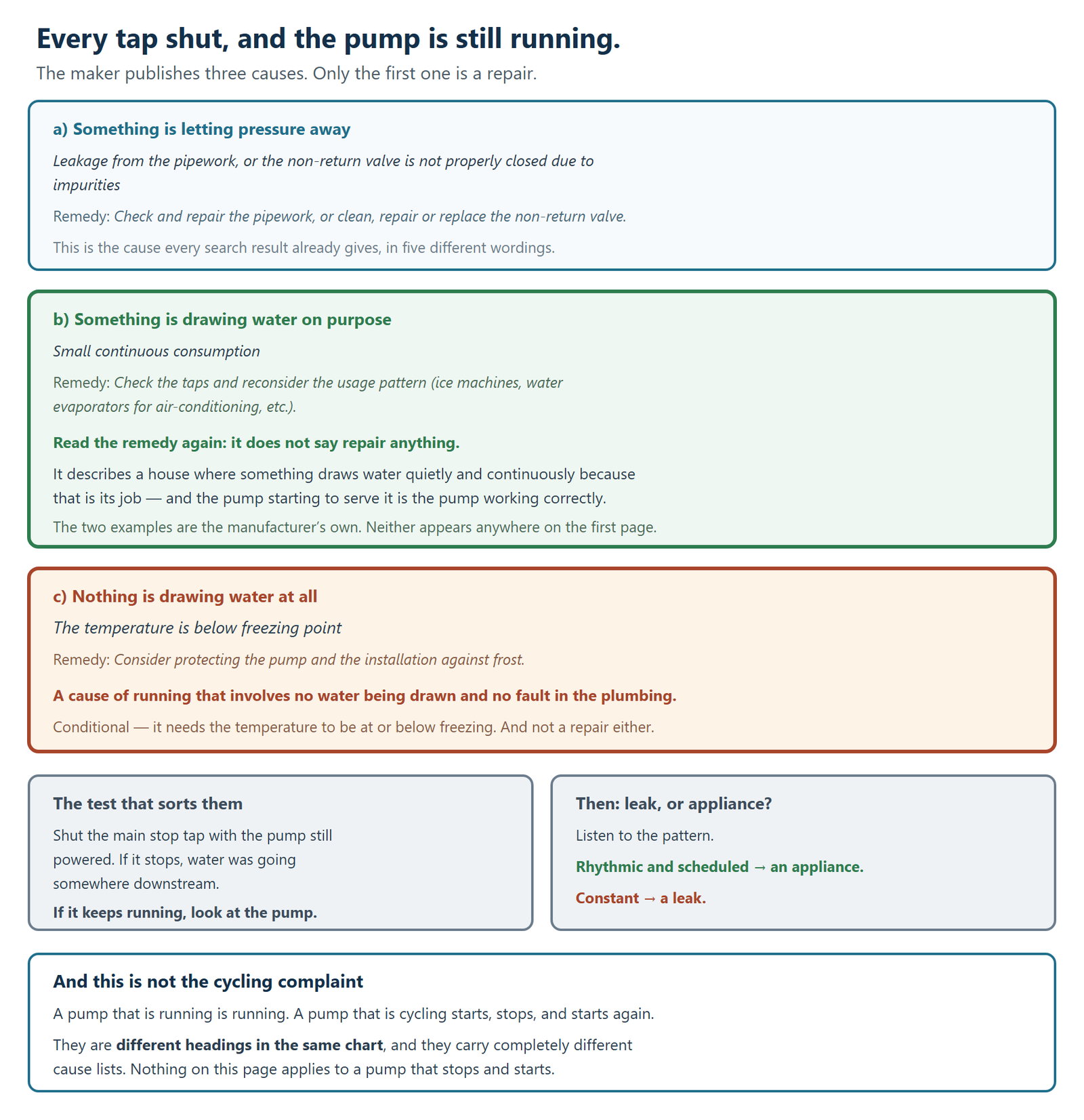
From the Grundfos SCALA fault finding chart, fault 2 — the pump running when nothing is calling for water. All three causes and remedies verbatim:
a) “Leakage from the pipework, or the non-return valve is not properly closed due to impurities” — remedy: “Check and repair the pipework, or clean, repair or replace the non-return valve.”
b) “Small continuous consumption” — remedy: “Check the taps and reconsider the usage pattern (ice machines, water evaporators for air-conditioning, etc.).”
c) “The temperature is below freezing point” — remedy: “Consider protecting the pump and the installation against frost.”
Three causes, three remedies, and one of them is not a repair.
Cause (a): the leak, and why it is still first
Order matters, and this one is first because it is the likeliest.
A booster holds pressure on the house side. If that pressure falls, the pump starts. So anything that lets water out — or lets it back — makes the pump run.
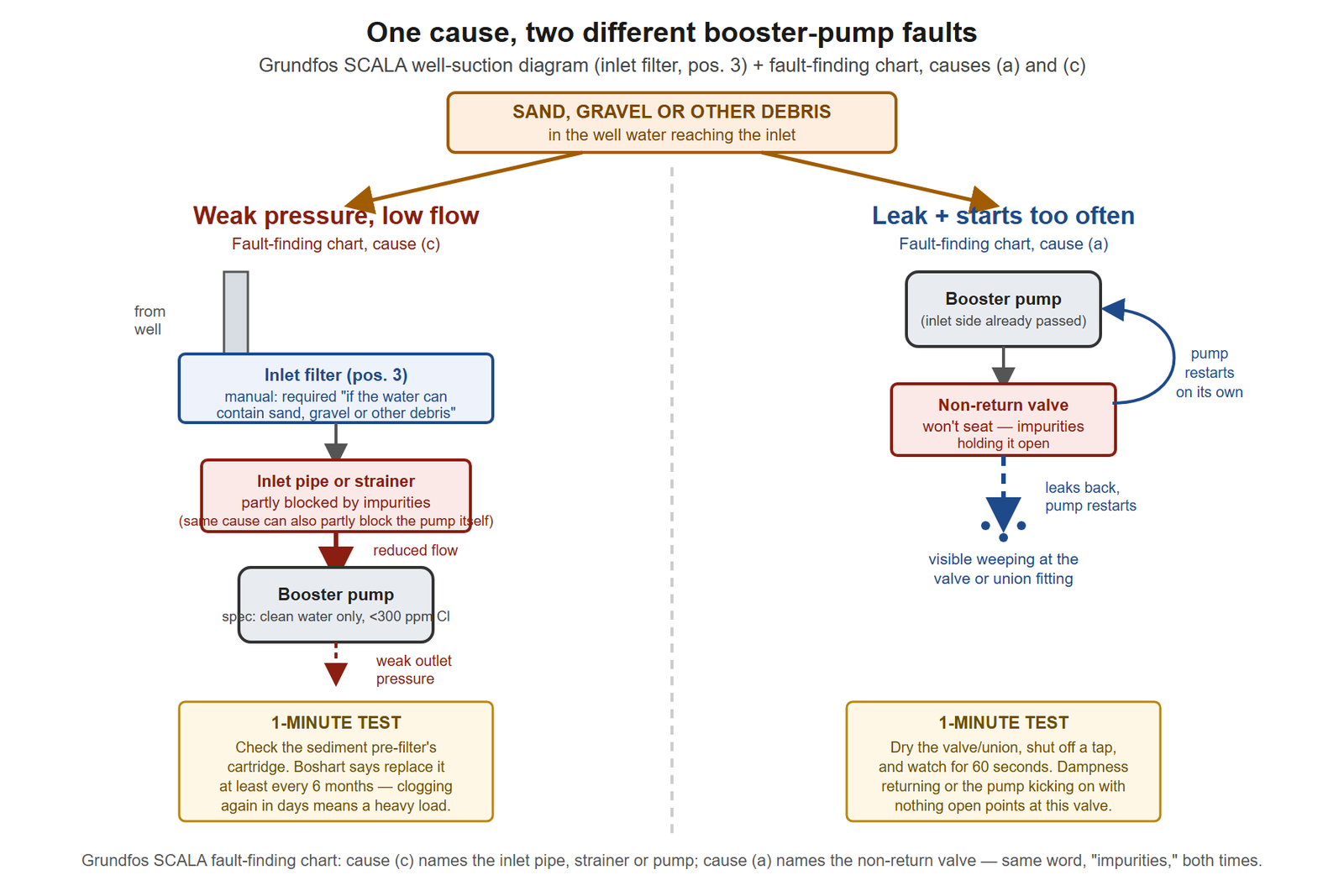
The published cause covers two different things in one sentence. Leakage from the pipework is the obvious one. “The non-return valve is not properly closed due to impurities” is the one people miss: a valve held fractionally open by grit will let pressure bleed away continuously, and nothing is visibly leaking anywhere.
The one-minute test is the oldest one there is, and it still works. Shut the main stop tap to the house with the pump still powered. If the pump stops and stays stopped, water was going somewhere downstream. If it keeps running, the problem is at the pump or on its inlet side.
And a running toilet is the single most common downstream answer — silent, continuous, and the simplest thing on this page to put right.
If you are also seeing water at the pump itself, that is a separate question — the shaft seal is lubricated by the water it pumps and is meant to weep a little, so visible water there is not the same thing as a leak in the pipework.
Cause (b): the one that is not a fault
This is the finding worth the page, and it is easy to read past:
“Small continuous consumption” — “Check the taps and reconsider the usage pattern (ice machines, water evaporators for air-conditioning, etc.).”
Read the remedy again. It does not say repair anything. It says reconsider the usage pattern.
The manufacturer is describing a house where something draws water quietly and continuously because that is its job — and the pump starting to serve it is the pump working correctly.
The two examples given are the manufacturer’s own, and both are worth knowing about:
An ice machine. It fills on its own schedule, in small amounts, at hours nobody is awake for. Nothing in the house is “on” and water is being used.
A water evaporator for air-conditioning. Equipment that consumes water as part of how it rejects heat — again, continuously, and again, invisibly.
Neither appears on any page currently ranking for this problem, which all stop at “check for a dripping tap.”
What this does to your diagnosis: if the stop-tap test above shows water genuinely going somewhere downstream, that does not automatically mean a fault. The next question is whether anything in the house is supposed to be drawing it.
One observation that separates the two, and it costs nothing: note whether the running is rhythmic and scheduled or constant. An appliance filling on a cycle gives you a pattern. A leak gives you a constant.
Cause (c): frost
And the one nobody writes down:
“The temperature is below freezing point” — “Consider protecting the pump and the installation against frost.”
A cause of running that involves no water being drawn and no fault in the plumbing.
It is listed third and it is conditional — it needs the temperature to be at or below freezing — but if your pump has started running at night in winter and stops being odd in spring, this is in the manufacturer’s own list and nothing else on the internet will tell you so.
The remedy is not a repair either. It is protection: insulation, heat, or a position that is not exposed. Where the pump stands is a specification in its own right, and an unheated garage or an outbuilding is where this cause lives.
This is not the same complaint as cycling
Worth separating, because the two get typed into a search box the same way.
A pump that is running is running. A pump that is cycling starts, stops, starts again.
They are different headings in the same chart and they carry completely different cause lists. Cycling on this class of pump has its own two causes — the inlet cutoff doing its job, and the pump hunting around its own start pressure — and neither of them appears under the running fault.
If yours stops and starts rather than simply running, that article is the one you want, and the causes here will not apply.
One part, two opposite failures
A detail worth holding on to if you read more than one page on this site.
The non-return valve inside the pump appears in cause (a) here as a component that fails to close. It also appears in the overpressure fault as a component doing its job properly — holding pressure in, so that heated water expanding downstream has nowhere to go.
Same part. Opposite failure modes. Opposite symptoms. A valve that will not close makes the pump run; a valve that closes perfectly is part of why pressure can build.
When this needs a pro
Anything inside the pump. Cause (a)’s remedy includes “clean, repair or replace the non-return valve”, and on a sealed unit that is not an owner task.
Tracing a leak you cannot find. If the stop-tap test says water is going somewhere and nothing is visibly wet, that is a leak-detection job rather than a plumbing repair.
Frost protection on an installed pump. Insulating or heating a pressurised water installation properly is trade work, and getting it wrong creates a burst rather than preventing one.
And deciding whether the pump is right for the house at all. If an appliance is drawing continuously and the pump is starting for it every time, that is a sizing and selection conversation rather than a fault.
What you can do yourself: shut the stop tap with the pump powered and watch for two minutes, then — if it stops — go round the toilets and listen. Then ask what in the house uses water without anyone touching it. Two tests and one question, and between them they sort all three published causes.
FAQ
Why does my booster pump run when no taps are open?
The manufacturer publishes three causes: leakage from the pipework or a non-return valve held open by grit, small continuous consumption somewhere in the house, or a temperature below freezing point. Each has its own printed remedy.
Can an ice maker make a booster pump run?
The pump manufacturer names ice machines directly, under the cause “small continuous consumption”. The published remedy is to check the taps and reconsider the usage pattern rather than to repair anything — an appliance drawing water by design is not a fault.
Why would a booster pump run when it is freezing?
Because the manufacturer lists temperature below freezing point as one of the three causes, with the remedy “consider protecting the pump and the installation against frost”. It is the only one of the three that involves no water being drawn.
How do I tell a leak from an appliance?
Shut the main stop tap with the pump still powered. If the pump stops, water was going somewhere downstream. Then look at the pattern: an appliance filling on a cycle gives rhythmic running, while a leak gives constant running.
Is a booster pump running constantly damaging it?
Nothing in the fault chart says so, and no such claim is made here. But a pump running when nothing is calling for water is reporting one of three conditions, and two of them are worth resolving regardless.
Is this the same as my booster pump cycling on and off?
No. Running and cycling are separate headings in the same fault chart with completely different cause lists. If yours starts and stops repeatedly rather than running, the causes on this page do not apply to it.