On this page
Last Updated on October 2, 2026 by Muhammad Toqeer
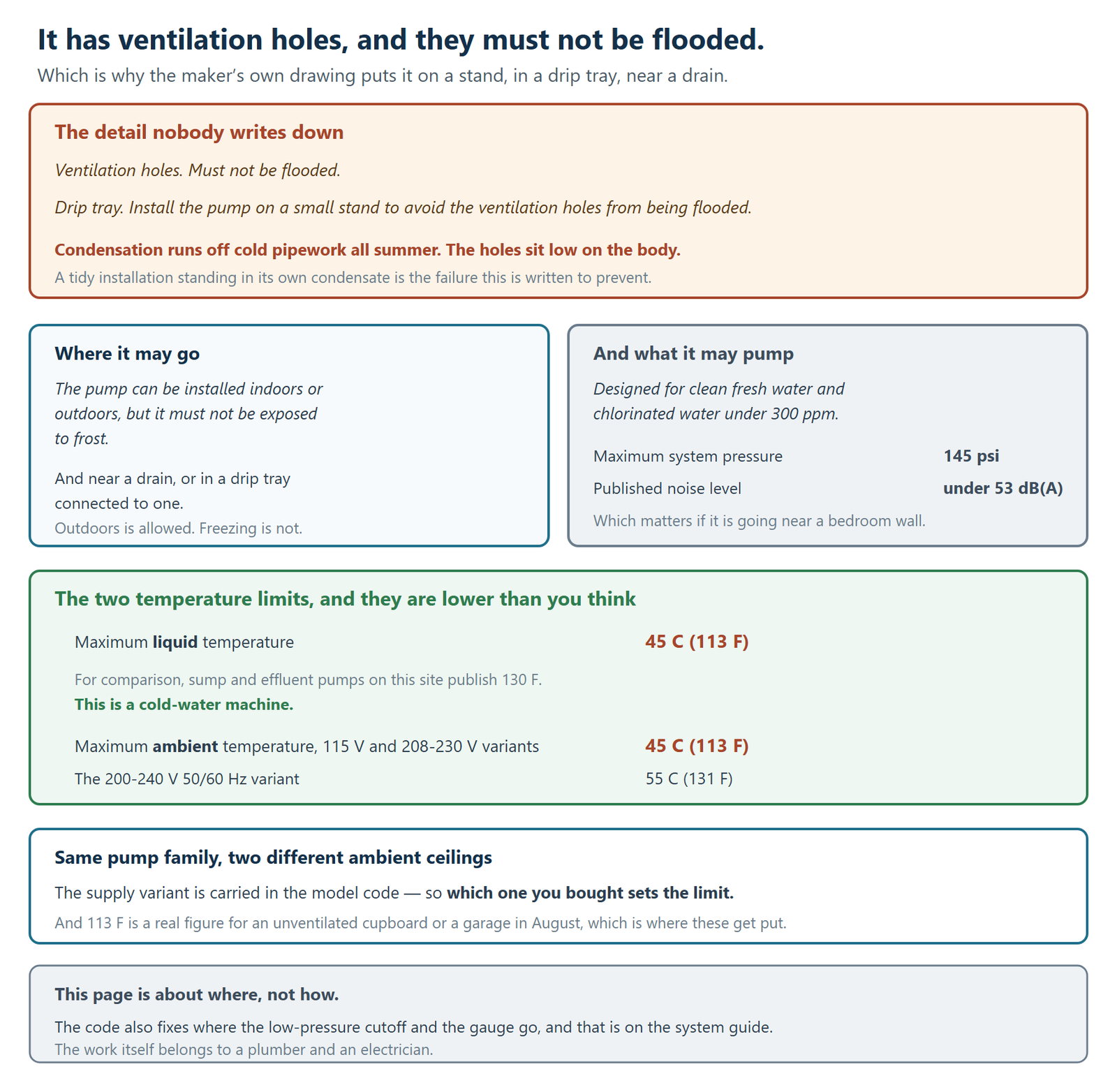
Indoors or outdoors, but never where it can freeze, and never standing in water — including its own. A booster pump has ventilation holes low on its body, and the manufacturer’s own installation drawing puts the pump on a small stand, inside a drip tray, near a drain.
That is the detail nobody writes down. The drawing labels the holes and says, in four words, “Must not be flooded.”
Everything else about siting follows from two numbers that are lower than people expect, and from one that changes depending on which version of the pump was bought.
The holes are the constraint
The manufacturer’s installation text, verbatim:
“The pump can be installed indoors or outdoors, but it must not be exposed to frost. We recommend that you install the pump near a drain or in a drip tray connected to a drain in order to lead away possible condensation from cold surfaces.”
And on the drawing itself, two labelled parts:
“Ventilation holes. Must not be flooded.”
“Drip tray. Install the pump on a small stand to avoid the ventilation holes from being flooded.”
Read those together and the reasoning is complete. Cold pipework sweats through a humid summer. The condensate runs down and pools under the pump. The ventilation holes sit low on the body. A stand raises them above the pool, and the tray takes the water to a drain.
One-minute check on an existing installation: crouch down and look at where the pump meets the floor. If there is a tidemark, a rust ring, or damp concrete under it, the position is already wrong — and nothing about the pump will tell you so until it fails.
Outdoors is allowed. Freezing is not.
This surprises people, because a booster is usually thought of as an indoor machine.
The maker allows outdoor installation outright. The constraint is frost, not weather — and frost is a constraint on the water inside the pump, not on the housing.
So an unheated garage or a crawl space is a question about winter minimums, not about whether the location is “indoor” enough. The winterizing question has its own answer, and it starts from the same place: water left in a pump that drops below freezing.
Two temperature limits, both lower than you think
The maximum liquid temperature is 45 °C (113 °F).
That is well below what this site records elsewhere. Sump and effluent pumps publish 130 °F routinely. A booster is a cold-water machine, and the limit is worth checking against anything that could send warm water back through it — a recirculation loop, a solar preheat, a crossover at a mixing valve.
And the pumped liquid is specified too:
“The pump is designed for clean fresh water and chlorinated water < 300 ppm.”
The ambient limit is the one that catches people, because it depends on which pump you bought.
| Supply variant | Maximum ambient |
|---|---|
| 1 × 115 V, 60 Hz | 45 °C (113 °F) |
| 1 × 208-230 V, 60 Hz | 45 °C (113 °F) |
| 1 × 200-240 V, 50/60 Hz | 55 °C (131 °F) |
Same pump family, two different ceilings. The supply variant is carried in the model code — which is the same code that decides what a pump will and will not do on your supply — so the version on the box sets the limit.
One-minute check: 113 °F is not a theoretical number. An unventilated cupboard, a sealed closet above a water heater, or a garage in August all reach it, and a pump running at its ambient ceiling is a pump with no margin left for a hot day.
The two siting figures nobody quotes
Maximum system pressure: 10 bar (145 psi). That is a property of the position as much as the pump — it is the pressure the pump plus the incoming supply can produce at that point in the system. The maker adds that a pressure-relief valve belongs on the outlet side if the installation cannot stand up to 6 bar (87 psi).
Published noise level: under 47–53 dB(A). This is a siting figure, and it is the reason a pump that is electrically and hydraulically perfect can still be in the wrong place. A shared wall with a bedroom, a hallway cupboard, a thin ceiling under a bed — the pump is quiet, but it is not silent, and it runs when someone opens a tap at night.
Pro note: the published figure is a range because the pump varies its speed. A pump sitting near the top of its curve for most of its running life is at the loud end of that range, which is a sizing question presenting itself as a siting one.
Where the code puts things, and where it does not
The code has opinions about position, but about two specific components rather than the pump’s location.
The low-pressure cutoff must sit within five feet of the pump inlet, and a pressure gauge is required between the shutoff valve and the pump. Those requirements, the municipal variations on them, and the public-health reason behind them are on the system guide — and they constrain the pipework around the pump, not where the pump itself may stand.
So the two sets of constraints do not conflict. The manufacturer tells you about frost, flooding, ambient heat and noise. The code tells you what has to be within five feet of the inlet once you have chosen.
One practical consequence: a position so tight that the cutoff and gauge cannot physically be fitted and read is not a position, however well it suits the pump.
Choosing the position before you choose the pump
It is the right order, because the ambient ceiling and the noise figure are both properties of the machine, and both are published.
If the only available position is a hot, sealed cupboard, the voltage variant matters before anything else about the pump does. If it is a shared wall with a bedroom, the noise figure is a selection criterion, not an afterthought. The buying guide compares the models that are still in production, with the specs that are actually published — and those two figures are in it.
When this needs a pro
The work itself, all of it.
The pipework. A booster sits on the potable supply, which means a cross-connection risk and a code inspection, not a plumbing project.
The electrical connection. Fixed wiring on a motor load, often in a damp location.
Deciding whether a position is legal. The cutoff and gauge requirements are enforced locally and amended locally, and the amendments are not minor.
What you can do yourself: measure the ambient temperature of the position you have in mind on the hottest week of the year, look for standing water or a tidemark on the floor, and note what is on the other side of the wall. Three observations, no tools — and they rule out more positions than any amount of pump specification does.
FAQ
Can a booster pump be installed outside?
Yes. The manufacturer allows indoor or outdoor installation outright, with one condition: it must not be exposed to frost. The constraint is on the water inside the pump freezing, so an unheated garage is the same question as an outdoor wall.
Does a booster pump need a drip tray?
The maker recommends one, connected to a drain, to lead away condensation from cold surfaces. It also says to raise the pump on a small stand inside the tray, because the pump has ventilation holes low on its body that must not be flooded.
How hot can the room be where a booster pump is installed?
It depends on the supply variant. The 115 V and 208-230 V versions are rated to a maximum ambient of 45 °C (113 °F); the 200-240 V 50/60 Hz version is rated to 55 °C (131 °F). The variant is carried in the model code.
What water temperature can a booster pump handle?
A maximum of 45 °C (113 °F), which is far lower than most people assume — sump and effluent pumps commonly publish 130 °F. A booster is a cold-water machine, and it is specified for clean fresh water or chlorinated water below 300 ppm.
Is a booster pump loud enough to matter where it is installed?
The published level is under 47–53 dB(A), which is quiet but not silent. It matters on a shared bedroom wall or in a hallway cupboard, because the pump runs whenever a tap is opened, including at night.
How close to the pump does the low-pressure cutoff have to be?
The model code puts it no more than five feet from the pump inlet, with a pressure gauge between the shutoff valve and the pump. Municipalities commonly amend the pressure threshold, so the local version is the one that counts.