On this page
Last Updated on October 7, 2026 by Muhammad Toqeer
A booster pump is fitted because there is not enough pressure. So a fault that stops it for having too much reads like a contradiction.
It is one of only five faults in the manufacturer’s chart, and it has a name: System overpressure.
Three causes are published under it. Two are about the pump’s own settings and supply. The third is not about the pump at all:
“The maximum pressure has been exceeded — equipment elsewhere in the system causes a high pressure at the pump (e.g. water heater or defective safety equipment).”
The pump is the component that stops, and the cause is somewhere else in the house. That is the hard part of this fault, and it is why it gets chased around the pump for weeks.
And one more thing, which is the reason you may be reading this after the event: all three causes are marked for automatic reset.
The three published causes
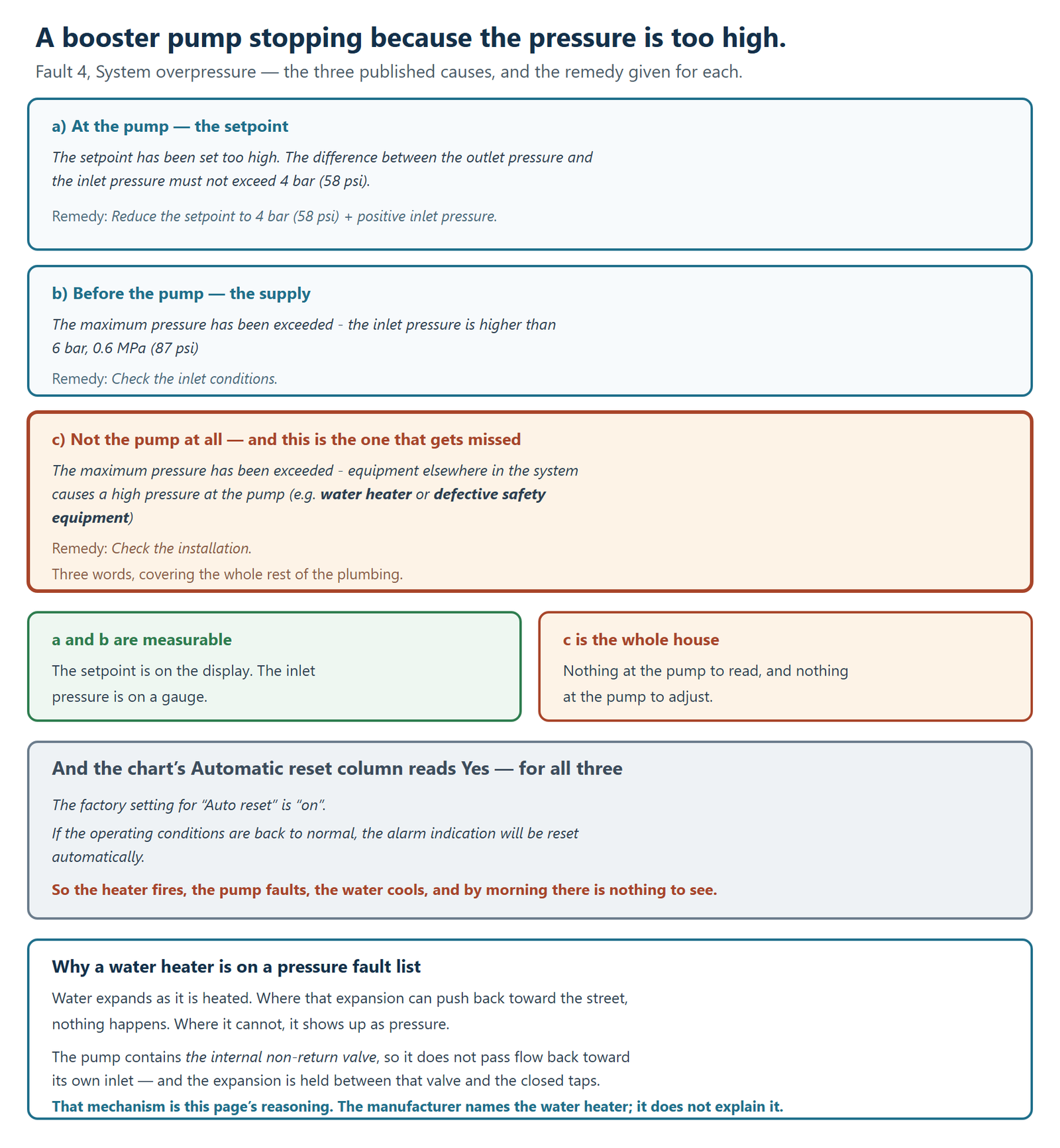
From the Grundfos SCALA fault finding chart, fault 4, System overpressure — all three causes and remedies verbatim:
a) “The setpoint has been set too high. The difference between the outlet pressure and the inlet pressure must not exceed 4 bar (58 psi). Example: If the required outlet pressure is 5 bar (73 psi), the minimum inlet pressure must be 1 bar (14.5 psi).” The remedy: “Reduce the setpoint to 4 bar (58 psi) + positive inlet pressure.”
b) “The maximum pressure has been exceeded – the inlet pressure is higher than 6 bar, 0.6 MPa (87 psi).” The remedy: “Check the inlet conditions.”
c) “The maximum pressure has been exceeded – equipment elsewhere in the system causes a high pressure at the pump (e.g. water heater or defective safety equipment).” The remedy: “Check the installation.”
Two of the three are at the pump. The setpoint is on the pump’s own display, and the inlet pressure is measurable on a gauge upstream of it.
The third is the whole rest of the plumbing, and its remedy — “Check the installation” — is three words covering an afternoon’s work.
Cause (a) is arithmetic, and it is the first thing to rule out
The setpoint cause is the only one of the three you can settle in a minute, because the manufacturer gives you the sum.
Outlet minus inlet must not exceed 4 bar, which is 58 psi. Measure your inlet pressure, add 58, and compare that to the setpoint on the display.
If the setpoint is higher than that figure, the published remedy is to lower it — “Reduce the setpoint to 4 bar (58 psi) + positive inlet pressure.”
This is the same 58 psi limit that appears when a booster disappoints in the other direction, and the two readings of it are worth keeping straight. In the no-increase case the 58 psi is a ceiling on how much pressure the pump can add; here it is the point past which asking for more is a fault condition rather than a disappointment. One published limit, two symptoms.
Cause (b) means the problem arrived before the pump
A booster has a maximum inlet pressure, and exceeding it is listed as overpressure: “the inlet pressure is higher than 6 bar, 0.6 MPa (87 psi).”
Which is a strange situation to be in, since a pump of this kind is fitted to houses whose incoming pressure is too low. 87 psi at the inlet of a booster pump is roughly double a comfortable domestic supply.
So cause (b) usually points at something that changed, not at a long-standing condition: a municipal supply alteration, a pressure-reducing valve that has failed open, or a pump fitted where it was never needed.
The maximum pressures that apply at the pump’s position are set out in the placement article, including the relief valve the maker puts on the outlet side.
And one inconsistency in the manufacturer’s own document is worth knowing about, because it will confuse you if you read the installation drawings after the fault chart. The spec table and the fault chart both put the maximum inlet pressure at 6 bar (87 psi). The installation example then labels an item “Optional pressure-reducing valve on the inlet side if the inlet pressure can exceed 10 bar (145 psi).” Those two thresholds do not agree. 145 psi is the maximum system pressure elsewhere in the same document. This page reports both as published and does not reconcile them — if your inlet is anywhere near either figure, that is a question for the maker rather than for a web page.
Cause (c) is the one worth the page
Read it once more:
“equipment elsewhere in the system causes a high pressure at the pump (e.g. water heater or defective safety equipment)”
A water heater, named by the pump manufacturer, on a list of pressure faults.
Here is why that belongs there — and this part is this page’s reasoning, not a manufacturer’s statement. Water expands as it is heated. In plumbing that can push back toward the street, that expansion goes somewhere and nothing happens. In plumbing that cannot, the expansion has nowhere to go, and it shows up as pressure.
The pump itself is part of why. The fault chart elsewhere refers to “the internal non-return valve” as a component of the pump — so the pump does not allow flow back toward its own inlet. Heat the water downstream of it with every tap closed, and the expansion is held between that valve and the fixtures.
The pressure rises on the outlet side of the pump, and the pump reports overpressure. It has done nothing wrong, and there is nothing at the pump to adjust.
**The second half of the quotation matters just as much: “defective safety equipment”.** Safety and pressure-control devices exist on domestic systems precisely to absorb or relieve this, and the manufacturer’s phrasing covers the case where one of them is no longer doing its job.
And it can clear itself before you get there
**The fault chart has an Automatic reset column. For all three overpressure causes it reads Yes.**
And the function is on by default: “The factory setting for ‘Auto reset’ is ‘on’.” With it on, “this function allows the pump to automatically check if the operating conditions are back to normal. If the operating conditions are back to normal, the alarm indication will be reset automatically.”
Put the water-heater cause together with that column and you get the pattern that wastes the most time.
The heater fires. Pressure rises. The pump faults. The water cools, or somebody runs a tap, and the pressure falls. The pump clears its own alarm.
By morning there is nothing to see. The pump works, the display is normal, and the only evidence was a stoppage nobody witnessed.
Which is why an intermittent, unexplained booster stoppage in a house with a water heater deserves this cause considered early rather than after everything at the pump has been replaced.
One useful observation, and it costs nothing: note whether the stoppages correlate with hot water being heated rather than with water being drawn. That single pattern separates cause (c) from everything else on the list.
What this is not
It is not cycling. A booster that starts and stops repeatedly has its own three causes, and overpressure is a stoppage on a fault rather than normal switching.
It is not a fault with the pump’s ability to make pressure. That is a separate heading in the same chart — performance insufficient — and it is the opposite complaint.
And it is not solved by a different pump. Choosing a booster is a sizing exercise done before installation; a system overpressure fault is telling you about the system the pump is in.
When this needs a pro
Cause (c), effectively all of it. The remedy is “Check the installation”, and that means establishing how the house handles the expansion of heated water and whether the devices meant to manage pressure are working. That is a plumber’s assessment of the whole system, not a pump repair.
Anything to do with a failed pressure-control or safety device. These are pressure-bearing components on a potable system, and a defective one is the stated cause rather than an incidental finding.
Verifying an inlet pressure near the maximum. Cause (b) at 87 psi is a supply question, and it may involve the water utility as much as the house.
And any work on the water heater. The pump is the component reporting the fault, not the component at fault, and a heater on a system that cannot absorb expansion is a safety matter in its own right.
What you can do yourself: read the setpoint off the display, read the inlet pressure off a gauge, do the 58 psi sum, and keep a note of when the stoppages happen relative to hot water use. Three readings and a diary — and they tell a plumber in one sentence which of the three causes you are looking at.
FAQ
Why would a booster pump stop because the pressure is too high?
Because the manufacturer lists system overpressure as one of five faults. The pump protects itself when the pressure it sees exceeds its limits, and that can happen even though the pump was fitted to raise pressure in the first place.
What causes a system overpressure fault on a booster pump?
Three published causes: the setpoint has been set too high, the inlet pressure is higher than 6 bar or 87 psi, or equipment elsewhere in the system is causing a high pressure at the pump — the manufacturer names a water heater or defective safety equipment as examples.
Can a water heater cause a booster pump fault?
The pump manufacturer names a water heater as an example under this fault. Water expands as it is heated, and where that expansion cannot go anywhere it appears as pressure — the pump contains an internal non-return valve, so expansion downstream of it is held rather than pushed back.
Why does the fault disappear on its own?
The fault chart marks all three overpressure causes for automatic reset, and auto reset is on from the factory. Once operating conditions return to normal the alarm indication clears by itself, so a stoppage overnight can leave no trace by morning.
How do I check whether the setpoint is too high?
Measure the inlet pressure and add 58 psi. The manufacturer limits outlet minus inlet to 4 bar, so that total is the most the outlet can be asked for. If the setpoint on the display is above it, the published remedy is to reduce the setpoint.
Does an overpressure fault mean the pump is damaged?
Nothing in the chart says so — it is listed as a fault condition with a cause and a remedy, and all three causes are marked for automatic reset. But a pump repeatedly stopping on overpressure is reporting a condition in the system that has not been dealt with.