On this page
Last Updated on September 29, 2026 by Muhammad Toqeer
Work out the gap first: what your static pressure is, and what you want it to be. That difference is the only number that selects a booster pump, and it is smaller than most people assume. Then check the pump is still made — two of the models these round-ups recommend most often are discontinued, and both are still on sale everywhere.
Every figure below is from the manufacturer’s own published data.
Start with the gap, not the biggest number
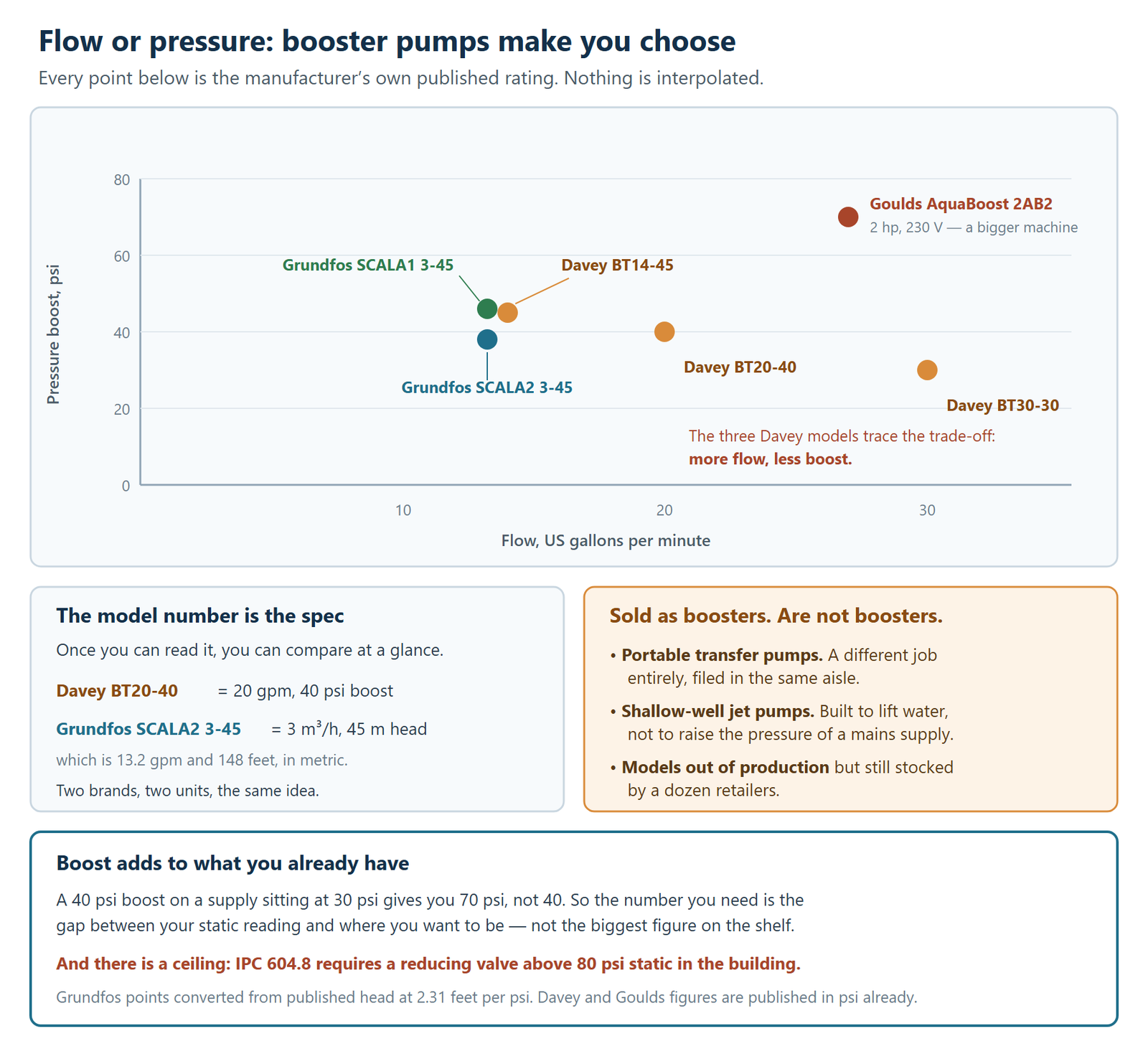
A booster adds to what you already have. Forty psi of boost on a supply sitting at 30 psi gives you 70 psi — not 40.
So take the static reading first, decide where you want to land, and buy for the difference. Aiming at 50 to 60 psi from a 30 psi supply needs 20 to 30 psi of boost, which is the small end of everything on this page.
And there is a legal ceiling. IPC 604.8 requires a pressure-reducing valve where building pressure exceeds 80 psi static, so the answer is never “the biggest one”.
Two numbers, and they trade against each other
Look at Davey’s own range and the trade-off is written into the model numbers: BT14-45 gives 14 gpm at 45 psi. BT30-30 gives 30 gpm at 30 psi. Same family, more flow, less pressure.
That is the shape of this entire category. A pump that holds high pressure across many open taps at once is a bigger, heavier machine than one that holds it across two.
Read the model number
Once you can decode it, you can compare anything, including pumps not on this page.
- Davey BT20-40 — 20 gpm, 40 psi of boost. Stated in US units.
- Grundfos SCALA2 3-45 — 3 m³/h and 45 m of head. Which is 13.2 gpm and 148 feet.
Two brands, two unit systems, the same convention. Neither company hides the specification; it is the name of the product.
Check it is still made — this is not a formality
This is where most round-ups on this subject fall over.
The Grundfos MQ3-45 is discontinued. Grundfos succeeded it with the SCALA1 3-45. It remains listed at PexUniverse, Ferguson, SupplyHouse and FreshWaterSystems.
The Burcam 506532SS is discontinued. It is still stocked by at least nine retailers.
Neither fact appears on any page currently ranking for this search. A pump being purchasable tells you nothing about whether the maker still builds it, supports it, or stocks seals for it — which is the whole question when the thing is plumbed into your water main.
And three things sold as boosters that are not
- Portable transfer pumps. Cast iron, hose fittings, a carry handle, a short cord. A genuinely useful tool for a different job, filed in the same aisle.
- Shallow-well jet pumps. Built to lift water from below. A mains supply is already pressurised; that is a different problem.
- Anything out of production, as above.
The six
Grundfos SCALA2 3-45 — the integrated default
Grundfos SCALA2 3-45, 115 V — also sold as a 230 V version. Flow 0 to 22 gpm, rated 13.2 gpm; head 0 to 147.6 ft, rated head 88.6 ft; factory-set outlet 3 bar, which is 44 psi, adjustable; 1-inch NPT both ports; 47 dBA.
Who it is for: almost anyone on municipal supply who wants one box on the wall. Pump, motor, tank, sensor, drive and non-return valve are all inside it — there is no separate tank to pre-charge and no external switch to set.
The honest drawback: it is a sealed electronic unit in a damp basement. When the control fails you are not swapping a pressure switch for a new one, and there is no mechanical fallback. The integration that makes it simple to fit also removes the parts you could otherwise swap.
Grundfos SCALA1 3-45 — more rated head, fewer electronics
Grundfos SCALA1 3-45 — flow 0 to 22 gpm, rated 13.2 gpm; head 0 to 144 ft, rated head 105.6 ft; rated power 0.791 hp; system pressure 115 psi; maximum inlet pressure 43 psi; start pressure 31.9 psi.
Who it is for: the same house as the SCALA2, where constant-pressure control across simultaneous taps is not the priority. This is the model Grundfos put in the MQ3’s place, so it is the direct replacement if you are changing one out.
The honest drawback: the maximum inlet pressure is 43 psi. That is the lowest inlet limit on this page and it rules the pump out on a supply that is only sometimes low — if your street runs to 50 psi overnight and sags in the afternoon, check this number before anything else.
Worth knowing: its rated head is higher than the SCALA2’s while its maximum is slightly lower. The 1 and the 2 are not a simple ranking.
Davey BT14-45 — the most pressure per gallon here
Davey BT14-45 with Torrium2 — 14 gpm, 45 psi. 36-month warranty.
Who it is for: a small house or apartment with genuinely poor street pressure, where you need a lot of lift but not many taps at once.
The honest drawback: 14 gpm is not much. Two showers and a dishwasher will find the ceiling. This is a pressure pump, not a volume pump.
Davey BT20-40 — the middle, and probably the right one
Davey BT20-40 with Torrium2 — 20 gpm, 40 psi. 36-month warranty.
Who it is for: the standard family house. Twenty gallons a minute covers normal simultaneous use and 40 psi of boost lifts most weak supplies into a comfortable range.
Davey on the controller: “Due to large water pathways, the intelligent Torrium2 controller operates with lower head loss than comparable controllers, providing superior hydraulic performance with less wasted energy.”
The honest drawback: Davey does not publish horsepower on the series page, so you cannot compare its motor against the Grundfos units directly, and it is a dealer-network product rather than something you add to a cart.
Davey BT30-30 — volume over pressure
Davey BT30-30 with Torrium2 — 30 gpm, 30 psi. 36-month warranty.
Who it is for: a larger house, or one where the complaint is that pressure collapses when several fixtures run rather than that it is low all the time.
The honest drawback: only 30 psi of boost. On a supply at 25 psi that lands you around 55 — fine, but there is no margin left if the street gets worse.
Goulds AquaBoost 2AB2HSC20B — when the others are not enough
Goulds AquaBoost 2AB2HSC20B — 2 hp, 230 V, single-phase in and three-phase out, 6.9 A maximum output current. 27 gpm at 70 psi of boost. Field adjustable 20 to 80 psi total system pressure. Supplied as a kit: pump, controller, 2-gallon tank, transducer, gauge and relief valve.
Who it is for: a large house, a long run, irrigation, or a filtration system eating pressure. It is the only unit here that delivers high flow and high boost at the same time.
The honest drawback: it is a different class of installation. 230 V, a separate controller and tank to mount, and a physical footprint the integrated units do not have. Its adjustment range tops out at exactly the 80 psi the code caps you at, which is a useful reminder that the top of the dial is not a target.
Side by side
| Pump | Flow | Boost | Supply | Warranty | Notes |
|---|---|---|---|---|---|
| Grundfos SCALA2 3-45 | 13.2 gpm rated | 88.6 ft rated head | 115 or 230 V | — | All-in-one, 47 dBA |
| Grundfos SCALA1 3-45 | 13.2 gpm rated | 105.6 ft rated head | 115 or 230 V | — | Max inlet 43 psi |
| Davey BT14-45 | 14 gpm | 45 psi | — | 36 months | Torrium2 |
| Davey BT20-40 | 20 gpm | 40 psi | — | 36 months | Torrium2 |
| Davey BT30-30 | 30 gpm | 30 psi | — | 36 months | Torrium2 |
| Goulds AquaBoost 2AB2 | 27 gpm | 70 psi | 230 V | — | 2 hp, kit with tank |
A dash means the manufacturer does not publish that figure on its own product data. Nothing here is borrowed from a reseller. Grundfos publishes head in feet and Davey publishes boost in psi; at 2.31 feet per psi, the SCALA2’s 88.6 ft rated head is about 38 psi.
Before you buy anything
Take the two gauge readings. Static, and under flow. If a healthy static reading collapses when one tap opens, the problem is a restriction and none of these pumps will fix it.
Call the water utility. A booster on municipal supply needs a low-pressure cutoff, and some cities require a break tank instead of a direct connection. That is all covered here, and it determines what you are allowed to fit.
If you are on a well, none of this applies. Low pressure on a well is a different diagnosis with a different cause list.
When this needs a pro
The connection itself. It is a cross-connection to the public supply, and it is permit and inspection work in most jurisdictions.
Anything 230 V, which covers the Goulds and the 230 V Grundfos units.
Sizing for a house with a filtration system or irrigation, where the pressure the equipment consumes has to be added to the gap you are trying to close.
FAQ
What size booster pump do I need for my house?
Buy for the gap. Take a static pressure reading, decide what you want, and size the boost to the difference — most homes need 20 to 30 psi, not the largest figure on the shelf. Then check the flow rating covers how many fixtures run at once.
Is the Grundfos SCALA1 or SCALA2 better?
Neither is simply better. The SCALA2 has a higher maximum head and constant-pressure control across simultaneous taps; the SCALA1 has a higher rated head but a maximum inlet pressure of 43 psi, which can rule it out on a supply that is only sometimes low.
Is the Grundfos MQ3-45 still made?
No. It has been discontinued and succeeded by the SCALA1 3-45, though it is still listed by several major retailers. That is worth knowing before you buy one.
Can I use a shallow well jet pump as a booster pump?
It is the wrong machine. A jet pump is built to lift water from below; a mains supply is already pressurised, which is a different problem. Retailers often file both under the same heading.
How much pressure can a booster pump add?
The models here range from 30 psi to 70 psi of boost. What matters is that boost adds to your existing pressure, and IPC 604.8 requires a pressure-reducing valve where the building exceeds 80 psi static.
Do booster pumps increase flow as well as pressure?
Only up to what the supply pipe delivers. If the service line is the restriction, a bigger pump does not widen it — and starving the pump’s inlet is exactly what the code-required cutoff switch exists to prevent.