On this page
Last Updated on October 13, 2026 by Muhammad Toqeer
If your basement bathroom sits below the sewer line, something has to lift its waste up to meet it. That is what a sewage ejector does — and it is not the same machine as the grinder pump or the sump pump that also end up in basements.
The three are not interchangeable, and the one you own decides what can go down the toilet, what a noise means and what a repair costs. You cannot see into a sealed pit to find out. You can look at the discharge pipe.
Which of the three do you have?
Measure the pipe leaving the pit.
| Discharge pipe | What you have |
|---|---|
| 2 inches | Sewage ejector |
| 1¼ inches | Grinder |
That is the whole test, and it works from across the room.
The ejector
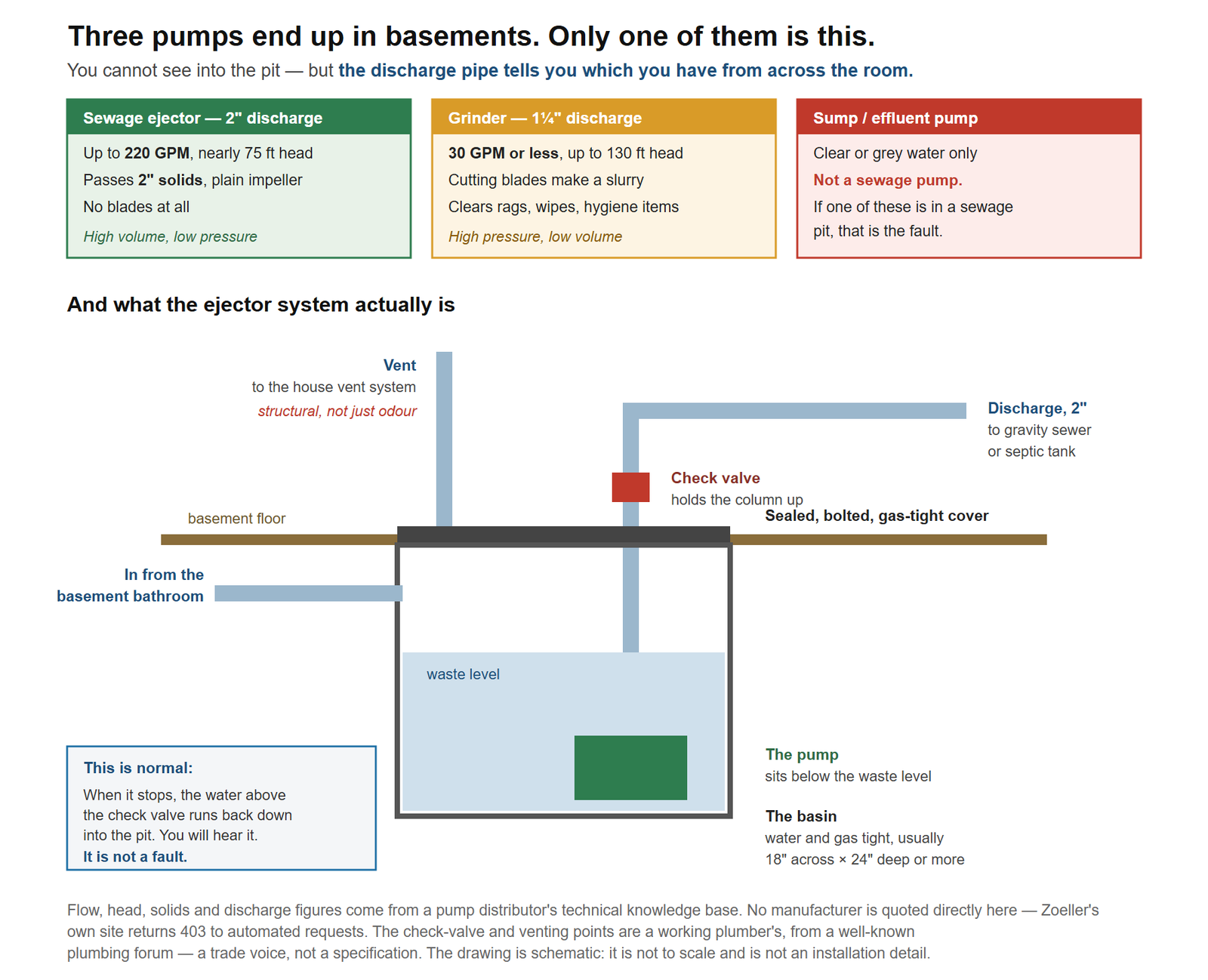
A high volume, low pressure pump. It moves up to 220 GPM against nearly 75 feet of head, and it has no blades at all — just an impeller big enough to pass a 2-inch solid whole.
It is built for short runs, under about 750 feet, into a gravity sewer or a septic tank. That is almost every basement bathroom.
The grinder
The near-opposite: high pressure, low volume. 30 GPM or less, but up to 130 feet of head and distances measured in thousands of feet, because it is designed to push into a pressurised main rather than fall into a gravity one.
It gets there by cutting. Blades reduce everything to a slurry before it enters that narrow 1¼-inch pipe.
And that is the difference a household actually feels. Both will pass a 2-inch solid. Only the grinder deals with the things that are not solids in any useful sense — rags, towels, wipes, hygiene products. On an ejector, those are what the impeller jams on.
The sump pump, which should not be there
A sump or effluent pump moves clear or grey water. It is not a sewage pump and never was.
If you find one sitting in a sewage pit, you have not identified your system — you have found the fault.
What makes an ejector different from every other pump in the house
The pump is the ordinary part. The system around it is what is unusual, and it exists for one reason: what is in the pit is not just water.
The pit is sealed on purpose
The basin has to be water and gas tight — typically at least 18 inches across and 24 inches deep — and its cover is bolted down, not rested on top. Zoeller describe their own package cover as sealed and bolted “so the system is water and gas tight, eliminating the escape of any odor.”
That cover is the only thing between your basement and sewer gas. If yours is loose, cracked, or has a cable grommet somebody has cut out and not resealed, that is worth fixing before anything else on this page.
The vent is structural, not cosmetic
Every ejector pit needs a vent tied into the house’s venting system. People assume it is there for smell. It is doing something mechanical as well.
It does not have to be a dedicated pipe to the roof, whatever you have read — both model codes allow the pit’s vent to be combined with other vents, and the IPC sizes it from the pump’s gallons per minute.
A working plumber on Terry Love’s forum put it plainly:
“Poor venting does not allow the check (flapper) to reseat properly causing a vacuum”
A blocked or missing vent stops the check valve closing properly — so a venting problem shows up as a check valve problem, and replacing the valve does not fix it.
The check valve, and the noise that is not a fault
There is a check valve on the discharge, above the lid. Its job is to hold the column of waste in the pipe so it does not all come back when the pump stops.
But some of it does come back, and it is supposed to. From the same thread:
“When the ejector pump shuts off, all the water in the piping up to the check valve will run back down into the sump. That part is perfectly normal.”
So: the pump stops, and you hear water running back down into the pit. That is the pipe between the pump and the valve emptying itself. It happens every cycle on every correctly working system.
What is not normal is a violent bang or a shudder through the pipework. In that thread a 2017-built house blew out three “quiet” check valves in a row. Several plumbers looked at it, and the causes they listed were all installation rather than pump: no soft-seat check valve, PVC carrying noise that cast iron would have absorbed, pipework inadequately supported, an undersized waste line, and an oversized ejector. That thread ended unresolved, which is worth knowing — this is a genuinely difficult fault, not something you have missed.
What goes wrong
Each of these is its own article, and they will be linked here as they publish.
- It will not turn on. Float, switch, breaker — and on a sealed pit, none of them is a casual check. Count the cords first: two means you can split the fault at the outlet without opening anything.
- The alarm is going off. A high-water alarm means the level reached a point it should never reach. Something is not pumping, or not pumping fast enough. Or the alarm itself has failed — it can sound with an empty pit.
- It runs constantly. Either it cannot clear the pit, or something is telling it the pit is still full. Does it ever stop? That one question rules out half the usual causes.
- The pit smells. Almost always the seal rather than the pump — and the vent is not taking it away, whatever you have been told.
- A grinder trips its breaker. Cutting blades jam on what they were bought to handle — but the motor has its own protector, and which one acted is the diagnosis.
- A macerating toilet will not flush. A different machine again, behind the wall rather than under the floor — and if the sink still drains, the fault is the pipe rather than the pump.
When this needs a pro
More of this silo than any other on this site, and the reason is not caution about difficulty.
Anything that involves opening the pit. The cover is a gas seal. Sewer gas contains hydrogen sulphide and methane — one of which you stop smelling at exactly the concentrations that matter. Do not put your head into an ejector pit, and do not leave the lid off while you go and find a tool.
Any electrical work in or near the pit. Line voltage plus a wet, enclosed, potentially gas-filled space.
Anything to do with the vent. It is part of the house’s drainage venting and it is code-governed.
A pit that has overflowed. That is a contaminated-water clean-up, not a mopping job.
What you can reasonably do yourself: look at the discharge pipe, check the cover is properly seated and bolted, listen to a cycle and note what you hear, check the breaker, and read the alarm panel if there is one. That is genuinely useful information to hand somebody, and it is all obtainable without opening anything.
And if the pump itself is what is being replaced, comparing sewage ejector pumps starts with the flow each one still delivers at the lift your pit actually has — which is not the number printed on the box.
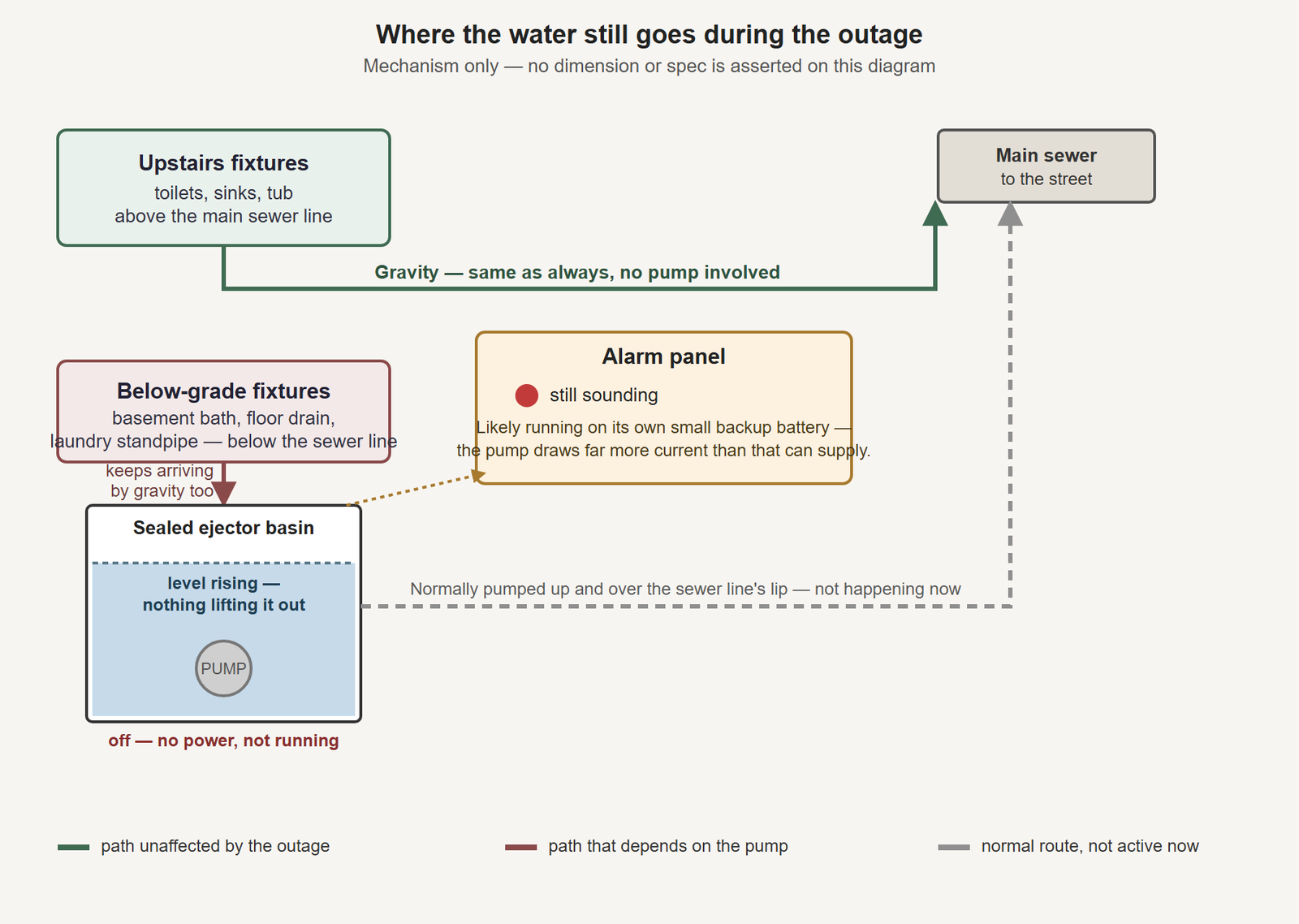
And if the alarm is sounding during a power cut, the pump is off but the basin keeps filling by gravity — the alarm runs on its own small battery, which the pump cannot, so the useful move is to stop sending water to it.
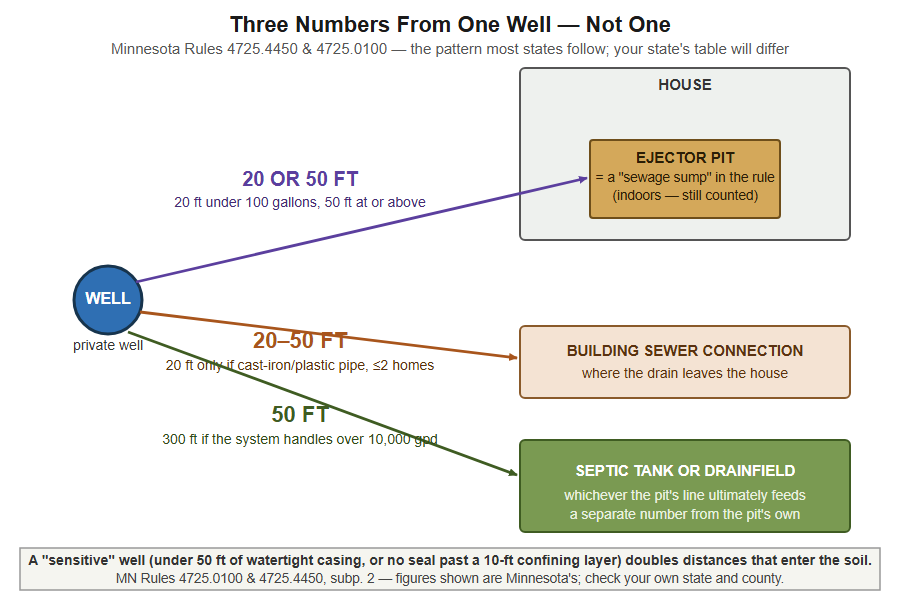
And if there is a private well on the property, the pit has a setback of its own — one state’s rule turns on whether the basin holds under 100 gallons, which makes capacity the whole decision rather than an afterthought.
And on how big the basin itself has to be, the code minimum is a floor rather than a target — 18 by 24 inches, ending in the words <em>unless otherwise approved</em>, and the maker lists an undersized basin as a published cause of short cycling.
And if the bathroom it serves is hardly ever used, the maker publishes a monthly routine for a pump left idle — thirty seconds at the breaker panel, with the lid staying shut, because the seals are lubricated by the pump turning.
And if the lift is more than an ejector can manage, a grinder is the next machine, not a bigger version of the same one — twice the horsepower, a third of the flow, and twice the head.
And if nothing with a toilet drains into the pit, an effluent pump is the machine for settled water — half to three-quarter inch solids rather than two, and two of them at the same horsepower are fourteen feet of head apart.
And if a two-inch drain cannot be routed at all, an upflush unit macerates so it can run on one inch — which is the whole reason that product class exists.
And if something other than a fixture wants to drain into the basin, the answer turns on what that appliance makes. A water softener belongs on the sanitary side, so the destination is right and only the connection is wrong — it discharges to a receptor that drains to the pit, never through the lid.
And if the pump is running while the level sits where it is, four of the five causes the maker lists are outside the pump altogether — a shut service valve, a check valve in backwards, a blocked discharge, or a lift it never could manage.
And if the complaint is noise rather than performance, the maker lists four causes and three of them route to the factory — the only one with a remedy that leaves the lid bolted down is rigid pipework carrying vibration into the building.
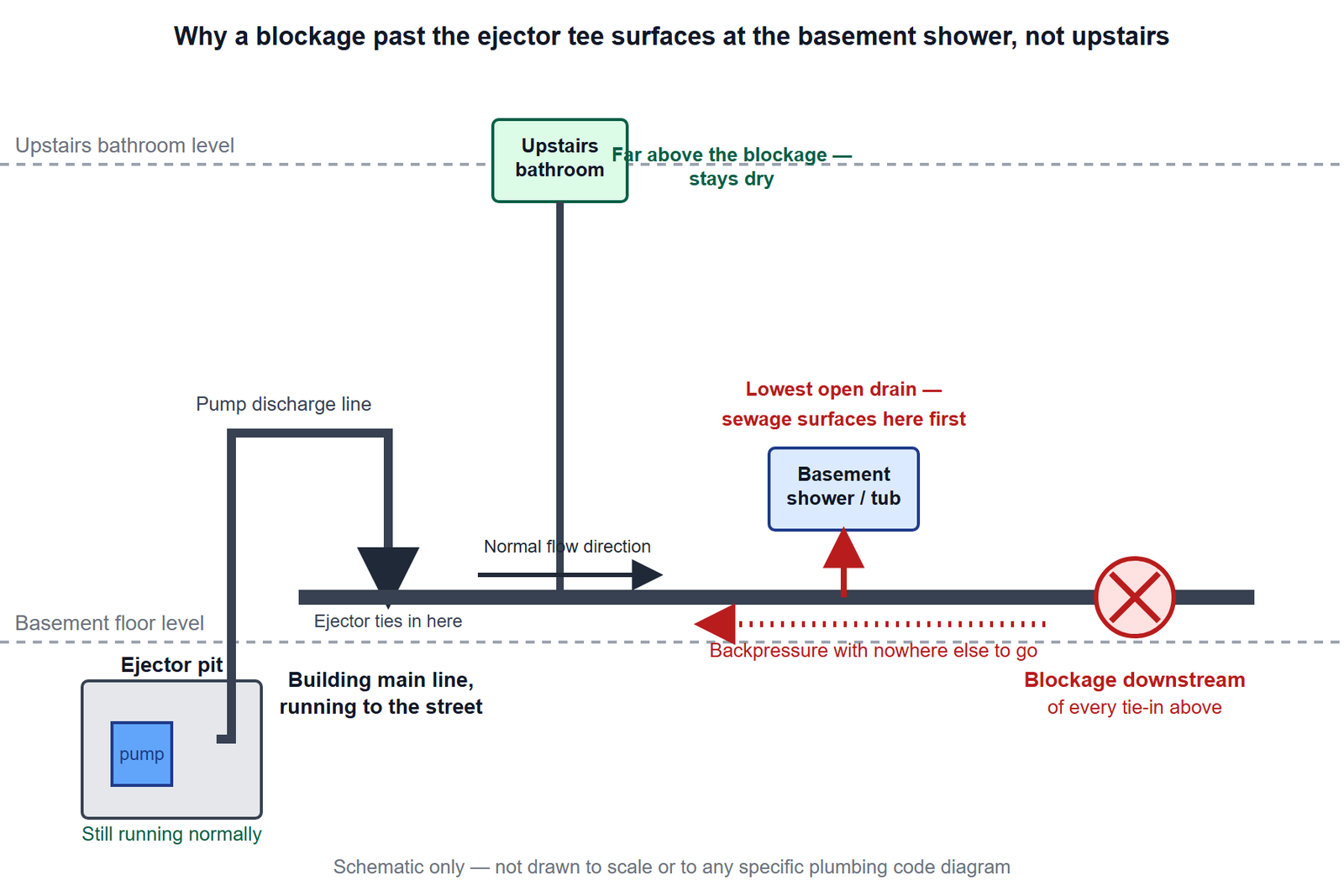
And if sewage comes up in the basement shower while the upstairs bathroom stays dry, that pattern points past the ejector tee rather than at the pump — a blockage downstream of every tie-in surfaces at the lowest open drain first.
FAQ
How do I know if I have an ejector pump or a grinder pump?
Look at the discharge pipe leaving the pit. An ejector normally has a 2-inch discharge; a grinder normally has 1¼-inch. You do not need to open the lid.
Why do I hear water running back into the pit after the pump stops?
That is the water in the pipe above the check valve draining back, and it is normal on every correctly working system. What is not normal is a bang or a shudder through the pipework.
Can I put a sump pump in a sewage pit?
No. Sump and effluent pumps are for clear or grey water. A sewage ejector is built to pass 2-inch solids with an impeller sized for it, and a sump pump in a sewage pit is a fault to correct rather than a setup to keep.
Does a sewage ejector pit need a vent?
Yes, though it does not have to be a dedicated pipe to the roof — both model codes permit it to be combined with other vents. It is not only about odour either: poor venting stops the check valve flapper reseating properly, so it shows up as a valve problem.
What should not go down a basement toilet on an ejector?
Anything fibrous. Both ejectors and grinders pass 2-inch solids, but only a grinder’s blades deal with rags, towels, wipes and hygiene products. On an ejector those wrap the impeller.
Is it safe to open the ejector pit lid myself?
Treat it as no. The lid is a gas seal on a space containing sewer gas, and this is the part of the system where the risk is genuinely to you rather than to the plumbing.