On this page
Last Updated on October 2, 2026 by Muhammad Toqeer
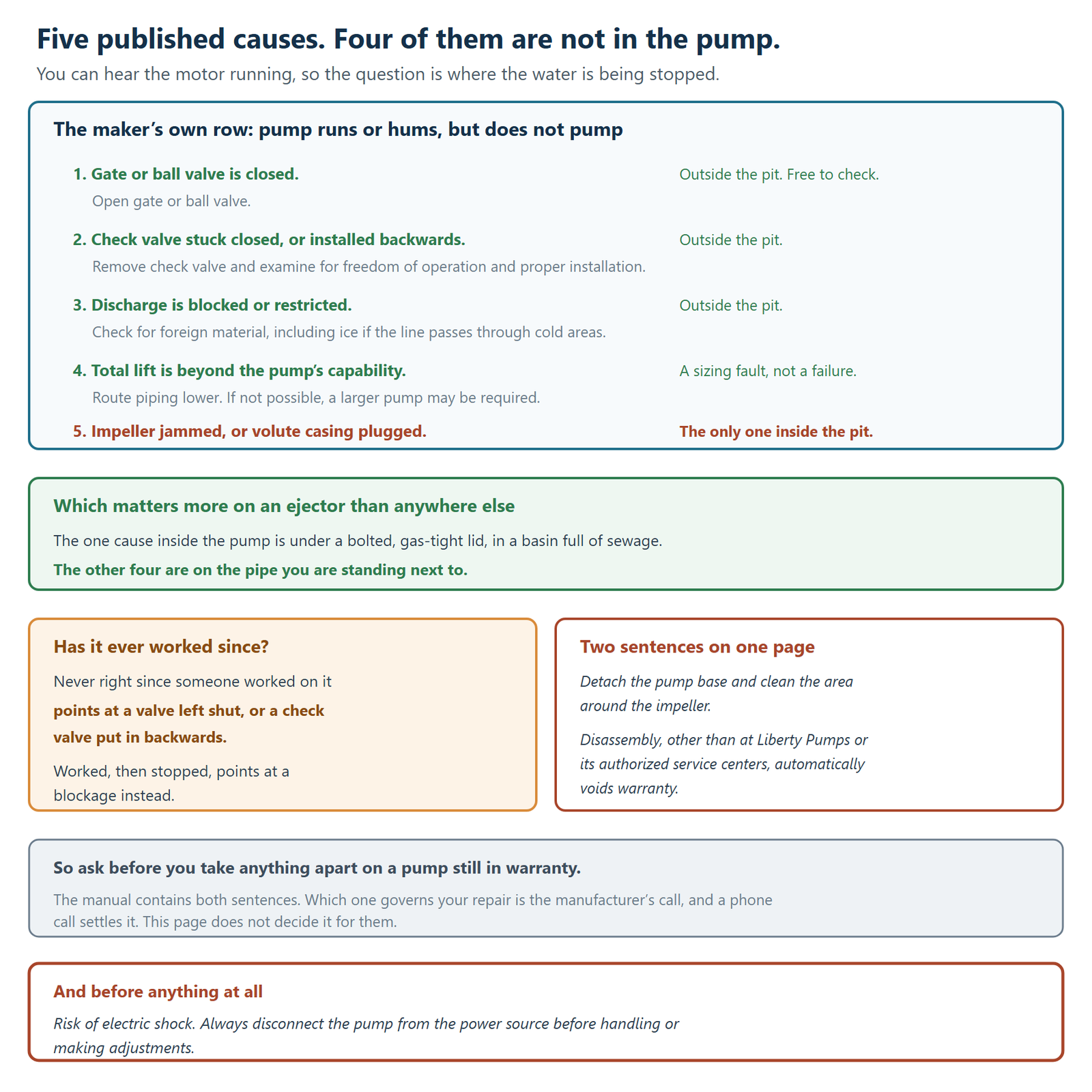
You can hear it running, so stop thinking about the motor. The manufacturer’s own troubleshooting row for this exact symptom lists five causes, and four of them are nowhere near the pump — a closed service valve, a check valve, a blocked discharge, and a lift the pump was never able to manage.
Only one of the five is inside the basin. On a sewage ejector that distinction decides everything, because the one inside is under a bolted, gas-tight lid in a pit full of sewage, and the other four are on the pipe you are standing next to.
So the first question is not “is the pump dead”. It is: where is the water being stopped?
The maker’s list, and the order to work it in
**From Liberty’s Pro-Series sewage system manual, the row headed “Pump runs or hums, but does not pump”:**
– “Discharge is blocked or restricted.” – “Check valve is stuck closed or installed backwards.” – “Gate or ball valve is closed.” – “Total lift is beyond pump’s capability.” – “Pump impeller is jammed or volute casing is plugged.”
The manual lists those causes. It does not rank them, and neither does any honest reading of a forum thread.
The order below is this page’s, and it is ordered by one thing only: what you can check without opening anything. That is the right order on an ejector regardless of which fault turns out to be yours.
1. Is a valve shut?
“Gate or ball valve is closed.” — “Open gate or ball valve.”
It is the most trivial entry in the manufacturer’s list and it is printed alongside the serious ones, which tells you how often it happens.
A service valve on the discharge gets closed during any work — a check valve swap, a pipe repair, work on a fixture upstairs — and reopening it is the step that gets forgotten.
One-minute check: follow the discharge pipe up from the basin and look for a handle or a wheel. A lever at right angles to the pipe is shut. This costs nothing and it is the only cause on the list you can both diagnose and fix in the same minute.
2. Is the check valve stuck — or in backwards?
“Check valve is stuck closed or installed backwards.” — “Remove check valve(s) and examine for freedom of operation and proper installation.”
Read that again, because the manufacturer did not write “failed” or “worn”. It wrote installed backwards, and a manufacturer only prints that when it happens often enough to be worth printing.
A check valve in backwards produces this symptom perfectly. The pump runs, builds pressure against a valve that cannot open, and moves nothing. And it does it from the moment the work was finished, not gradually.
Every check valve has an arrow on the body showing the direction of flow, and on an ejector that arrow must point away from the basin.
One-minute check: look at the arrow. That is the whole test.
3. Is the discharge blocked?
“Discharge is blocked or restricted.” — “Check the discharge line for foreign material, including ice if the discharge line passes through or into cold areas.”
The ice clause is worth noticing on a sewage line, because people associate freezing with sump discharges that run outside. A sewage ejector line crossing an unheated crawl space or garage is in the same position, and the manufacturer treats it as the same problem.
Otherwise it is what went down the toilet. An ejector handles solids, but it handles the solids it was designed for, and the things that block these lines are the things that should never have been flushed.
One-minute observation: this is the cause that fits a pump that worked fine and then stopped, rather than one that never worked right.
4. Was the lift always too much for it?
“Total lift is beyond pump’s capability.” — “Try to route piping to a lower level. If not possible, a larger pump may be required. Consult the factory.”
This one is a sizing fault wearing the costume of a failure.
It shows up when something has changed — a pump replaced with a smaller one, a discharge rerouted higher, a restriction added that raised the effective head. The pump is working exactly as specified and the specification was wrong for the job.
This is precisely why flow has to be read at the height your pit actually lifts to, not off the box — a pump with the biggest headline number can be the weakest of its group at a real lift.
One-minute check: has anything about the pump or the pipe changed recently? If a pump was swapped and it has never kept up since, this and the two valve causes are your whole shortlist.
5. And the one inside the basin
“Pump impeller is jammed or volute casing is plugged.” — “Remove the pump from the basin. Detach the pump base and clean the area around the impeller. Reassemble and reinstall.”
This is the last one to reach, and on an ejector it is a different order of job from the four above.
It means opening a gas-tight lid on a basin of sewage, lifting a pump out of it, and taking part of that pump apart. It is not a weekend task, and nothing on this page is an instruction to do it.
And there is something on the same page of that manual worth knowing before anyone touches it.
Two sentences on one page
The remedy, quoted above, says to detach the pump base. On the same page:
“NOTE: Liberty Pumps, Inc. assumes no responsibility for damage or injury due to disassembly in the field. Disassembly, other than at Liberty Pumps or its authorized service centers, automatically voids warranty.“
Both sentences are in the manual. Whether detaching the base counts as the disassembly that voids the warranty is the manufacturer’s call and not this page’s — and on a pump still in warranty, one phone call settles it before anything comes apart.
Pro note: this is a good reason to exhaust the four external causes first even if you suspect the impeller. They are free, reversible, and they do not put a warranty in question.
And before any of it
“Risk of electric shock. Always disconnect the pump from the power source before handling or making adjustments.”
On a sewage ejector that compounds, because the environment is sealed sewage as well as 120 volts in a damp basement. Every check on this page above number five can be done without going near either.
What this is not
This is not a pump that will not stop. If it runs and runs but the level does drop, the question is where the water is coming from, and that has an entirely different answer — including a check valve fault that looks like the opposite of the one here.
This is not a pump that will not start. If nothing happens at all, counting the cords splits pump from switch at the wall with the lid still bolted down.
And an alarm sounding is its own question. The panel is a separate machine and it can be the fault.
When this needs a pro
Everything from number five onwards, without qualification.
Removing or examining a check valve. It is on the discharge of a sewage line and it is full of what the pump has been moving.
Any decision about pump capacity. Sizing an ejector against the lift it actually has is a calculation, not a judgement by eye.
Anything, at all, if the pit is overflowing or the alarm is sounding. Stop sending water down there first — that is the only genuinely urgent instruction on this page.
What you can do yourself: look for a closed valve, look at the arrow on the check valve, and work out whether this has ever been right since someone last worked on it. Three checks, no tools, no lid — and between them they cover three of the manufacturer’s five causes.
FAQ
Why does my ejector pump run but not empty the pit?
The manufacturer lists five causes and four are outside the pump: a closed gate or ball valve, a check valve stuck closed or installed backwards, a blocked or restricted discharge, and a total lift beyond the pump’s capability. Only a jammed impeller or plugged volute is inside the basin.
Can a check valve be installed backwards?
Yes, and the manufacturer lists it by name as a cause of this exact symptom. Every check valve has a flow arrow on the body, which on an ejector must point away from the basin. A valve fitted the wrong way round produces this fault from the moment the work was finished.
My ejector pump hums but nothing happens — is the motor dead?
A hum means it is getting power and trying to turn, which puts it in the same troubleshooting row as a pump that runs normally without pumping. Work the external causes first: a closed valve, the check valve, the discharge line.
Could the discharge line be frozen on a sewage pump?
The manufacturer includes ice in its list, noting the discharge should be checked for foreign material including ice if the line passes through or into cold areas. A sewage line crossing an unheated crawl space or garage is in the same position as a sump line running outside.
What if it never worked properly after a repair?
That narrows it considerably. A fault present from the moment work finished points at a service valve left shut or a check valve installed backwards, rather than at a blockage that would have developed over time.
Can I clear the impeller myself?
The manual’s remedy is to remove the pump from the basin, detach the pump base and clean around the impeller — but the same page states that disassembly outside the manufacturer’s own service centres automatically voids the warranty. On a pump still in warranty, ask the manufacturer before anything comes apart.