On this page
Last Updated on October 2, 2026 by Muhammad Toqeer
You are buying a one-inch drain line. Everything else about an upflush system — the box behind the toilet, the noise, the blade, the rules about elbows — is a consequence of that single decision.
A sewage ejector passes solids whole and needs two inches. An upflush unit macerates first and runs on three-quarters of an inch or one inch, which is a pipe a quarter of the area.
That is what buys you a bathroom where a two-inch drain cannot go, and it is the only reason to accept any of the rest.
Why the horsepower on the box is useless here
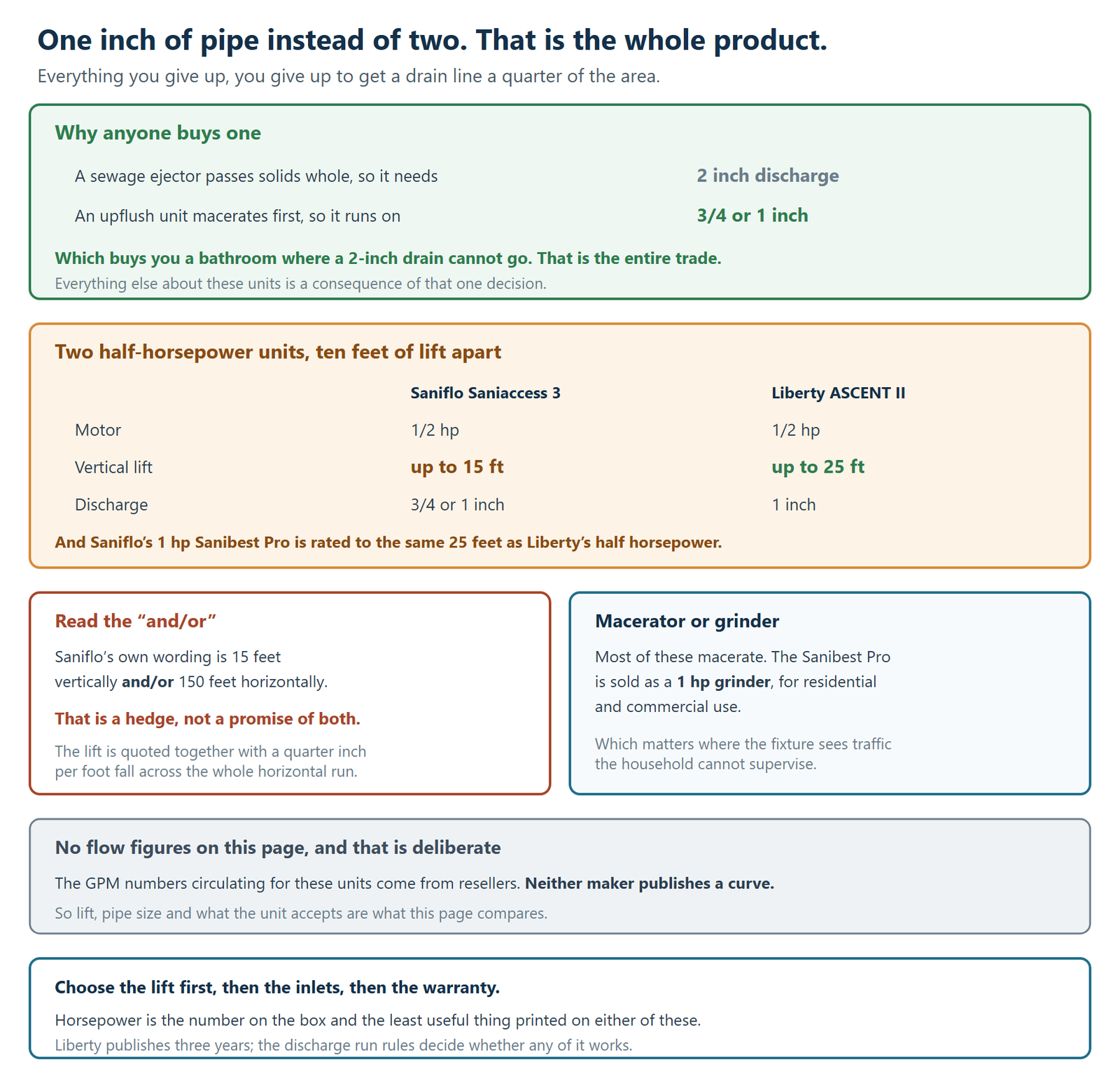
Two half-horsepower units, and ten feet of lift between them:
| Saniflo Saniaccess 3 | Liberty ASCENT II | |
|---|---|---|
| Motor | 1/2 hp | 1/2 hp |
| Vertical lift | up to 15 ft | up to 25 ft |
| Horizontal | up to 150 ft | 150 ft |
| Discharge | ¾ in or 1 in | 1 in |
Both figures are from the manufacturers’ own product pages.
Two thirds more lift from the Liberty, on the same nameplate. And Saniflo’s 1 hp Sanibest Pro is rated to the same 25 feet as Liberty’s half horsepower — so horsepower does not order these units at all.
Measure your lift before you look at anything else. It is the only specification that eliminates models.
Read the “and/or”
**Saniflo’s own wording for the Saniaccess 3 is up to 15 feet vertically and/or 150 feet horizontally.**
That is a hedge, and it is worth noticing. It does not say both at once, and buyers routinely read it as “25 feet up and 150 feet along.”
The reason is in the installation rules, which this site covers in detail: the lift figure is quoted together with a continuous quarter-inch-per-foot fall across the whole horizontal run, and the discharge run has four rules that decide whether any of it works — including that once the pipe goes horizontal it may never rise again.
Read those before you choose a model, because a run that breaks them will fight whichever unit you buy.
Macerator or grinder
Within this category there are two different machines.
Most of them macerate — a blade reduces waste enough to pass a small bore.
The Sanibest Pro is sold as a 1 hp grinder, for residential and commercial use.
Which matters where the fixture sees traffic the household cannot supervise — a rental, a basement apartment, a shop washroom. The common failure of every unit in this class is something going in that should not, and a grinder is the more tolerant answer.
The five worth knowing
A short list on purpose. The residential upflush field is genuinely small, and the round-ups reach ten by counting bowl shapes and colours as separate products.
Liberty ASCENT II — the most lift on half a horsepower
Liberty ASCENT II — “pump up to 25′ vertically” and “150′ horizontally through a 1″ discharge pipe.” RazorCut™ maceration. Supplied with a 1.28 GPF high efficiency toilet. Insulated tanks to eliminate sweating. Three-year warranty. Available elongated (ASCENTII-ESW) or round (ASCENTII-RSW).
Who it is for: the lift. Twenty-five feet from half a horsepower is the best ratio here, and if your fixture is well below the sewer line this is the one that reaches.
The honest drawback: one-inch discharge only, with no three-quarter-inch option — which is a constraint if the route you have in mind is already tight.
Liberty ASCENTII-MUW — the unit without the bowl
Liberty ASCENTII-MUW — the macerating unit on its own.
Who it is for: anyone who already has a toilet they want to keep, or who wants to choose the bowl separately.
The honest drawback: compatibility is now yours to establish rather than the manufacturer’s, and a rear-discharge bowl is not a standard fitting.
Saniflo Saniaccess 3 — the full-bath kit
Saniflo Saniaccess 3 — ½ hp, discharge ¾ in or 1 in, up to 15 feet vertically and/or 150 feet horizontally. Sold as a complete kit with an elongated bowl.
Who it is for: a full bathroom where the lift is modest — the unit takes a toilet plus additional fixtures, which is what “3” in the name refers to.
The honest drawback: fifteen feet. That is ten less than the Liberty on the same horsepower, and on a deep basement it is the figure that rules it out.
Saniflo Saniaccess 3, pump only — for an existing bowl
Saniflo Saniaccess 3 macerator — P/N 082, the pump without the toilet.
Who it is for: the same installation as above where a bowl is already chosen or already fitted.
The honest drawback: same lift ceiling, and the same compatibility question as any pump-only purchase.
Saniflo Sanibest Pro — the grinder
Saniflo Sanibest Pro — 1 hp grinder, rated to install a bathroom up to 25 ft below the sewer line or 150 ft away, for residential and commercial use.
Who it is for: heavier or less supervised use, and the deeper installations the Saniaccess cannot reach.
The honest drawback: a full horsepower buys you the same 25 feet Liberty manages on half, so you are paying for the grinder rather than for the lift.
Side by side
| Unit | Motor | Vertical lift | Discharge | Type |
|---|---|---|---|---|
| Liberty ASCENT II | 1/2 hp | 25 ft | 1 in | Macerator |
| Liberty ASCENTII-MUW | 1/2 hp | 25 ft | 1 in | Macerator, unit only |
| Saniflo Saniaccess 3 | 1/2 hp | 15 ft | ¾ or 1 in | Macerator |
| Saniflo Saniaccess 3 (pump only) | 1/2 hp | 15 ft | ¾ or 1 in | Macerator |
| Saniflo Sanibest Pro | 1 hp | 25 ft | — | Grinder |
There are no flow figures on this page, and that is deliberate. The gallons-per-minute numbers circulating for these units come from resellers; neither manufacturer publishes a curve. Lift, pipe size and what the unit accepts are what can be compared honestly.
How to choose
1. Measure the lift, from the unit to where the discharge meets gravity drain. That single number eliminates models.
2. Then count the fixtures. A unit rated for a toilet alone is a different purchase from one taking a basin and a shower as well.
3. Then decide macerator or grinder, which is really a question about who uses the fixture.
4. Then the warranty, which is the one figure stated the same way by everybody.
5. Horsepower last, or not at all. Two of the units here are half a horsepower and one is a full one, and the lift ratings do not follow.
And before any of it, read the discharge run rules. A unit chosen perfectly and piped badly is the most common failure in this category, not a bad pump.
When this needs a pro
The discharge run. It is small-bore pipe carrying macerated waste under pressure, with rules about elbows, fall and direction that are unforgiving.
Anything electrical, and anything involving the existing drain connection.
Establishing whether you need one at all. If a two-inch drain can be routed, a conventional sewage ejector moves far more water for less complexity — these units exist for the case where it cannot.
Any installation in a sealed or vented pit arrangement, which is its own system with its own code requirements.
What you can do yourself: measure the vertical distance from the fixture to the drain it has to reach, and count what else needs to drain into the same unit. Two numbers, and they decide the shortlist.
And if the unit you have already stops working, start with which fixtures still clear rather than with the pump — the pattern tells you more than the noise does.
FAQ
What size pipe does an upflush toilet use?
Three-quarters of an inch or one inch, depending on the model — Liberty’s ASCENT II is one inch, Saniflo’s Saniaccess 3 offers either. A conventional sewage ejector needs two inches, and the smaller pipe is the entire reason these systems exist.
How high can an upflush toilet pump?
It depends on the model, not the horsepower. Saniflo’s half-horsepower Saniaccess 3 is rated to 15 feet; Liberty’s half-horsepower ASCENT II to 25. Saniflo’s one-horsepower Sanibest Pro is also rated to 25.
Can an upflush toilet pump 25 feet up and 150 feet along at the same time?
Read the manufacturer’s wording carefully — Saniflo says vertically and/or horizontally, which is a hedge rather than a promise of both. The lift rating is quoted together with a continuous quarter-inch-per-foot fall across the horizontal run.
What is the difference between a macerating and a grinding upflush unit?
Most upflush units macerate, reducing waste enough to pass a small-bore pipe. Saniflo’s Sanibest Pro is sold as a grinder and rated for commercial as well as residential use, which makes it the more tolerant choice where the fixture is not supervised.
Is an upflush toilet better than a sewage ejector pump?
Neither is better; they solve different problems. An ejector moves far more water and needs a two-inch drain. An upflush unit exists for the case where a two-inch drain cannot be routed at all.
Do upflush toilet systems come with the toilet?
Both ways. Liberty’s ASCENT II is sold complete with a 1.28 GPF bowl or as a macerating unit only, and Saniflo’s Saniaccess 3 is sold as a kit or as the pump alone.