On this page
Last Updated on September 29, 2026 by Muhammad Toqeer
Pick on two things: how much the pump still moves at the height your pit actually lifts to, and whether its float is inside the pump or on a separate plug. Both are printed on the maker’s specification sheet. Neither is the number on the box — and on one popular pump the box number is measured at no lift at all.
Every figure on this page comes from the manufacturer’s own published sheet, not a retail listing.
Read the flow number with its height attached, or do not read it
A pump’s flow depends entirely on how far it has to push. Quote a flow figure without its height and you have said nothing.
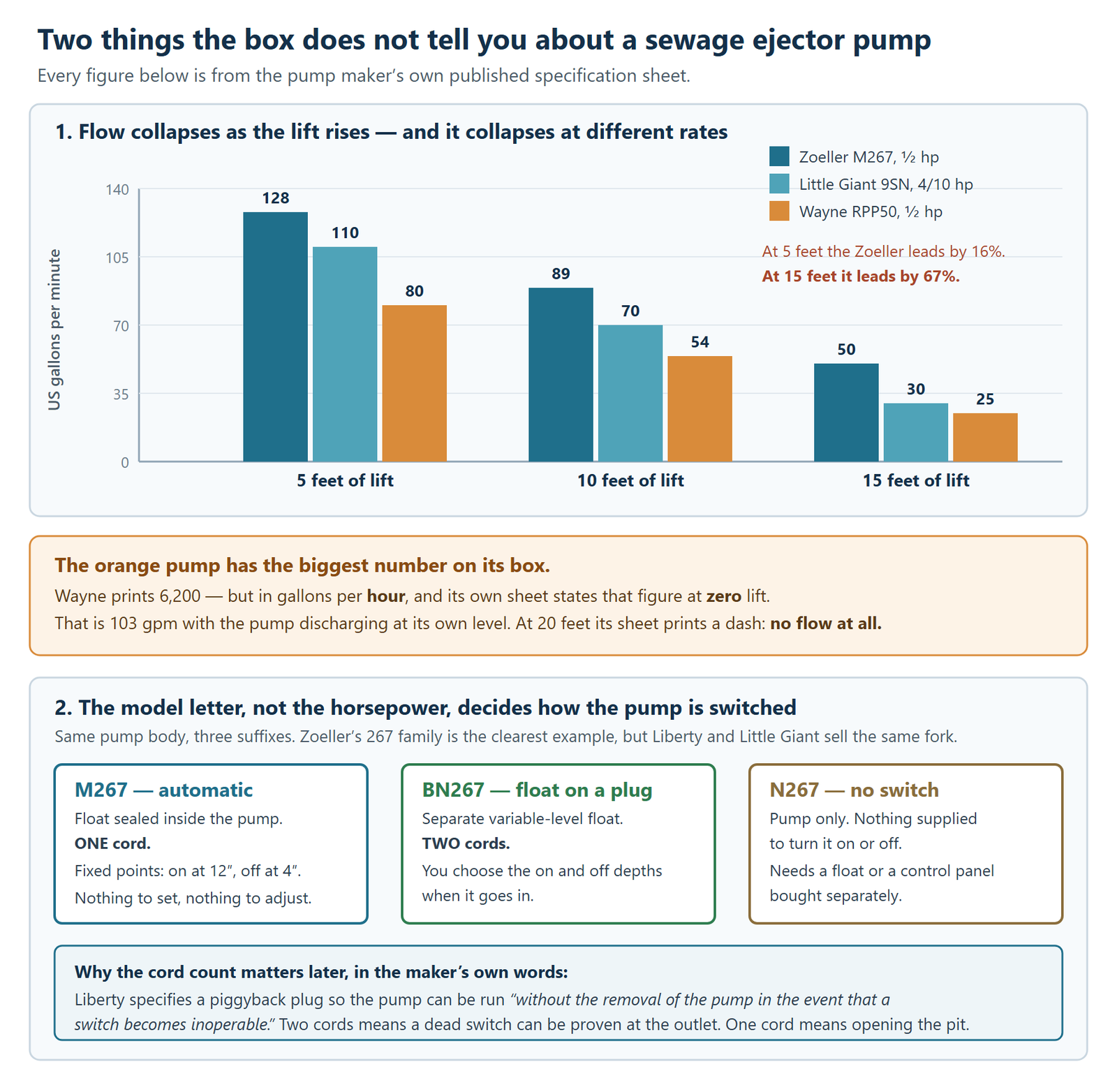
Here is what that does to a comparison. The Zoeller M267 and the Little Giant 9SN, read off their own tables:
| Lift | Zoeller M267 | Little Giant 9SN | Difference |
|---|---|---|---|
| 5 feet | 128 GPM | 110 GPM | 16% |
| 10 feet | 89 GPM | 70 GPM | 27% |
| 15 feet | 50 GPM | 30 GPM | 67% |
At five feet these two look like near neighbours. At fifteen they are not in the same class. The gap more than quadruples, because the two pumps lose flow at different rates — the 9SN sheds 73% of its flow between five and fifteen feet, the M267 sheds 61%.
The slope of that decline is a specification in its own right, and no retail listing shows it. A basement pit commonly lifts ten to fifteen feet to reach a gravity drain, so fifteen feet is the honest place to compare, not five.
The biggest number on any of these boxes is the smallest pump
Wayne prints 6,200 on the RPP50. Everyone else on this page prints a figure between 110 and 141. It looks like a rout.
It is a unit change. Wayne publishes in gallons per hour; the others publish in gallons per minute. And Wayne’s own sheet states that 6,200 at zero feet of lift — the pump discharging at its own level, which is not a thing an ejector pit ever asks it to do.
Wayne’s published table, converted to gallons per minute:
- 5 feet — 80 GPM
- 10 feet — 54 GPM
- 15 feet — 25 GPM
- 20 feet — a dash. No flow at all.
At every real height the RPP50 is the weakest pump here, including against two pumps of lower horsepower. Its headline number is the biggest and its performance is the smallest.
The model letter decides the switch, and the switch decides what you can do later
This is the part buyers get wrong, because the suffix looks like a catalogue detail. Zoeller sells what is essentially the same pump three ways:
- M267 — automatic. The float is a snap-action switch sealed inside the pump, with fixed points: on at 12 inches, off at 4 inches. One cord.
- N267 — non-automatic. No switch at all. The pump only.
- BN267 — the non-automatic pump supplied with a piggyback variable-level float on a 15-foot cord. Two cords.
Zoeller’s own reason for the variable-level version:
“The purpose of the variable level float switch is to increase the capacity or run time for the pump when it is operating, instead of having a non-adjustable ON and OFF point like the M267.”
Liberty and Little Giant sell the same fork. Little Giant’s 9SN sheet says the series is “available in manual or automatic operation” and lists two different automatic arrangements with different ranges — a piggyback mechanical float switching on between 9 and 14 inches, or an integral snap-action float switching on between 9 and 12.
Why the cord count matters more than it looks
Liberty states the consequence outright in its LE50-Series specification. The piggyback plug exists so the pump can be run:
“without the removal of the pump in the event that a switch becomes inoperable.”
That is the whole argument for two cords. A pump on a piggyback float can be unplugged from its switch and plugged straight into the outlet. If it runs, the pump is fine and the switch is dead. That test is the fastest way to diagnose a pump that will not start, and it happens at the wall — nobody opens the pit.
A one-cord pump cannot be tested that way, because its switch is sealed inside the unit and wired in series with the motor. To find out whether the motor or the switch has failed, the pump comes out of the pit.
The second consequence is run length. A fixed 12-inch-on, 4-inch-off pump empties the same 8 inches of pit every time, forever. A variable-level float lets you set a deeper on-point and a lower off-point, so each run moves more and the runs come further apart — which is the lever you reach for when a pump is cycling more often than it should.
And it decides how much sewage stands in the pit between runs, which is the variable behind most complaints about a pit that smells. The published on-levels across these pumps are not close:
| Pump | Turns on at | Turns off at |
|---|---|---|
| Little Giant 9SN (piggyback) | 9–14 in | 2–6 in |
| Little Giant 9SN (integral) | 9–12 in | 3–6 in |
| Zoeller M267 | 12 in (fixed) | 4 in (fixed) |
| Wayne RPP50 | 16 in | 7.5 in |
The RPP50 lets waste stand sixteen inches deep before it starts and leaves seven and a half inches behind when it stops — the highest of both in this group.
The pumps
Zoeller M267 (267-0001) — the default, if you accept a fixed float
Zoeller M267 Waste-Mate — ½ hp, 115 V, 2-inch NPT discharge, 2-inch solids, cast iron switch case, motor housing and pump housing. 128 GPM at 5 feet, 89 at 10, 50 at 15. Three-year warranty.
Who it is for: anyone who wants the thing to work without decisions. It arrives switched, tested against its published curve, and the flow at fifteen feet is the best of the tabulated pumps here.
The honest drawback: one cord and a float you cannot move. On at 12 inches, off at 4, permanently. You cannot lengthen the runs to cut cycling, and you cannot test it at the outlet when it stops starting — the pump has to come out of the pit to find out why.
Zoeller BN267 (267-0032) — the same pump with the float outside it
Zoeller BN267 with variable-level float — the non-automatic 267 supplied with a piggyback variable-level float switch on a 15-foot cord. Two cords.
Who it is for: anyone who has already had a pit pump fail and does not want to guess next time, or whose pump cycles too often for the pit it sits in. You set the on and off depths to suit the basin.
The honest drawback: you have to set them, and you can set them wrong. Too short a float tether and it short-cycles; too long and waste stands deeper and longer than it should. A pump that arrives configured removes a decision that a variable float hands back to you.
Zoeller N267 (267-0002) — pump only, for a panel
Zoeller N267 non-automatic — ½ hp, 115 V, 2-inch NPT discharge, 15-foot cord. No switch supplied.
Who it is for: a basin already running a control panel, or a replacement where the existing float and alarm are sound and only the pump has failed.
The honest drawback: on its own it does nothing. Without a float or a panel it will not start, and buying this by mistake instead of an M267 is the single most common ordering error in this family.
Liberty LE51A — the strongest shut-off head here
Liberty LE51A — ½ hp, 115 V, 11.0 full load amps, 2-inch discharge, 2-inch solids, wide-angle tilt float on a piggyback plug, 10-foot cord. Shut-off head 24 feet; 141 GPM at 5 feet. Class 25 cast iron, oil-filled motor, upper and lower ball bearings rated for a minimum 50,000 hours. Three-year warranty.
Who it is for: a deeper lift than usual. Twenty-four feet of shut-off head is the highest on this page, which means more margin left at fifteen feet than a pump that quits at twenty.
The honest drawback: Liberty publishes a curve, not a table. Its specification gives shut-off head and one flow figure at five feet, so there is no manufacturer-stated number at ten or fifteen feet to compare against the others. Resellers quote “90 GPM at 15 feet” freely; Liberty does not publish it, so this page does not repeat it.
A note on those listings: several give this pump as 12.0 amps and up to 160 GPM. Liberty’s own electrical data table says 11.00 amps, and its specification says 141 GPM at 5 feet. Where they disagree, believe the manufacturer.
Liberty LE41A — the same build, one size down
Liberty LE41A — 4/10 hp, 115 V, 2-inch discharge, 2-inch solids. Shut-off head 21 feet; 125 GPM at 5 feet. Three-year warranty, same cast iron and oil-filled motor construction as the LE51A.
Who it is for: a shallower lift — a pit that only has to reach a drain eight or ten feet up — where the LE51A’s extra head would never be used.
The honest drawback: three feet less shut-off head than the LE51A, and the same missing middle of the table. On a fifteen-foot lift you would be working much closer to the top of its curve, with less in reserve for a partly blocked discharge.
Little Giant 9SN — the longest cord and the lowest current draw
Little Giant 9SN — 4/10 hp PSC motor with thermal overload protection, 115 V, 8.5 amps, 2-inch discharge, 2-inch solids, epoxy-coated cast iron housing, nylon vortex impeller, 20-foot cord. 110 GPM at 5 feet, 70 at 10, 30 at 15, shut-off 20 feet.
Who it is for: a pit whose outlet is a long way from the pump. Twenty feet of cord is twice what the M267 and the LE51A supply, and 8.5 amps is the lightest draw here — which matters on a circuit already carrying something else.
The honest drawback: a two-year warranty, not three, and 30 GPM at fifteen feet is the weakest of the cast-iron pumps that publish a table. If the lift is genuinely fifteen feet, this is not the pump.
Wayne RPP50 — included because its numbers need explaining
Wayne RPP50 — ½ hp, 120 V, cast iron, vortex impeller, bottom suction, 2-inch NPT discharge, tether float switch, 8-foot cord. 80 GPM at 5 feet, 54 at 10, 25 at 15, and nothing at 20.
Who it is for: a shallow lift, and a buyer who has read the table above and knows exactly what they are getting.
The honest drawback: a one-year warranty — a third of what Zoeller and Liberty give — the shortest cord here at eight feet, the highest on-level at sixteen inches, and its own sheet shows the pump running out before twenty feet. The 6,200 on the box is gallons per hour at zero lift.
Side by side
All figures from manufacturers’ own sheets. A dash means the maker does not publish that figure — it has not been borrowed from a reseller.
| Pump | HP | 5 ft | 10 ft | 15 ft | Shut-off | Cord | Warranty | Cords |
|---|---|---|---|---|---|---|---|---|
| Liberty LE51A | ½ | 141 | — | — | 24 ft | 10 ft | 3 yr | 2 |
| Zoeller M267 | ½ | 128 | 89 | 50 | 21.5 ft | 10 ft | 3 yr | 1 |
| Liberty LE41A | 4/10 | 125 | — | — | 21 ft | 10 ft | 3 yr | 2 |
| Little Giant 9SN | 4/10 | 110 | 70 | 30 | 20 ft | 20 ft | 2 yr | 1 or 2 |
| Wayne RPP50 | ½ | 80 | 54 | 25 | under 20 ft | 8 ft | 1 yr | 2 |
| Zoeller BN267 | ½ | — | — | — | — | 15 ft | 3 yr | 2 |
| Zoeller N267 | ½ | — | — | — | — | 15 ft | 3 yr | none |
Flow figures are US gallons per minute. Wayne’s are converted from the gallons per hour its sheet uses, so the column compares like with like.
How to choose in two minutes
Measure the lift first. From the pump sitting at the bottom of the pit up to the height where the discharge pipe meets the gravity drain. That is the number the table is indexed on.
Then decide where you want the float. Sealed inside the pump is simpler on day one. On a separate plug is better on the day it fails, and better if the pump cycles more than the pit warrants.
Then read the warranty, because it is the only figure here that the manufacturers are not measuring in different units — and it ranges from one year to three across these seven pumps.
One caution on ordering. Retail listings reuse the same description across a whole model family, so a listing’s account of the switch can describe a different pump in the series. The model letter is reliable; the listing’s switch paragraph is not. Check the suffix, not the blurb.
When to get a pro involved
Sizing for anything that is not a single household bathroom group. Fixture counts, simultaneous demand and the diameter of the existing discharge all change the answer, and this page assumes an ordinary residential pit.
Any pit where the existing pump failed early. A pump that died in two years usually died of something — short-cycling, a check valve, a discharge restriction — and fitting the same pump again buys the same outcome.
Fitting it. A sewage ejector pit is a sealed, vented, gas-tight system tied into the house drainage. Choosing the pump is a homeowner job. Installing it is not.
And if you are not certain which pump you currently have, start by identifying it — the discharge pipe size and the cord count tell you most of it before you touch anything.
FAQ
What size sewage ejector pump do I need for a basement bathroom?
Measure the vertical lift from the pump to where the discharge joins the gravity drain, then read each pump’s flow at that height rather than its headline figure. For an ordinary residential pit a ½ hp pump with 2-inch solids handling is the usual answer, but the lift decides which ½ hp pump.
Is a higher horsepower sewage pump always better?
No. A 4/10 hp Little Giant moves more at five feet than a ½ hp Wayne does, because the curves differ. Horsepower does not tell you flow at a given height; the manufacturer’s table does.
What is the difference between the Zoeller M267, N267 and BN267?
The pump is essentially the same; the letters describe the switch. The M267 is automatic with a float sealed inside and fixed on and off points. The N267 has no switch at all. The BN267 is the non-automatic pump supplied with an adjustable piggyback float on its own plug.
Should I buy an automatic pump or one with a piggyback float switch?
A piggyback float lets you set the on and off depths and, as Liberty puts it, run the pump without removing it if the switch fails. A sealed automatic pump needs no setting up but cannot be tested at the outlet when it stops working.
Why does one pump say 6,200 and the others say around 120?
A unit change. Wayne publishes gallons per hour; most makers publish gallons per minute. 6,200 gallons per hour is about 103 per minute, and Wayne’s sheet states that figure at zero lift rather than at any working height.
How many gallons per minute does a sewage ejector pump lose as the lift increases?
A great deal, and at different rates. Between five and fifteen feet the Little Giant 9SN drops from 110 GPM to 30, a loss of 73%, while the Zoeller M267 drops from 128 to 50, a loss of 61%.