On this page
Last Updated on October 4, 2026 by Muhammad Toqeer
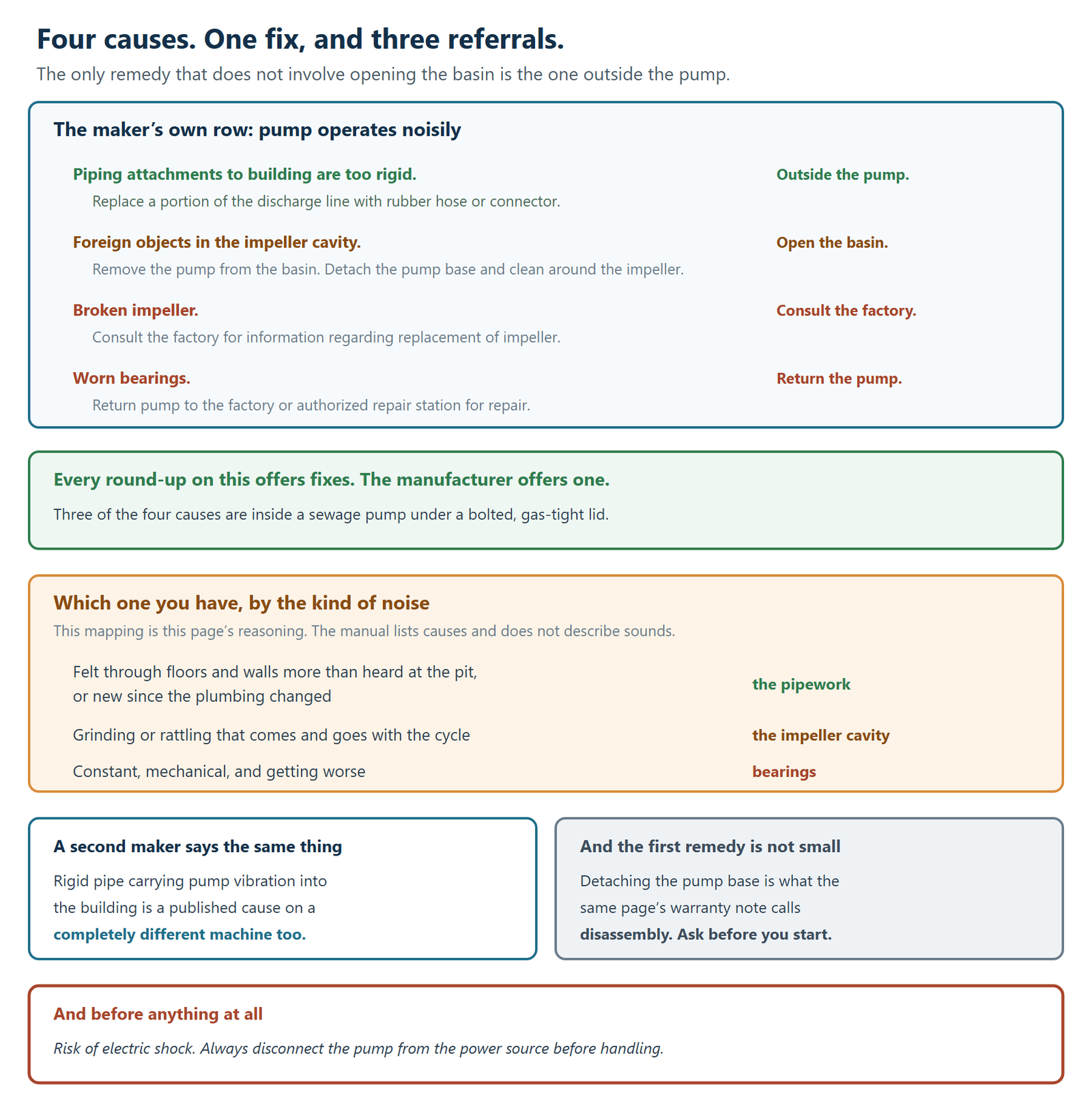
Start with the pipe, because it is the only cause you can do anything about. The manufacturer’s troubleshooting row for a noisy sewage ejector lists four causes — and three of them are inside a pump sitting under a bolted, gas-tight lid in a basin of sewage.
The fourth is not in the pump at all: “Piping attachments to building are too rigid.” The remedy is to replace part of the discharge line with rubber hose or a connector.
That inversion is worth sitting with. Every article on a noisy pump offers you fixes. The manufacturer offers one fix and three referrals — clean it, consult the factory, or send the pump back.
The maker’s own row
**From Liberty’s Pro-Series sewage system manual, the row headed “Pump operates noisily”:**
– “Piping attachments to building are too rigid.“ — “Replace a portion of the discharge line with rubber hose or connector.” – “Foreign objects in the impeller cavity.“ — “Remove the pump from the basin. Detach the pump base and clean the area around the impeller. Reassemble and reinstall.” – “Broken impeller.“ — “Consult the factory for information regarding replacement of impeller.” – “Worn bearings.“ — “Return pump to the factory or authorized repair station for repair.”
Read the remedies rather than the causes. They escalate through three distinct levels of “not a job you do at the pit”: clean it, ring the factory, ship the pump.
Only the first cause has a remedy that leaves the lid bolted down.
Start with the pipework
It is first here because it is the only one you can investigate without opening a sewage basin, not because it is the most likely — the manual does not rank its causes and neither will this page.
A sewage ejector is bolted to a rigid discharge line that is itself strapped to the building. The pump vibrates, the pipe carries that vibration into joists and walls, and the house becomes the thing making the noise.
The published remedy is specific: replace a portion of the discharge line with rubber hose or a connector. Not the whole run — a section, to break the mechanical path.
And a second manufacturer publishes the same cause on a completely different machine. Rigid pipework transmitting pump vibration into the structure appears in the troubleshooting material for pressure boosters too, where flexible hose is again one of the named measures. Two makers, two product categories, one diagnosis: the pipe is the loudspeaker.
One-minute check, and it is a good one: go and stand somewhere other than next to the pit. If the noise is worse in the room above, or through a wall, than it is standing over the basin, the pipe is carrying it. A pump that is genuinely loud is loudest where it is.
Which of the four you have, by the kind of noise
A caution before the list: the manual names causes and does not describe sounds. The mapping below is this page’s reasoning from what each fault physically is, not something the manufacturer published.
Felt more than heard, or new since someone worked on the plumbing. That is the pipework. A noise that arrived after a discharge line was re-run, a strap was added, or the pump was replaced with a different model has a mechanical path that did not exist before.
Grinding or rattling that comes and goes with the cycle. Something is in the impeller cavity, and it is making the noise only while the impeller is turning against it. On a sewage pump, “something” is whatever went down the toilet — and that is the same family of object behind a pump that runs without emptying the pit.
Constant, mechanical, and getting worse. Bearings. There is no version of this that improves on its own, and the published remedy is a factory return.
Pro note: the useful distinction is whether the noise tracks the pump’s work or the pump’s rotation. A noise that changes as the pit empties is hydraulic or obstructive. A noise that is identical from the first second to the last is mechanical.
The first in-pump remedy is bigger than it reads
“Remove the pump from the basin. Detach the pump base and clean the area around the impeller.”
On a sewage ejector that sentence means opening a gas-tight lid, lifting a pump out of a basin of sewage, and taking part of that pump apart.
And the same page of the same manual says:
“Disassembly, other than at Liberty Pumps or its authorized service centers, automatically voids warranty.“
This site has already worked through that tension and the honest answer has not changed: both sentences are in the manual, which one governs your repair is the manufacturer’s call, and one phone call settles it before anything comes apart on a pump still in warranty.
Which is a further reason to exhaust the pipework first. It is reversible, it costs nothing to investigate, and it does not put a warranty in question.
And before any of it
“Risk of electric shock. Always disconnect the pump from the power source before handling or making adjustments.”
On this machine that compounds, because the environment is sealed sewage as well as mains voltage in a damp basement. Every check on this page short of the impeller can be done without going near either.
What this is not
It is not a pump that will not start. If nothing happens at all, counting the cords splits pump from switch at the wall with the lid still bolted down.
It is not a pump that will not stop. If it runs and runs, the question is where the water is coming from.
And a grinder is a different machine. Cutting noise from a grinder pump is the machine doing its job, and it is not what this row describes.
When this needs a pro
Everything except looking at where the noise is loudest.
Any work on the discharge line. It is a sewage line under pressure when the pump runs, and cutting a section out to fit a flexible connector is plumbing on the sanitary side.
Opening the basin, for any reason. The seal is the only thing between the basement and sewer gas.
Anything the manual routes to the factory — a broken impeller or worn bearings. Those are not field repairs on a residential sewage pump, and the manufacturer says so in its own remedy column.
And a pump noisy enough to be a complaint, on a system you are already unhappy with. If it is heading for replacement anyway, the specs that separate these pumps are a different question — and sizing one against the lift your pit actually has is where that starts.
What you can do yourself: listen from the room above as well as at the pit, note whether the noise tracks the cycle or runs constant, and work out whether anything about the pipework changed before it started. Three observations, no tools, lid stays on — and they place you on the manufacturer’s own four-cause list before anyone is called.
FAQ
Why is my sewage ejector pump so loud?
The manufacturer lists four causes: rigid piping attachments to the building, foreign objects in the impeller cavity, a broken impeller, and worn bearings. Only the first has a remedy that does not involve opening the basin — replacing a portion of the discharge line with rubber hose or a connector.
Can the pipework make an ejector pump noisy?
Yes, and it is a published cause rather than a theory. The remedy given is to replace part of the discharge line with rubber hose or a connector, which breaks the path carrying vibration into the building. A second manufacturer names the same cause on a different class of pump.
How do I tell what kind of noise I have?
The manual lists causes without describing sounds, so this is judgement rather than specification. A noise felt through floors and walls more than heard at the pit suggests the pipework. Grinding that comes and goes with the cycle suggests the impeller cavity. Constant mechanical noise that worsens suggests bearings.
Can I clean the impeller myself?
The manual’s remedy is to remove the pump from the basin, detach the pump base and clean around the impeller — but the same page states that disassembly outside the manufacturer’s own service centres automatically voids the warranty. On a pump still in warranty, ask the manufacturer before anything comes apart.
Are worn bearings on an ejector pump repairable at home?
Not according to the manufacturer. The published remedy is to return the pump to the factory or an authorized repair station. A broken impeller is one step less severe — the manual says to consult the factory about replacement rather than to return the pump.
Should a sewage ejector pump be audible at all?
It will be audible while it runs, and a cycle is short. What is worth investigating is a noise that is louder elsewhere in the house than it is at the pit, a noise that has changed, or one that is getting worse — those are the three patterns that map onto the manufacturer’s causes.