On this page
Last Updated on October 7, 2026 by Muhammad Toqeer
The number is eighteen inches across and twenty-four inches deep:
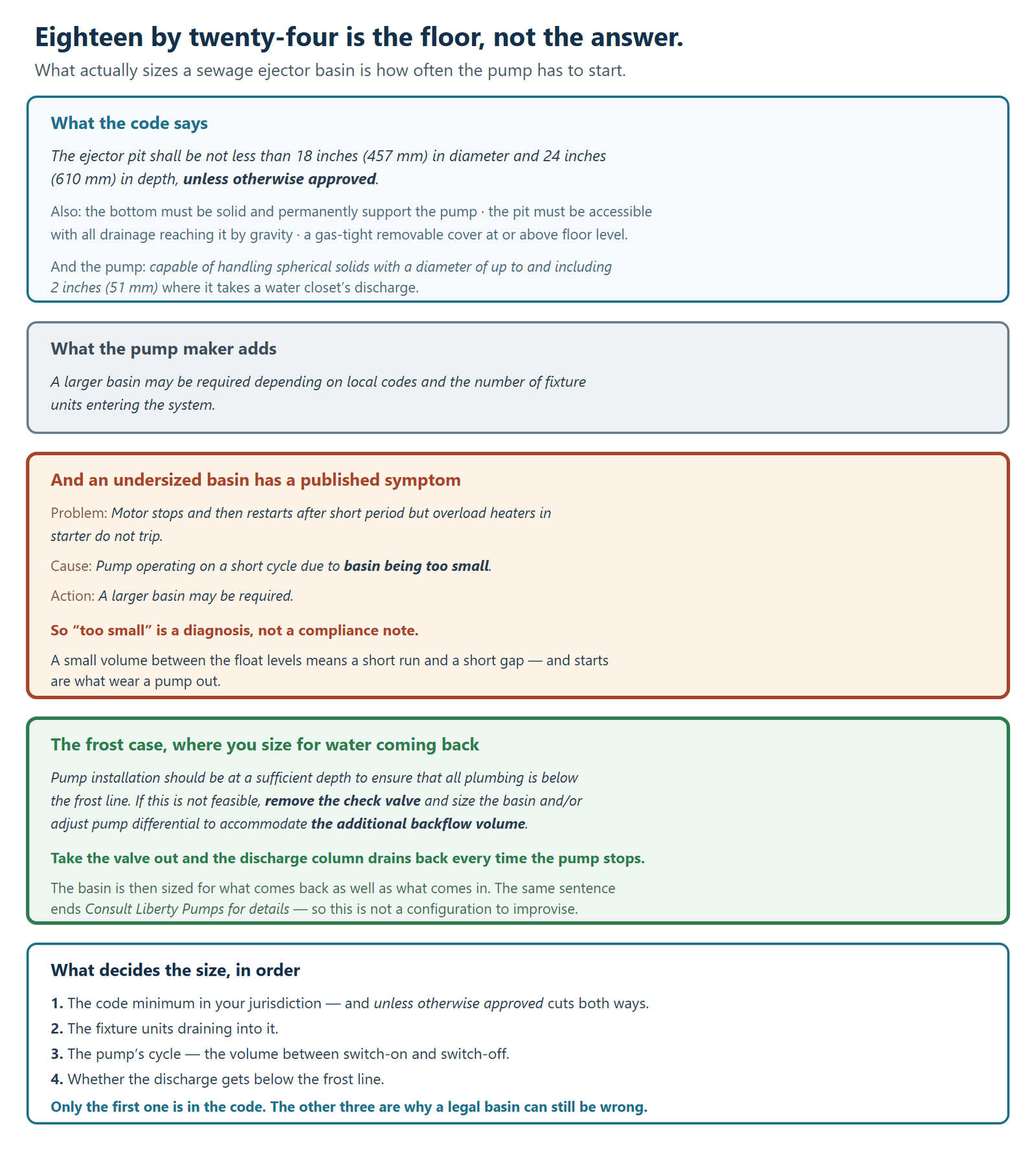
“The ejector pit shall be not less than 18 inches (457 mm) in diameter and 24 inches (610 mm) in depth, unless otherwise approved.”
That is the code minimum, and it is the figure every page on this subject gives you.
**Now read the last four words again: unless otherwise approved. It is a default, not an absolute — and a basin that meets it can still be the wrong basin**, because the thing that actually sizes a pit is not the code floor. It is how often the pump has to start.
What the code requires
From Section 712 of the plumbing code, read at up.codes this session. This is the New York City adoption — your own jurisdiction governs, and the first job on this page is to tell you to check it.
712.3.2 “The ejector pit shall be not less than 18 inches (457 mm) in diameter and 24 inches (610 mm) in depth, unless otherwise approved.”
“The pit bottom shall be solid and provide permanent support for the pump.”
“The pit shall be accessible and located such that all drainage flows into the pit by gravity.”
“The ejector pit shall be fitted with a gas-tight removable cover that is installed flush with grade or floor level, or above grade or floor level.”
And the pump that goes in it has a requirement of its own:
712.4.1 “Pumps or ejectors that receive the discharge of water closets shall be capable of handling spherical solids with a diameter of up to and including 2 inches (51 mm).”
Five requirements, and only one of them is a dimension. The rest are about support, access, gravity and sealing — and the last one is about what has to fit through the pump.
The number the manufacturer adds
Liberty publishes the same minimum, and then immediately qualifies it:
“The diameter should be a minimum of 18 [inches] and the depth a minimum of 24 [inches]. A larger basin may be required depending on local codes and the number of fixture units entering the system.“
Fixture units are how plumbing counts demand — a toilet, a basin, a shower and a laundry each carry a value, and they add up. Fixture units already decide the venting on this kind of pit, and they bear on the basin too.
What Liberty does not publish is a conversion, and this page is not going to invent one. There is no gallons-per-fixture-unit figure here, because the number that matters comes from whoever sized the system against your local code.
What you can take from it is the direction: more fixtures draining into the pit means more basin, and the minimum assumes the small end.
An undersized basin has a symptom
This is the part worth the page, and it comes out of the manufacturer’s troubleshooting matrix rather than any code.
Problem: “Motor stops and then restarts after short period but overload heaters in starter do not trip.”
Possible cause: “Pump operating on a short cycle due to basin being too small.”
Corrective action: “A larger basin may be required. Consult Liberty Pumps.”
So “the basin is too small” is a diagnosis, not a compliance note.
The mechanism is simple arithmetic. A pump moves a fixed amount per minute. The basin holds a fixed amount between the switch-on level and the switch-off level. A small basin means a short run and a short gap, and the pump starts far more often than a larger one would for the same household.
And starts are what wear a pump out — the current draw and the heat are both at startup rather than during running.
One useful observation: watch a cycle and count. If the pump runs for only a few seconds at a time and does it often, the volume between the float levels is small — and whether that is a basin problem or a float-setting problem is the next question.
A pump that runs and refills repeatedly has its own diagnosis, with a leaking check valve and a running toilet both well ahead of basin size on the list. Rule those out before concluding the pit is undersized, because replacing a basin is the most disruptive answer on this page.
The frost case, where you size for water coming back
And one instruction that runs the other way entirely.
“Pump installation should be at a sufficient depth to ensure that all plumbing is below the frost line. If this is not feasible, remove the check valve and size the basin and/or adjust pump differential to accommodate the additional backflow volume. Consult Liberty Pumps for details on how this should be done.”
Read that twice. The manufacturer is describing a configuration where the check valve comes out on purpose — because a check valve holds a column of liquid in a discharge line, and a discharge line above the frost line is a line that can freeze solid.
Take the valve out and that column drains back into the pit every time the pump stops.
Which means the basin is no longer sized only for what comes in. It has to hold the backflow as well, and the manufacturer says so in the same sentence: “size the basin and/or adjust pump differential to accommodate the additional backflow volume.”
**It also ends with “Consult Liberty Pumps for details”, which is the manufacturer saying this is not a configuration to improvise. This page reports it; it does not tell you how to do it.**
What actually decides the size, in order
Four things, and the code floor is only the first.
The code minimum in your jurisdiction. 18 × 24 in the adoption quoted above, and “unless otherwise approved” means a local official can say otherwise in both directions.
The fixture units draining into it. Named by the manufacturer as the reason a larger basin may be required.
The pump’s cycle. The volume between switch-on and switch-off sets how often it starts, and too small a volume shows up as short cycling.
And whether the discharge is below the frost line. If it is not, the backflow volume gets added to the requirement.
The pump you are putting in it bears on all of this — its flow rate, its physical size, and the 2-inch solids capability the code requires of anything taking a toilet’s discharge.
When this needs a pro
All of the sizing, honestly. Three of the four inputs above are design decisions against a local code, and the fourth is a frost depth.
Working out whether a pit is even the right approach. The basin, the vent, the check valve and the alarm are a system rather than a pump, and the sizing question sits inside that.
Replacing or enlarging a basin. It is excavation in a finished basement, a sealed and vented connection to the sanitary drain, and a gas-tight cover afterwards. It is the single most disruptive job in this silo.
Anything in the frost-line configuration. The manufacturer’s own instruction ends by telling you to consult it.
And entering the basin, ever. Sewage and effluent emit gases that are poisonous, and the manufacturer’s manuals say plainly not to enter a pump basin after it has been used.
What you can do yourself: measure the pit you have — across and deep — count the fixtures draining into it, and time one pump cycle from start to stop. Three numbers off a tape measure and a watch — and they tell a plumber in one sentence whether the basin is the problem or the float settings are.
FAQ
What is the minimum size for a sewage ejector basin?
The code section quoted here states not less than 18 inches in diameter and 24 inches in depth, and ends with “unless otherwise approved”. That is the New York City adoption; your own jurisdiction governs, so check it rather than assuming.
Can a sewage ejector basin be too small even if it meets code?
Yes. The pump manufacturer lists “basin being too small” as a cause of short cycling in its own troubleshooting matrix, with a larger basin as the corrective action. Meeting the minimum and suiting the pump are two different tests.
Does the number of bathrooms change the basin size?
The manufacturer says a larger basin may be required depending on local codes and the number of fixture units entering the system. It does not publish a conversion from fixture units to gallons, and no such figure is given here.
Why would you remove a check valve from a sewage ejector?
Only in one published case: where the plumbing cannot be got below the frost line. The manufacturer then says to remove the check valve and size the basin to accommodate the additional backflow volume, and to consult it for details.
What else does the code require of the pit besides size?
That the bottom is solid and permanently supports the pump, that the pit is accessible and all drainage reaches it by gravity, and that it has a gas-tight removable cover at or above floor level. A pump taking a toilet’s discharge must also pass 2-inch spherical solids.
How do I tell whether my basin is undersized?
Time a cycle. Frequent short runs point to a small volume between the float levels — but a leaking check valve and a running toilet cause the same pattern and are far more common, so rule those out first.