On this page
Last Updated on September 29, 2026 by Muhammad Toqeer
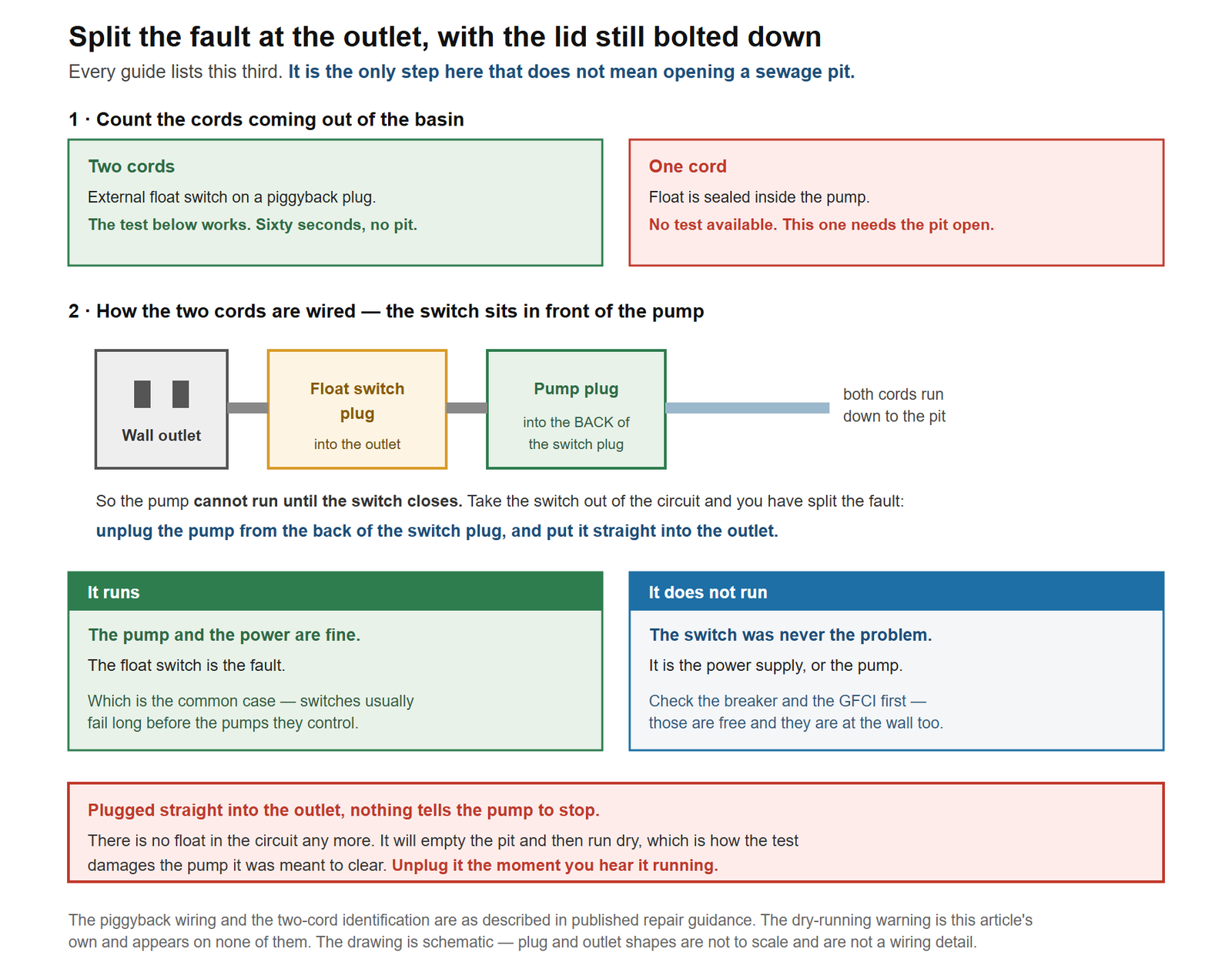
Count the cords coming out of the basin. Two cords means the float switch is a separate device on a piggyback plug, and you can find out whether the pump or the switch has failed in about a minute, at the wall, with the lid still bolted down.
One cord means the float is sealed inside the pump, and you cannot. That is the honest answer, and almost nobody gives it.
Before anything: stop putting water down there
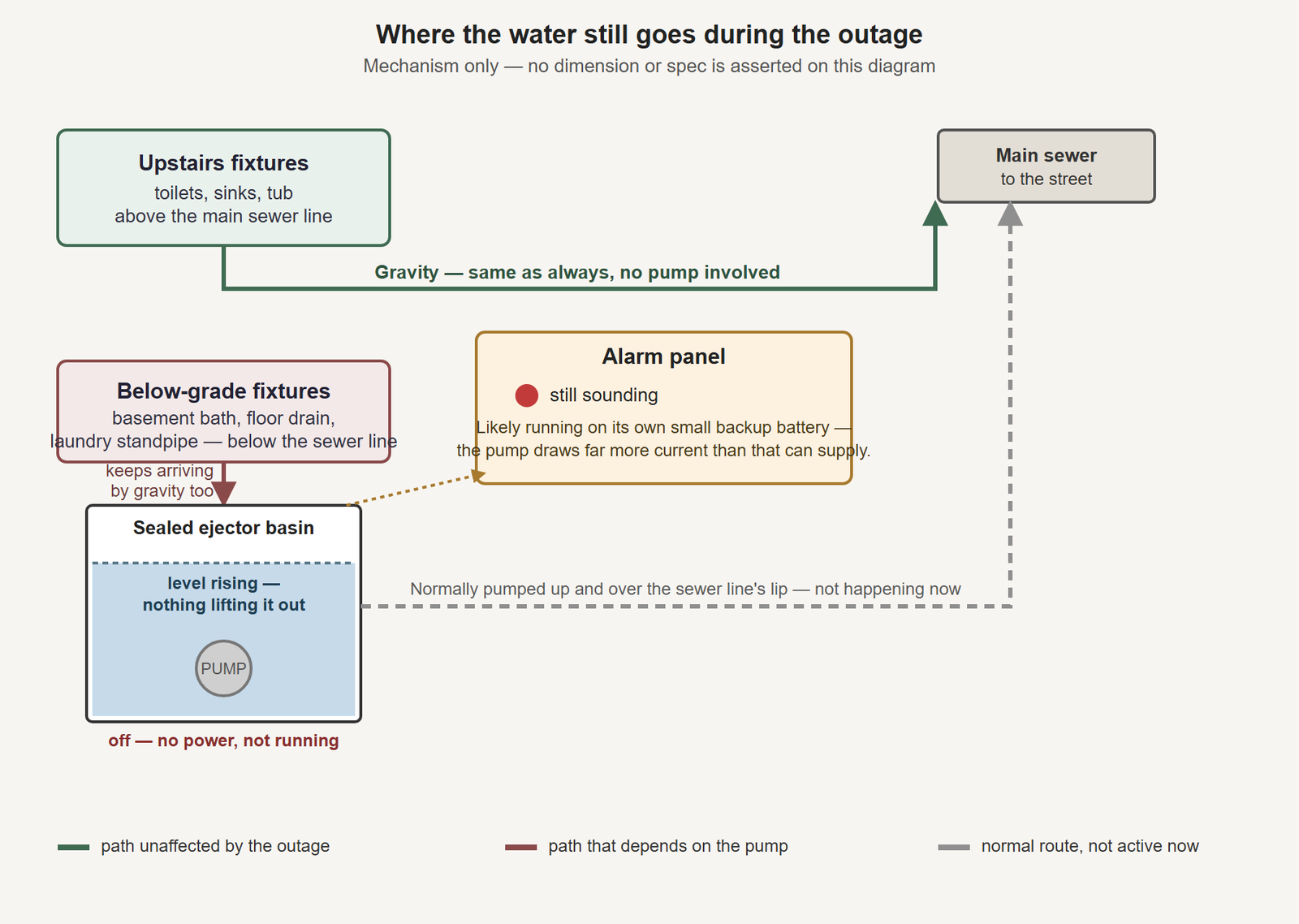
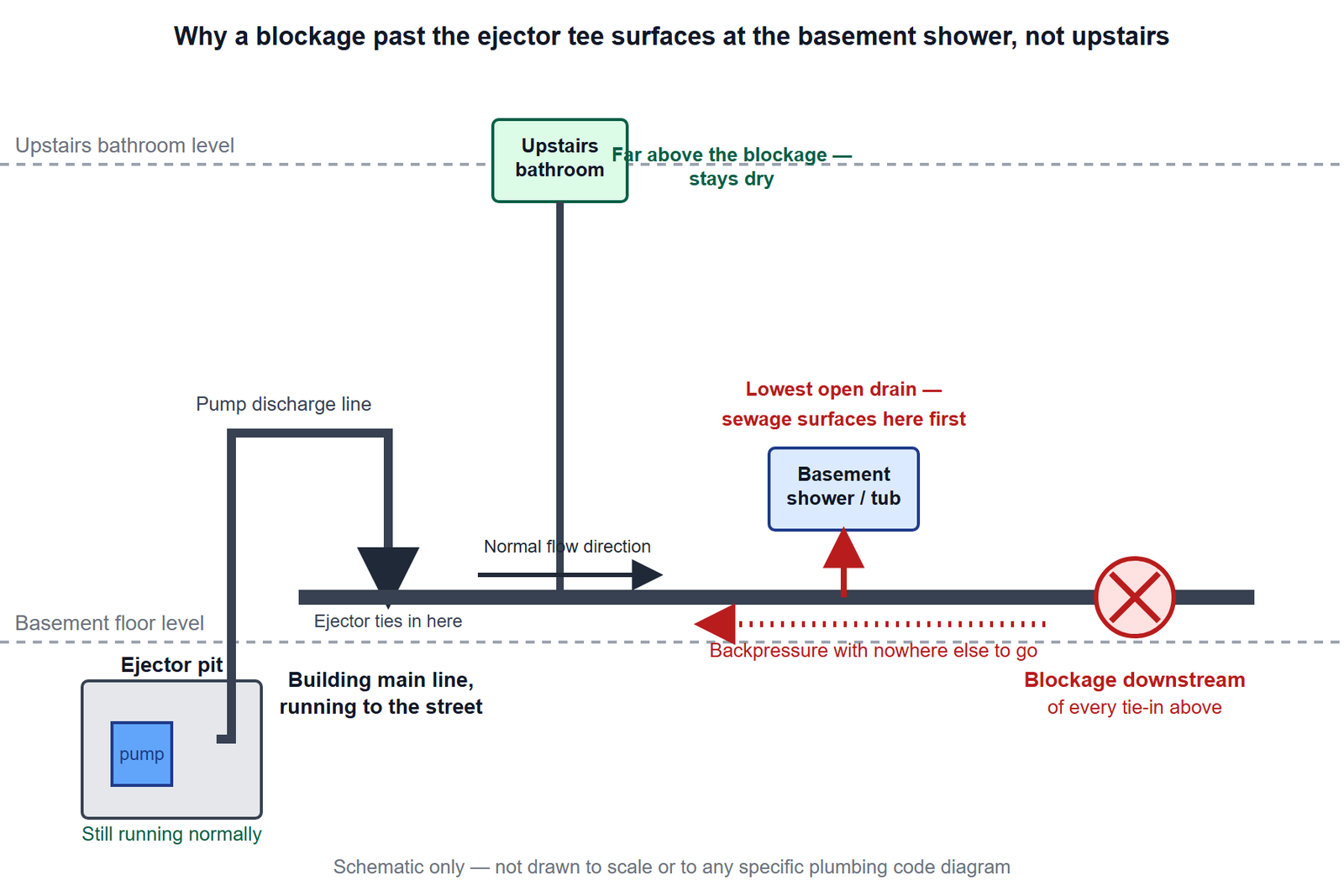
An ejector pit is the low point of your basement drainage. If the pump is not running, everything you send down there stays there — and when it fills, it comes back out of the lowest fixture.
A homeowner on Terry Love’s forum found out the usual way: water backing up into the basement bathroom during a shower. Their pump sits four feet below the waste line in the slab, so there is nowhere else for it to go.
So before you diagnose anything: nothing goes down a basement drain until this is fixed. No toilet, no shower, no laundry if it drains that way. The rest of the house on upper floors is usually fine — it reaches the sewer by gravity and never enters the pit.
If a panel is also sounding, read that first — the alarm is a separate device and it can be the fault on its own.
Step one: count the cords
Follow the cords from the basin back to the outlet.
Two cords and you have an external float switch. The switch’s plug goes into the outlet, and the pump’s plug goes into the back of the switch’s plug — a piggyback. The switch sits electrically in front of the pump, which is why the pump cannot run until the float closes it.
That arrangement is also the test. Unplug the pump from the back of the switch plug and put it straight into the outlet. You have just removed the switch from the circuit entirely.
One warning first, and it is not on any of the pages that describe this test. Plugged direct, the pump has nothing telling it to stop. There is no float in the circuit. It will empty the pit and then run dry, which is how a test meant to save your pump damages it instead. Unplug it the moment you hear it running.
If it runs: the switch is the fault
Good news, and it is the likely one. As the repair guidance puts it, “pump switches often fail long before the pump itself has a problem.”
What actually goes wrong depends on which float you have, and the two types have genuinely different failure modes.
A tethered float hangs on a cord and swings up and out as the level rises. It needs an 18-inch pit to swing in, and it is adjustable — a longer tether means a deeper draw and 3 to 4 more gallons moved per cycle.
It can also foul the pit wall or the discharge pipe on the way up or down. That is what “the float is stuck” means, and it is specifically a tethered-float problem.
A vertical float slides up and down a short rod and works in basins as small as 14 inches. The manufacturers’ own point about it is the relevant one here: it “moves up and down with no chance of getting hung up on the pit wall.”
So: if yours is tethered, stuck is a real possibility. If it is vertical, the switch has more likely failed electrically than mechanically. Either way it is a switch replacement, and either way the pit has to come open to do it.
If it does not run: power first, then the pump
The switch was never the problem, and there are two things left. Check the free one first, because it is also at the wall.
The breaker and the GFCI. Ejector outlets are frequently on a GFCI, and a damp basement trips them. A tripped GFCI looks exactly like a dead pump from across the room. Reset it and try again.
And if the breaker trips again immediately, stop. Something is drawing far more current than it should, and repeatedly resetting it is not diagnosis.
If the power is good and it still does nothing, the pump is the problem — and at that point you are no longer doing anything at the wall.
If you only have one cord
This is the case the troubleshooting lists skip, and it deserves saying plainly.
A single cord means the float is inside the pump housing, sealed. There is no piggyback plug to unplug, nothing to bypass, and no way to separate switch from pump without getting the pump out of the pit.
The homeowner in that forum thread had exactly this — “one wire sticking out of the top that plugs into an outlet” — which is why their diagnosis went the way it did.
You are not missing a clever test. There isn’t one. What you can still do: check the breaker and the GFCI, confirm the outlet is live, and listen at the lid for a hum. Then hand it over.
Where this stops being your job
Every other page on this subject will now tell you to reach into the basin and work the float up and down by hand.
This one will not, because the cover on an ejector pit is a gas seal and what is behind it is not water. That is not caution about difficulty; it is the one genuinely dangerous part of the system.
A working plumber on that thread put the boundary about as honestly as it can be put:
“The only way is to open the cover and get all stanky dirty!”
That is right, and it is the job you are paying somebody for.
Before you pay for a diagnosis
Worth knowing what a call-out is likely to conclude, because it changes how you weigh the cord test.
The trade default once a sewage pump is out of the pit is replacement, not repair. From the same thread:
“If I pull it, I replace it. Same goes for submersible water pumps.”
That is a tradesman’s practice, not advice for you — do not replace a working pump on the strength of it. But if yours has to come out, expect the conversation to go that way, and the cord test is worth doing first precisely because it can prove the pump never needed to come out at all.
That thread, incidentally, was never resolved. The pump was restarted, the owner was careful about what went down it, and it happened again. This is not a fault you should feel slow for not having cracked.
When this needs a pro
Anything that means opening the pit. Stated once more because it is the whole boundary of this article.
A breaker that trips again as soon as you reset it.
Any electrical work at the outlet or beyond it in a damp basement.
A pit that has already overflowed. That is a contaminated-water clean-up, not a mopping job.
And a pump that has run dry because it was left plugged direct. Tell whoever comes out — it changes what they check.
And if the answer is a new pump, choose the cord count deliberately — a pump with its float on a separate plug can be tested at the outlet exactly the way this page describes, and a sealed one-cord pump cannot.
FAQ
Why is my sewage ejector pump not turning on?
Usually the float switch rather than the pump. If two cords come out of the basin, unplug the pump from the back of the switch’s piggyback plug and put it straight into the outlet: if it runs, the switch has failed.
How do I know if it is the pump or the float switch?
The cord test at the outlet. It takes the switch out of the circuit, so the pump running proves the pump and the power are both fine. It only works if you have a separate float switch, which means two cords.
What does it mean if there is only one cord?
The float is sealed inside the pump, so there is no switch to bypass and no way to separate the two without pulling the pump. You can still check the breaker, the GFCI and whether the outlet is live.
Can I leave the pump plugged directly into the outlet?
No. With the float out of the circuit nothing stops it, so it will empty the pit and run dry. Unplug it as soon as you hear it running.
Why does my ejector float get stuck?
Almost always a tethered float, which swings out across the pit as the level rises and can foul the wall or the discharge pipe. A vertical float slides on a rod and cannot hang up that way.
Can I use the bathroom while the ejector pump is out?
Not the one it serves. Anything that drains into the pit stays there until the pump runs, and when the pit fills it backs up through the lowest fixture. Upper floors usually reach the sewer by gravity and are unaffected.