On this page
Last Updated on October 1, 2026 by Muhammad Toqeer
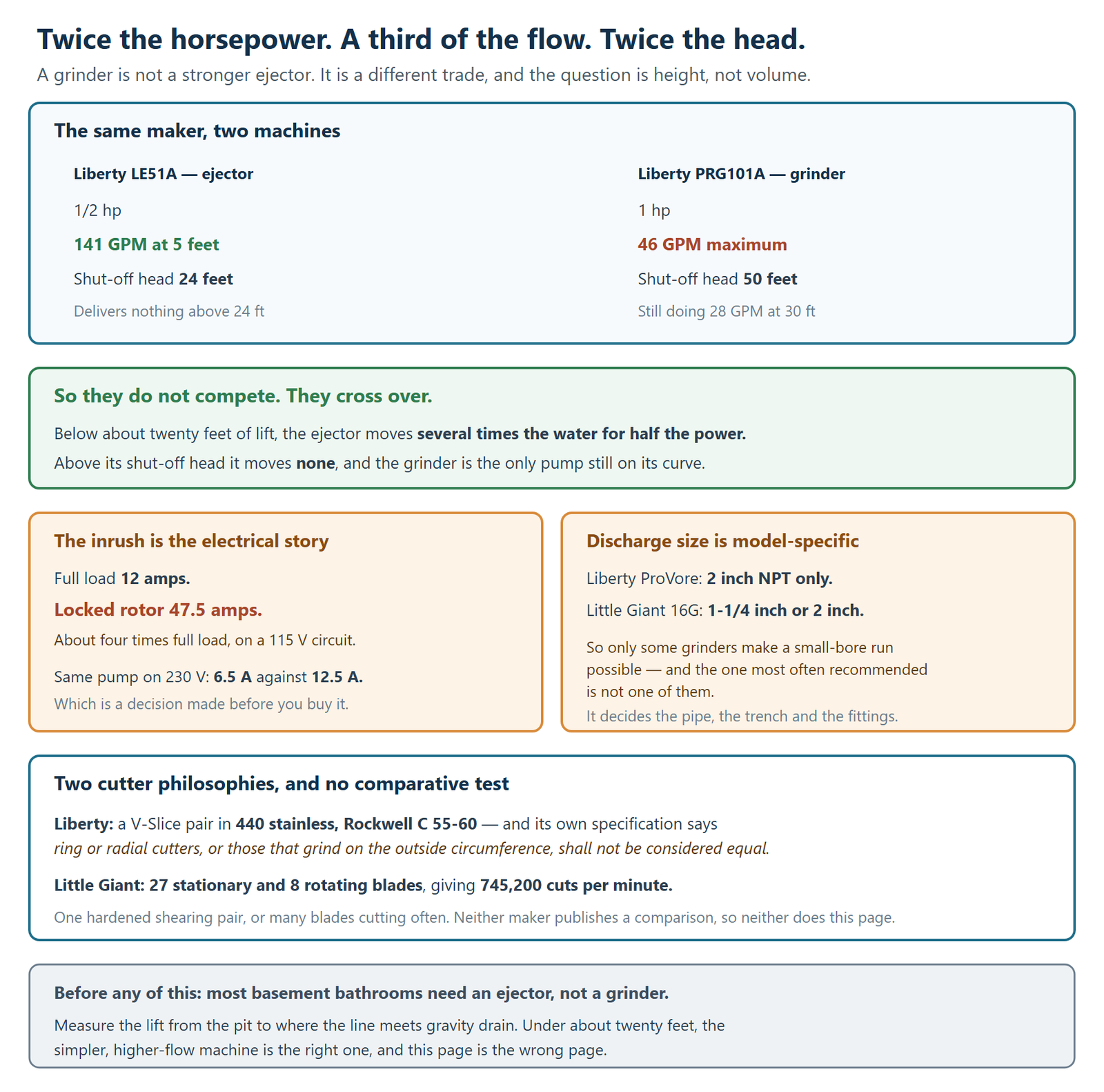
Measure your lift before you buy anything. A 1 hp grinder pump delivers 46 gallons a minute at its best. A half-horsepower sewage ejector delivers 141 at five feet of lift.
Twice the horsepower, a third of the flow. What the grinder buys instead is head — 50 feet against the ejector’s 24 — and that is the only reason to own one.
So the question is not how much sewage. It is how high, and how far.
The same maker, two machines, two different trades
Liberty makes both, which removes the brand variable.
| LE51A — ejector | PRG101A — grinder | |
|---|---|---|
| Horsepower | ½ hp | 1 hp |
| Flow | 141 GPM at 5 ft | 46 GPM max; 28 GPM at 30 ft |
| Shut-off head | 24 ft | 50 ft |
| Discharge | 2 in | 2 in NPT |
Read the two columns against each other and the trade is obvious. The ejector moves roughly three times the water using half the power. The grinder pushes it more than twice as high.
Above 24 feet the ejector is not slower — it is finished. That is what a shut-off head means: the column of water in the pipe is heavier than the pump can lift, and flow stops. At 30 feet the grinder is still delivering 28 GPM.
That crossover is the whole decision, and it happens around twenty feet.
So which do you actually need?
Measure from the pit to the point where your discharge line meets gravity drain. Not the ceiling, not the floor above — the point where the water stops needing to be pushed.
Under about twenty feet: an ejector. Compared properly, with flow read at the height it was measured at, the ejectors move more water for less power, and a basement bathroom tying into a nearby stack is the ordinary case.
Above that, or a long run to a sewer main or a tank uphill: a grinder. This is the case grinders exist for — a pressurised force main rather than a short lift into a gravity stack.
And if the problem is a single fixture rather than a whole bathroom, neither may be the machine — an upflush macerator behind the toilet is a third thing again, with its own limits and its own failure modes.
The electrical spec that decides your circuit
This is where grinders surprise people, and the figures are published.
Liberty’s engineering specification for the PRG101A gives 12 full-load amps and 47.5 locked-rotor amps — the current it draws at the instant of starting.
That is roughly four times full load, on a 115-volt circuit.
It is also exactly why a grinder trips a breaker that a sewage pump never bothered — the running current is unremarkable and the starting current is not.
And there is a decision to make before you buy. Little Giant publishes both voltages for the same pump:
“115 V, 60 Hz, 12.5 A” and “230 V, 60 Hz, 6.5 A”
Half the current on 230 volts. Where 230 V is available at the pit, it is the better circuit for a machine with this inrush — and swapping later means changing the pump, not the wiring.
The spec that decides your pipe
Grinders are often described as allowing a smaller discharge line. That is true of some of them and not others, and the difference matters before you dig anything.
- Liberty PRG101A ProVore: 2-inch NPT. Only. Same pipe as an ejector.
- **Little Giant 16G: “1-1/4″ (31.75 mm) and 2″ (50.8 mm) NPT adapter.”**
So a small-bore force main is a Little Giant option and not a ProVore one, and the pump most often recommended for residential work is the one that cannot do it.
Check this before the trench is specified, because it decides the pipe, the fittings and the dig.
Two cutter designs, and nobody has tested them against each other
Worth knowing because the marketing sounds identical and the engineering is not.
Liberty specifies a hardened shearing pair:
“The cutter and plate shall be of the V-Slice design and consist of 440 stainless steel with a Rockwell C hardness of 55-60.”
And then writes the alternative out of its own specification:
“Ring or radial cutters, or those that grind on the outside circumference of shall not be considered equal.”
Little Giant builds the alternative:
“Cutting mechanism equipped with 27 stationary blades and 8 rotating blades – producing 3450 RPM and 745,200 cuts per minute”
One approach is a hard pair shearing with close tolerances; the other is many blades cutting very often. Both are real engineering positions. Neither manufacturer publishes a comparative test, so this page does not declare a winner — it tells you the choice exists, which is more than the round-ups do.
The six worth knowing
A short list on purpose. The residential 1 hp grinder field is genuinely small, and the ten-item round-ups reach ten by including 2 hp commercial pumps that do not belong in a house.
Liberty PRG101A ProVore — the default
Liberty PRG101A — 1 hp, 115 V, 1-phase, 3450 RPM. 12 full-load amps, 47.5 locked-rotor. 2-inch NPT discharge. 46 GPM max, 28 GPM at 30 feet, 50-foot shut-off. V-Slice cutter in 440 stainless. Class 25 cast iron housing and volute, 303 stainless shaft, graphite-impregnated silicon carbide seal, minimum bearing life 50,000 hours. Wide-angle tilt float, 10-foot SJTW cord. 61 lbs. SSPMA and cCSAus certified.
Who it is for: a residential lift that genuinely exceeds what an ejector can do, on a 115-volt supply.
The honest drawback: 2-inch discharge only, so it gives you nothing on pipe size over the ejector you might have fitted instead. And at 61 lbs in a sewage pit, it is not a pump one person lifts out casually.
Liberty PRG101A-2 — the same pump, 25 feet of cord
Liberty PRG101A-2 — identical specification, 25-foot cord instead of 10.
Who it is for: a pit where the receptacle is not adjacent. This is the entry to buy if there is any doubt, because the alternative is an extension cord on a sewage pump, which manufacturers prohibit.
The honest drawback: none beyond the obvious — more cord to route and secure.
Liberty PRG101M — manual, for a control panel
Liberty PRG101M — same pump, no switch supplied.
Who it is for: installations running a proper control panel with its own float tree, which is the normal arrangement where alarms and duplex control are involved.
The honest drawback: it will not run on its own. Buying this by mistake means a pump that never starts.
Little Giant 16G-M151-20 — the 115-volt alternative
Little Giant 16G-M151-20 — 1 hp, 115 V, 12.5 A. 49.3 GPM at 10 feet, 53-foot shut-off. 1-1/4-inch or 2-inch NPT discharge. Class F motor, 20-foot sealed cord. Manual. Three-year warranty. Model 509809.
Who it is for: anyone who wants the smaller discharge option, or the longer cord as standard.
The honest drawback: manual, so it needs a switch or panel. And the 1-1/4-inch option is a decision, not a free upgrade — a narrower pipe runs at higher velocity and leaves less margin if anything restricts it.
Little Giant 16G-M231-20 — the same pump at 230 volts
Little Giant 16G-M231-20 — as above, 230 V, 6.5 A. Model 509812.
Who it is for: any installation where 230 V is already available at the pit. Half the current for the same work.
The honest drawback: 230 V is not usually sitting in a basement pit waiting, and adding it is electrician work that must be decided before the pump is bought.
Little Giant 16G-F151-20 — the automatic version
Little Giant 16G-F151-20 — the 115-volt 16G with a float switch fitted. Model 509810. Vertical-float variants exist as 16G-V151-20 (509811) and 16G-V231-20 (509814).
Who it is for: a straightforward single-pump installation with no panel.
The honest drawback: the float is the part that fails first on any pit pump, and an integrated one is less easily swapped than a piggyback.
Side by side
| Pump | HP | Volts / FLA | Flow | Shut-off | Discharge |
|---|---|---|---|---|---|
| Liberty PRG101A | 1 | 115 / 12 (47.5 LRA) | 46 max, 28 at 30 ft | 50 ft | 2 in |
| Liberty PRG101A-2 | 1 | 115 / 12 | as above | 50 ft | 2 in |
| Liberty PRG101M | 1 | 115 / 12 | as above | 50 ft | 2 in |
| Little Giant 16G-M151-20 | 1 | 115 / 12.5 | 49.3 at 10 ft | 53 ft | 1¼ or 2 in |
| Little Giant 16G-M231-20 | 1 | 230 / 6.5 | 49.3 at 10 ft | 53 ft | 1¼ or 2 in |
| Little Giant 16G-F151-20 | 1 | 115 / 12.5 | 49.3 at 10 ft | 53 ft | 1¼ or 2 in |
Zoeller’s Shark grinders exist in this space. They are not specified here because Zoeller’s own site is not reachable for verification, and the reseller listings contradict each other — one titles the fractional model “Fractional HP Grinder Pump 1.0 HP”, which cannot both be true. Nothing is asserted about them rather than something wrong.
When this needs a pro
All of it, frankly, and more than with most pumps on this site.
The electrical. A 47.5-amp inrush on a dedicated circuit is a calculation, not a guess, and sewage pits are damp.
The discharge and the force main. This is pressurised sewage. A joint that fails on a gravity line makes a mess; one that fails on a force main makes a much bigger one.
Anything involving opening the pit. A sewage pit is sealed and vented as part of the drainage system and opening it is not a casual job.
What you can do yourself: measure the vertical distance from the pit to where the line meets gravity drain, and find out what voltage is available at the pit. Two numbers — and between them they decide whether you are on this page at all.
FAQ
Do I need a grinder pump or a sewage ejector pump?
Measure the lift from the pit to where the discharge meets gravity drain. Below about twenty feet an ejector moves roughly three times the water for half the horsepower. Above an ejector’s shut-off head it delivers nothing, and a grinder becomes the only option.
Is a grinder pump more powerful than a sewage ejector?
It has more horsepower and far less flow. A 1 hp grinder peaks around 46 GPM where a half-horsepower ejector does 141 GPM at five feet. The grinder spends its power on head instead — 50 feet against 24.
Why does a grinder pump trip the breaker?
Because of starting current. Liberty publishes 12 full-load amps and 47.5 locked-rotor amps for its 1 hp residential grinder, roughly four times the running figure, and that surge is what a breaker sees at every start.
Can a grinder pump use a smaller discharge pipe?
Some can. Little Giant’s 16G offers a 1-1/4-inch or 2-inch discharge; Liberty’s ProVore is 2-inch NPT only. It is a model-by-model question and it needs settling before the pipe run is specified.
Should I get a 115V or 230V grinder pump?
Where 230 V is available at the pit, it halves the current — Little Giant lists 12.5 A at 115 V and 6.5 A at 230 V for the same pump. It is decided at purchase, because changing later means changing the pump.
What is the difference between grinder cutter designs?
Two approaches are sold. Liberty uses a hardened V-Slice shearing pair in 440 stainless; Little Giant uses 27 stationary and 8 rotating blades at 745,200 cuts a minute. No manufacturer publishes a test comparing them, so treat confident rankings with suspicion.