On this page
Last Updated on September 29, 2026 by Muhammad Toqeer
Does it ever stop?
A pump that never shuts off and a pump that shuts off cleanly then starts again ten minutes later are two completely different faults, and every troubleshooting list on this subject offers the same causes for both. One question separates them — and whichever answer you get rules the other set out entirely.
If it stops properly and then restarts, nothing on your pump is wrong. The pit is refilling behind it.
If it never stops, switch it off first
A pump running continuously with nothing left to move is a pump destroying itself — the water it moves is what carries its heat away, and an empty pit takes that away.
Kill the breaker, then work out why. You have a little time before the pit fills again, and you will not get that pump back once it has cooked.
If it is stopping and starting normally, you are not in a hurry. Annoying, expensive in pump life, but nothing is burning.
What the level does tells you which fault you have
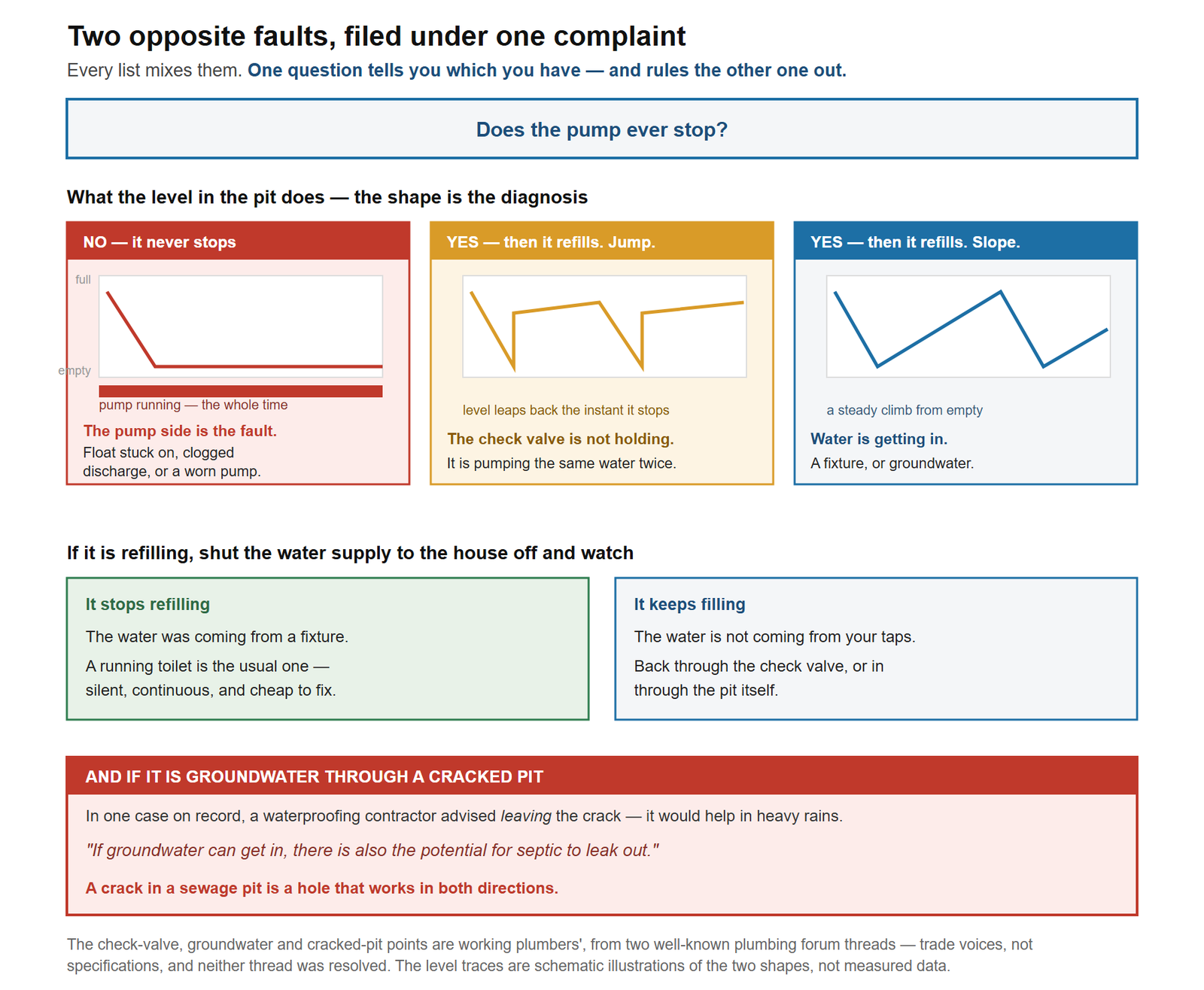
It never stops
The pump cannot reach the level that would shut it off, or is never told to.
A float stuck in the on position is the common one — and it is the same float whose wiring lets you test it at the outlet. Stuck on rather than stuck off, but the same part and the same limitation: freeing it means opening the pit.
A clogged or restricted discharge, so the pump runs and moves very little.
A worn pump that no longer shifts what it used to.
All three are below the lid, which is where this stops being a homeowner job.
It stops, then refills
This is the more common complaint and the more misdiagnosed one, because the pump is working perfectly. A pump that shuts off cleanly is not a pump with a stuck float or a dead motor. Cross the whole first list off.
The question becomes: where is the water coming from? There are only three answers.
First, shut the water supply to the house off
Then watch the pit.
If it stops refilling, the water was coming from a fixture. A running toilet is the usual culprit — silent, continuous, and the cheapest repair on this page. That is the answer you want.
If it keeps filling with the supply shut off, the water is not coming from your taps at all. Two possibilities left, and the timing tells them apart.
A jump means the check valve
Watch the level the moment a cycle ends. If it leaps straight back up, the check valve is not holding — that is the column of waste in the discharge pipe coming back down. As a tradesman on Terry Love’s forum put it:
“the check valve could be leaking by letting the sewage flow back into the tank”
The pump is then moving the same water over and over, which is why the cycles are short and pointless.
One caution, because this is easy to misread. Some backflow is completely normal — the pipe above the valve always empties when the pump stops, and you will hear it. The fault is not that water returns. The fault is that enough returns to trigger another cycle.
A slope means water is getting in
If instead the level climbs back steadily from empty, something is feeding the pit. Often it is audible: a homeowner in that same thread described “trickling water in the pit even with no water running” after spring rains.
That is groundwater, and it is worse after rain, worse in spring, and better in a dry month — which is itself the giveaway.
When the water is groundwater
This deserves its own section, because the obvious fix is not the one you will be offered.
A homeowner in Chicago had an ejector pit with a structural crack three inches below the drain tiles. The geometry is the whole mechanism: because the crack sat below the tile line, groundwater reached the ejector pit before the sump pit could fill. The sewage pump was doing the sump pump’s job, all year. Their own summary:
“ejector pump runs a lot so I’m at risk of burning through them well before the typical useful life”
And a waterproofing contractor recommended leaving the crack alone, on the grounds that it would help in heavy rains — along with drilling further holes in the basin to share the load between the two pumps.
A plumber on the thread disagreed, in one sentence that settles it:
“If groundwater can get in, there is also the potential for septic to leak out.”
A crack in a sewage pit is a hole that works in both directions. Treating it as a handy drain means treating it as an outlet as well, into the ground under your house.
And it shows up as a second symptom: the same crack that lets groundwater in lets sewer gas out.
That thread, like the other one, was never resolved — the owner never came back to say what they did.
When this needs a pro
Anything below the lid, which on this symptom is most of it: a stuck float, a clogged discharge, a check valve that is not holding, a worn pump.
A pump that never shuts off. Switch it off, then call. Every extra hour is pump life.
A pit that fills with the house supply shut off. Something structural is going on, and it needs somebody who can look.
Any cracked or damaged basin. Get it quoted as a repair or replacement, not as a feature.
What you can do yourself, all from outside the pit: time a cycle, watch whether the level jumps or climbs, shut the supply off and wait, check every toilet in the house for a silent runner, and note whether it is worse after rain. That is a genuinely useful handover, and none of it needs the lid off.
And if a panel is sounding as well, the alarm is a separate device with its own faults.
And if the cycling turns out to be the pit rather than a fault, a pump with an adjustable float lets you lengthen each run, which a sealed automatic pump with fixed on and off points cannot.
FAQ
Why does my sewage ejector pump keep running?
Establish whether it ever stops. If it never shuts off, the fault is the pump side — a stuck float, a clogged discharge or a worn pump. If it shuts off cleanly and restarts minutes later, the pump is fine and the pit is refilling.
How often should an ejector pump run?
As often as the household sends water into the pit and no more. There is no fixed figure, which is why the useful question is not how often it runs but whether the pit is filling from somewhere it should not be.
Why does my ejector pit fill up when no water is running?
Either sewage is coming back through a failing check valve, or groundwater is getting into the basin. Shut the house water off and watch: a level that jumps the moment the pump stops is the check valve, a steady climb is groundwater.
Is it normal for water to run back into the pit after the pump stops?
Yes. The pipe above the check valve always empties back, and you will hear it. What is not normal is enough coming back to trigger another cycle.
Can a running toilet make the ejector pump cycle?
Very much so, and it is the cheapest cause on the list. A silent leaking flapper sends water into the pit continuously. Shutting the supply off and watching the pit is the quickest way to find it.
Should I leave a crack in my ejector pit if it helps with drainage?
No. A crack that lets groundwater in can let sewage out. Whatever it does for your water table, it is a hole in a vessel holding raw sewage under your house.