On this page
Last Updated on October 7, 2026 by Muhammad Toqeer
A basement bathroom that gets used twice a year still has a pump in the floor, and the manufacturer has a published interval for exactly that situation.
“Installed pumps that are idle for greater than one month should have cutters and impellers manually operated through the breaker panel once a month to lubricate the seals.”
One month. Not one year, and not “when you remember.”
The reason given is the seals. A grinder pump’s shaft seals are lubricated by the pump turning, so a pump that never turns is a pump whose seals are never lubricated.
And the whole routine is done at the breaker panel in 30 seconds, with the lid staying shut.
Who this is for
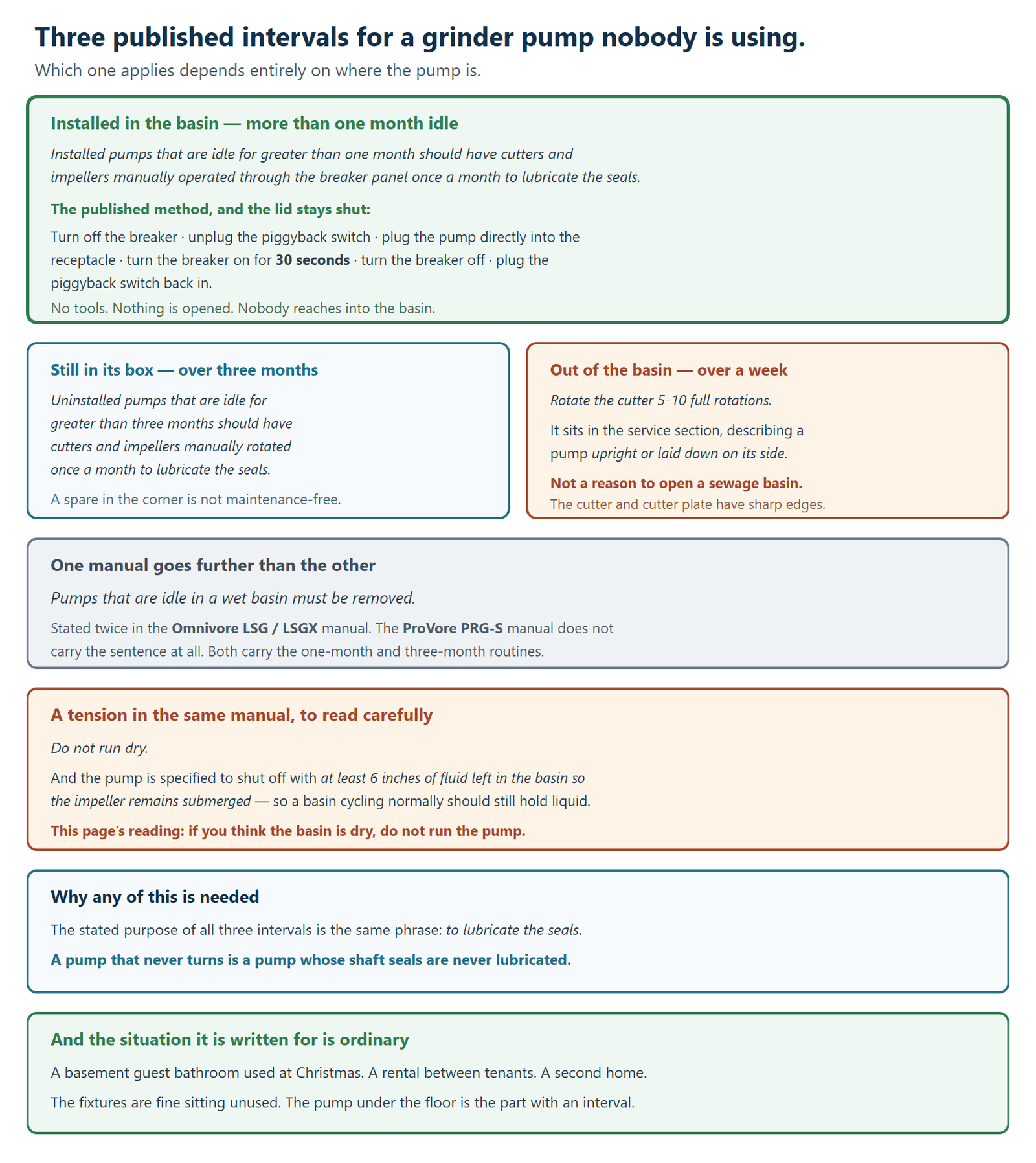
The situation this is written for is ordinary. A finished basement with a bathroom below the sewer line. A guest suite used at Christmas. A rental between tenants. A second home.
The fixtures are fine sitting unused. The pump underneath them is the part with a published interval.
And it is the component nobody thinks of, because it is under a sealed lid, it made no noise, and nothing has gone wrong.
Before you start
Tools: none. This is done at the breaker panel and at the receptacle the pump is plugged into.
What you need to know first: whether your pump is an automatic model on a piggyback switch. That is the arrangement the published procedure is written for — the pump’s own plug goes into the back of a float switch plug, and the float switch plug goes into the receptacle.
Safety note, and it is the manufacturer’s own: “Pumps should only be operated without the float switch by using the circuit breaker or panel disconnect.”
Which means the breaker is the switch for this job. You are not plugging and unplugging a live pump, and you are not reaching into the basin at any point.
**One more published warning from the same manual: “Do not run dry.”** The pump is also specified to shut off with “at least 6 [inches] of fluid left in the basin so the impeller remains submerged”, so a basin that has been cycling normally should still hold liquid. This page’s reading of those two statements together is simple: if you have reason to think the basin is dry, do not run the pump.
The published routine, step by step
This is the manufacturer’s procedure, in its own order:
1. Turn off the breaker for the pump circuit.
2. Unplug the piggyback switch from the receptacle.
3. Plug the pump directly into the receptacle. The pump is now wired past its own float switch, which is the point — you are no longer waiting for the basin to fill.
4. Turn the breaker on for 30 seconds. That is the published duration.
5. Turn the breaker off.
6. Plug the piggyback switch back in, and restore the normal arrangement.
Then turn the breaker back on so the system is live again and the float switch is back in control.
Once a month, for as long as the bathroom is out of use.
Why 30 seconds, and why not longer
The manufacturer bounds the run. It does not say to run the pump until the basin empties, and it does not say to run it for five minutes.
Thirty seconds is enough to turn the impeller and the cutter, which is the stated purpose — “to lubricate the seals.”
**Running it longer is where the “Do not run dry” warning starts to matter, because with the float bypassed nothing is going to stop the pump when the liquid runs out. The float switch is the protection you have deliberately removed for 30 seconds**, which is a good reason to put it straight back.
The one-week figure, and why it is not for you
The same manual carries a shorter interval, and it is easy to misread:
“rotating the cutter helps to lubricate the shaft seals if the pump has been non-operational for more than a week. It is recommended to rotate the cutter 5-10 full rotations.”
One week. But read where it sits. The passage around it describes a pump that “can remain upright or can be laid down on its side for easier access to the cutter” — a pump that is out of the basin, in someone’s hands.
It is a service instruction, not a homeowner one. The manual also says to “wear protective gloves as the cutter and cutter plate have sharp edges.”
So the one-week figure is not a reason to open a sewage basin. That basin is sealed and vented for health and plumbing code reasons, and opening it is not a monthly maintenance task.
And a third interval, for a pump still in its box
If you have a spare, or a replacement waiting to go in:
“Uninstalled pumps that are idle for greater than three months should have cutters and impellers manually rotated once a month to lubricate the seals.”
Three months before the clock starts, then monthly. The manual also asks that a stored pump stay in its shipping container, somewhere “clean, dry temperature-stable”, with “the cord ends… protected against moisture.”
A spare pump bought and left in a basement corner is a reasonable precaution — it just is not a zero-maintenance one.
One manual goes further than the other
This is worth knowing if you are reading Liberty’s documentation and wondering why it does not match what you were told.
The Omnivore LSG and LSGX manual carries a flat instruction, stated twice:
“Pumps that are idle in a wet basin must be removed.”
The ProVore PRG-S manual does not contain that sentence. Both carry the one-month breaker routine and the three-month storage routine; only the LSG and LSGX manual adds the removal instruction.
This page reports that difference rather than resolving it. If your pump is an LSG or LSGX and the basin is going to sit wet and unused, that sentence is in your manual and it is unambiguous — and acting on it means pulling a pump, which is not a homeowner job.
When this needs a pro
Removing a pump from a wet basin. Whichever manual you are holding, this is confined-space, sewage-gas and heavy-lift territory. The manuals carry warnings about poisonous gases and about energised water, and neither is a caution to work around.
Anything involving the cutter. Sharp edges, and a pump that must be out and isolated before anyone touches it.
A pump that does not run when you try this. If the breaker goes on and nothing happens, that is a diagnosis in its own right rather than a sign the monthly routine was overdue.
A pump that runs but the basin does not go down. That has its own causes, and running it for longer will not help.
And any of this on a system you do not have the manual for. The pit, the vent, the check valve and the alarm are a system rather than a pump, and the intervals above are from two specific Liberty manuals rather than a universal rule.
What you can do yourself: find the model number on the pump nameplate or on the paperwork, download that manual, and check whether your maker publishes an idle interval at all. Five minutes, and it tells you whether the thirty-second routine applies to your pump or whether yours says something different.
FAQ
How often should a grinder pump be run if the bathroom is not used?
Liberty’s manuals say installed pumps idle for more than one month should have the cutters and impellers operated through the breaker panel once a month, to lubricate the seals. The published run is 30 seconds.
Why does an unused pump need running at all?
Because the seals are lubricated by the pump turning. The stated purpose of the monthly routine is “to lubricate the seals” — a pump that never runs is a pump whose shaft seals are never lubricated.
How do I run a grinder pump manually?
The published method for automatic models: turn off the breaker, unplug the piggyback switch, plug the pump directly into the receptacle, turn the breaker on for 30 seconds, turn it off, then plug the piggyback switch back in. The manufacturer adds that pumps should only be operated without the float switch by using the circuit breaker or panel disconnect.
Is 30 seconds long enough?
It is the published duration, and the purpose is to turn the impeller and cutter rather than to empty the basin. Running longer matters because the float switch is bypassed during the procedure, and the same manual says not to run the pump dry.
Should I open the basin to turn the cutter by hand?
No. The five-to-ten-rotation instruction appears in the service section and describes a pump that is out of the basin, upright or laid on its side, handled with protective gloves. It is not a homeowner task and not a reason to open a sealed sewage basin.
Does a pump left in a wet basin have to be removed?
The Omnivore LSG and LSGX manual states that pumps idle in a wet basin must be removed, and says it twice. The ProVore PRG-S manual does not carry that sentence. Check which manual applies to your pump, and treat removal as a job for a professional.