On this page
- Check Whether the Pump Is Actually Running First
- Why Would a Working Pump Make Sewage Back Up at All?
- The Basement Shower Floods Before the Upstairs Bath Does
- The Pit's Own Check Valve Doesn't Guard This Drain
- Clearing the Main Line Is Not a DIY Job
- Shutting the Breaker Buys Time; Clearing the Line Fixes It
Last Updated on October 11, 2026 by umar bwn
If sewage is coming up a shower or tub drain and the house also has an ejector pit, the instinct is to blame the pump. Nine times out of ten the pump is fine — it’s still running, still pushing water into the main line — and the real blockage sits downstream, where that line has nowhere to send it. A dead pump floods the pit itself. It doesn’t force water up a drain across the room.
That distinction is the whole article. Get it backwards and you spend an afternoon pulling a working pump out of a pit while the actual clog, further down the line, puts sewage back in the same shower the moment you turn anything on again.
Check Whether the Pump Is Actually Running First
Before touching the pit, find out which situation you actually have. Lift the pit lid, or just stand next to it, and run water somewhere in the house that drains into that basin — a basement sink, a laundry tap, the toilet nearest the pit. Listen and feel the discharge pipe a few feet from the pump for the next minute.
- Nothing hums, nothing pulses, the level in the pit just keeps climbing. The pump itself isn’t running. That’s a dead motor, a tripped switch or a stuck float — not this article’s fault. See sewage ejector pump not turning on for the wiring and float checks, because a non-running pump only ever overflows at the pit. It has no way to push water into a shower on the other side of the basement; it isn’t adding pressure anywhere.
- The pump kicks on, you can feel it pulsing through the discharge pipe, and the level in the pit visibly drops when it does. The pump is doing its job correctly. Keep reading — this is the case the rest of this article is actually about.
- The pump runs, but the level in the pit barely moves even after a full cycle. That’s a different fault sitting inside the pit’s own circuit — a closed valve, a jammed impeller, a check valve stuck backwards, or lift beyond what the pump can manage. Ejector pump runs but the pit doesn’t empty walks through those five causes in the order they’re actually worth checking.
- The pump never stops — it’s not cycling on and off, it’s just running continuously. That’s a separate symptom with its own causes (a float that can’t reach its off position, a slow-filling source that never lets it rest). See ejector pump running constantly instead.
If your pump lands in the second bullet — running, pulsing, and visibly emptying the pit — and sewage is still showing up in a shower or tub, the fault isn’t in the basin at all.
Why Would a Working Pump Make Sewage Back Up at All?
An ejector pit exists because the fixtures feeding it — usually a basement bathroom, a laundry sink, a wet bar — sit below the level the building’s main drain line needs to leave the house by gravity. The pump’s only job is to lift that wastewater up into the main line, where gravity takes over again and carries it out to the street or the septic tank.
That main line has a fixed capacity, and once the ejector’s discharge joins it, the pump has no control over what happens next. If something blocks the line downstream of that joint — roots, grease, a collapsed section, a flushed object the line can’t pass — the wastewater the pump is still faithfully lifting has nowhere to go. It backs up inside the pipe until it finds the lowest point in the system that’s still open to the air. In a house with a basement ejector system, that’s very often the basement shower or tub drain, not the pit.
So “the ejector pump failed” usually means something closer to the opposite: the main line failed, and the pump is still running exactly as designed, making the backup worse one cycle at a time by continuing to add volume to a pipe that’s already full.
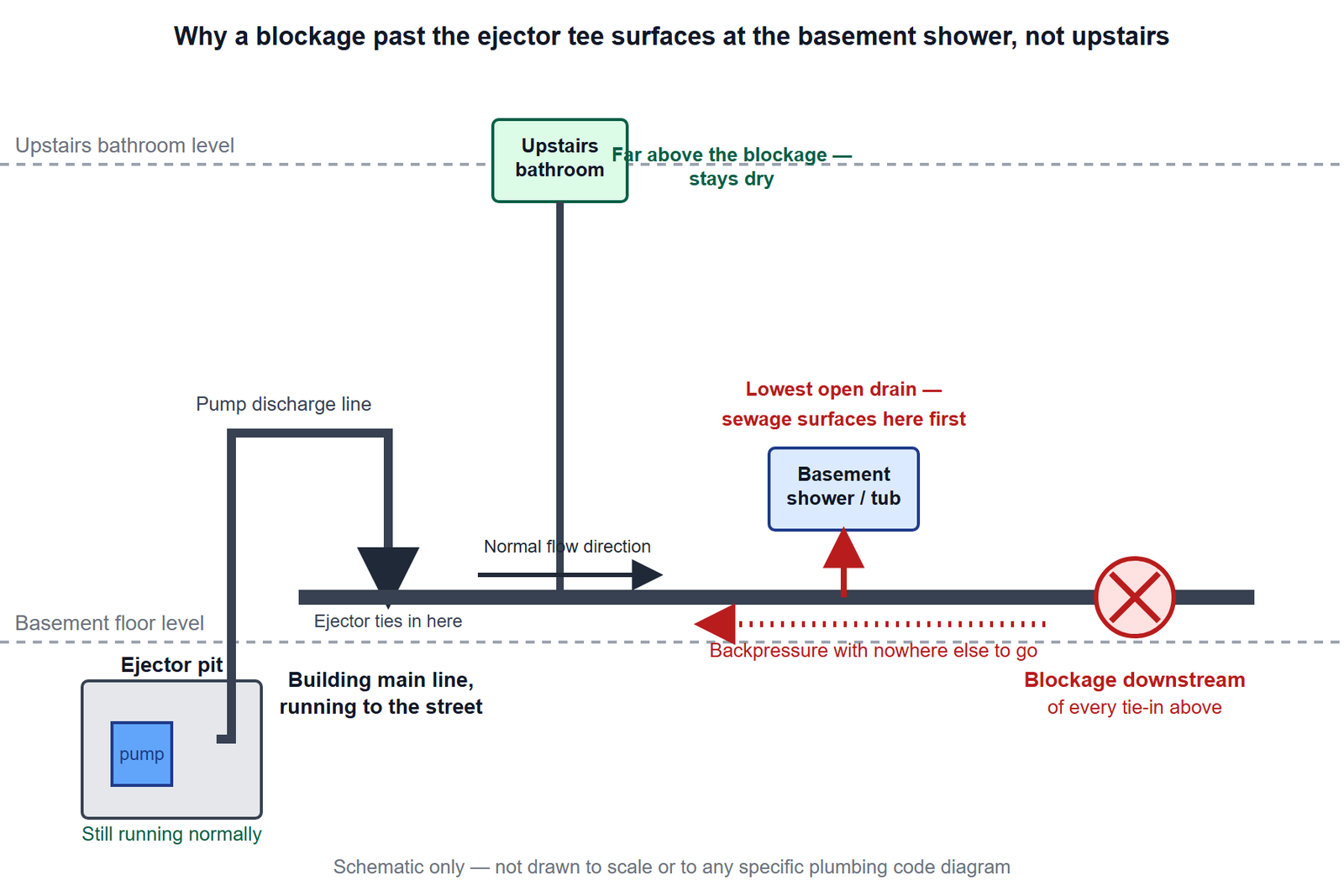
One-minute test for this specific cause: with the pump confirmed running and the pit confirmed emptying (previous section), shut the pump off at its breaker and watch the shower or tub for the next few minutes. You’re not fixing anything by doing this — you’re confirming the mechanism. If the level at the fixture stops climbing, or climbs noticeably slower, once the pump stops adding volume, that confirms a downstream blockage is the problem and the pump was simply making it worse. Leave the breaker off until a plumber clears the line; don’t turn the pump back on in the meantime, or the pit itself will start filling toward its own overflow.
The Basement Shower Floods Before the Upstairs Bath Does
Which fixture backs up first isn’t random. It’s whichever drain in the house sits at the lowest elevation relative to the blockage, and in a house with a basement ejector system, that’s almost always a fixture down there — the basement shower, the tub, or a floor drain — rather than anything upstairs.
An upstairs bathroom is protected by the one thing a basement fixture doesn’t have: height. For backed-up sewage to reach an upstairs drain, the water in the blocked line would have to rise all the way up to that floor’s elevation before it could come out anywhere else. It almost never gets that far, because a much lower opening — the basement shower pan, sitting barely above the main line itself — fills and overflows long before the pressure could climb that high. The symptom shows up downstairs specifically because downstairs is where the path of least resistance actually is.
The Pit’s Own Check Valve Doesn’t Guard This Drain
It’s a reasonable guess that the ejector pit’s check valve is somehow involved, since that valve is the one component in the system whose entire job is stopping backward flow. It isn’t involved here, and it’s worth being specific about why: that check valve sits in the pump’s own discharge line, right above the basin, and its only job is to stop water in the main line from draining back down into the pit itself once the pump shuts off. Ejector pump shuts off and restarts on its own covers exactly what happens when that valve fails — the pit refills from its own discharge and the float re-triggers the pump.
What it does not do is stand between a downstream blockage and your shower drain. That valve protects the basin. The shower’s trap and drain line are a completely separate branch tied into the same main line, with nothing in between them and a clog three fixtures away. A perfectly healthy check valve in the ejector pit has no bearing on whether sewage can rise up a different drain entirely.
Clearing the Main Line Is Not a DIY Job
This is the point where the smart move is to stop, not to start pulling things apart. Raw sewage carries pathogens that a wet-vac and a pair of dish gloves do not protect you from — this is a job for a licensed plumber with the right PPE, not an afternoon project.
There’s also a practical reason beyond safety: finding and clearing a blockage downstream of the ejector tie-in usually means locating the right cleanout and camera-scoping the line to see exactly where and what the obstruction is, which isn’t equipment most homeowners own or need to own for a problem that, with any luck, happens once. If the line backs up this way more than once, ask the plumber about a backwater valve on the building drain — a code-recognized fix in many jurisdictions for exactly this failure mode, installed below the point where fixtures tie in so a downstream surcharge can’t push back up into the house at all. Confirm the specific requirement with your local plumbing authority before paying for one; code adoption and placement rules vary by jurisdiction and this is not something to get wrong on a guess.
Shutting the Breaker Buys Time; Clearing the Line Fixes It
Two different problems look identical at the shower drain, and only one of them involves the pump at all. A pump that’s gone silent floods the pit it sits in — reset or replace it, and that’s the whole fix. A pump that’s still running and still emptying the basin isn’t the fault; it’s adding fuel to a blockage further down the building’s main line, and the fix is clearing that line, not servicing the pump.
If the first section’s test did point to a genuinely dead pump — not running, not pulsing, pit climbing on its own — and it turns out to be old or simply worn out rather than a wiring or float problem, that’s when replacement is the actual answer rather than a guess. Best sewage ejector pumps covers what holds up under continuous residential duty and what doesn’t. But if the pump in your pit is running fine right now, a new one won’t touch this problem. Shut it off at the breaker, call a plumber for the line, and leave the pit alone.