On this page
Last Updated on October 1, 2026 by Muhammad Toqeer
Both of these are half a horsepower, and that is the least useful thing printed on either box. One has a shut-off head of 23 feet and passes ½-inch solids. The other reaches 37 feet and passes ¾-inch.
The reason is on the spec sheet and nowhere on the shelf: one spins at 1725 RPM and the other at 3450.
Effluent is a category, not a specification — and the first thing to settle is whether you are even on the right page.
Where an effluent pump sits
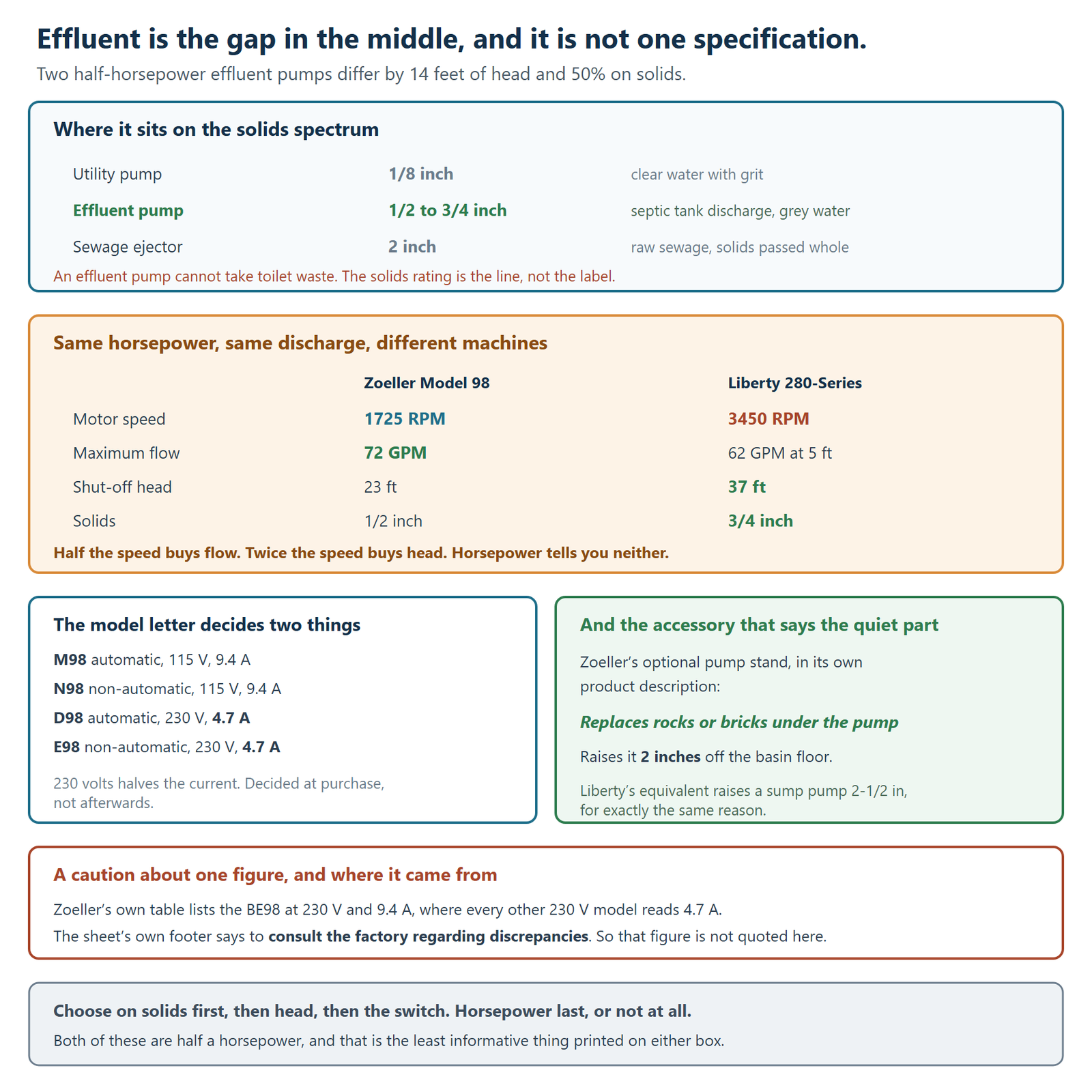
This site already compares the machines either side of it, so the spectrum can be laid out with its own published figures:
| Machine | Solids | What it is for |
|---|---|---|
| Utility pump | 1/8 in | Clear water with grit |
| Effluent pump | 1/2 to 3/4 in | Septic tank discharge, grey water |
| Sewage ejector | 2 in | Raw sewage, solids passed whole |
An effluent pump cannot take toilet waste. If there is a toilet on the line, you want the two-inch machine and this is the wrong page.
An effluent pump is for water that has already had its solids settled out — the discharge side of a septic tank, a STEP or mound system, grey water, or a high-output sump where a plain sump pump cannot cope with what arrives.
Same horsepower, different machines
| Zoeller Model 98 | Liberty 280-Series | |
|---|---|---|
| Horsepower | 1/2 | 1/2 |
| Motor speed | 1725 RPM | 3450 RPM |
| Max flow | 72 GPM | 62 GPM at 5 ft |
| Shut-off head | 23 ft | 37 ft |
| Solids | 1/2 in (13 mm) | 3/4 in |
| Discharge | 1-1/2 in NPT | 1-1/2 in |
Fourteen feet of head and fifty per cent on solids, between two pumps with the same number on the box.
The motor speed is the explanation. A pump turning at 1725 RPM moves more water against a low head; one turning at 3450 pushes much higher and gives up some flow doing it.
Which you want depends on your lift, not on your horsepower — and horsepower is the only one of those three figures most listings put in the title.
The seven worth knowing
Zoeller M98 — automatic, 115 V
Zoeller M98 — 1/2 hp, 115 V, 9.4 amps, 1725 RPM, permanent split capacitor, insulation Class B. 1-1/2 inch NPT discharge, 1/2 inch (13 mm) spherical solids. Max head 23 feet, max flow 72 GPM. Non-clogging vortex impeller in engineered plastic. Cast iron cap, motor housing and pump housing. Oil-fed cast iron upper and lower bearings, carbon and ceramic mechanical seals, stainless hardware. Auto-reset thermal overload. 9-foot cord. Auto on/off points 9½ and 3 inches — a 6½-inch drawdown. Max liquid temperature 130°F. Tested to UL778.
Who it is for: the default residential effluent job on a 115-volt supply, where the lift is modest and the flow matters more than the height.
The honest drawback: 23 feet of shut-off head is the lowest here. On a long or uphill run it has little in reserve, and the published curve falls to 45 GPM at 15 feet and 25 GPM at 20.
Zoeller N98 — the same pump without the switch
Zoeller N98 — identical pump, non-automatic, 115 V, 15-foot cord instead of nine.
Who it is for: any installation running a control panel or a separate float tree, which is the normal arrangement where alarms or duplex control are involved.
The honest drawback: it will not run on its own. Buying this by mistake means a pump that never starts — the same trap the sewage ejector guide flags on the N267.
Zoeller D98 and E98 — the 230-volt pair
Zoeller D98 / E98 — same pump at 230 V, drawing 4.7 amps instead of 9.4. D98 automatic, E98 non-automatic.
Who it is for: anywhere 230 V is already available. Half the current for the same work, which matters on a long cable run or a loaded circuit.
The honest drawback: 230 V rarely exists at a septic tank already, and adding it is electrician work decided before the pump is bought, not after.
Zoeller BN98 — automatic with a piggyback switch
Zoeller BN98 — automatic 115 V, and Zoeller notes that BN and BE models “include a 20′ (6 m) piggyback variable level pump switch.”
Who it is for: installations where the on and off levels need setting rather than accepting, and where a replaceable switch is worth having.
The honest drawback: a piggyback float is one more thing in the basin to foul, and a 20-foot switch cord needs somewhere sensible to go.
A caution on its 230-volt sibling. Zoeller’s own table lists the BE98 at 230 V and 9.4 amps, where every other 230 V model on the same sheet reads 4.7. That looks like an error in the data sheet, and the sheet’s own footer says to “Consult factory regarding discrepancies or inconsistencies.” No amperage is quoted here for the BE98.
Liberty 280-Series — the high-head option
Liberty 280-Series — 1/2 hp, 115 or 208-230 V, 3450 RPM. Shut-off head 37 feet, 62 GPM at 5 feet. 3/4-inch solids. Class 25 cast iron with an oil-filled motor housing to dissipate heat. Motor shaft 300 or 400 series stainless, minimum diameter 0.311 inch. Unitized carbon ceramic seal with stainless housings and spring, equal to Crane Type 6A. Vortex impeller in engineered polymer with pump-out vanes on the back shroud. 1-1/2 inch discharge. Liberty names STEP systems, mound systems, liquid waste transfer and high-output sump as its applications.
Who it is for: a genuine lift — a mound system, a long run, anything where 23 feet of shut-off head leaves nothing spare. And the 3/4-inch solids rating is the widest here.
The honest drawback: 3450 RPM. A faster pump in abrasive water is working harder than a slower one, and the flow at low head is lower than the Zoeller’s.
Liberty 287 — the 280 with a float fitted
Liberty 287 — the 280-Series supplied as an automatic with a VMF switch.
Who it is for: the same job as the 280, in an installation with no panel.
The honest drawback: as with any integrated float, it is less easily swapped than a piggyback when it eventually sticks.
Zoeller pump stand 10-2421 — the accessory that admits what people do
Zoeller pump stand — noncorrosive ABS, raises the pump 2 inches (5 cm) off the bottom of the basin, “reduces potential clogging by debris”, and allows the intake to be raised further with sections of 1-inch or 2-inch PVC.
Who it is for: every installation, honestly. Zoeller’s own description of what it is for is “Replaces rocks or bricks under the pump” — the manufacturer naming the field practice out loud.
The honest drawback: it raises the pump, which raises the off level, which costs you a little drawdown. Worth it for an intake that is not sitting in the sediment.
How to choose, in order
1. Solids first. If a toilet discharges into it, you need two inches and a different pump entirely.
2. Then head. Measure the vertical lift from the pump to where the line meets gravity. Twenty-three feet or thirty-seven is the first real fork on this page.
3. Then the switch. Automatic, non-automatic for a panel, or a piggyback you can set and replace.
4. Then the voltage, if you have the choice, because 230 V halves the current.
5. Horsepower last, or not at all. Both machines on this page are half a horsepower and they are not interchangeable.
When this needs a pro
Anything connected to a septic system. Dosing volumes, drainfield loading and mound design are jurisdictional and they are not pump questions — the pump is chosen to suit a design somebody else is responsible for.
All of the electrical. Zoeller’s own sheet says plainly that installation of controls, protection devices and wiring should be done by a qualified licensed electrician, and names the NEC and OSHA.
Anything involving opening a sealed basin. A pit in the drainage system is sealed and vented for reasons, and opening it is not a casual job.
What you can do yourself: measure the lift, and find out what discharges into the basin. Two facts — and they settle both the pump and whether this is the right page.
And if the pump you already have is not running at all, that has its own short list and most of it is above the basin. If it runs and will not stop, the causes are different again — replacing a pump that works is the common mistake in both cases.
FAQ
What is the difference between an effluent pump and a sewage ejector pump?
Solids. An effluent pump passes half to three-quarters of an inch and is for water whose solids have already settled, such as septic tank discharge. A sewage ejector passes two inches and takes raw sewage. An effluent pump cannot handle toilet waste.
Can I use an effluent pump for a septic tank?
That is one of its intended jobs — pumping settled effluent from a tank to a drainfield, mound or STEP system. The dosing design itself is a septic system question with local rules, and the pump is chosen to suit it.
What size effluent pump do I need?
Settle solids and head before horsepower. Two half-horsepower effluent pumps on this page differ by fourteen feet of shut-off head and fifty per cent on solids, so the nameplate tells you almost nothing on its own.
Why do two 1/2 hp effluent pumps have such different specs?
Motor speed. The Zoeller Model 98 turns at 1725 RPM and the Liberty 280-Series at 3450. The slower pump produces more flow at low head; the faster one produces far more head and slightly less flow.
What do the letters mean on a Zoeller 98?
They set the switch and the voltage. M98 is automatic at 115 V, N98 non-automatic at 115 V, D98 automatic at 230 V and E98 non-automatic at 230 V. BN and BE models come with a 20-foot piggyback variable level switch.
Should an effluent pump sit directly on the basin floor?
No. Zoeller sells a stand that raises the pump two inches, describing its purpose as replacing the rocks or bricks people otherwise use, and it reduces clogging from debris that has settled at the bottom.