On this page
- Submersible or non-submersible — the choice that actually matters
- The GPH number on the box isn't the number you get
- Sizing one for your actual job
- How close to dry it actually gets
- Why it runs but won't move water
- The GFCI rule that explains a lot of "why does it keep tripping"
- When this needs a licensed pro
- FAQ
Last Updated on October 14, 2026 by Muhammad Toqeer
Most guides treat “utility pump” and “transfer pump” as two different tools. They’re not. A transfer pump is just the industry’s name for a non-submersible utility pump — the kind that sits on dry ground with a hose running down into the water, rather than sitting in the water itself. If you’re shopping and see both terms, you’re looking at the same category, split by one design choice: does it go in the water, or does the water come to it.
Submersible or non-submersible — the choice that actually matters
Everything else is downstream of this one decision. A submersible pump sits directly in the water, is sealed against it, and pushes water up and out through a discharge hose — quieter, because the water muffles the motor noise, and it can typically get a floor closer to dry since the intake sits right where the water is lowest. A non-submersible (“transfer”) pump stays on dry ground and pulls water up through a suction hose, which means it has to build suction before it moves anything — the step that fails when a fitting isn’t airtight.
For a flooded basement, a drained water heater, or a pool cover full of rainwater, submersible is almost always the easier tool: drop it in, plug it in, done. Non-submersible pumps earn their keep when the water is somewhere a submersible can’t sit — a shallow puddle too thin to cover the pump body, or a job where you’re moving clean water between two containers rather than draining a space. A hot tub is the one job with rules of its own — a pump rated below the water’s temperature and a city that may not allow where the hose ends — which how to drain a hot tub fast covers.
The GPH number on the box isn’t the number you get
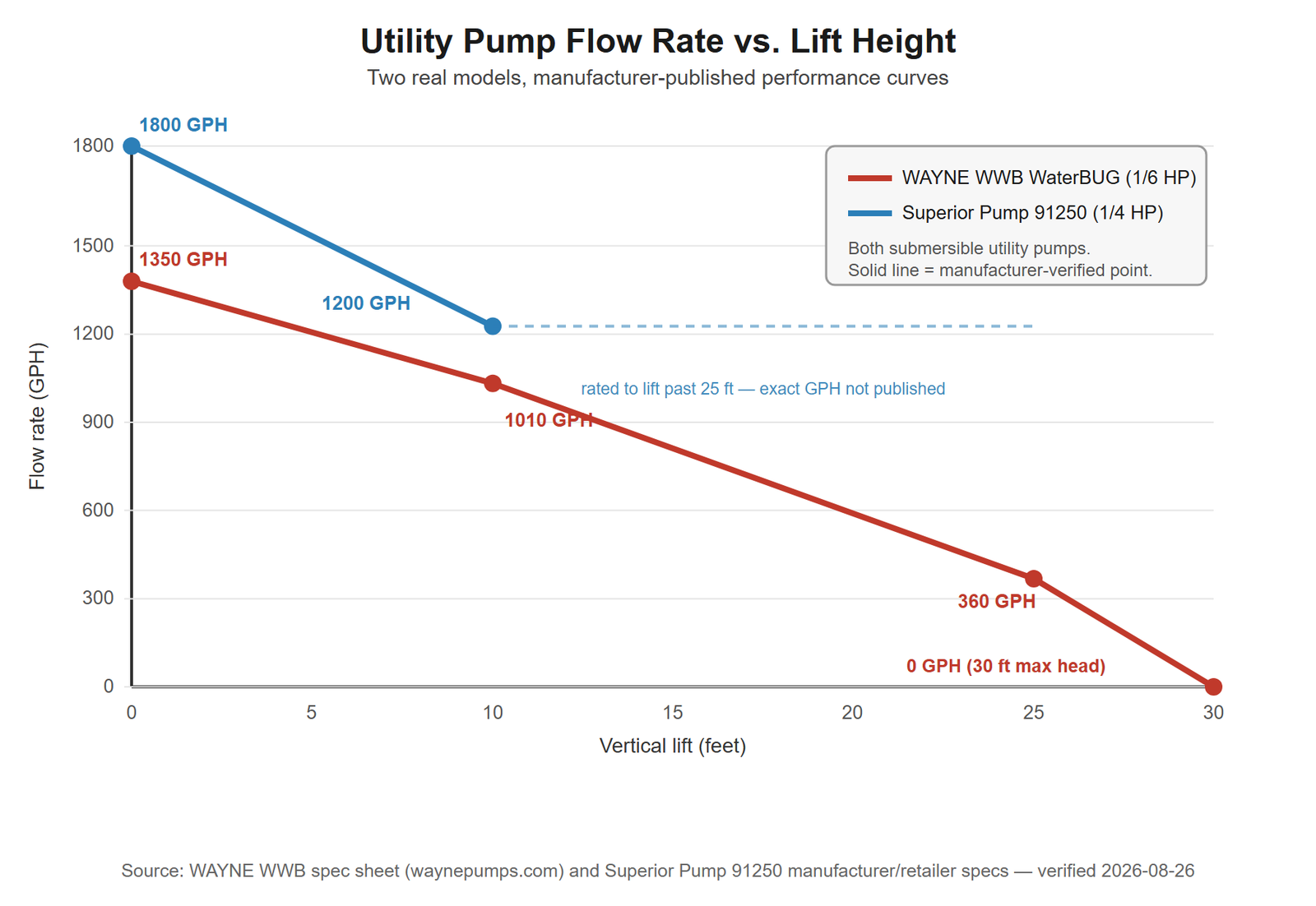
Every utility pump is sold on a peak GPH (gallons per hour) figure, and that number is only real at zero lift — with the discharge hose lying flat, not climbing a wall or a set of basement stairs. Push water uphill and the flow drops, the same way it does on a condensate pump, just at a different scale.
Two real models show the shape of it, and the buying guide plots five of them against each other. A WAYNE WWB WaterBUG is rated 1,350 GPH at zero lift, drops to 1,010 GPH at 10 feet, and falls to 360 GPH by 25 feet — its rated max head. A Superior Pump 91250 starts higher, at 1,800 GPH at zero lift, and is still moving 1,200 GPH at 10 feet. Neither number on the box tells you that on its own — you have to look at the curve, not the headline figure, especially if you’re pumping up and out of a window well or over a foundation wall rather than straight into a nearby drain.
Sizing one for your actual job
Match the pump to the water, not the other way round. Draining a water heater or a shallow pool cover puddle is a low-volume job where almost any submersible utility pump finishes in minutes regardless of GPH rating — the number that matters there is drain-down depth (below), not flow. A flooded basement with real standing water is a volume job: a 1,350–1,800 GPH pump clears a few inches over a typical basement floor in well under an hour, assuming the discharge run is short and mostly flat. The number that actually changes your buying decision is lift, not flow: if the discharge has to climb out a window well or over a foundation wall, check the pump’s curve at that height, not its zero-lift headline number, the same way you would for a condensate pump. Turning that into an actual answer takes three lines of arithmetic — gallons in the room, minus what the pump cannot reach, divided by the flow at your real head — and the last of those is the step most people skip. Then there is the question of where the thing actually goes, which turns out to hinge on one phrase in the manual: the pump stops 1/16 inch above whatever you stand it on, not above your floor. And the hose you screw onto it costs more than almost anything else you can change — its bore matters far more than its length, to the point where a hundred feet of the right hose beats twenty-five feet of the wrong one. That connection is also where most leaks start, because the pump port and the hose end are two different thread standards — one seals on tape, the other on a washer. And because these pumps spend most of the year in a box, the other common complaint is one that will not start in spring — where the first move is to turn the impeller by hand, not to plug it in. A pool cover is the one job where the buying rule inverts entirely: there, the depth the pump waits for matters more than how fast it moves water, because a cover fails under weight. Draining a water heater inverts it again, onto a spec almost nobody prints: the maximum liquid temperature the pump is rated for, which on several of these sits level with the setting on your thermostat. And if the water has grit in it, the deciding number changes once more: how big a solid the pump can swallow and how much water that costs you, because both come from the same intake screen. Cut the cord and the rule changes again, because the battery rather than the motor sets what you can finish: every cordless pump that publishes the figures gives you about half an hour. And the question that follows all of them — whether one of these can just live in a sump pit — has a manufacturer’s answer with a condition attached: Superior permits it by adding a float switch, while two other pumps are ruled out by their own duty ratings.
How close to dry it actually gets
This is the spec nobody puts on the front of the box, and it’s the one that decides whether you’re finishing the last inch with a pump or a towel. A WAYNE WWB drains down to 1/16 inch of the surface. A Superior Pump 91250 is built with a base designed to sit in the hub of a standard floor drain, which matters more in a basement with a drain already in the floor than the last-inch number does. Neither spec shows up in most buying guides, and neither is something you can tell from a product photo — check the manufacturer page before assuming.
Why it runs but won’t move water
The single most common non-submersible complaint is a pump that runs and sounds fine but never actually primes — never builds enough suction to start pulling water. The suction side of the pump has to be completely airtight from the strainer to the impeller; a loose hose fitting, a hairline crack, or a worn gasket is enough to let air in and keep the pump from ever holding prime, even though the motor itself is working correctly. A clogged intake strainer causes the same symptom for a different reason — worth checking both before assuming the pump itself has failed. There is more to it than that on both sides: why it won’t prime covers the suction side, including the fifteen-foot limit that counts sideways as well as up, and running but not moving water covers what to check once it is primed — starting with a ten-second test that halves the problem. A pump that worked and then quit partway through a job is a third case again, because the job itself changed the conditions: see losing suction mid-job. And if it is heat rather than flow that keeps stopping it, which pump you own decides the cure — a submersible is cooled by the water it stands in, while a transfer pump’s manual says plainly that it is air cooled and not designed to operate under water. And a pump that has started making a grinding noise is usually not full of grit at all — the manual says it “may become noisy” as the water gets low, because it is drawing air in alongside the water. And the opposite complaint — a pump that runs and never shuts off — has only two published causes, one of which is the discharge height: the pump stops when the water is gone, so one that cannot lift the water out never reaches its own stop condition.
The GFCI rule that explains a lot of “why does it keep tripping”
The National Electrical Code requires GFCI protection on any outdoor receptacle (NEC 210.8(F)) and on any outlet within 6 feet of a water source, indoors or out. Separately, NEC 422.5(A)(6) requires GFCI protection on permanently wired, non-submersible pump motors. In practice this means a utility pump plugged into an outdoor outlet, a garage outlet near a hose bib, or a basement outlet close to the sump it’s draining is very likely on a GFCI circuit whether you installed one specifically for the pump or not — and a GFCI that trips under load is doing exactly what it’s designed to do, not necessarily failing. It’s worth knowing before you assume the pump itself is the problem. One ordering point is worth carrying from the manufacturer’s own troubleshooting table: if the breaker or GFCI has tripped and the pump now won’t turn on at all, inspect the cord and the housing before you reset anything, because on a submersible pump a trip can mean water reached the motor. And if it keeps tripping the breaker, the first thing to establish is which device actually tripped — a breaker and a GFCI protect against completely different faults, and the manufacturer’s own warning panel says a GFCI covers line-to-ground faults only.
When this needs a licensed pro
Running a new dedicated circuit, wiring a pump into a permanent sump or ejector setup, or troubleshooting a GFCI that trips immediately on every reset (rather than intermittently under load) is electrical work, not a DIY pump fix — call an electrician rather than bypassing the GFCI. If the water you’re pumping is anything other than clean or lightly soiled — sewage, standing floodwater that’s been sitting for days, anything with a strong odor — that’s a different problem than a utility pump is built for, and typically means a sewage ejector setup and possibly a restoration contractor, not a bigger pump.
And if the float is chattering on and off, the pit may simply be too narrow for the float’s own swing — one maker publishes a 15-inch minimum basin diameter against on and off levels of roughly 9 and 4 inches, and a narrow basin crosses that band in seconds.
And if anyone felt a shock or a tingle in the water, stop and read that before anything else — a felt shock does not mean the GFCI has failed, and one voltmeter reading taken twice says whether the fault is inside the house or upstream of the meter.
FAQ
Is a transfer pump the same thing as a utility pump?
Yes, functionally. “Transfer pump” is the common name for the non-submersible type of utility pump — the one that stays on dry ground and pulls water up through a suction hose, rather than sitting in the water itself.
What GPH do I actually need for a flooded basement?
For a genuinely flooded basement (a few inches of standing water over the floor), a pump in the 1,200–1,800 GPH range at low lift clears it in well under an hour on a short, mostly flat discharge run. Past that, lift matters more than the headline GPH number — check the pump’s rating at your actual discharge height, not at zero feet.
Can a submersible utility pump run dry?
Most can’t safely run dry for long — check the specific model’s manual. This is part of why drain-down depth matters: a pump that can only get within an inch or two of dry needs to be shut off manually before it’s pumping air, not left running unattended until the basement looks empty.
Why does my pump keep tripping the GFCI?
Often it’s the GFCI doing its job on a circuit that’s required to have one — see the code section above — rather than a sign the pump has failed. A GFCI that won’t reset at all, versus one that trips repeatedly under load, points to different problems and is worth mentioning to an electrician either way.


