On this page
Last Updated on September 19, 2026 by Muhammad Toqeer
Three lines. Gallons in the room, minus the water the pump physically cannot reach, divided by the flow it makes at your actual head. An 800 square foot floor under three inches of water is 1,496 gallons, and a 1,350 GPH pump clears it in about an hour and a half — not the hour the box implies.
The gap between those two numbers is where every sizing mistake lives, and it comes from reading the right curve at the wrong point.
Step 1: how many gallons are actually in there
Floor area in square feet, times depth in feet, times 7.48 gallons per cubic foot.
The depth conversion is where people slip, because water depth gets measured in inches and the formula wants feet. Three inches is 0.25 feet, not 3.
800 sq ft × 0.25 ft = 200 cubic feet 200 × 7.48 = 1,496 gallons
Do this before you look at a single product page. It is the only number in the process that belongs to your house rather than to a pump, and it is what makes every later figure mean something. A pump’s rating is an abstraction until you have a volume to divide it into.
One-minute test: if you cannot get a depth reading because the floor slopes, measure at the deepest point and at the shallowest and average the two. It is close enough — this calculation is deciding whether you need one hour or six, not whether you need 1,496 gallons or 1,510.
Step 2: subtract the water the pump cannot reach
This one is missing from every guide, and it is not a rounding error.
A submersible utility pump stops when the water gets below its intake. Manufacturers publish that depth: Wayne’s WaterBUG “removes water down to a 1/16 inch of the surface.” Other pumps stop at 1/8 inch, and some of the high-flow ones stop at 3/8.
Spread across a floor, those fractions are a lot of water:
| Pump drains down to | Left on an 800 sq ft floor |
|---|---|
| 1/16 inch | 31 gallons |
| 1/8 inch | 62 gallons |
| 3/8 inch | 187 gallons |
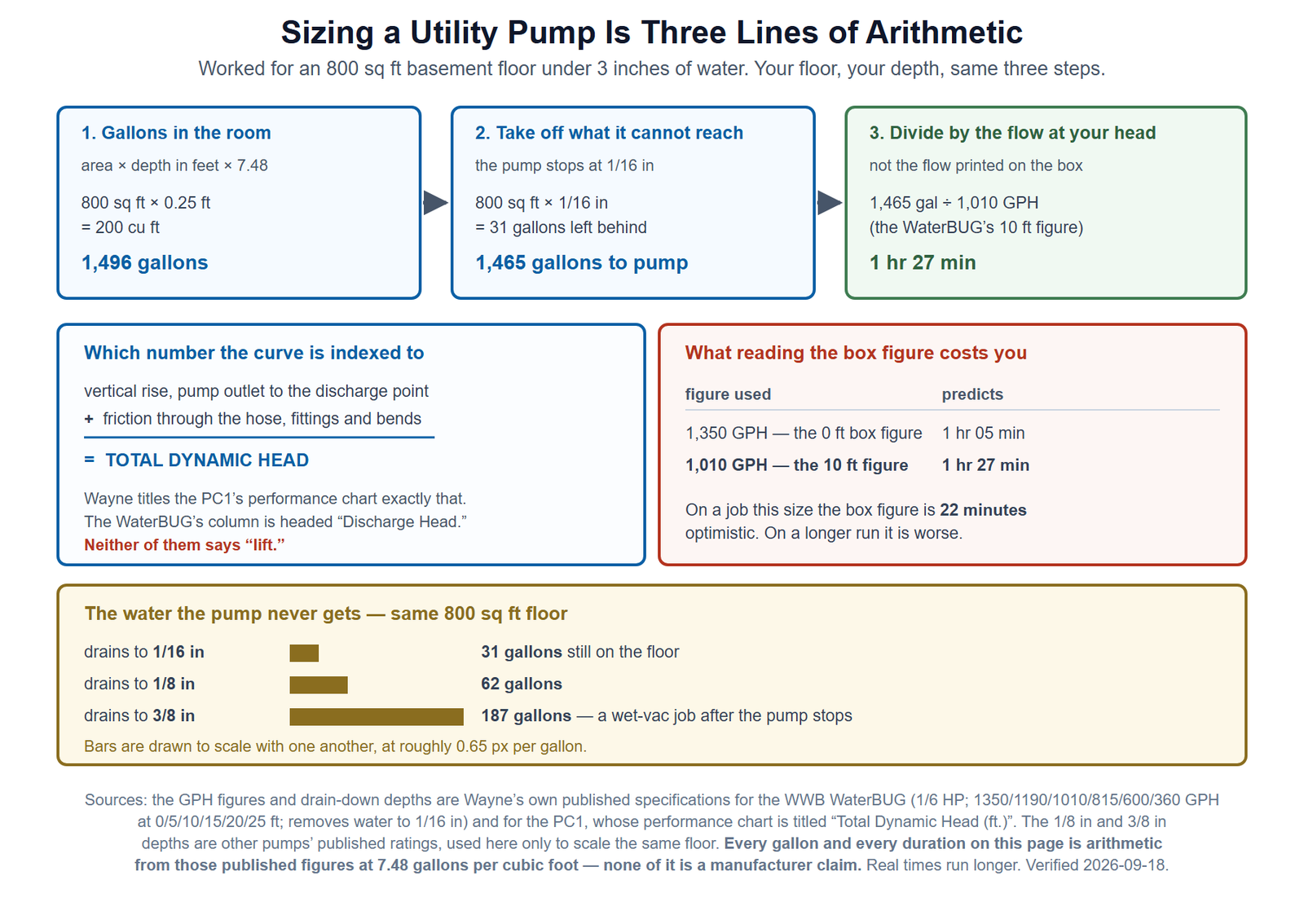
187 gallons is not a damp floor. That is a wet vac and an afternoon, after the pump has finished and been put away. If the surface underneath is finished — a floated floor, a carpet pad, anything with a seam — the difference between a pump that scavenges to 1/16 inch and one that quits at 3/8 is the difference between drying and replacing.
So the number you are actually pumping, on this job, is 1,496 − 31 = 1,465 gallons.
Worth saying plainly: the very high-flow pumps are usually the ones that leave the most behind, because a wide shallow intake and a big fast impeller are competing designs. The buying guide plots that trade-off across five real models, and it is the single most useful thing to look at before buying.
Step 3: divide by the flow you will actually get
Here is the part that makes the arithmetic honest.
Every pump is sold on its peak figure, and that figure is measured with the discharge lying flat. The WaterBUG’s published curve is 1,350 / 1,190 / 1,010 / 815 / 600 / 360 GPH at 0 / 5 / 10 / 15 / 20 / 25 feet. Zero feet is a laboratory condition, not a basement.
Run our 1,465 gallons through both:
| Figure used | Time predicted |
|---|---|
| 1,350 GPH — the number on the box | 1 hr 05 min |
| 1,010 GPH — the number at 10 feet | 1 hr 27 min |
Twenty-two minutes on a small job. On a deeper flood with a longer run, the same error compounds into hours, and it is the reason a pump that was “big enough” is still going at midnight.
The word that causes it
The curve is not indexed to the height you measure with a tape.
Wayne’s performance chart for their PC1 transfer pump is titled, in their own words, “Total Dynamic Head (ft.)”. The WaterBUG’s column is headed “Discharge Head.” Neither of them says lift — and the difference is not pedantry:
Total dynamic head = the vertical rise from the pump outlet to the discharge point, plus the friction of pushing water through the hose, the fittings and every bend in the run.
Your tape measure gives you the first part only. The second part is real, and it always makes the number bigger, which always makes the flow smaller. No figure for it appears here on purpose, because the tidy rule you will find quoted — a foot of head for every ten feet of hose — does not survive contact with its own sources, which put 100 feet of 2-inch pipe closer to 14 feet. It depends on diameter and on how fast the water is moving.
What to do instead: measure your vertical rise, then read the curve a few feet further down than that. If the answer at that point still works, you have margin. If it only works at the box figure, you do not have a pump, you have an optimistic afternoon.
One-minute test: stand where the pump will sit and look at where the water comes out. Count the vertical feet, then count the 90-degree bends in the hose route. Every bend is a reason to read further down the curve.
The advice you will find is written for a different machine
Search this question and almost everything that comes back is about sizing a sump pump. That matters more than it sounds, because the two are not the same problem.
A sump pump is sized against an inflow rate. The published method is to let the pit fill, time how fast it rises, convert that to gallons per minute, and buy something that outruns it — indefinitely, through every storm.
A utility pump is sized against a fixed volume and a deadline. Nothing is flowing in. There is a room with water in it and a time by which you want it gone. Measuring an inflow rate here gives you a number that describes nothing.
The horsepower advice comes across wrong too. Those pages recommend 3/4 to 1 HP moving 3,000–5,000 GPH, which describes a permanently installed machine in a pit. The pumps actually sold for this job — including every model in this silo’s buying guide — are 1/6 to 1/4 HP. Buying a sump pump because a sump-pump article told you to is how people end up with something that cannot sit flat on a floor and cannot reach the last inch.
The one thing both silos agree on is the curve, which is why the GPH number on the box isn’t the number you get is the first thing to understand about either.
A sanity check on your answer
Before you buy on the strength of this, two checks.
Does the time you calculated sound survivable for the pump? A long continuous run is its own question — small utility pumps are not all rated to run for hours without a break, and one that overheats mid-job has turned a two-hour task into a two-day one. If your number came out large, what makes these pumps overheat is worth reading before you commit to it.
Does the answer depend on the pump performing perfectly? If your calculation only works at the published figure with no margin, assume it will take longer. Published curves are measured on new pumps with clean intakes and ideal hose. A pump that runs but moves less water than it should is common enough that planning with zero slack is planning to be wrong.
And the honest caveat on all of the above: every gallon and every duration on this page is arithmetic from published figures, not a manufacturer claim. Real jobs run longer than the calculation says. The point of doing it is not to predict the minute — it is to find out whether you are an hour away or a day away, because those need different decisions.
When this needs a pro
If the water is not clean. Sizing stops being the question when the water is sewage or has come up through a floor drain. That is a different pump, different handling, and a health issue.
If the water is touching anything electrical. Standing water near outlets, a submerged furnace, or a panel in the flooded area — the pump is not the first problem.
If you cannot find where it came from. Clearing 1,496 gallons is pointless if it refills. Once there is an inflow, you have left utility-pump territory entirely and you are in sump, drainage or groundwater work, which is a contractor’s call.
FAQ
How do I calculate how many gallons are in a flooded basement?
Floor area in square feet, times water depth converted to feet, times 7.48 gallons per cubic foot. An 800 square foot floor under three inches of water is 800 × 0.25 × 7.48 = 1,496 gallons. The common slip is leaving the depth in inches.
What GPH do I need to drain a flooded basement?
Work backwards from the time you will accept. 1,465 gallons in about 90 minutes needs roughly 1,000 GPH at your head, which on a typical 1/6 HP pump means a box rating nearer 1,350. Size against the figure at your lift, never the peak figure.
Why does my pump move less water than its rating?
Because the rating is measured at zero head, with the discharge flat. The WaterBUG is rated 1,350 GPH at 0 feet and 1,010 at 10 feet — a quarter of the flow gone to ten feet of rise, before any hose friction. Manufacturers index these curves to total dynamic head, not to the height you measure.
How much water does a utility pump leave behind?
Whatever is below its intake. Published drain-down depths run from about 1/16 inch to 3/8 inch, which on an 800 square foot floor is 31 gallons at best and 187 at worst. The last of it is a wet-vac or mop job whatever pump you buy.
Can I use a sump pump to drain a flooded basement instead?
It is the wrong shape for the job. A sump pump is built to sit in a pit and match a continuous inflow; a utility pump is built to sit flat on a floor and clear a fixed volume down to the last fraction of an inch. Most sizing advice online is written for the former, including the horsepower figures.


