On this page
Last Updated on September 14, 2026 by Muhammad Toqeer
Take the discharge hose off and run the pump for a second. If water leaves the port, the pump is working and your problem is somewhere in the hose. If nothing leaves the port, stop looking at the hose entirely. That one test splits five possible causes into two groups before you unscrew anything.
And if you have a WaterBUG, check the spare port before anything else — there are two, and the manual says water will not reach your hose if the unused one is uncapped.
First: is it actually still running?
Worth thirty seconds, because “running but not pumping” and “already shut itself off” look identical from across a basement.
The WaterBUG shuts down on its own after running dry, and it does not restart by itself. The manual: “If the pump runs dry, the pump will shut off. A manual reset is required.” It also turns off “after approximately 10 minutes once it has stopped moving water.”
On the lighted-plug models the plug tells you which state you are in: “When the pump is off the plug will indicate this with a red light. When the pump is on, the plug will indicate this with a green light.”
One-minute test: look at the plug. Red means it has already stopped and nothing you do at the pump will help until it is reset. The reset is a wait, not a button — “unplug pump and wait approximately 1 hour”, or the fast version, “unplug pump, submerge in cold water, and wait approximately 15 minutes.”
That fifteen-minute trick is in the manual and almost nowhere else. Without it people wait an hour or decide the pump is dead.
The test that halves the problem
Now the hose comes off.
A homeowner on a pump forum described the pattern exactly: theirs “worked fine in a tub with no discharge line” and failed every time once a ten-foot discharge run was connected. That is the whole diagnostic in one sentence — the pump was never the problem.
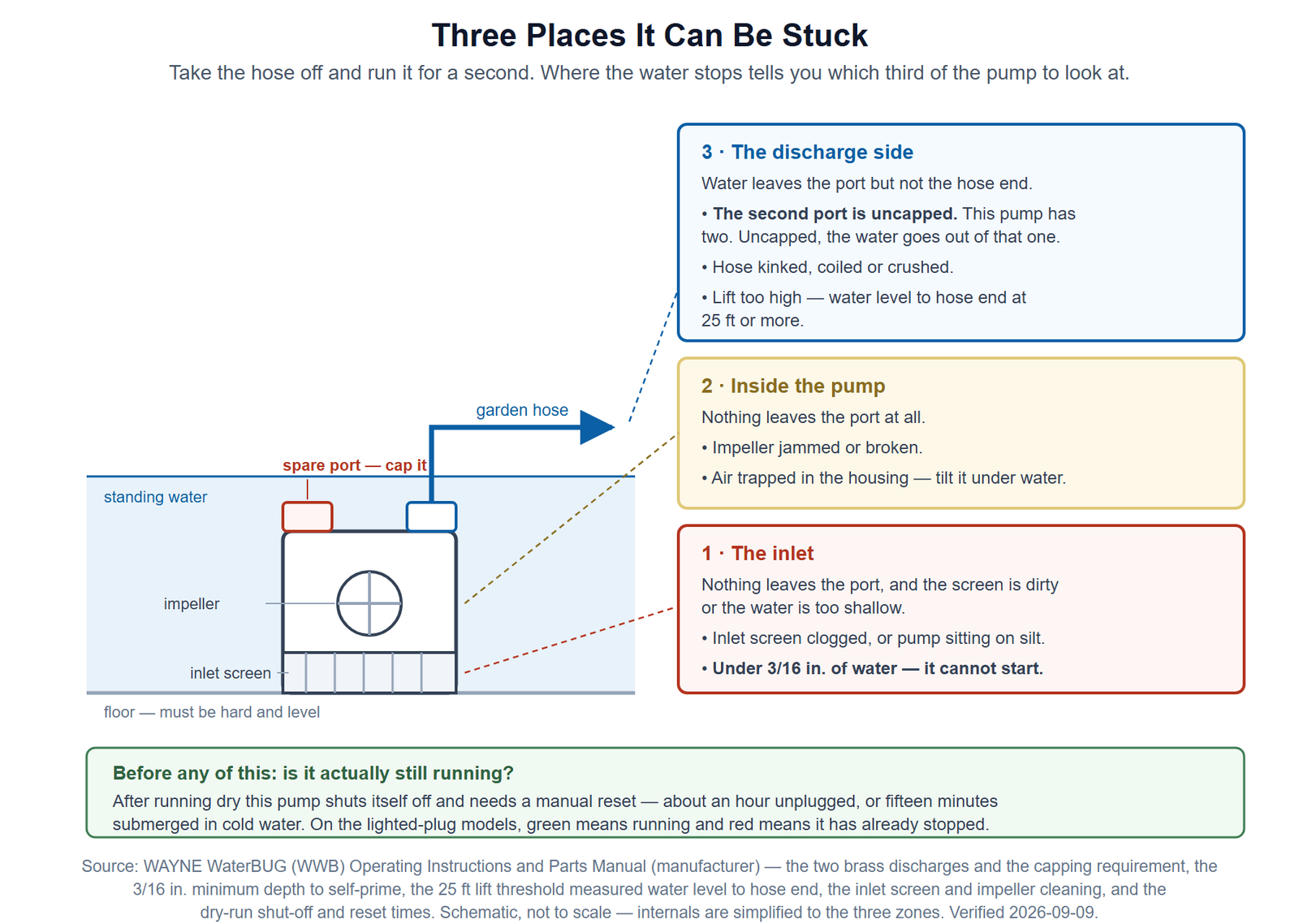
Water leaves the port, but not the hose end
Everything here is on the discharge side, and the first one costs nothing to check.
The spare port. The WaterBUG has two brass discharge fittings, and you use one. The manual is explicit about the other: “Make sure the discharge not being used is securely sealed using the attached screw-on cap (if unused discharge is not capped, water will not be pumped through the garden hose).”
That is this exact symptom, described by the manufacturer, with the consequence in brackets. The cap is small, it lives loose in the box, and it is the first thing lost. Worth noting that this cause does not appear in the same manual’s troubleshooting table — so somebody with the problem, doing the sensible thing and turning to the troubleshooting page, gets sent to five places that are not it.
A kinked or coiled hose. The manual’s remedy is plain: “Unwind garden hose, remove any kinks or restrictions in hose.” A hose still in its coil is a restriction even when nothing looks pinched.
Too much lift. The manufacturer sets the threshold and, importantly, tells you where to measure from: “Water level to end of garden hose is 25 ft. or greater, reduce vertical lift.” Not pump to hose end — water level to hose end. A pump sitting at the bottom of a deep sump has already spent part of that budget before the hose leaves the pit.
The published curve shows why it fades rather than stops: 1350 gallons an hour at zero lift, 1010 at ten feet, 600 at twenty, and 360 at twenty-five. The utility and transfer pumps guide covers reading those curves properly.
Nothing leaves the port at all
Now it is the pump or the water it is standing in.
Check the depth before anything else. Two different numbers, and only one gets quoted in reviews: “The water level must be at least 3/16 inch deep for the pump to self-prime.” The famous figure — down to 1/16 inch — is what it will keep removing once started. A pump sitting in a film thinner than 3/16 will run and move nothing, and that is a specification rather than a fault.
Where it is standing matters too. “Sitting the pump directly on a loose/dirty surface will not allow the filter features to work to their full extent”, and the manual asks you to “clean an area on the hard surface for the pump to sit while working.” On silt or leaf litter, the screen blocks from underneath where you cannot see it. Level matters as well — “for pump to remove water as low as possible the pump must be on a level surface.”
The inlet screen. The manual’s first listed cause for little or no flow, and the remedy is to “clean debris from exterior of inlet screen and all debris filtering features.”
Trapped air. A submersible can hold a pocket of air in its housing when the level drops, and the impeller then spins in air instead of water. Lift the pump, keep it fully submerged, and tilt it side to side until the bubbles stop; then set it back down. If it works after that and fails again next time the level drops, the fix is a permanent one rather than a repeat of the tilt.
The impeller. If none of the above changes anything, the impeller is the remaining candidate. Cleaning it means opening the base — and note which screws: “Remove inner 6 screws… do not remove the outer screws!” The outer ones hold the motor housing together and are not a homeowner job.
What this article is not going to guess at
The manufacturer’s own troubleshooting table lists five causes for little or no flow, and it puts them in its order, not in order of likelihood. Neither will this article.
The checks above are ordered by how fast they are to do — plug, spare cap, hose, depth, surface, screen, air, impeller — because that is the ordering that costs you least when you are wrong. If you also have a transfer pump that has never moved water on this setup at all, that is a different fault with a different first question, covered in utility pump won’t prime.
When this needs a pro
Two of the manual’s five causes are not DIY.
Low supply voltage is listed as a cause of weak flow, and the manual’s remedy is simply “Contact an electrician.” A pump on a long extension cord or a tired circuit can spin without developing pressure, and that is an electrical diagnosis, not a pump one.
A seized motor is the other. If the pump hums but the impeller will not turn by hand with the power unplugged, that is a replacement rather than a repair on a pump at this price — and the buying guide covers what actually separates the replacements, which is not the GPH figure on the box.
And the standing rule for anything submersible: unplug it at the outlet before your hands go anywhere near the water or the base. Not the switch — the plug.
FAQ
Why is my utility pump running but no water is coming out?
Take the hose off and run it for a second. Water at the port means the fault is in the hose — most often an uncapped second discharge port, a kink, or too much lift. No water at the port means the fault is the inlet, trapped air, or the impeller.
My WaterBUG runs but nothing comes out of the hose. What is it?
Check the spare discharge port first. The pump has two, and the manual states that if the unused one is not capped, water will not be pumped through the garden hose. The cap screws on and is easy to lose.
How deep does the water need to be for a utility pump to work?
At least 3/16 inch for the WaterBUG to start pumping. It will then keep removing water down to about 1/16 inch, but it cannot begin in less than 3/16, so a very shallow film will leave it running and moving nothing.
My pump shut off and will not restart. Is it broken?
Probably not. After running dry it shuts down and needs a manual reset — unplug it and wait about an hour, or submerge it in cold water and wait about fifteen minutes, then plug it in to check. A red light on the plug means it is off; green means running.
How high can a utility pump push before flow drops off?
It fades rather than stops. A 1/6 HP WaterBUG moves 1350 gallons an hour at no lift, 1010 at ten feet and 360 at twenty-five. The manual’s own threshold for “too high” is 25 feet or more measured from the water level to the end of the hose.


