On this page
Last Updated on September 26, 2026 by Muhammad Toqeer
Breaker off, submersible pump in the deepest part of the tub, garden hose to a drain, and the shell is empty in ten to fifteen minutes. That part is easy. The two places it goes wrong are the pump’s temperature rating and where the hose ends up — and almost no guide mentions either.
Turn the power off first, and leave it off
Both spa manufacturers whose instructions were read for this article start in the same place. Hot Spring: “Turn the power to the spa off at the circuit breaker.” Jacuzzi gives the reason: “Running pumps or heaters while water levels drop below intake points can cause catastrophic damage requiring expensive repairs.”
The tub’s own pump and heater do not know you are draining it. Take the breaker off before the level starts falling, not after.
Will your pump survive the water?
A hot tub is kept at 100 to 102 °F for most adults, and the ceiling is 104 °F, a figure Master Spas attributes to the US Consumer Product Safety Commission in 1979. That is warmer than some pumps are certified to handle.
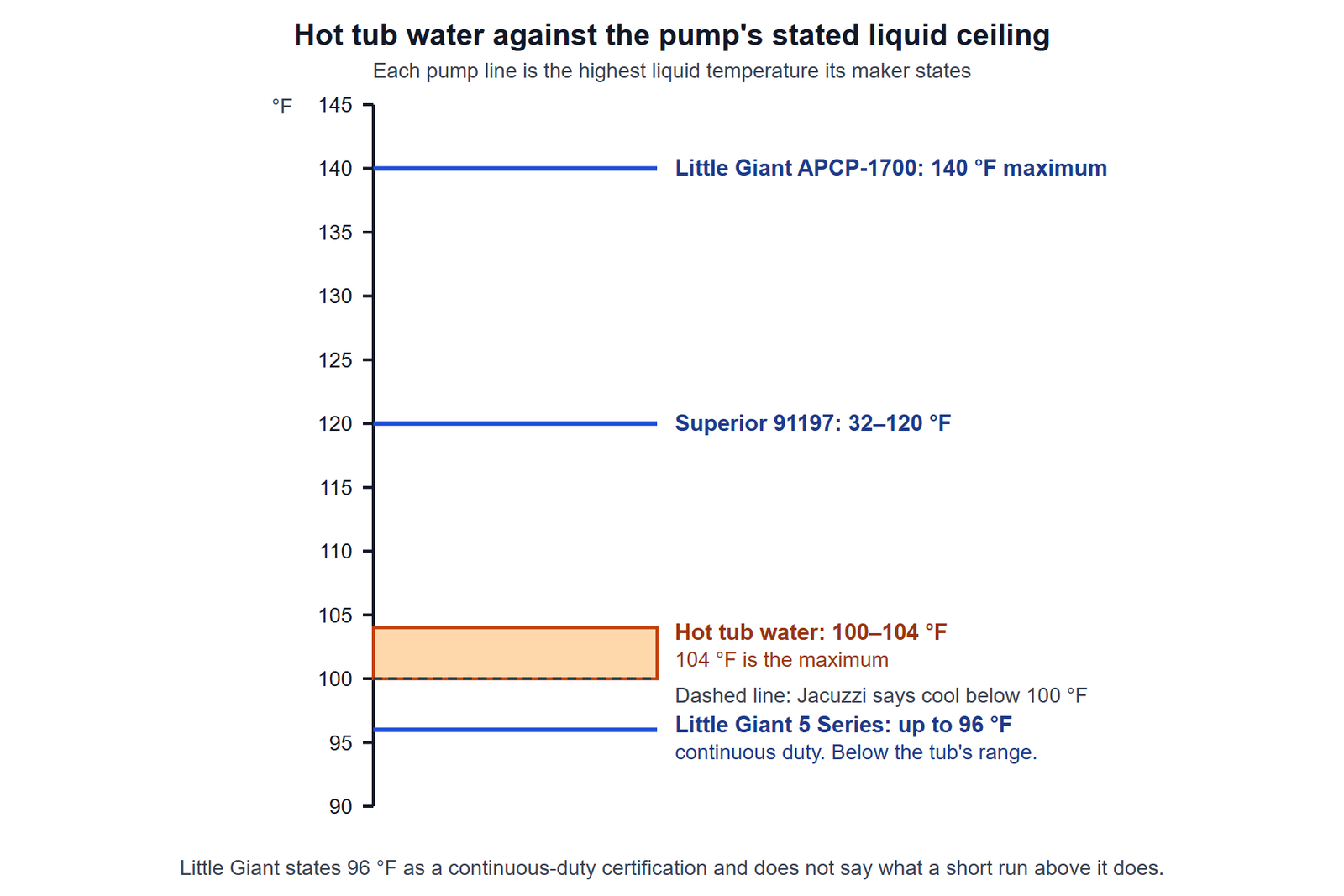
| Pump | Liquid temperature rating | Where that comes from |
|---|---|---|
| Little Giant 5 Series | “continuous duty liquid temperature rating of up to 96 °F (30 °C)” | Little Giant’s series page |
| Superior 91197 | 32–120 °F | Superior’s product page |
| Little Giant APCP-1700 | 140 °F maximum | Little Giant’s product page |
Read the first row against a tub at 102 °F. The pump is certified for continuous duty only up to 96 °F, so a full tub is outside the stated condition. A ten-minute drain is not continuous duty, and Little Giant does not say what happens above the figure, so this is not proof the pump will die. It is an unknown, and you are the one carrying it.
One-minute test: find the liquid temperature range in your pump’s manual or on its label, and compare it with the reading on the spa’s display. If the pump’s ceiling is below the water, let the tub cool before you start. Jacuzzi says to “allow water temperature to cool below 100°F for safety” in any case, since hot water makes connecting the hose a burn risk. Hot water is also the manufacturers’ first-listed cause when a pump trips its thermal cut-out, which the overheating article covers. If you would rather buy a pump with headroom, the submersible guide lists the ratings alongside the flow figures.
Where the water is allowed to go
Most guides stop at “check local regulations”. Here is what one city’s regulations actually say, so you know what you are checking for. Portland, Oregon:
- “City code prohibits the discharge of heated, chlorinated, or salt-treated waters, such as from a pool or hot tub, to a storm drain or into the city’s stormwater system.” Heated is on that list by itself, before any chemistry.
- The preferred routes are “the sanitary sewer or allow it to infiltrate into the ground, if available.” Never onto the sidewalk, the street or a neighbour’s property.
- Water containing bromine, and water from a salt-sanitised system, may not go to the storm system at all, under any conditions.
- A storm drain is a last resort, and then only if the water has cooled for at least 12 hours, been dechlorinated to 0.1 mg/L total residual chlorine or less, been left to sit out for at least two weeks, is at neutral pH, and leaves at under 50 gallons per minute.
That is Portland’s rule, not yours. Yours may be looser or tighter, and the city or county stormwater office will tell you in one phone call. But the pattern is common enough that assuming the street drain is fine is the wrong default.
Hot Spring’s own advice is plainer: “Transport the water to an existing drain, to avoid damage to your lawn or patio.” In practice that means a laundry standpipe, a floor drain, or a sanitary cleanout, and a hose long enough to reach one. Length costs flow, and by more than people expect. Twenty-five feet of ordinary garden hose takes about half the flow off a 1,350 GPH pump.
The 50 gallons-per-minute cap is 3,000 GPH. The Little Giant 5 Series, at 1,500 gph at 1 ft, is under it. The Superior 91197, at 4,980 GPH at 5 ft on its curve, is over it on paper, though a garden hose will throttle it well below that.
Put the pump in and run it
Set the pump on the deepest surface in the tub. Screw a garden hose onto the adapter (a rubber washer seals a hose thread, not tape, and that is why a fitting drips). Run the hose to the drain before you plug in, so the first water goes where it should.
Plug into a GFCI-protected outlet (the rule is in the utility pumps guide), keep the cord out of any puddle, and stay with it. A submersible is cooled by the water around it, so running it dry is how it overheats. Switch it off when the last of the water reaches the intake.
Jacuzzi puts a good pump at 10 to 15 minutes, against about an hour for the tub’s own spigot. The arithmetic is gallons divided by gallons per minute: as an example, and not a claim about your tub, 400 gallons at 30 gallons per minute is a little over 13 minutes. Hose bore and length usually set the real number, not the pump’s headline flow.
What the pump will not empty
Two things are left behind.
The last inch of the shell. A submersible stops where its intake meets the surface. Superior’s 91197 pumps down to 1 in; its 91330 to 1/2 in; Little Giant’s 5 Series to 1/8 in with the screen on. Jacuzzi’s answer is short: “Some residual water is normal with gravity draining. Use a wet/dry vacuum or towels to remove final puddles.”
Whatever is in the tub’s plumbing. A pump in the shell empties the shell. Hot Spring’s procedure has a second spigot for exactly this: “Use the primary spigot to drain most of the water, and then open the secondary spigot to drain the internal bleed lines.” Not every model has one. Look for two drain points in your owner’s manual. If you have two and only used one, there is still water in the jets and lines.
When to stop and call someone
If the tub is hard-wired and you cannot find the breaker, or the breaker will not reset, that is an electrician. If the drain valve will not close again after you open it, that is the spa dealer, and worth knowing before you refill.
FAQ
Can I use a sump pump to drain a hot tub?
Yes, as long as it is a clean-water submersible and its liquid temperature rating is above the water it will sit in. Jacuzzi describes “quality sump pump models designed for clean water” cutting the time from over an hour to 10 to 15 minutes.
What if my hot tub will not drain completely?
Some leftover water is normal. Jacuzzi’s advice is a wet/dry vacuum or towels for the last puddles. If you used a pump, also check whether the spa has a second drain point for its internal lines.
Can I drain a hot tub onto my lawn?
It depends on your city and on what is in the water. Portland allows draining to the ground where it can soak in, and bans anything reaching the street; it bans bromine and salt-water discharge to the storm system outright. Hot Spring also warns about lawn and patio damage and says to use an existing drain. Ask your local stormwater office before you aim the hose.


