On this page
Last Updated on September 14, 2026 by Muhammad Toqeer
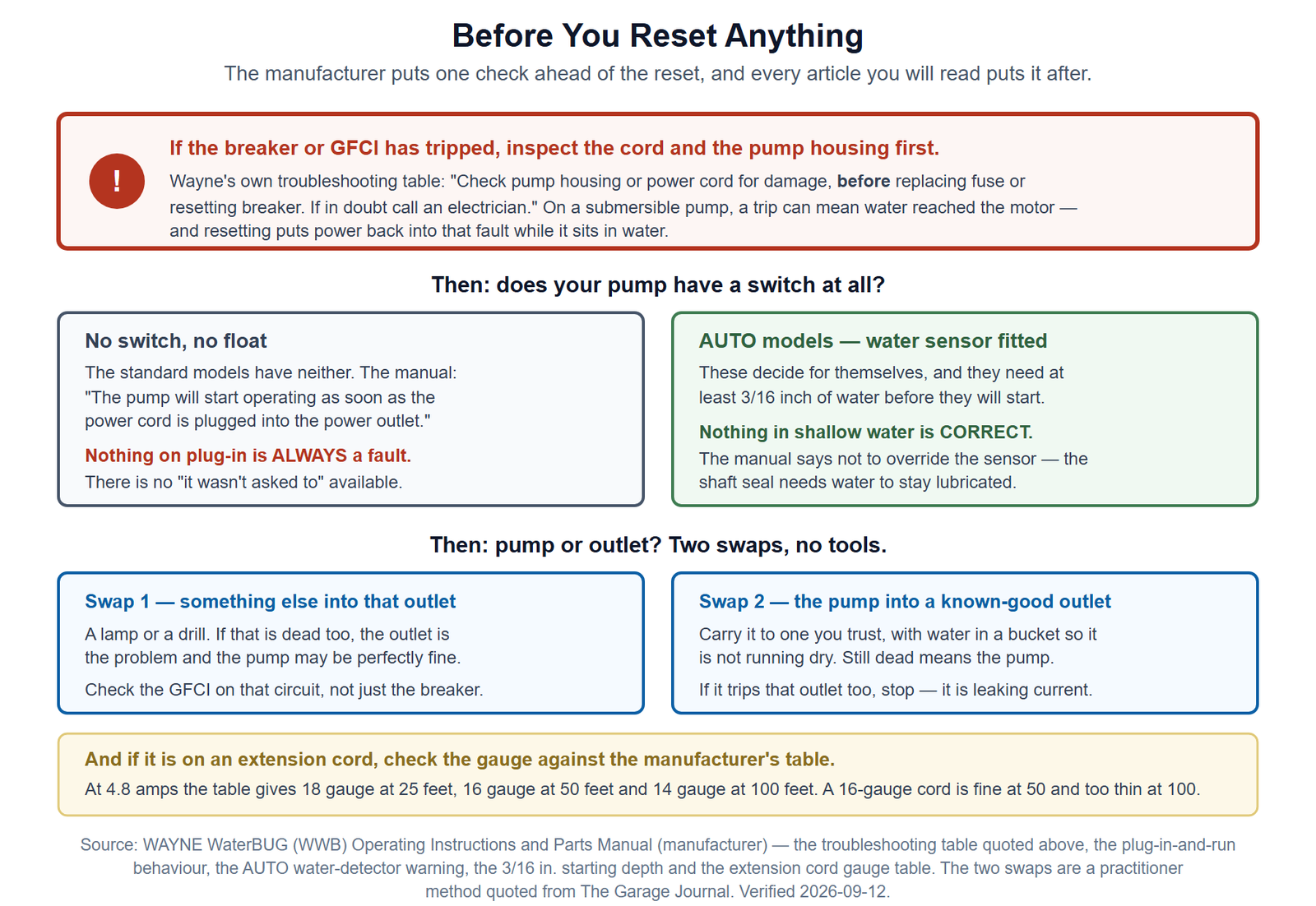
If the breaker or the GFCI has already tripped, do not reset it yet. Wayne’s own troubleshooting table puts one instruction ahead of the reset: “Check pump housing or power cord for damage, before replacing fuse or resetting breaker.” On a submersible pump, a trip can mean water has reached the motor — and resetting sends power straight back into a fault sitting in water.
Every page ranking for this problem has that order the other way round.
The reset is the step with a consequence
Nothing else on the list can hurt you. Checking the outlet, looking at the cord, moving the pump — all free. The reset is different, because the breaker or the GFCI may have done exactly what it exists to do, and putting it back is undoing that decision without knowing why it was made.
So take ninety seconds first. Unplug the pump. Run the cord through your hand end to end, looking for cuts, crush marks, a cracked plug body, or a spot where the jacket has gone soft. Then look at the pump housing itself — a split seam, a missing screw, a cord grip that has pulled loose where the cable enters the body. If any of that is there, the pump is a replacement decision and not a reset. If you are unsure, the manual’s own answer is “If in doubt call an electrician.”
If the breaker has not tripped, skip ahead — you have a different problem, and the rest of this page is about it.
Half of these pumps have no switch at all
This is the fastest sort available and almost nobody makes it, because it decides whether you are looking at a fault or at correct behaviour.
A standard WaterBUG has no switch and no float. The manual says it plainly: “The pump will start operating as soon as the power cord is plugged into the power outlet.” There is no on position, no float to hang up, and no “it wasn’t asked to run” explanation available. If a pump like that does nothing when you plug it in, the fault is electrical from the first second.
The AUTO models are the opposite case. They carry an automatic water detector that decides for itself, and they need “at least 3/16 inch” of water before they will start. An AUTO pump sitting in a thin film on a garage floor and doing nothing is not broken — it is doing what it was built to do. Wayne is emphatic that you should not try to talk it out of it: “Do NOT alter the pump to override the automatic water detector. The shaft seal depends on water for lubrication.” That override is how people destroy a working pump while trying to fix one that was never faulty.
One-minute test: look at the pump body for a sensor block or a float. If there is one, put the pump in a bucket with three or four inches of water and plug it in. If it runs there, the pump is fine and the puddle was too shallow.
Two swaps tell you which side of the plug the fault is on
Neither needs a meter, and between them they settle the question that everything else depends on.
Swap one — put something else into that outlet. A lamp, a drill, a phone charger. If that is dead too, the outlet is the problem and your pump may be in perfect health. Check the GFCI on that circuit specifically, not just the breaker panel — the reset button is often on a different receptacle in the same run, in a garage, a bathroom, or outdoors.
Swap two — put the pump into an outlet you trust. A DIYer diagnosing exactly this put both halves in one breath: “The thing is it could be the pump or it could be the GFCI outlet. Do you have another GFCI circuit you can test the pump on?” — and then, “Can you put the pump in the bathtub to test it?” Carry it to a known-good outlet with water in a bucket or a tub so it is not running dry. Still dead means the pump. If it trips that outlet too, stop there: the pump is leaking current, and finding an unprotected outlet to run it from is the wrong answer to that.
There is one more thing worth checking at the receptacle, which no checklist carries: “Check the ground on your GFI receptacle and make sure its tight. A loose ground will cause it to trip as well.”
The extension cord is the cause that hides best
Because nothing is broken. The pump is fine, the outlet is fine, and the pump still will not run properly — or starts and dies.
Wayne publishes a gauge table for this, and most people have never looked at it:
| Current at 120 V | Up to 25 ft | Up to 50 ft | Up to 100 ft |
|---|---|---|---|
| Up to 4 A | 18 gauge | 18 gauge | 16 gauge |
| Up to 6 A | 18 gauge | 16 gauge | 14 gauge |
| Up to 10 A | 16 gauge | 14 gauge | 12 gauge |
The WaterBUG draws 4.8 amps, which puts it on the middle row. At 100 feet that is 14 gauge — heavier than the cord most people reach for, and the length people actually use when the water is at the far end of a yard or down a driveway. A 16-gauge cord is fine at 50 feet and undersized at 100.
Low supply voltage appears twice in the manufacturer’s own troubleshooting list — once under “Pump will not start or run” and once under “Pump starts but delivers little or no flow” — and both times the remedy given is “Contact an electrician.” An undersized cord produces that condition with nothing at all wrong with the pump.
Wayne’s PC4 manual is more cautious still and declines to give a rule at all: “Use an extension cord only if necessary. Contact Customer Support (800-237-0987) for guidance.”
One-minute test: read the gauge printed on the cord jacket, and remember that on wire gauge the bigger number is the thinner wire. Then plug the pump straight into the wall with no cord at all. If it comes to life, you have found it.
It may have already stopped itself
Both manuals list “thermal protector open” as a cause of a pump that will not run, and this is the one case where the pump is neither broken nor being asked to do anything wrong — it is just not finished cooling.
The PC4’s protector is “automatic resetting” and Wayne warns the pump “MAY restart unexpectedly” because of it, which matters for your hands as much as your diagnosis. The WaterBUG’s dry-run shutdown is stricter: once it has run dry it “will shut off” and “a manual reset is required” — roughly an hour unplugged, or about fifteen minutes submerged in cold water.
So a pump that died mid-job and now refuses to start may simply be one you are asking too early. If it stopped hot, leave it and come back. If it keeps stopping once it does restart, that is the running-and-then-quitting picture rather than this one — a pump that runs but moves no water covers where that goes.
What this page deliberately does not cover
Two neighbouring problems get mixed into articles like this one, and mixing them is why those articles help nobody.
A breaker or GFCI that trips again after a clean reset is a different fault with a different method — you are no longer asking whether the pump has power, you are asking where the current is going. And a pump that hums, or turns a fraction and stops, is not a pump that will not turn on; that is usually a seized impeller after storage, and it wants a different first move entirely.
If the pump turns out to be genuinely dead — no response on a known-good outlet, no response with no extension cord, nothing after a full cool-down — replacement is the honest answer — these are not machines with serviceable electrics, and a rewind costs more than the pump. The buying guide covers what to compare once you are shopping, starting with the two specs that are not GPH. If it starts but will not pull water, that is the priming problem instead.
When this needs a pro
Three specific points, none of them boilerplate.
Damage you can see on the cord or housing ends the DIY path. This is a mains-voltage appliance that is designed to sit in water. The manufacturer’s instruction is to inspect first and call an electrician if in doubt, and that is the correct order to keep.
A pump that trips a second, known-good GFCI is telling you something specific. It is leaking current to ground. The tempting move — find an outlet without GFCI protection so it will run — removes the only thing standing between that leakage and a person standing in the water. Do not do it.
A slow trip is not a mild one. The thing people find most confusing about a water-ingress fault is that the pump runs for a minute or several before the circuit goes. One electrically-minded poster explained why in a sentence: “It takes time to trip because water is an imperfect conductor.” The fault is not intermittent, it is progressive — the leakage path is getting wetter. A pump that trips after a delay is not a pump that half works.
For what these pumps are rated for in the first place, and where the GFCI requirement comes from, the utility and transfer pumps guide has the background.
FAQ
My utility pump won’t turn on and the breaker tripped. Can I just reset it?
Not until you have looked at the cord and the pump housing. The manufacturer’s troubleshooting table puts that inspection before the reset, because on a submersible pump a trip can mean water has reached the motor. If the cord or the housing is damaged, resetting re-energises a fault that is sitting in water.
Do utility pumps have an on/off switch?
Many do not. Standard models have no switch and no float — the manual says the pump starts operating as soon as the cord is plugged into the outlet. AUTO models have an automatic water detector instead, and those need at least 3/16 inch of water before they will start.
Why won’t my automatic pump start in a shallow puddle?
Because it is not supposed to. The water sensor needs about 3/16 inch of depth to trigger. The manufacturer specifically warns against overriding the detector, because the shaft seal relies on water for lubrication and running dry is what damages it.
Can an extension cord stop a utility pump from starting?
Yes, and it is easy to miss because nothing is broken. At 4.8 amps the manufacturer’s table calls for 14 gauge at 100 feet; a thinner cord at that length drops the voltage enough to show up as a pump that will not start or will not move water. Plug it directly into the wall to rule it out.
My pump ran for a few minutes, then the GFCI tripped. Is that a small problem?
No. A delay before the trip usually means moisture has found a leakage path and is working its way in — water is a poor conductor, so it takes time to draw enough current to trip. That is an electrical fault in the pump, not an outlet being fussy, and the pump should stay unplugged.


