On this page
Last Updated on September 14, 2026 by Muhammad Toqeer
There are two kinds of utility pump and they are cooled in opposite ways. A submersible stands in the water and that water carries its heat away. A transfer pump stays on dry ground, and its manual says in as many words that it is not designed to operate under water. So a pump that keeps shutting off on heat needs more water over it — or needs to be got out of the wet entirely. Which one depends on what you own, and almost every page online only tells you the first.
Work out which you have and you have already halved the problem.
Which one is standing in front of you
No spec sheet needed. Look at where the pump sits while it’s working.
In the water. You lower the whole unit into the puddle, the pit or the tub, and only the hose and cord come back out. That’s a submersible. The WaterBUG is one. Its manual describes the motor as “oil-filled and sealed for cooler operation” — the oil moves heat out to the shell, and the water the pump is standing in takes it from there. The water is the coolant, and it is doing that job whether you thought about it or not.
Beside the water. The pump sits on the ground and a suction hose reaches in. That’s a transfer pump. Wayne’s PC4 is one, and its manual is blunt about the difference:
“The motor is air cooled; it is not designed to operate under water.”
And a line further on, telling you exactly what it wants:
“The motor is designed to be used in a clean, dry location with access to adequate cooling air.”
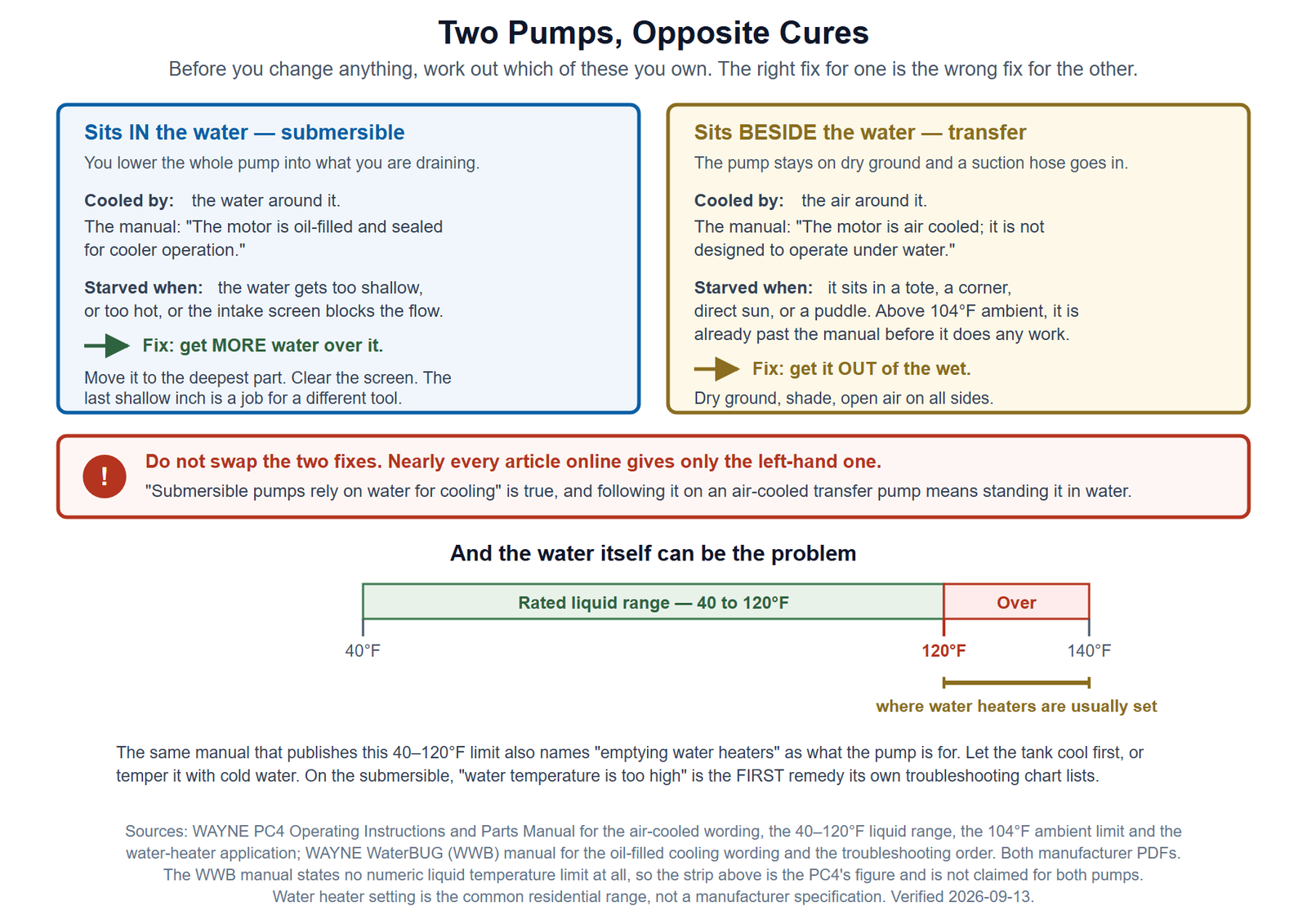
One-minute test: if the pump is out of the water and the motor housing is too hot to keep your hand on, its cooling air is the problem. If the pump is in the water and the housing is hot, the water around it is either too shallow or too warm.
If it’s a submersible: it is running out of water, not out of air
The mistake here is thinking of the water as the thing being moved rather than the thing doing the cooling.
As the level falls, less and less of the shell is in contact with water. A pump lying in an inch of water on a garage floor is mostly in air, and air is a poor substitute — it’s carrying heat away from a sealed motor at a fraction of the rate. That’s why these pumps so often cut out at the end of a job rather than the start.
The intake screen matters for the same reason. The WaterBUG’s own troubleshooting chart lists a clogged inlet as a cause of the thermal protector opening: it isn’t just about flow, it’s that flow is the cooling.
One-minute test: stop the pump and look at how much of the body is actually submerged. If the water is below the halfway mark on the housing, that’s your answer before you check anything else.
The fix is to put more water over it, not to run it harder. Move it to the deepest part of what you’re draining. Pull it out and clear the screen. And accept that the last shallow inch is a different job — a wet vac finishes it without asking a submersible motor to run in air. If the flow has fallen off as well as the temperature climbing, that’s a pump running but not moving water.
If it’s air cooled: it’s suffocating, and the fixes are free
This is the half nobody writes about, and every item on the list costs nothing.
Wayne’s full explanation of what makes the thermal protector trip is worth reading whole, because the second half of it never gets quoted:
“Protector tripping is an indication of motor overheating because of operating pump at low heads (low discharge restriction), excessively high or low voltage, inadequate wiring, excessive surrounding air temperature, inadequate ventilation, and/or defective motor or pump.”
Excessive surrounding air temperature. Inadequate ventilation. Two named causes, both of them about where you set the pump down.
In practice that means:
- A pump in a tote, a bucket or a milk crate — people do this to keep it out of the mud, and it turns into an oven.
- A pump backed into a corner or against a wall, with no air moving on three sides.
- A pump in direct sun on a summer afternoon. The manual caps ambient at “104F (40C)”, and a black plastic driveway in August clears that before the pump does any work at all.
- A pump standing in the puddle it’s draining — which happens by accident constantly, and is the one thing its manual specifically tells you not to do.
One-minute test: put your hand flat on the ground beside the pump and then on the motor housing. If the ground is hot too, you have a location problem, not a pump problem. Move it to shade, set it on something dry, and leave a clear foot of air around it.
Two other items on that list are worth naming. Low voltage makes a motor draw more current to do the same work, and that extra current becomes heat — well-pump servicers use a rule of thumb of staying within 10% of the motor’s nameplate voltage, and the usual cause on a portable pump is a long, thin extension cord. That’s covered properly in what to check when it won’t start, which carries the manufacturer’s cord gauge table.
The water itself may simply be too hot
Here’s the one that catches people out, and it’s a contradiction sitting inside a single document.
The PC4’s manual describes the pump as being for “such applications as emptying water heaters, livestock tanks, etc.” Its specification block, on the same page, gives:
LIQUID TEMPERATURE RANGE 40° F – 120° F
A domestic water heater is commonly set at 120 °F, and plenty of them run hotter. So the manufacturer names the job and then publishes a limit that the job sits right on top of.
Someone on a garage forum ran the experiment without meaning to, flushing a steam boiler and a water heater:
“Tried the HF one stainless steel, and 12V, works great until it seized when the temp got too hot. so probably not good for hot water.”
A reply gave him the fix in one line — “what about just shutting it down and letting water cool down before starting to pump it out?” — and another offered the workaround: “maybe drain it into a bucket while tempering with a hose, then pump from that.”
His own update, later in the thread, is the whole article in a sentence:
“Just a little update the hf transfer pump worked nice when the temp of water is only warm or hot not boiling. Did try it again and it flush and drain both boiler and water heater effortlessly.”
Same pump, same job, one variable changed.
This applies to the submersible too, and more strongly than anyone admits. On the WaterBUG’s troubleshooting chart, under thermal protector open, the first remedy listed is “Water temperature is too high, allow pump and/or water to cool” — ahead of a clogged inlet, ahead of a seized motor. It is the manufacturer’s leading suspect.
Worth being straight about one gap: the WaterBUG’s manual gives no number. It names hot water as the top cause of the thermal trip and never says how hot is too hot. The 40–120 °F range above is the PC4’s figure and shouldn’t be assumed to apply to a different pump. If you’re draining something warm with a submersible, the manual’s own instruction is the only guidance there is — let it cool.
One-minute test: put your hand in it. If you wouldn’t leave it there comfortably, the pump is being asked to work in water that’s warmer than the specification of the one pump in this class that publishes a specification.
Before you touch it, twenty minutes
Every article says let it cool. One manual says how long, and says why in capitals:
“Let pump cool for at least 20 minutes before attempting to service. Motor MAY be extremely hot. Personal injury MAY result.”
The PC4’s motor housing is cast iron, which holds heat far longer than a plastic one and gives you no warning by looking at it.
There’s a second reason to wait, and it’s the one that catches hands rather than fingers. The thermal protector is automatic resetting. The manual’s warning is that the pump “MAY restart unexpectedly” — so a machine that has gone quiet has not turned off, it has paused, and it can come back on its own while you’re clearing the intake. Unplug it at the receptacle, so you can see it’s disconnected.
And note that this is not the breaker. If the pump stopped but the panel is untouched and the outlet still has power, the protector did it, not the circuit. That distinction is worth keeping straight — a pump tripping the breaker is a different problem with a different method.
What it means if it keeps happening
Cutting out once at the end of a long, hot job is a pump protecting itself. Cutting out repeatedly, on a job it used to manage, is information.
The manufacturer’s list ends with “and/or defective motor or pump” for a reason. If you have given it water or air as appropriate, kept the liquid inside its range, put it somewhere shaded and open, and it still stops every twenty minutes, the protector is reporting a motor that is no longer efficient — and the heat is a symptom rather than the cause. A pump that has previously been run dry for a long stretch is the usual history behind that, and at that point choosing the next one is a better use of an afternoon than nursing this one.
When this needs a pro
Repeated thermal cut-outs plus a burning smell is a stop-now situation. Insulation that has been cooked has a distinct smell, and a motor at that stage is not a cooling problem any more.
Do not defeat a thermal protector. It’s not an inconvenience to be worked around; on a sealed motor it is the only thing standing between an overheat and a winding failure, and on a cord-connected appliance sitting in water the failure mode after that is electrical.
Voltage is an electrician’s measurement, not a guess. If the pump overheats on every circuit you try, with a short heavy cord, in open air, then supply voltage becomes a real candidate — and that is checked with a meter by someone qualified, not inferred.
For what these pumps are rated to do in the first place, and why running one at very low lift works it harder rather than easier, the utility and transfer pumps guide has the background.
FAQ
Why does my utility pump keep shutting off after running for a while?
Its thermal protector is cutting the motor to stop it overheating, and it will reset itself once it cools. The cause depends on the pump: a submersible is usually running in water too shallow or too warm to carry its heat away, while an air-cooled transfer pump is usually somewhere with no airflow — a tote, a corner, direct sun, or standing in the water it’s draining.
Can I put a transfer pump in the water to keep it cool?
No, and it’s the most common way to destroy one. The manual states the motor is air cooled and not designed to operate under water. The advice you’ll read that submersibles rely on water for cooling is true of submersibles and dangerous applied to anything else.
How hot is too hot for the water I’m pumping?
Wayne’s PC4 gives a liquid temperature range of 40 °F to 120 °F. The WaterBUG’s manual gives no number at all, though it lists water that is too hot as the first cause of a thermal cut-out. A domestic water heater is usually set at or above 120 °F, so let the tank cool or temper it with cold water before pumping it out.
How long should I let an overheated pump cool before touching it?
The manual specifies at least 20 minutes before servicing, and warns the motor may be extremely hot. Unplug it at the outlet first — the thermal protector resets automatically and the pump can restart on its own while you’re working on it.
Does overheating damage a utility pump permanently?
One cut-out on a hot day usually doesn’t; that’s the protector doing its job. Repeated cut-outs are worth taking seriously, because the heat is cooking the motor’s insulation a little each time. If it keeps stopping after you’ve fixed the cooling, the motor itself is likely the problem rather than the conditions.


