On this page
Last Updated on September 19, 2026 by Muhammad Toqeer
At the lowest point of the floor, sitting flat on a patch of hard surface you have swept clear first. That is the whole answer, and the second half of it is the half nobody gives you — the pump’s drain-down rating is measured from whatever it is standing on, not from your floor.
Which means the most common improvement people make, standing it up on a brick to keep it out of the silt, quietly decides to leave a brick’s depth of water in the room.
All of this assumes the pump is already chosen and in your hands; if it is not, what these pumps are and how submersibles differ from transfer pumps comes first.
Find the low point, not the middle
Basement floors are not flat. They are poured with a fall toward a drain, or they have settled, or the slab was finished by someone having a bad afternoon in 1974. The water is already telling you where the low point is — it is the bit that is still wet when everything else is damp.
Put the pump there rather than in the middle of the room. A pump in the middle empties a circle around itself and then sits in a dry patch while the corner it should have been in stays flooded.
One-minute test: before you set the pump down, watch which way the surface moves when you push a broom through it. Water finds the fall faster than your eye does. Put the pump where the ripple settles.
The awkward part is that the low point moves as the job goes on. As the level drops, what was one sheet of water becomes separate puddles, and the pump can end up marooned in the one it has already emptied. Plan to pick it up and move it once or twice near the end — that is normal operation, not a sign you chose wrong.
Clear the spot before you put it down
This is an instruction from the manufacturer, and it is the most actionable thing here. WAYNE’s WaterBUG manual, step 6, verbatim:
“Place pump on a hard surface in the water. Do not set the pump directly on mud or sand surfaces. This will cause the inlet screen to clog. For best results clean an area on the hard surface for the pump to sit while working. The filter features of this pump work best if the debris is filtered from the outside in. Sitting the pump directly on a loose/dirty surface will not allow the filter features to work to their full extent.”
Two separate things are going on there.
The obvious one: mud and sand clog the inlet screen. The less obvious one is the mechanism — the filter is designed to work from the outside in. It expects debris to arrive with the water and be caught on the way. Stand the pump directly on a layer of silt and you have put the dirt on the inside of the filter, where the design has no answer for it.
So: sweep or squeegee a patch of bare floor, then set the pump on that. It takes thirty seconds and it is the difference between a screen that keeps working and one you are clearing every ten minutes.
And it must be flat. A pump tilted on a slab seam or a stone lifts one side of its intake clear of the water, which is both a performance problem and, more audibly, where that new grinding noise is coming from.
Do not raise it unless you mean to leave the water
Here is the trade-off that no page states, in the manufacturer’s own words:
“The pump will remove water down to approximately 1/16 inch of the surface the pump was placed on.“
Read that last phrase again. Not 1/16 inch of the floor. 1/16 inch of whatever is underneath the pump.
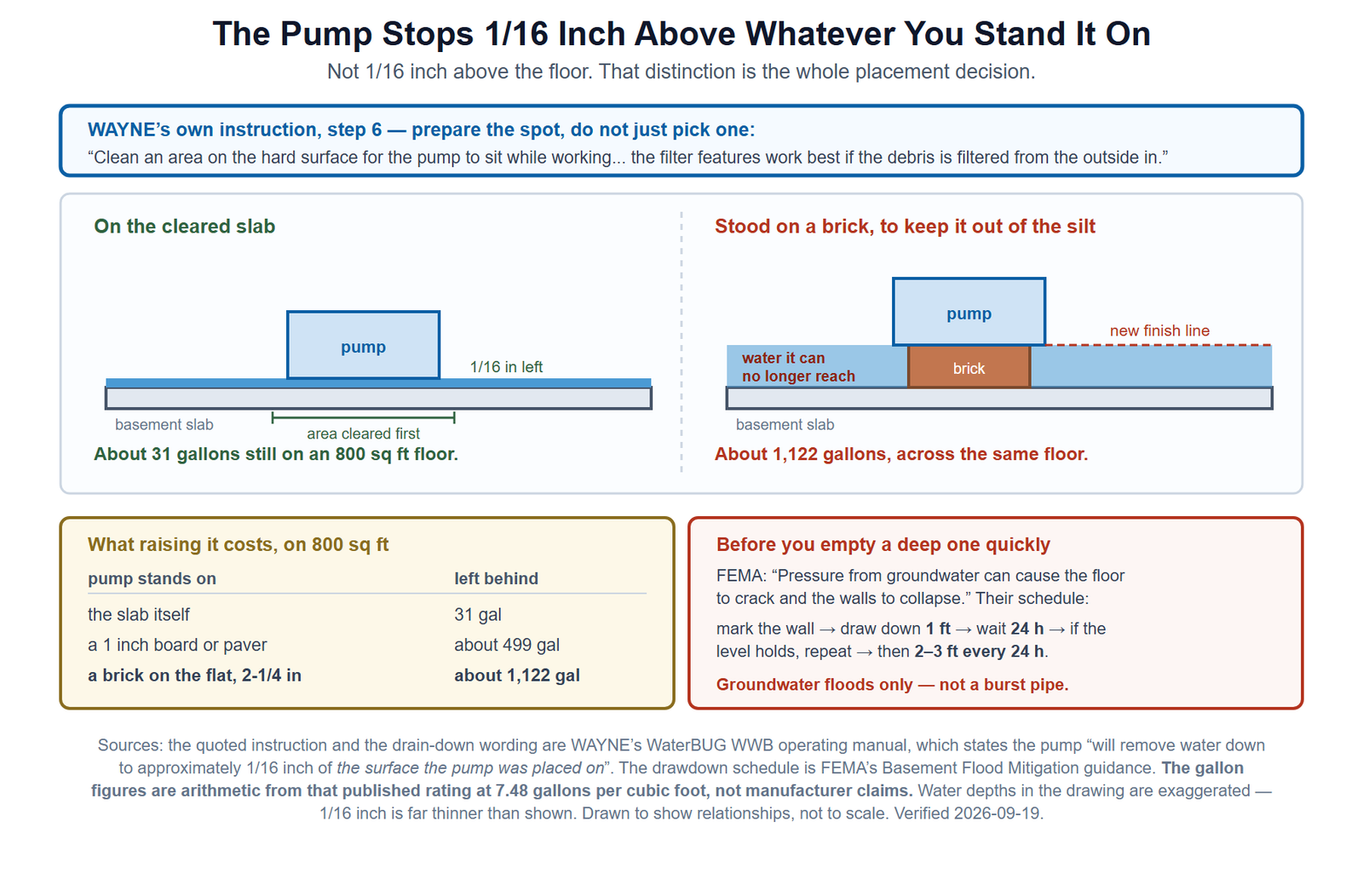
Every inch you lift the pump is an inch of water it can no longer reach, across the entire floor:
| Pump stands on | Water left on an 800 sq ft floor |
|---|---|
| the slab itself | about 31 gallons |
| a 1 inch board or paver | about 499 gallons |
| a brick on the flat, 2-1/4 inches | about 1,122 gallons |
Those are not damp patches. A thousand gallons is most of the job still sitting there — and if you have already worked out how long the job should take, raising the pump has just invalidated the number.
When raising it is still the right call: if the water is genuinely dirty — a crawl space, a silted garage, anything with grit moving in it — protecting the pump may be worth more than the last two inches, because a clogged or seized pump finishes nothing at all. Do it deliberately, knowing the cost, and plan to lower it onto the cleared slab for the final pass once the water running into it is clean.
What you should not do is raise it by reflex because it feels tidier.
One-minute test: slide your hand under the pump. If anything is between its feet and the floor, you have moved the finish line up by that much.
If the last fraction of an inch is what matters most to you — a finished floor, a carpet pad, anything with a seam — that is a purchase decision as much as a placement one, and the buying guide compares five models on exactly that spec.
Where the hose ends decides whether you do this twice
The pump is portable, so its discharge hose is not a buried pipe running to a proper outfall. It is a length of hose lying wherever you dropped it — and if that is just outside the door, you are pumping water onto ground that drains back toward the foundation you just emptied.
Drainage practice for a permanent discharge puts it at least 6 to 10 feet from the foundation, with 10 to 20 feet preferred, for exactly this reason: water put down beside the wall finds its way back in. Those are recommendations rather than a code citation, and they are written for sump installations, but the physics does not care that your pump is temporary.
Two things worth checking before you switch on:
- The hose runs downhill, away from the house, the whole way. A hose that climbs over a threshold and then sits in a dip is holding water against the pump.
- The far end is not somewhere that drains back. A window well, the top of a driveway that slopes to the garage, or a flower bed against the wall all return the favour.
How fast to empty it — and when that question matters
This applies to one specific situation and not to the others, so the condition matters as much as the rule.
If the basement flooded from outside — groundwater, a river, a storm, saturated soil all around the walls — then the water inside is holding the walls up. FEMA is blunt about what happens if you remove it too quickly:
“Pressure from groundwater can cause the floor to crack and the walls to collapse.”
Their published schedule is slow on purpose:
“Test the rate of water coming in by marking the wall and draw down 1 foot of water. Wait 24 hours. If the water level has not changed, draw down another foot of water and mark the new level. Wait another 24 hours. When the water level has remained down, begin to draw down 2-3 feet of water every 24 hours until the basement is empty.”
Marking the wall does double duty: it tells you whether water is still coming in, and it stops you guessing about progress.
If the water came from inside — a burst supply line, a failed water heater, an overflowing appliance — none of the above applies. The soil outside is not saturated, there is no pressure imbalance to manage, and the right answer is to get it out promptly before it soaks into anything.
Knowing which situation you are in is the actual skill here. If you do not know where the water came from, treat it as the outside case and go slowly.
When this needs a pro
Before anything else: kill the power. Standing water and mains electricity in the same room is the part of this that hurts people. This Old House’s instruction is to make sure “the power is turned off at the source” before you enter a flooded basement — and if the breaker panel is itself in the flooded area, that is a phone call to the utility, not a wade across the room.
The pump must be on a GFCI outlet. WAYNE’s manual, step 8: “Plug the power cord into a grounded 120 VAC GFCI protected power outlet. Make sure the electrical outlet is grounded and is rated for at least 15 amps.” Not an extension lead into whatever is nearest.
If the water is sewage or came up through a floor drain, placement is not your problem. That is contaminated water, a different class of pump, and a health issue.
If the level does not go down, or drops and comes back, something is still feeding it. At that point you have left utility-pump territory — a portable pump is for clearing water that has stopped arriving, and a continuing inflow is drainage or groundwater work.
And if the pump is running hot on a long job, where it sits affects how it cools — these motors are cooled by the water they sit in, which is another reason the floor is a better place for it than a brick.
FAQ
Where exactly should I put a utility pump in a flooded basement?
At the lowest point of the floor, flat, on a patch you have swept clear of silt and grit first. The manufacturer asks for a hard surface and specifically says to clean an area for the pump to sit, because its filter is designed to catch debris arriving from the outside rather than sitting in it.
Should I put my utility pump on a brick or block?
Only deliberately, and only for dirty water. The published drain-down depth is measured from the surface the pump stands on, so a 2-1/4 inch brick leaves about 1,122 gallons on an 800 square foot floor that the pump can no longer reach. If you raise it to protect it from grit, lower it onto the slab for the final pass.
Do I need to move the pump as the water goes down?
Usually once or twice, yes. As the sheet of water breaks up into separate puddles, the pump can end up in one it has already emptied while another sits full. That is normal, not a sign the first position was wrong.
How fast should I pump out a flooded basement?
If it flooded from outside, slowly — FEMA’s schedule is to draw down 1 foot, wait 24 hours, check the level, repeat, then 2 to 3 feet every 24 hours, because groundwater pressure against empty walls can crack the floor and collapse them. If the water came from a burst pipe inside the house, that does not apply and you should clear it promptly.
How far from the house should the discharge hose end?
Far enough that the water does not come back. Drainage practice for permanent discharge is at least 6 to 10 feet from the foundation and preferably 10 to 20, and a hose lying just outside the door is the most common reason a floor refills while the pump is still running.


