On this page
- The two devices, and why every article merges them
- If it was the breaker, the timing is the diagnosis
- A 15-amp circuit isn't designed to carry 15 amps
- The amp clamp settles it, and the shape of the number is the answer
- On a brush-type pump, carbon is a real cause
- Things that are not the breaker
- When this needs a pro
- FAQ
Last Updated on September 14, 2026 by Muhammad Toqeer
Two different devices can cut power to your pump, and they trip on faults that have nothing to do with each other. A breaker trips because too much current is flowing. A GFCI trips because a small amount of current is going somewhere it shouldn’t — a few thousandths of an amp is enough. So the first question isn’t what’s wrong with the pump. It’s which one you had to reset.
Get that backwards and you spend the afternoon looking for a fault the device that tripped cannot detect.
The two devices, and why every article merges them
Read the ranking pages on this problem and you’ll find “water got into the pump and current is leaking to ground” listed as a reason the breaker trips. It’s on nearly all of them.
Wayne prints the correction on the pump’s own warning panel:
“GFCI receptacles will provide protection against line to ground faults only. The ground fault receptacle does NOT limit the magnitude of fault current and will NOT prevent electrical shock.”
Line to ground faults only. That’s the GFCI’s entire job, and it does it at a handful of milliamps. Your breaker is a 15-amp device — it needs roughly three thousand times more current before it notices anything. Wet insulation leaking a few milliamps to ground will trip the GFCI all day long while the breaker sits there perfectly happy.
Someone on a tractor forum, working through his own tripping problem, explained the mechanism better than any of the articles did:
“they have a very sensitive circuit that compares the current in the hot line to the current in the neutral line. If there is difference of more than 3-4 milliamps between the current flowing in and the current flowing out, the GFCI will trip… I believe it has nothing to do with overload.”
He’s right, and that last line is the whole point.
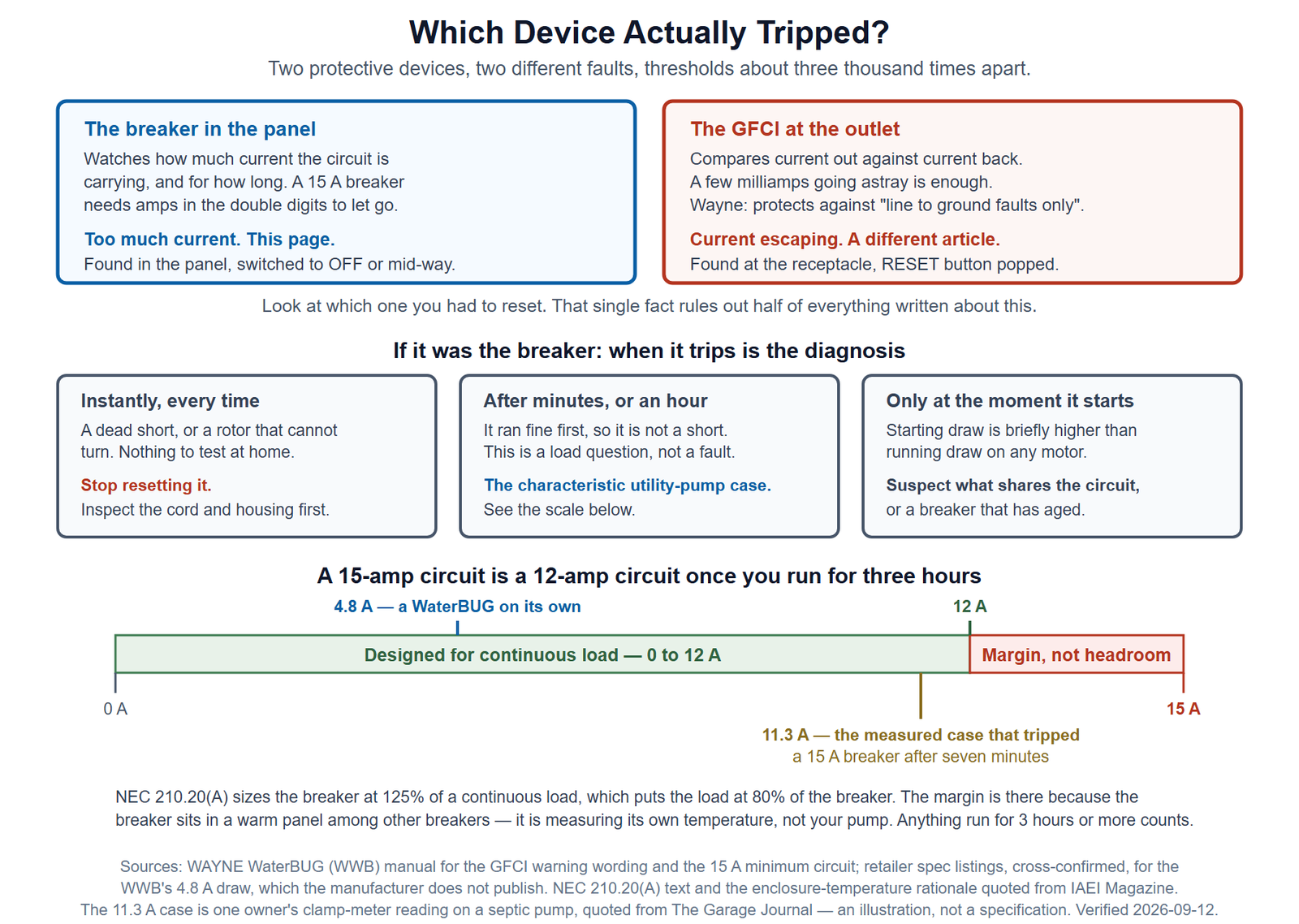
One-minute test: go and look. A tripped breaker is in the panel, sitting off or halfway between. A tripped GFCI is at the receptacle with its RESET button popped out — and it might not be the receptacle your pump is plugged into, because one GFCI often protects several downstream outlets.
If it was the GFCI, most of what follows doesn’t apply to you. Skip to the last section.
If it was the breaker, the timing is the diagnosis
Almost nobody asks this, and it splits the problem three ways before you touch anything.
It trips instantly, every time. The pump never really runs. That’s a dead short or a rotor that physically cannot turn, and there is nothing to test at home. Before you reset it again, read what to check before you reset anything — the manufacturer’s own troubleshooting table puts inspecting the cord and housing ahead of the reset, and on a submersible pump that ordering exists for a reason.
It runs fine, then trips after several minutes or an hour. This is the interesting case and it’s the one that fits a utility pump. A dead short doesn’t let a pump run for forty minutes first. Something about running is the problem, not something about the pump being connected.
It only trips at the instant the pump starts. Every motor draws more current getting going than it does once it’s turning. If the circuit is already close to its limit from something else, the start is what pushes it over.
A 15-amp circuit isn’t designed to carry 15 amps
Here’s the part that explains the second case, and it isn’t in any of the pump articles because it isn’t really about pumps.
NEC 210.20(A):
“Where a branch circuit supplies continuous loads or any combination of continuous and noncontinuous loads, the rating of the overcurrent device shall not be less than the noncontinuous load plus 125 percent of the continuous load.”
Turn that around and you get the number electricians actually use: a continuous load can occupy no more than 80% of the breaker’s rating. A 15-amp breaker is a 12-amp circuit. A 20-amp breaker is a 16-amp circuit.
And “continuous” in the code means running for three hours or more — which is precisely what a utility pump does. Nobody runs one for ninety seconds. You run it until the basement is empty.
The reason for the margin is the bit that makes the behaviour make sense. From an IAEI Magazine piece by an Eaton engineer who sits on the NEC code-making panel:
“Applying an OCPD at 80% of its rating for continuous loads accounts for the resulting higher ambient temperatures found when an overcurrent device is contained within an enclosure.”
A standard breaker is a thermal device. It is not measuring your pump — it is measuring its own temperature, inside a warm steel panel, packed against other warm breakers. That’s why “12 is less than 15, so I’m fine” doesn’t predict what happens two hours in.
A Wayne WaterBUG draws 4.8 amps. Both Wayne manuals ask for a circuit “rated for at least 15 amps.” On its own, the pump isn’t remotely close to the limit. The pump is almost never the whole load — the question is what else is on that circuit.
One-minute test: in an unfinished basement or a garage, walk the circuit. Chest freezer, dehumidifier, shop vac, a space heater, the garage door opener, a battery charger. A freezer compressor that kicks in an hour into your pumping session is a classic — it isn’t running when you start, so nothing looks wrong at the beginning. Unplug everything else and run the pump alone.
The amp clamp settles it, and the shape of the number is the answer
If you own or can borrow a clamp meter, this is the test that ends the guessing. Clamp the hot conductor and watch the reading while the pump runs.
The usual advice, from someone diagnosing exactly this on a forum:
“You need to put an amp clamp on the power line and observe the amp load as the pump runs. You’ll most likely see the amps increase as the pump heats up which eventually trips the breaker. If so, time for a new pump.”
That’s right as far as it goes. But the same thread contains the case that shows why you have to watch the number over time rather than just read it once. The owner clamped his line and reported:
“When I first flipped the breaker on, it showed 11.43A. After running for about 5 minutes it went down very slightly to about 11.3A. After the pump was running for about 7 minutes or so, the breaker tripped, but the amps had not climbed up any higher than they had started at, and actually stayed slightly lower than it started, around 11.25~11.3A.”
A steady 11.3 amps tripped the breaker after seven minutes. Nothing was degrading. The current never rose. That’s a thermal breaker doing what a thermal breaker does — it trips on current and time together, not on a threshold being crossed — at 75% of its rating, in a warm panel, on a load that had been running long enough to count.
So read the trend, not the value:
- Amps climbing steadily as it runs → the pump. Something is making it work harder or the motor is failing.
- Amps flat, and it trips anyway → the circuit. You are near the continuous limit and the breaker is heating up.
- Amps well under 10 and it still trips quickly → suspect the breaker itself. They do weaken with age, and a breaker that trips with the pump unplugged has told you everything.
If the amps are climbing and the pump is the answer, the buying guide covers what to compare on the replacement — the two specs that matter are not the GPH figure on the box.
On a brush-type pump, carbon is a real cause
Worth its own section because it applies to a whole class of these pumps and appears in none of the ranking articles — every one of them is written around an induction motor in a well.
Wayne’s PC4 transfer pump lists its motor as brush type. Brushes are consumable, and the dust they shed is conductive. From the manual’s own maintenance section:
“Brushes for this pump should be inspected after 100 hours of operation. Pumps with excess of 100 hours of operation may stop operating or fail to start. This could be due to worn brushes or carbon build-up. The brushes should be removed and carbon removed. Worn brushes are not covered under warranty.”
A hundred hours sounds like a lot until you count a few long drain jobs. The manual gives the brush replacement procedure and Wayne sells a brush kit, so this is a serviceable item rather than a dead pump — but the first step is always the same one: unplug it at the outlet before the screwdriver comes out.
Things that are not the breaker
Two devices get blamed for breaker trips and neither is one.
The thermal protector inside the motor. Wayne’s PC4 has one, it resets itself, and the manual warns the pump “MAY restart unexpectedly” because of it. If your pump stopped but the breaker is still on and the outlet still has power, this is what stopped it — not the panel. That’s the overheating story, and the surprising part is that the easy jobs cause it; a pump losing suction mid-job covers why a short hose with no lift works the motor harder than a high lift does.
A GFCI that trips repeatedly. If resetting the GFCI gets you going for a while and then it goes again, that is a ground fault and it deserves its own diagnosis — leakage paths, damp receptacles, and moisture working its way into the motor. It is genuinely a different investigation from this one, and treating it as “the pump is overloading something” is how people end up plugging a leaking pump into an unprotected outlet.
When this needs a pro
A breaker that trips the instant you reset it, with the pump unplugged, is not a pump problem. That’s the circuit itself, and it’s an electrician’s job. Same for a breaker that feels warm, smells hot, or won’t stay in.
Never solve a tripping problem by moving up a breaker size. The breaker protects the wire in the wall, not the pump. A 20-amp breaker on 14-gauge wire lets the wire get hotter than it is rated to get, and the thing that was stopping a fire is now the thing permitting one. If a circuit genuinely can’t carry what you need, the answer is a properly sized circuit, not a bigger breaker on the old one.
A melted or discoloured plug, or an outlet that’s warm, needs looking at now. A loose connection generates heat without necessarily drawing enough current to trip anything, which means the protective device you’re relying on isn’t watching the thing that’s actually going wrong.
And the standing one for this class of pump: it is a mains appliance designed to sit in water. Unplug it at the receptacle before you touch it — not the breaker, the plug, so you can see it’s disconnected. Background on what these pumps are rated for and where the GFCI requirement comes from is in the utility and transfer pumps guide.
FAQ
How do I know if it was the breaker or the GFCI that tripped?
Go and look at both. A tripped breaker sits off or halfway in the panel. A tripped GFCI has its RESET button popped out at the receptacle — and it may be an upstream outlet in another room, since one GFCI often protects several. The two trip on completely different faults, so this tells you which problem you actually have.
Can a utility pump overload a 15-amp circuit on its own?
Usually not. A Wayne WaterBUG draws 4.8 amps, well under the 12 amps a 15-amp circuit is designed to carry continuously. On its own it has plenty of room. It’s what shares the circuit — a freezer, a dehumidifier, a space heater — that pushes the total over.
Why does my breaker trip after the pump has been running fine for an hour?
Because a standard breaker trips on current and time together, not on a fixed threshold. It’s a thermal device sitting in a warm panel, and the code sizes circuits so a load running three hours or more stays under 80% of the breaker’s rating for exactly this reason. A load that’s fine for five minutes can trip the same breaker after an hour.
Should I put in a bigger breaker to stop it tripping?
No. The breaker is sized to protect the wire behind the wall, not the pump. Fitting a larger one lets that wire carry more current than it’s rated for, which is a fire risk rather than a fix. If the circuit can’t carry the load, you need a different circuit.
My pump stopped but the breaker didn’t trip. What happened?
Most likely the thermal protector inside the motor. It’s an automatic-resetting device that shuts the motor down when it overheats, and the manufacturer warns the pump may restart on its own once it cools — so treat a quiet pump as a live one and unplug it before touching the intake.


