On this page
- What a depth of water actually weighs
- Superior 92395 — the one that starts earliest
- Little Giant APCP-1700 — the one with the most head
- WAYNE WAPC250 — the fastest, and the most compromised
- Little Giant PCP-550 — the manual option
- The comparison
- A note on where these figures came from
- Which one to buy
- When this needs a pro
- FAQ
Last Updated on September 23, 2026 by Muhammad Toqeer
Every guide to these leads on gallons per hour. The number that actually decides how hard your cover works is the depth the pump waits for before it switches on — and across the three automatic pumps here that runs from 1-1/2 inches to 2-1/8 inches.
On an ordinary 16 × 32 foot cover, that spread is about 1,664 pounds of standing water. None of it shows up in a flow figure.
What a depth of water actually weighs
A pool cover does not fail because water arrives too fast. It fails because water sits on it. So the useful way to read a switch depth is as a load.
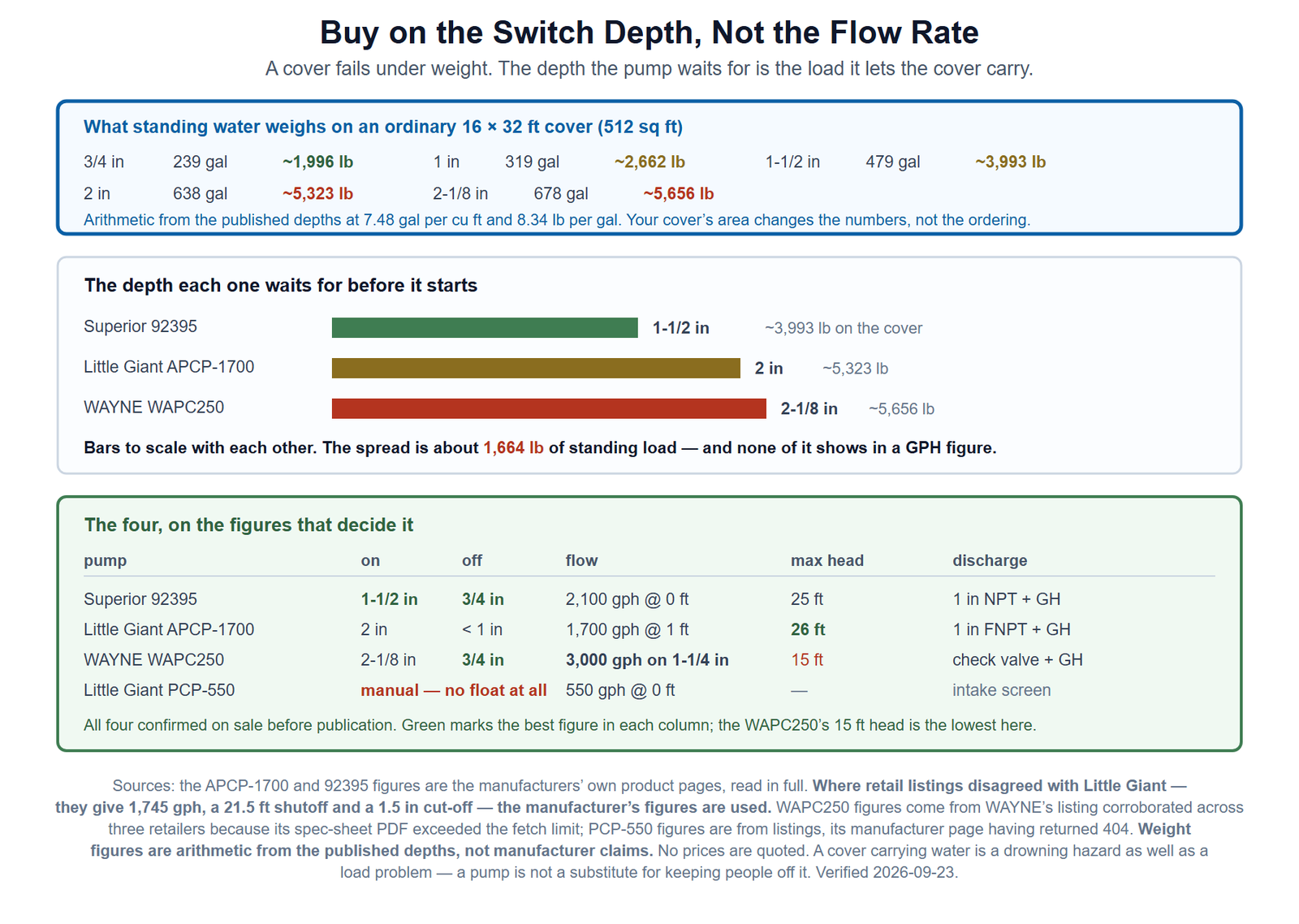
On 512 square feet of cover, at 7.48 gallons per cubic foot and 8.34 pounds per gallon:
| Depth standing on the cover | Water | Weight |
|---|---|---|
| 3/4 in | 239 gal | ~1,996 lb |
| 1 in | 319 gal | ~2,662 lb |
| 1-1/2 in | 479 gal | ~3,993 lb |
| 2 in | 638 gal | ~5,323 lb |
| 2-1/8 in | 678 gal | ~5,656 lb |
That is arithmetic from the published depths rather than anybody’s claim, and your cover’s area changes the numbers — but not the ordering. A pump that waits for 2-1/8 inches lets the cover hold roughly 1,664 pounds more than one that starts at 1-1/2.
Superior 92395 — the one that starts earliest
Who it is for: almost everyone, and particularly anyone whose cover already sags.
120 V, 3.8 A, permanent-split capacitor motor. 2,100 GPH at 0 ft, 35 GPM, maximum head 25 ft. Vertical float switch, on at 1-1/2 inches, off at 3/4 inch, and the manufacturer states it “pumps down to 3/4 in of water.” 1 inch NPT discharge with a 3/4 inch garden hose adapter, 25 ft cord, thermoplastic housing, base and impeller.
It has the earliest switch-on and it ties for the lowest cut-off. On the weight table above, those two figures together are the whole argument.
The honest drawback: Superior does not publish a horsepower figure for it, which makes direct comparison with the others awkward, and 25 ft of head is mid-pack. If your discharge run climbs a long way, check that figure against the route rather than assuming.
Little Giant APCP-1700 — the one with the most head
Who it is for: covers where the water has to go a long way up or a long way off.
1/3 hp, 115 VAC, 2.2 A. 1,700 gph at 1 ft, with a 26 ft shutoff head — the highest here. 1 inch FNPT discharge with a garden hose adapter, 25 ft insulated cord. Integrated mechanical float switch, on at 2 inches, off below 1 inch. Nylon impeller, wide footprint and a low centre of gravity, built-in handle. Maximum liquid temperature 140 °F.
The honest drawback: it waits for 2 inches before starting, which on that 16 × 32 cover is about 5,300 pounds of standing water — roughly 1,300 more than the Superior lets accumulate. There is a second point worth knowing: its motor carries an automatic-resetting thermal protector, and the owner’s manual warns the pump “may restart unexpectedly.” On a pump left unattended on a cover for months, that is worth understanding rather than discovering.
WAYNE WAPC250 — the fastest, and the most compromised
Who it is for: heavy rainfall, where volume genuinely is the problem.
120 V, 2.5 A, 1/4 hp. 3,000 GPH maximum — but only through a 1-1/4 inch hose — and 2,400 GPH at 5 ft. Its iSwitch activates at or above 2-1/8 inches and deactivates at or below 3/4 inch. Ships with a check valve and 3/4 inch garden hose adapter, a 25 ft cord, and a 25 ft “pull to shore” rope so you can reposition it without walking on the cover — which is a genuinely good idea nobody else here includes.
The honest drawback: two. Its maximum lift is 15 feet, the lowest in this group by ten feet, so it is the wrong pump if the water has to climb. And that headline 3,000 GPH needs the 1-1/4 inch hose; fit the supplied 3/4 inch garden hose adapter and you have throttled it — which is the same trap covered in why hose bore matters more than hose length.
Little Giant PCP-550 — the manual option
Who it is for: occasional use where you are present anyway, and a smaller budget.
550 GPH at 0 ft, 400 GPH at 3 ft, 58 W. Removable intake screen, 25 ft cord.
The honest drawback: it has no float switch at all. It runs until you unplug it, which means it will happily run dry if you walk away — and running dry is what kills the shaft seal on this class of pump, as the seized-after-storage article sets out. A manual pump on a cover is a pump you have to stand next to.
The comparison
| Pump | On | Off | Flow | Max head | Discharge |
|---|---|---|---|---|---|
| Superior 92395 | 1-1/2 in | 3/4 in | 2,100 gph @ 0 ft | 25 ft | 1 in NPT + GH |
| Little Giant APCP-1700 | 2 in | < 1 in | 1,700 gph @ 1 ft | 26 ft | 1 in FNPT + GH |
| WAYNE WAPC250 | 2-1/8 in | 3/4 in | 3,000 gph on 1-1/4 in | 15 ft | check valve + GH |
| Little Giant PCP-550 | manual — no float | — | 550 gph @ 0 ft | — | intake screen |
A note on where these figures came from
Worth saying, because the listings disagree.
Retail pages for the APCP-1700 give 1,745 GPH, a 21.5 ft shutoff and a cut-off at “approximately 1.5 inches.” Little Giant’s own product page gives 1,700 gph at 1 ft, 26 ft shutoff, and “turns off when water drops below 1 inch.”
The manufacturer’s figures are the ones used above. This is the third time this site has found retail listings contradicting the maker — it happened with a discontinued condensate pump and again with a utility pump’s curve — and the rule that has held every time is to go to the manufacturer and let the retailer be wrong.
Which one to buy
Least load on the cover: the Superior 92395. Earliest start, lowest cut-off.
The water has to climb: the Little Giant APCP-1700, for its 26 ft of head.
Serious rainfall and a short, level discharge: the WAYNE WAPC250 — on 1-1/4 inch hose, not on the garden hose adapter.
You will be standing there anyway: the PCP-550, and unplug it before it runs dry.
If what you actually have is a flooded basement rather than a cover, that is a different pump entirely — the flooded-basement guide covers those.
When this needs a pro
A cover holding water is a drowning hazard as well as a load problem, particularly with children or pets around. A pump is not a substitute for keeping people off it.
If the cover is already deeply pooled, do not walk on it to place a pump. That is what the WAYNE’s shore rope is for, and it is the reason to position a pump before the weather rather than during it.
Electrically, these are mains appliances sitting in water outdoors. The GFCI requirement and the reasoning behind it are in the utility and transfer pumps guide.
And they spend nine months of the year in storage, which is its own failure mode — clean and cool before it goes away, per what seizes a pump over the winter.
One limitation stated plainly: four pumps here rather than the usual five. A fifth candidate was researched and dropped because its figures existed only on a vendor listing with no datasheet behind them, and an entry with no verified specification is not an entry.
FAQ
What size pool cover pump do I need?
Ask about depth before flow. The switch-on depth decides how much water your cover carries between cycles — 1-1/2 inches on the Superior 92395 against 2-1/8 on the WAYNE WAPC250, which on a 16 × 32 ft cover is a difference of roughly 1,664 lb of standing water.
Is an automatic pool cover pump worth it over a manual one?
On a cover, yes, for one specific reason: a manual pump has no cut-off and will run dry if you forget it, and running dry is what damages the shaft seal. An automatic switches itself off — the Superior and WAYNE at 3/4 inch, the Little Giant below 1 inch.
How much water can a pool cover hold before it is a problem?
More than it looks. Two inches across a 16 × 32 ft cover is about 638 gallons, or roughly 5,300 lb. That is why the depth a pump waits for matters more than how fast it moves water once it starts.
Which pool cover pump has the highest lift?
Of these, the Little Giant APCP-1700 at 26 ft of shutoff head. The WAYNE WAPC250 is the lowest at 15 ft despite having the highest flow figure, so a high GPH number does not mean the water will climb.
Why is the GPH on the box different from what I get?
Because those figures are quoted at zero or one foot of lift and through the pump’s full-size discharge. The WAPC250’s 3,000 GPH needs a 1-1/4 inch hose; put the supplied 3/4 inch garden hose adapter on it and the bore becomes the limit.


