On this page
Last Updated on September 14, 2026 by Muhammad Toqeer
Two numbers decide how fast a flooded basement empties, and gallons per hour is only one of them. The other is the discharge port — because a 3,100 GPH pump with a garden hose screwed to it is a garden-hose pump. And a third number decides how the job ends: how close to dry the pump gets, which varies eightfold across pumps that otherwise look the same.
Worse, the first and third pull against each other. You can have the last sixteenth of an inch or you can have the most water per hour. Not both.
The trade-off nobody puts side by side
Take four submersibles that all get recommended for this job, and plot what their makers publish.
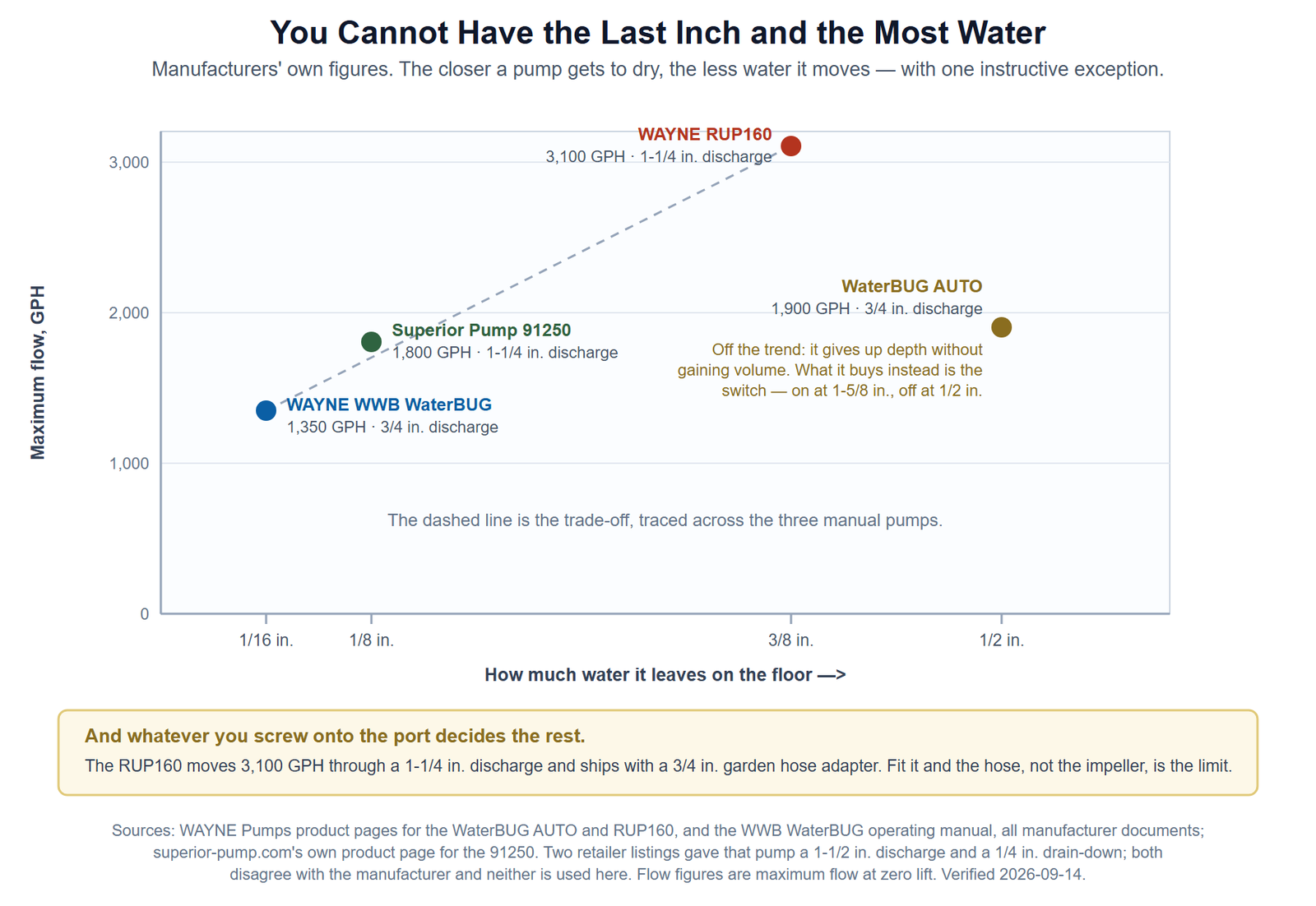
Read the dashed line. The WaterBUG gets down to 1/16 inch and moves 1,350 GPH. The Superior 91250 gets to 1/8 inch and moves 1,800. The RUP160 moves 3,100 — more than twice the WaterBUG — and stops at 3/8 inch, six times more water left on your floor.
That is not a defect in any of them. A pump that scavenges the last sixteenth of an inch needs a wide, shallow intake and a small outlet; a pump that shifts 3,100 gallons an hour needs a big impeller and a big port, and it cannot sit that flat. The guides that rank these by GPH alone are ranking them on one end of a trade-off and ignoring the other.
The WaterBUG AUTO is the exception, and it is worth understanding. It sits off the line — worse on depth than the RUP160 while moving far less water. What its half inch buys is not volume, it is the automatic switch: on at 1-5/8 inches of water, off at half an inch. If you want a pump you can leave running unattended, that is the price.
The hose is the other half of the answer
The RUP160 moves 3,100 GPH through a 1-1/4 inch discharge. In the box is a 3/4 inch garden hose adapter.
Fit the adapter and you have not bought a 3,100 GPH pump. You have bought a pump whose impeller could move 3,100 GPH, connected to a hose that cannot. The restriction moved from the pump to the plumbing, and nothing on the box tells you that.
So the real question before you buy is what you are going to run the water through:
- A garden hose — because it is what you own, or the route is long and awkward. Then buy for depth and convenience, not for GPH. A 3/4-inch pump like the WaterBUG loses nothing, because the hose was always the limit.
- 1-1/4 inch discharge hose or pipe — because the water has somewhere real to go. Then the big-port pumps earn their rating, and a garden hose adapter should stay in the box.
This is the same restriction that turns up as a symptom later: a pump that seems to be running fine while barely moving water is very often a discharge problem rather than a pump problem.
The five pumps
All five confirmed as current product lines on their manufacturers’ own sites. Every figure below is the maker’s.
WAYNE WWB WaterBUG — for getting the floor properly dry
1/6 HP, 120 V. 1,350 / 1,190 / 1,010 / 815 / 600 / 360 GPH at 0 / 5 / 10 / 15 / 20 / 25 feet. Removes water down to approximately 1/16 inch of the surface. Two 3/4-inch discharge fittings, top and side. Oil-filled sealed motor. Multi-ring suction strainer. No switch — it runs the moment you plug it in.
Nothing else here gets as close to dry, and on a basement floor that is the number that decides whether you finish with a pump or a mop. The side discharge is the quiet advantage: on a flat open floor it keeps the hose from standing the pump up on its own fitting.
The honest drawback: the 3/4-inch port caps it. If you have a real discharge route and want the basement empty in half the time, this is the wrong pump — and with no switch, it must not be left running unattended, because it will happily run itself dry.
Superior Pump 91250 — the best balance of the five
1/4 HP, 3.8 A. 1,800 / 1,320 / 1,200 / 960 / 540 / 120 GPH at 0 / 5 / 10 / 15 / 20 / 25 feet. Pumps down to 1/8 inch. 1-1/4 inch discharge, garden hose adapter included. Handles 1/8 inch solids. Continuous-duty, thermally protected split-capacitor motor. 10-foot cord. One-year warranty.
This is the one I would buy without a specific reason to buy something else. It is within a sixteenth of an inch of the WaterBUG on depth, moves a third more water, has the big port when you want it, and its motor is rated continuous duty — which matters when the job is four hours long rather than four minutes.
The honest drawback: no switch as sold. Superior notes it “can be used as a sump pump by adding an optional float switch,” which is an extra purchase and an extra thing to go wrong.
WAYNE RUP160 — when the water has somewhere to go
1/6 HP. 3,100 / 2,350 / 1,600 / 900 / 250 GPH at 0 / 5 / 10 / 15 / 20 feet. Removes water down to 3/8 inch. 1-1/4 inch discharge with a 3/4 inch garden hose adapter. Oil-free. Wayne describe it as being for removing water from flooded basements and other indoor applications.
At ten feet of lift it is still moving 1,600 GPH — more than the WaterBUG manages at zero. If you have a foot of water over a large floor and a proper discharge route, this empties it faster than anything else on the list.
The honest drawback: 3/8 inch is a lot of water to leave behind on a finished floor, and the curve falls off a cliff after fifteen feet — 250 GPH at twenty. Buy it for volume at low lift, not for height.
WAYNE WWB WaterBUG AUTO — the one you can walk away from
1/4 HP. 1,900 / 1,580 / 1,250 / 850 / 350 GPH at 0 / 5 / 10 / 15 / 20 feet, 23 ft max head. Automatic switch: on at 1-5/8 inches of water, off when the water is gone. Removes down to 1/2 inch. 3/4 inch discharge fitting for a standard garden hose. 10-foot cord, carrying strap, six-leg base.
The argument for this one is not a number. If the water is still coming in, or you need to sleep, an automatic pump is a different kind of tool from one that must be watched.
The honest drawback: half an inch. It stops with more water on the floor than any other pump here, and it has the small port as well — so you are paying for the switch with both of the specs the rest of this page is about.
WAYNE PC4 — not for the floor, for the long way up
1/2 HP, cast iron housing and volute, brush-type motor. 1,600 / 1,500 / 1,240 / 950 / 660 gallons per hour at 10 / 20 / 40 / 60 / 80 feet. 3/4 inch brass suction and discharge fittings. Liquid range 40–120 °F.
Read that curve again and compare it to the others. Every submersible above is finished by twenty-five feet. The PC4 is still moving 660 GPH at eighty. It is a different machine for a different problem: pumping up out of a window well, over a foundation wall, and a long way across to somewhere the water can legally go.
The honest drawback: it is the wrong tool for a basement floor and its manual says why — “The motor is air cooled; it is not designed to operate under water.” It sits on dry ground and sucks through a hose, so it cannot chase the last inch at all, it has to be primed, and putting it in the water you are removing destroys it. Which pump you own decides how it cools, and getting that backwards is expensive.
Side by side
| Pump | Max GPH | GPH at 10 ft | Drains to | Discharge | Switch |
|---|---|---|---|---|---|
| WWB WaterBUG | 1,350 | 1,010 | 1/16 in. | 3/4 in. (×2) | None |
| Superior 91250 | 1,800 | 1,200 | 1/8 in. | 1-1/4 in. | Optional float |
| RUP160 | 3,100 | 1,600 | 3/8 in. | 1-1/4 in. | None |
| WaterBUG AUTO | 1,900 | 1,250 | 1/2 in. | 3/4 in. | Automatic |
| PC4 (transfer) | 1,600 at 10 ft | 1,600 | n/a — stays dry | 3/4 in. | None |
The PC4’s column is deliberately awkward, because it is not the same kind of machine. Its 1,600 GPH is measured at ten feet of head, where the submersibles’ headline figures are measured at zero.
Submersible or transfer, for a basement
Folded in here because it is the question underneath the whole list, and it has a short answer for this particular job.
For water on a floor, you want a submersible. It goes in the water, it is cooled by the water, and it can sit flat enough to scavenge what is left. A transfer pump physically cannot do the last part — it stands on dry ground with a hose in the water, and a suction hose end is a round thing in a shallow puddle.
A transfer pump earns its place when the destination is the problem, not the source. Sixty feet of run and twenty feet of rise to a storm drain is a job the PC4 does comfortably and every submersible here fails. If your basement floods regularly and the water has to go a long way, owning both is not extravagant.
One caution that applies to the transfer side: it has to build suction before it moves anything, which is its own failure mode. Why a utility pump won’t prime covers the fifteen-foot suction limit and the airtight-fitting problem that catches people out.
Three shortcuts
One flood, finished floor, and you want it dry: WWB WaterBUG. The 1/16 inch is the reason.
You want one pump that does most things well: Superior Pump 91250. Best compromise on the chart, continuous-duty motor, big port when you need it.
Water still coming in, or you need to leave it: WaterBUG AUTO, and accept the half inch.
And before any of them: work out what the water is going to run through. That decision caps everything else, and it is free to make before you spend anything.
When this needs a pro
Standing water and mains electricity is the one genuinely dangerous part of this. Every pump here is a 120 V appliance you are putting into water. Plug it into a GFCI-protected outlet — not an extension cord to an unprotected one. If the GFCI trips, that is the device working, and the answer is never to find a socket without one. What to check before you reset anything covers the order the manufacturer wants, which is not the order most people use.
If the water reached outlets, the panel, or the furnace, stop. That is an electrician’s call before it is a pumping problem, and the pump can wait an hour.
If the water is not clean, none of these is the right pump. Sewage backup is a different product class and a different job. The utility pumps here are rated for clear water and small solids — the Superior handles 1/8 inch and that is the largest figure on this page.
For what these pumps are and where their limits sit generally, the utility and transfer pumps guide is the background.
FAQ
What is the best utility pump for a flooded basement?
For most people, the Superior Pump 91250 — 1,800 GPH, down to 1/8 inch, a 1-1/4 inch discharge and a continuous-duty motor. If getting the floor as dry as possible matters more than speed, the Wayne WWB WaterBUG reaches 1/16 inch, which is the closest of any pump here.
Does a higher GPH rating mean the basement empties faster?
Only if the discharge can carry it. The Wayne RUP160 is rated 3,100 GPH through a 1-1/4 inch port, but it ships with a 3/4 inch garden hose adapter — fit that and the hose becomes the restriction. Decide what you are running the water through before you compare pump ratings.
How close to dry will a utility pump get?
It varies far more than people expect. Across four pumps sold for the same job the published figures run from 1/16 inch to 1/2 inch — an eightfold difference. The pumps that get closest tend to move the least water, because a flat, wide intake and a big impeller are not compatible.
Should I get an automatic utility pump?
If water is still coming in, or you cannot stand over it, yes. The trade is depth: the WaterBUG AUTO switches on at 1-5/8 inches and off at 1/2 inch, so it leaves more behind than any manual pump on this list. For a one-off flood you are present for, a manual pump gets you drier.
Can I use a transfer pump instead of a submersible?
Not for the floor itself. A transfer pump stays on dry ground — its manual says the motor is air cooled and not designed to operate under water — so it cannot chase the last inch, and it has to be primed. Where it wins is distance and height: the Wayne PC4 still moves 660 GPH at eighty feet of head, where every submersible here has stopped by twenty-five.


