On this page
Last Updated on September 23, 2026 by Muhammad Toqeer
Every listing sorts these by gallons per hour. The number that decides whether the pump survives is how big a solid it can swallow — and buying more of that costs you the one thing most people actually want, which is a dry floor.
Those two specifications come from the same component, and they move in opposite directions.
The part that sets both numbers
A submersible utility pump draws water through a screen around its base. That screen is doing two jobs at once, and they conflict.
Wide gaps let grit and small stones pass through the impeller instead of jamming it — and hold the intake further off the floor, so the pump stops sooner and leaves more water behind.
Narrow gaps get you closer to dry — and turn every pebble into something that can stop the pump.
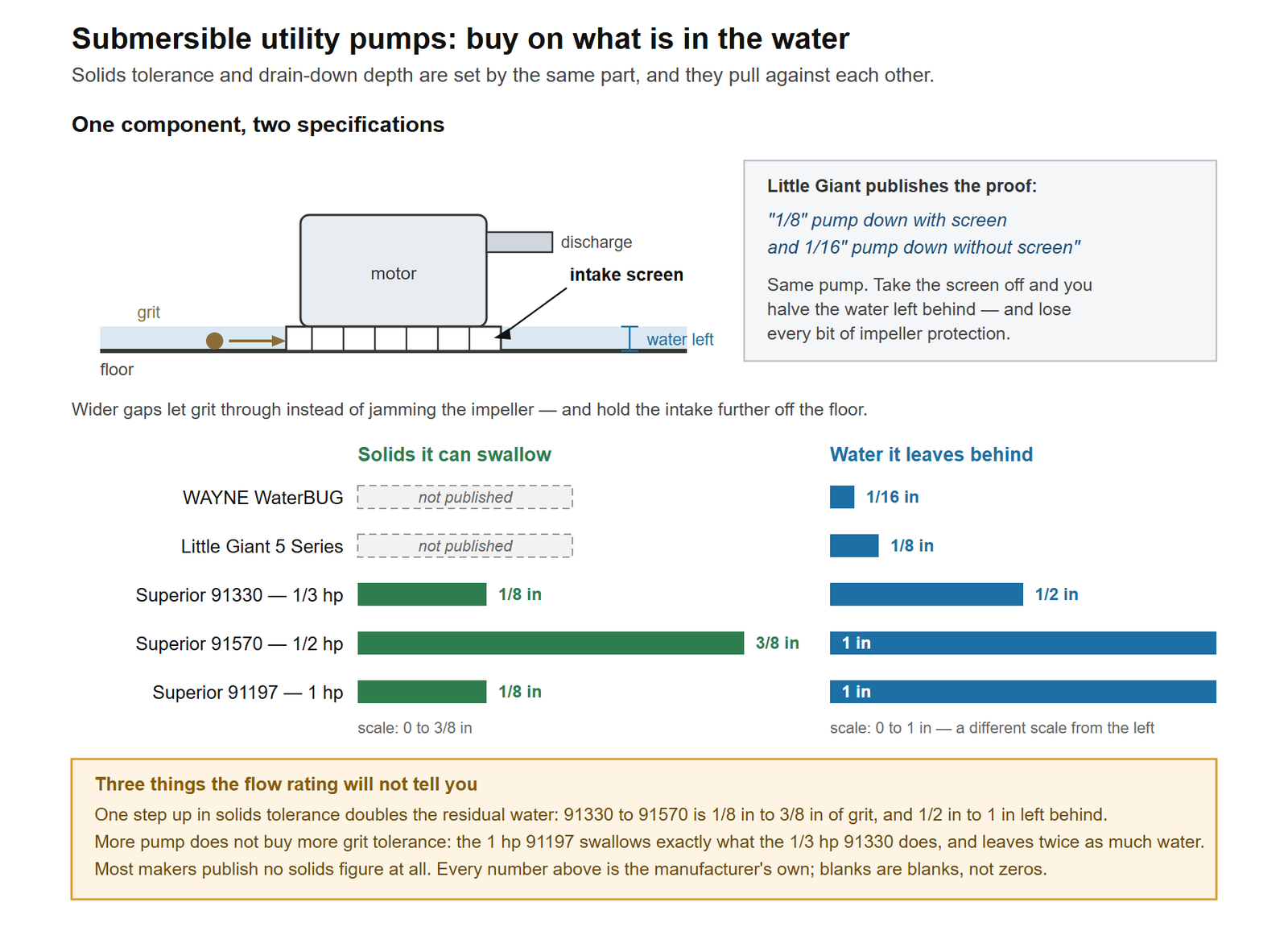
You do not have to take that on trust, because one manufacturer prints the experiment. Little Giant’s 5 Series page gives two drain-down figures for the same pump:
“1/8″ pump down with screen and 1/16″ pump down without screen”
Same body, same impeller, same motor. Pull the screen off and you halve the water left on the floor — and hand the impeller every stone in the room.
What the published figures actually show
Superior is the only maker in this category that publishes a solids figure for every model in its utility line, so its own range is the cleanest place to see the trade-off. These are all the manufacturer’s numbers:
| Model | HP | Solids | Pumps down to | Max GPH | Discharge |
|---|---|---|---|---|---|
| Superior 91330 | 1/3 | 1/8 in | 1/2 in | 2,400 | 1-1/4 in |
| Superior 91570 | 1/2 | 3/8 in | 1 in | 3,300 | 1-1/2 in |
| Superior 91197 | 1 | 1/8 in | 1 in | 5,898 | 1-1/2 in |
Two things fall out of that.
One step up in grit tolerance doubles the water left behind. Going from the 91330 to the 91570 takes you from 1/8 inch solids to 3/8 — and from 1/2 inch of residual water to a full inch.
Buying more pump does not buy more grit tolerance. The 1 hp 91197 is three times the horsepower of the 1/3 hp 91330 and swallows exactly the same 1/8 inch solid, while leaving twice as much water on the floor. What the extra horsepower buys is flow: 5,898 GPH against 2,400.
And a warning about where these numbers apply at all: drain-down depth is measured from the surface the pump is standing on, not from your floor. Stand one on a brick and you have added the brick to every figure above — which is the whole argument of where to actually put it.
The five, in order of how much grit they will tolerate
Superior 91570 — the one that handles debris
Who it is for: water with sand, silt or small stones in it. A crawl space, a stock tank, a pond, a flooded pit with a dirt bottom.
1/2 hp, 4.9 A. Continuous duty, thermally protected split-capacitor motor. 3,300 / 2,880 / 2,520 / 2,040 / 1,500 / 960 GPH at 0 / 5 / 10 / 15 / 20 / 25 ft, max head 25 ft. Solids handling 3/8 inch — the largest here by a factor of three. 1-1/2 inch side discharge. Thermoplastic housing with a stainless steel impeller. 10 ft cord. Three year warranty, the longest in this group.
The honest drawback: it stops at 1 inch from the surface. On a finished basement floor that is a bucket and a mop, and it is the price of the wide intake. The 10 ft cord is also short for the size of job this pump is bought for.
Superior 91197 — the corrosion-proof one
Who it is for: salt water, pool and hot tub water, and anything you want to own for a decade.
1 hp, 11.4 A. Continuous duty, thermally protected. 5,898 / 4,980 / 3,840 / 2,940 / 1,860 / 1,020 / 300 GPH at 0 / 5 / 10 / 15 / 20 / 25 / 30 ft — the only pump here still moving water at 30 feet. Stainless steel housing, impeller and intake screen. 1-1/2 inch discharge, 25 ft cord — by far the longest. Liquid temperature range 32–120 °F. Solids handling 1/8 inch. Retail listings add salt-water use and draining pools, boats and hot tubs.
The honest drawback: for all that money and stainless steel, it swallows no more grit than the 1/3 hp model and leaves the same inch of water behind. It is also 11.4 amps, which is a real load on a shared 15 A circuit with anything else running.
Superior 91330 — the one that gets closest to dry with a published solids figure
Who it is for: the general case — a basement, a window well, a hot tub you would rather not finish by hand.
1/3 hp, 4.1 A. Continuous duty, thermally protected. 2,400 / 2,040 / 1,680 / 1,320 / 720 / 120 GPH at 0 / 5 / 10 / 15 / 20 / 25 ft. Pumps down to 1/2 inch; solids 1/8 inch. 1-1/4 inch discharge. Thermoplastic housing and thermoplastic impeller. 10 ft cord.
This is the balance point of the three, and the only one of them that both publishes a grit figure and gets under an inch.
The honest drawback: the impeller is thermoplastic rather than the stainless used in the 91570, and the curve collapses at the top — 120 GPH at 25 feet is effectively nothing. Buy it for low lift. One year warranty, against the 91570’s three.
Little Giant 5 Series (5-MSP) — the one with the removable screen
Who it is for: clean water, repeatedly, where you want the choice of how close to dry you finish.
1/6 hp oil-free PSC motor, 115 V, 2.0 A, 220 W. 1,500 gph at 1 ft, shut-off head 26.3 ft. 1 inch FNPT discharge with garden hose adapter. Epoxy-coated cast aluminium housing, nylon impeller. Cord lengths from 10 to 25 ft depending on the item number. And the specification that makes it interesting: 1/8 inch pump down with the screen, 1/16 inch without.
The honest drawback: its continuous-duty certification is “up to 96 °F (30 °C)” — the lowest liquid-temperature ceiling of any pump covered on this site, and low enough to rule it out for a hot tub, a boiler, or anything warm. If that is the job, the temperature rating is the spec to shop on and this is the wrong pump. It also publishes no solids figure, and taking the screen off to chase that last sixteenth of an inch is exactly how you get something rattling in the impeller.
WAYNE WWB WaterBUG — the driest floor, and no grit tolerance at all
Who it is for: clean water on a finished floor, where the last eighth of an inch is the whole point.
Removes water down to approximately 1/16 inch — the lowest figure of any pump on this site — through a multi-ring suction strainer. No solids-handling figure is published, and that is consistent with what it does: you cannot pull to a sixteenth of an inch and pass stones.
Its full curve, ports and other trade-offs are set out in the flooded-basement guide, which ranks it against four other pumps on a different axis; there is no point repeating that here.
The honest drawback: it is a clean-water tool. Put it in silty water and the strainer is what stops first — and the blockage looks exactly like a pump that runs but moves nothing.
What none of these will do
Worth stating plainly, because the category names blur into each other on retailer sites.
None of these is a sewage pump. A utility pump passes 1/8 to 3/8 inch of grit. An effluent pump handles up to about 3/4 inch of light solids in treated wastewater. Neither will pass toilet solids, and feeding raw waste to one is a quick way to destroy it. If that is the job, it is a different pump on a different circuit with different code behind it.
None of these is a sump pump as sold. Several can be turned into one by adding a float switch, but a permanently installed sump pump is a different purchase with a different duty expectation.
And check the temperature ceiling before you assume. Three of these publish one — the 91197 at 120 °F, the Little Giant at 96 °F for continuous duty — and two publish nothing at all.
Which one to buy
There is grit in the water: the Superior 91570. Nothing else here is close, and the inch it leaves behind is what you are paying for.
Salt water, pool chemicals, or you want it to last: the Superior 91197, for the stainless housing and the 25 ft cord.
You do not know yet, and want one pump for most jobs: the Superior 91330. It is the only one that publishes a solids figure and gets under an inch.
Clean water and you want the floor genuinely dry: the WaterBUG at 1/16 inch, or the Little Giant 5 Series if you want a pump that will also run continuously — accepting its 96 °F ceiling.
If what you have is a flooded basement right now rather than a pump to own, the ranking is different, because there the argument is drain-down against discharge bore — that comparison is here.
When this needs a pro
These are mains appliances sitting in water. GFCI protection is not optional, and the reasoning is in the utility and transfer pumps guide.
The 1 hp 91197 draws 11.4 amps. On a 15 A circuit that is most of the capacity before anything else is plugged in. If you are running an extension lead to it, the lead’s gauge matters as much as the outlet does.
If the water might be contaminated — sewage backup, flood water that has been through a drain, anything from a septic field — stop. That is not a utility pump job and it is not a DIY cleanup either.
And if the pump is going into a pit or a confined space, the hazard is the space, not the pump.
FAQ
What size solids can a submersible utility pump handle?
Between 1/8 and 3/8 of an inch, where the figure is published at all — and most manufacturers do not publish one. Superior’s 91570 is the largest here at 3/8 inch; its 91330 and 1 hp 91197 both handle 1/8 inch. Wayne and Little Giant publish no figure for the models covered here.
Why does my pump leave water on the floor?
Because the intake sits above the floor by design, and the screen that protects the impeller is what holds it there. The published figures run from 1/16 of an inch to a full inch depending on the pump — and they are measured from whatever surface the pump is standing on, not from your floor.
Is a higher horsepower utility pump better?
It moves more water, and that is all it does. The 1 hp Superior 91197 handles exactly the same 1/8 inch solid as the 1/3 hp 91330 and leaves twice as much water behind. Horsepower buys flow and head, not grit tolerance and not dryness.
Can I take the screen off to get closer to dry?
Little Giant’s own figures say it works — 1/16 inch instead of 1/8 on the 5 Series. It also removes the only thing standing between your impeller and every stone in the water. Do it on clean water you can see the bottom of, and not otherwise.
Can a submersible utility pump handle dirty water?
Gritty water, yes, within its published solids rating. Wastewater with real solids in it, no — that is an effluent or sewage pump, and running a utility pump on raw waste will wreck it quickly.


