On this page
Last Updated on September 23, 2026 by Muhammad Toqeer
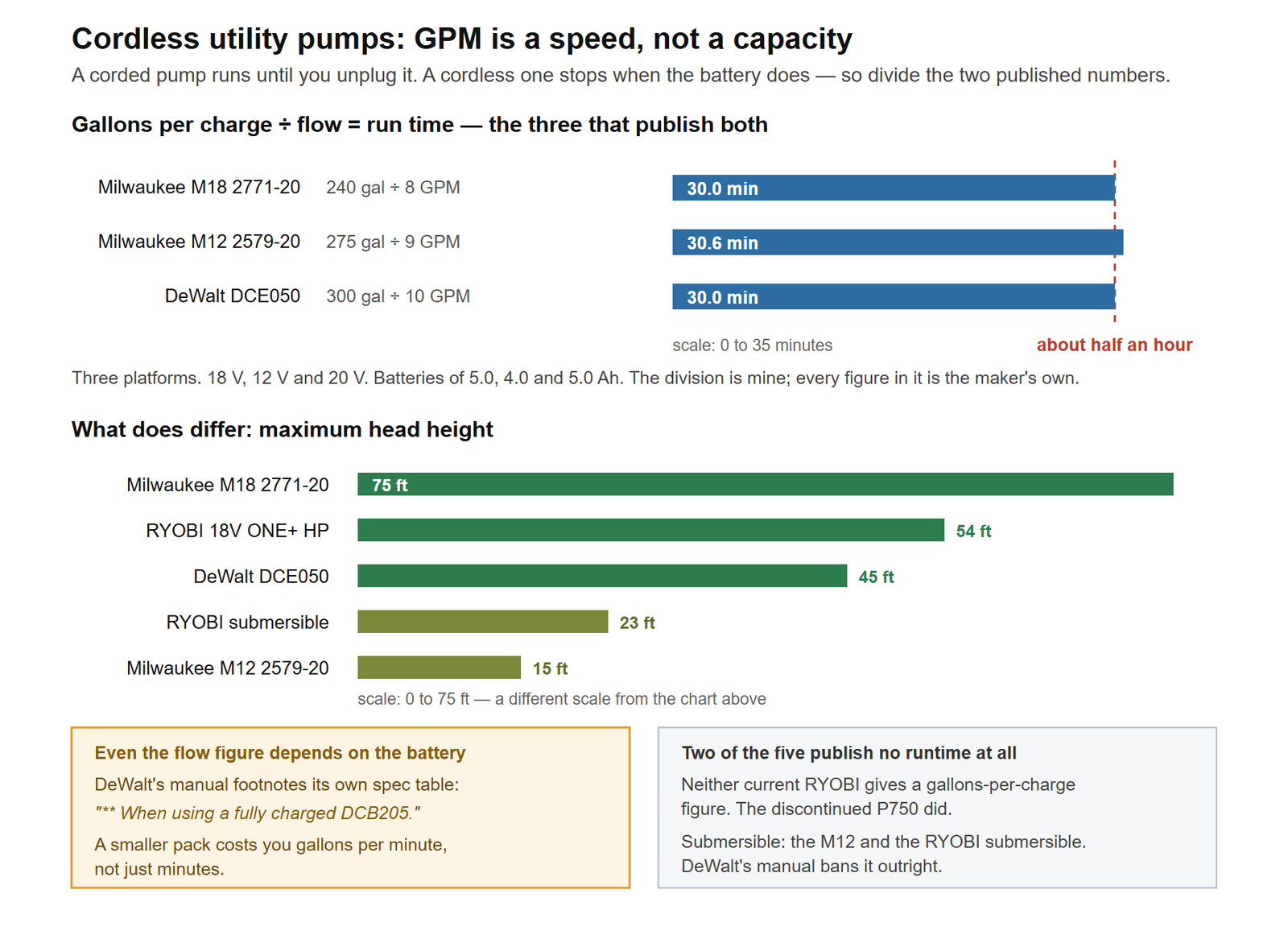
Three cordless pumps publish both a flow rate and a gallons-per-charge figure against a named battery. Divide one by the other and all three give you almost exactly thirty minutes of pumping — across three voltages, three platforms and two different battery capacities.
On a cordless pump, gallons per minute is a speed specification, not a capacity one. The faster pump does not move more water on a charge. It moves the same water sooner, then stops.
The division nobody does
A corded pump runs until you unplug it, so GPM tells you everything. A cordless pump stops when the battery does, which makes the useful question how much water per charge — and every listing leads on the number that cannot answer it.
Here is the arithmetic, using each maker’s own published figures:
| Pump | Platform | Per charge | Flow | Run time |
|---|---|---|---|---|
| Milwaukee 2771-20 | M18, XC5.0 | 240 gal | 8 GPM | 30.0 min |
| Milwaukee 2579-20 | M12, XC4.0 | 275 gal | 9 GPM | 30.6 min |
| DeWalt DCE050 | 20V MAX, DCB205 | 300 gal | 10 GPM | 30.0 min |
Nobody designed it that way on purpose. It is what happens when a manufacturer sizes a pump to run sensibly on one battery — and it means the interesting differences between these tools are somewhere else entirely.
The flow figure is conditional too
DeWalt’s manual footnotes its own specification table. The row reads “Rated Gallons per Minute\\“, and the footnote says:
“\\ When using a fully charged DCB205.”
That 10 GPM is not a property of the pump. On a smaller pack you lose gallons per minute, not just minutes — so which battery comes in the kit is part of the purchase, not an accessory to it.
What the half hour does not tell you
Three things actually separate these pumps, and none of them is flow.
Head height, which varies by five to one. The M18 manages 75 feet; the M12 manages 15. If the water has to climb out of a window well or up a stairwell, this is the only number that matters.
Whether it can go in the water. DeWalt’s manual is blunt — “Do not submerge the DCE050 in water or any liquid at any time” — while Milwaukee’s M12 is a 36-inch submersible barrel designed to stand in it. The two best-documented pumps in the category sit on opposite sides of that line, and getting it wrong destroys the tool.
Whether the maker tells you the runtime at all. Two of the five publish no gallons-per-charge figure.
The five
Milwaukee 2771-20 — the most head, and the best documentation
Who it is for: anyone already on M18, and anyone pushing water upwards.
18 V, 480 gph (8 GPM), up to 240 gallons per charge on an XC5.0 pack. Up to 18 ft of lift and 75 ft of head height — far more than anything else here. 3/4 inch brass inlet and outlet, self-priming, dry-run shutoff within 60 seconds, UL listed. Its impeller comes out from behind four cover screws.
The honest drawback: it is not submersible, it is a bare tool so the battery is a separate purchase, and its manual caps continuous running at one hour and forbids unattended operation. Its temperature limits are covered in full in the water-heater pump guide, which ranks it against corded pumps on exactly that axis — worth reading before you buy it for anything warm.
DeWalt DCE050 — the most water per charge
Who it is for: the 20V MAX ecosystem, and draining tanks.
10 GPM and up to 300 gallons per charge on a DCB205 — the most of any pump here. Maximum lift 25 ft; 4.5 GPM at 45 ft of head. 3/4 inch GHT female fittings at both ends, so a garden hose screws straight on. Self-priming with auto-shutoff to prevent dry running. Water temperature range 32–140 °F. It will handle a water/glycol mix up to 60/40, which most of these will not. DeWalt names the job outright: “transferring water from water heaters, tanks, etc.”
The honest drawback: submersion is banned outright, and the manual says the pump “is not waterproof or weatherproof and is not intended to be used outdoors.” That is a real constraint on a tool people buy for outdoor jobs. Its manual also warns that “pumped water is not safe for human or animal consumption” — worth knowing before you use one to fill anything.
RYOBI 18V ONE+ HP Transfer Pump — the most head for the money, and the least disclosure
Who it is for: the ONE+ ecosystem, and long horizontal runs.
10 GPM at 1/4 horsepower with three speed settings. 54 ft head height and 17 ft lift — second only to the Milwaukee M18 on head. A three-mode shutdown timer at 5, 10 and 15 minutes, plus a sensor that stops the pump when no water is detected. Metal pump housing, water-resistant sealed battery enclosure, mountable base plate.
The honest drawback: Ryobi publishes no gallons-per-charge figure, so the one number this article is about cannot be checked for it. That is not a claim it performs badly — it is an absence, and it means the 10 GPM sits on its own with nothing to divide it by. The shutdown timer partly compensates: set 15 minutes and you have bounded the job yourself.
Milwaukee 2579-20 M12 Stick Transfer Pump — the one that goes in
Who it is for: drawing from a tank, a pit or a drum you cannot get a hose into.
9 GPM, up to 275 gallons on one M12 REDLITHIUM XC4.0 battery. A 36 inch submersible aluminium barrel, so it stands in the water rather than sucking through a hose — no priming, nothing to lose suction. 3/4 inch outlet takes a standard garden hose. A 360° filter with HydroPass technology for pumping in heavy debris.
The honest drawback: 15 ft of head, the lowest here by a wide margin. It is a tool for lifting water out of something and running it away at a gentle grade, not for pushing it anywhere. Milwaukee publishes neither a maximum water temperature nor a run-time limit for it.
RYOBI 18V ONE+ Submersible Transfer Pump — the fastest, and the shortest reach
Who it is for: volume at low lift, in water with debris in it.
20 GPM — double anything else here — 1/6 horsepower, 23 ft head height. Integrated strainer for pumping water with debris in it, and the same three-mode shutdown timer with a no-water sensor. Submersible.
The honest drawback: no gallons-per-charge figure again, and at 20 GPM the battery question is sharper than on any other pump here — twice the flow on the same class of pack means the charge goes in half the time. Its strainer also sets how close to dry it finishes, which is the trade-off every submersible makes.
The battery you already own is most of the decision
Say it plainly, because the specification tables will not.
These are all bare tools or kits on platforms you either have or do not. A pump on a platform you already own costs you the pump. A pump on a new platform costs you the pump, a battery and a charger — and the DeWalt’s footnote means the cheap 2.0 Ah battery will not even give you the advertised flow.
If you own none of them, buy on head height and on submersible-or-not, because those are the two things that actually differ. If you own one of them already, that is your answer and the rest of this page is confirmation.
Where a cordless pump is the wrong tool
A long job. Half an hour per charge is fine for a water heater or a couple of drums. A flooded basement is not a half-hour job, and swapping batteries through it is worse than running an extension lead — the corded options are here.
Anything continuous. None of these is a sump pump and none should be left to work alone; Milwaukee says so in the manual.
Hot water, in a hot space. Milwaukee and DeWalt independently publish the same two limits: 140 °F maximum water and 104 °F maximum operating air temperature. An unconditioned garage in August can exceed the second one, and heat is already the leading suspect when a pump cuts out.
When this needs a pro
A cordless pump removes the shock hazard, not the water hazard. It is the one real safety advantage of the category — no mains cord in a wet room, so none of the GFCI reasoning that governs corded pumps applies. What it does not remove is the water: standing water over an unknown floor, a pit, or anything that has been through a drain is still a job to think about before stepping into.
Do not pump fuel, solvent or anything flammable with any of these. DeWalt’s manual is explicit: “Do not pump any flammable or hazardous liquids or chemicals.” These are clean-water tools with one glycol exception.
And the water coming out is not drinking water, whatever went in. That is DeWalt’s warning, and it applies to all of them.
If yours pulls nothing at all, the fault is usually on the suction side rather than the pump — start there, and if it runs but moves nothing, the intake is the first thing to check.
FAQ
How long does a battery-powered water pump run?
About half an hour, on the three that publish enough to work it out. Milwaukee’s M18 gives 240 gallons at 8 GPM, its M12 275 gallons at 9 GPM, and DeWalt’s DCE050 300 gallons at 10 GPM — 30.0, 30.6 and 30.0 minutes. Different platforms, same answer.
Is a higher GPM cordless pump better?
Not for capacity. The battery sets how much water you move; the GPM sets how quickly you move it and then stop. A 20 GPM pump on the same class of battery simply finishes sooner.
Which cordless transfer pump has the highest lift?
The Milwaukee 2771-20, at 75 feet of head height. The Ryobi 18V ONE+ HP is next at 54 feet, DeWalt’s DCE050 manages 4.5 GPM at 45 feet, and the Milwaukee M12 stick pump is lowest at 15 feet.
Can I put a cordless transfer pump in the water?
Only if it is built for it. Milwaukee’s M12 stick pump and Ryobi’s submersible are designed to stand in water. DeWalt’s manual bans it outright — “Do not submerge the DCE050 in water or any liquid at any time” — and the M18 is not submersible either.
Does a smaller battery just mean less run time?
Not on the DeWalt. Its manual rates 10 GPM “when using a fully charged DCB205”, so a smaller pack costs you flow as well as minutes. Treat the battery in the kit as part of the specification.


