On this page
Last Updated on October 8, 2026 by Muhammad Toqeer
The manufacturer’s troubleshooting row for this has exactly two causes. Not six, not a checklist — two.
“Pump will not shut off or runs continuously”
“1. Debris in switch” · “2. Discharge height exceeds capability”
The first is the one you would guess. The second is not, because nobody expects “pumping too high” to produce a pump that never stops. You would expect it to produce no water.
But think about what tells the pump to stop. It stops when the water is gone — and a pump that cannot lift the water out never gets there. It is not stuck on. It is still waiting.
The two causes, and the remedy for each
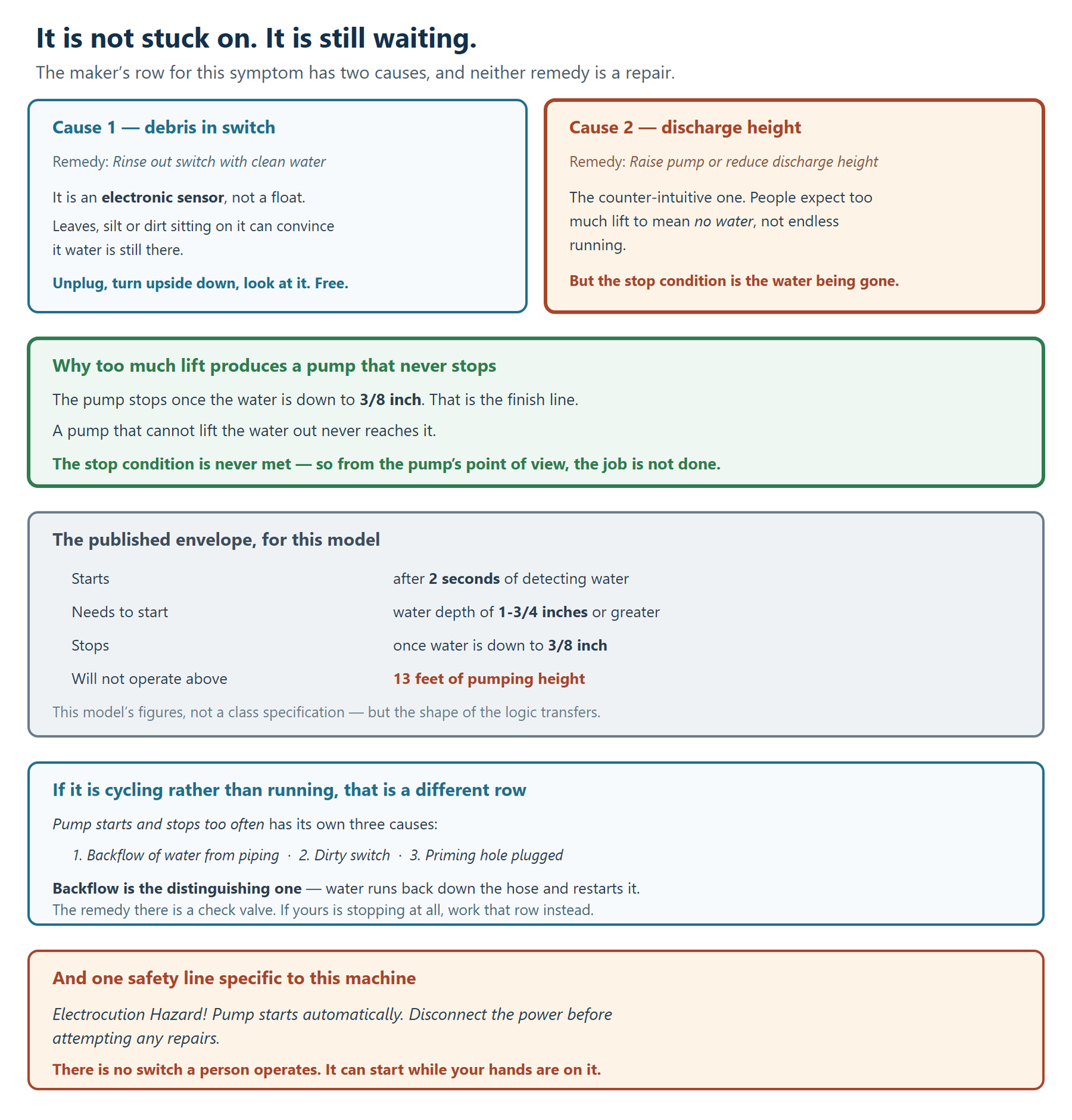
From the Wayne EEAUP250 manual, downloaded from the manufacturer’s own site. The row in full:
| Possible cause | Corrective action |
|---|---|
| 1. Debris in switch | “Rinse out switch with clean water” |
| 2. Discharge height exceeds capability | “Raise pump or reduce discharge height” |
Neither remedy is a repair. One is a rinse and the other is moving the pump. This is a symptom with no parts in it, which is worth knowing before anyone starts shopping.
Cause 1: it is a sensor, not a float
Most people picture a float — the hinged thing that rises with the water. This class of pump does not have one.
The manual’s instruction for continuous running is specific:
“If pump runs continuously, unplug the unit. Once unplugged, check for debris stuck inside the sensor body. Remove any trapped leaves, debris or dirt.”
An electronic sensor decides when the water is gone, and anything sitting on it can convince it that water is still there.
Which is an entirely plausible thing to happen to a pump whose whole job is standing in dirty water. Leaves, silt, a scrap of plastic.
And the manual gives the cleaning position: “Unplug the pump and turn upside down. The sensor should be checked for debris or build up of mater on the sensor.” (The typo is the manual’s.)
One-minute check, and it is the first thing to do: unplug it, turn it over, and look at the sensor. If something is sitting on it, that is your answer and it costs nothing.
Cause 2: the lift, and why it keeps the pump running
Here is the counter-intuitive one, and it is worth understanding rather than memorising.
The pump’s published stop condition is the water being gone. From the manual’s own operating description:
“The pump should start after 2 seconds of detecting water. Once the pump removes the water to a depth of 3/8 inch, the pump will stop automatically.”
Three-eighths of an inch. That is the finish line.
Now ask what happens if the pump cannot get the water out fast enough — or at all. The level never falls to three-eighths. The stop condition is never met. The pump keeps going, because from its point of view the job is not done.
And the manual puts a hard ceiling on how high it can work:
“Verify pumping height does NOT exceed 13 feet… If pumping height is greater than 13 feet, this pump will NOT operate.”
Thirteen feet, for this model. Above that, the manufacturer does not say it works poorly — it says it will not operate.
The remedy is the obvious one once you see the mechanism: “Raise pump or reduce discharge height.” Where the pump sits is half the lift, and raising the pump shortens the climb without moving anything else.
Hose length is a related but separate drag on what a utility pump can do — worth checking at the same time, and worth not confusing with vertical lift.
The numbers that bracket all of this
One of the more useful things in this manual is how precisely it describes when the pump acts. For this model:
| Starts | after 2 seconds of detecting water |
| Needs to start | water depth of 1-3/4 inches or greater |
| Stops | once water is down to 3/8 inch |
| Will not operate above | 13 feet of pumping height |
Those are this pump’s figures, not a universal specification — a different model will publish different ones. But the shape of the logic transfers: there is a depth that starts it, a depth that stops it, and a height beyond which none of it happens.
And if the lift you actually need is above what your pump publishes, no amount of cleaning fixes that. That is a sizing question rather than a fault, and the figure to compare against is the one printed in your own manual.
And the 1-3/4 inch figure explains a complaint people often have in the other direction — a pump that will not start in a shallow puddle is not broken. It is above its own starting depth.
If it is cycling rather than running, that is a different row
Worth separating, because the two get described the same way.
**The same chart has a separate symptom — “Pump starts and stops too often” — with its own three causes:**
“1. Backflow of water from piping” · “2. Dirty switch” · “3. Priming hole plugged”
Backflow is the distinguishing one. Water that has gone up the hose runs back down when the pump stops, refills the area around the sensor, and starts it again. The published remedy is a check valve.
The dirty switch appears on both rows, which is the one genuine overlap — so cleaning the sensor is a reasonable first move either way.
But if your pump is stopping at all, you are in that row rather than this one, and the lift is not your problem.
A safety line that is specific to this machine
The chart carries a warning worth quoting exactly:
“Electrocution Hazard! Pump starts automatically. Disconnect the power before attempting any repairs.”
“Pump starts automatically” is the whole hazard. There is no switch a person operates. It can start while your hands are on it, including while you are turning it over to look at the sensor.
So the manual’s own instruction — unplug it first — is not boilerplate. It is the one step that makes the rest of this safe.
When this needs a pro
Honestly, very little of this does — which is unusual for this site and worth saying plainly.
Rinsing a sensor and repositioning a pump are owner tasks, provided the thing is unplugged first.
What does need help:
Anything involving the electrical supply. If the pump is on a questionable circuit or a cord in standing water, that is not a plumbing question.
Standing water you cannot establish the depth or cleanliness of. Electricity and standing water together is the one combination to stop at.
And a pump that still will not stop after both published causes are cleared. If it is also not moving water, that is a different diagnosis entirely and the chart treats it as a separate symptom.
What you can do yourself: unplug it, turn it over, look at the sensor, rinse it, and measure the vertical distance from the pump to where the water is going. Two minutes and a tape measure — and between them they cover both of the manufacturer’s causes.
FAQ
Why won’t my utility pump shut off?
The manufacturer lists two causes: debris in the switch, or the discharge height exceeding what the pump can manage. The remedies are rinsing the switch with clean water, and raising the pump or reducing the discharge height.
How can pumping too high make a pump run constantly?
Because the pump stops when the water is gone. On this model it stops once the water is down to 3/8 inch. A pump that cannot lift the water out never reaches that depth, so the stop condition never arrives and it keeps running.
How high can a portable utility pump lift water?
This model publishes a maximum pumping height of 13 feet, and states that above that figure the pump will not operate. Other models publish different figures, so check the one on your own pump.
Does a utility pump use a float switch?
Not this kind. It uses an electronic sensor, which is why the published fix for continuous running is to unplug the pump, turn it over and rinse debris off the sensor rather than to adjust or replace a float.
What is the minimum water depth for a utility pump to start?
On this model, 1-3/4 inches, and it starts after 2 seconds of detecting water. A pump that will not start in a shallow puddle may simply be below its own starting depth.
My pump keeps starting and stopping instead — is that the same thing?
No, it is a separate row in the same chart with different causes: backflow of water from the piping, a dirty switch, or a plugged priming hole. Backflow is the distinguishing one and the remedy is a check valve.


