On this page
- Go and look at your thermostat before you buy anything
- Milwaukee 2771-20 — the only one that treats the limit as a safety warning
- Little Giant 370 Pony Pump (555113) — what the plumbers actually name
- Liberty 331 — the most head, and a wear part on a clock
- WAYNE PC4 — names the job, and has the lowest rating for it
- Superior 90040 — names the job and publishes no limit at all
- The trade thinks this whole article is about the wrong thing
- Side by side
- Why none of these is a submersible
- Which one to buy
- When this needs a pro
- FAQ
Last Updated on September 23, 2026 by Muhammad Toqeer
Every guide to these pumps ranks them on gallons per hour. The specification that decides whether the pump survives the job is its maximum liquid temperature, and almost nobody prints it.
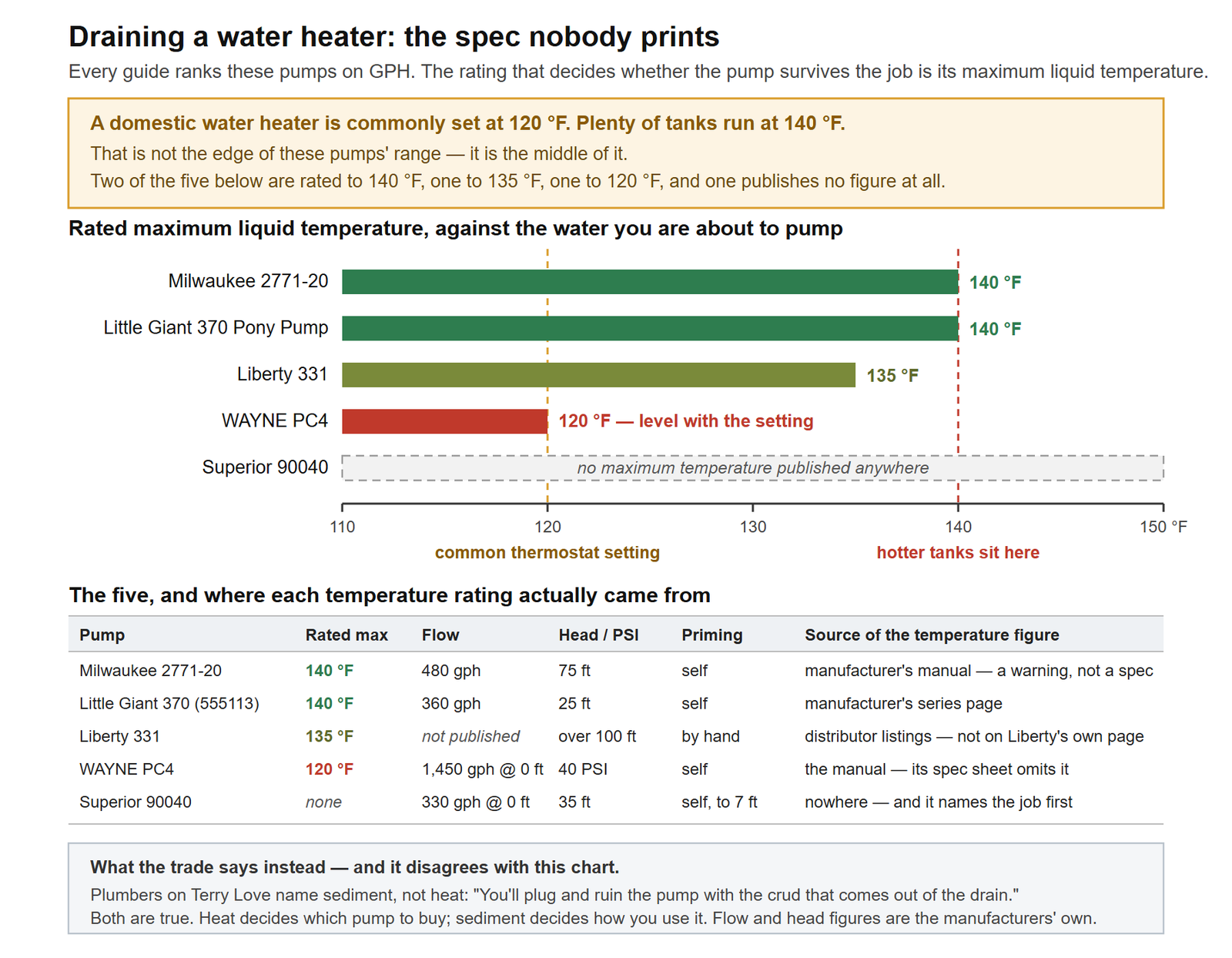
Your water heater is probably set to 120 °F. Of the five pumps most often recommended for draining one, the ratings run 120 °F, 135 °F, 140 °F, 140 °F — and, for the fifth, no published figure at all.
Go and look at your thermostat before you buy anything
This is the one-minute step that changes the answer.
A domestic tank is commonly set at 120 °F. Plenty run at 140 °F, either because someone turned it up or because the installer left it there. The dial is on the front of a gas heater, or behind an access panel on an electric one — and on an electric heater there are usually two thermostats, so check both.
The number on that dial is what the pump has to survive. Buy against it, not against a flow rate.
Milwaukee 2771-20 — the only one that treats the limit as a safety warning
Who it is for: anyone who would rather not run an extension cord to a wet basement, and anyone draining a tank that runs hot.
18 V cordless. 480 gph (8 gpm), up to 18 ft of lift and 75 ft of head height. 3/4 inch brass inlet and outlet. Self-priming with automatic dry-run protection — Milwaukee’s manual says a dry pump “may shut off automatically within 60 seconds.”
Its rated maximum is 140 °F, and Milwaukee does not file that under specifications. It files it under warnings:
“Do not pump water with a temperature over 140°F (60°C). Do not pump sand, particulate, or large [solids]. Damage to the pump will occur.”
That is the highest rating in this group and the most clearly stated. It is also the only pump here whose manual documents the impeller as a user-serviceable part behind four cover screws — which matters more than it sounds, for reasons the plumbers below will explain.
The honest drawback: two limits nobody quotes. Its maximum air temperature is 104 °F, which is a real constraint in an unconditioned summer garage, and the manual says plainly: “Do not run the pump for more than 1 hour continuously.” Milwaukee also tells you not to leave it working alone — “Do not allow this pump to operate unattended” — so this is not a set-it-and-walk-away tool. And it is a bare tool; the battery is a separate purchase.
Little Giant 370 Pony Pump (555113) — what the plumbers actually name
Who it is for: the standard 40 or 50 gallon tank, drained occasionally, on a budget.
1/10 hp, 115 VAC, 6 gpm / 360 gph, 0.38 inch discharge, 6 ft cord, manual switch. Self-priming. Little Giant’s series page gives a 140 °F maximum liquid temperature and a 25 ft shut-off head.
This is the pump named first when the question comes up on the trade forums, and its temperature rating is the reason it holds up.
The honest drawback: the 6 ft cord is short enough to force an extension in most utility rooms, and 360 gph means a 40 gallon tank takes around seven minutes of running rather than two. There is also a specification gap: Little Giant publishes no duty cycle. Retail listings claim intermittent duty of 15 minutes on and 45 minutes off, but that figure is not on the manufacturer’s own pages, so treat it as a retailer’s claim rather than a rating.
Liberty 331 — the most head, and a wear part on a clock
Who it is for: a tank in a basement where the water has to be pushed a long way, or up and out.
1/2 hp, 115 V, 8 A, 7500 RPM, thermally protected. Liberty’s own page describes a “powerful ½ HP motor capable of pumping to over 100 feet of head” in a one-piece cast aluminium housing with permanently lubricated bearings. Distributor specification blocks, consistent across four of them, add: maximum fluid temperature 135 °F, max head 105 ft, maximum suction lift 15 ft, up to 45 PSI, glass-reinforced thermoplastic impeller, 20 ft cord, 10-1/2 lb.
It has by far the most head here, and the longest cord.
The honest drawback: three, and the first is about sourcing. That 135 °F does not appear on Liberty’s own product page — it comes from distributor listings. It is consistent everywhere it appears, but it is not the manufacturer speaking, and this guide is not going to pretend otherwise. Second, it is not self-priming: you fill it through a prime plug before every start. Third, the distributor copy states that motor brushes need replacing at roughly 300 hours of use — a consumable that none of the others in this group has.
WAYNE PC4 — names the job, and has the lowest rating for it
Who it is for: high volume, on a tank you have deliberately let cool.
1/2 hp, cast iron pump and motor housing, cast iron carry handle, 3/4 inch brass hose adapters, reinforced thermoplastic suction strainer included. Wayne’s spec sheet gives “Pumps Up To 1450 GPH @ 0 ft.” and “Boosts Line Pressure Up To 40 PSI”, with a full performance table — at 5 PSI it holds 1,420 gph at 5 ft of suction lift and 1,350 gph at 10 ft. That is three to four times the flow of anything else here.
Wayne’s spec sheet also lists the applications, and the third one is explicit: “drainage, dewatering flooded basements, emptying stock tanks, draining water heaters, and charging polyglycol radiant heating lines.”
The honest drawback: its manual gives a liquid temperature range of 40 °F to 120 °F — the lowest ceiling in this group, sitting exactly on the common thermostat setting. The pump whose own literature names water heaters has the least room for one. That is not a reason to avoid it so much as a reason to let the tank cool first, which the utility pump overheating article covers in detail; hot water is the manufacturers’ own leading suspect when one of these trips its thermal cut-out.
There is a second, smaller problem: Wayne’s two documents disagree. Its product page advertises 1,600 gph; its own hosted spec sheet never exceeds 1,450 anywhere in the table. The spec sheet’s figures are the ones used here.
Superior 90040 — names the job and publishes no limit at all
Who it is for: occasional light use where the tank is cool and the budget is the constraint.
115 V, 2.3 A, cast iron, 6 ft cord, 3/4 inch garden hose connections at both ends, 1 year warranty. Self-priming up to 7 ft of depth. Flow: 330 gph at 0 ft, 270 at 10 ft, 198 at 20 ft, 114 at 30 ft, 60 at its 35 ft maximum head. Replaceable brushes.
Superior’s own product page lists what it is for, and water heaters come first: “draining water heaters, water beds, washing machines, or for filling radiant heating systems.”
The honest drawback: there is no published maximum liquid temperature. Not on Superior’s product page, and not on any distributor listing found. A pump sold first and foremost for draining water heaters does not tell you how hot the water may be. That is not evidence it is fragile — it may well be fine — but it is an unknown where every other pump here gives you a number, and an unknown is not something this site is willing to fill in for a manufacturer.
The trade thinks this whole article is about the wrong thing
Worth printing, because it is the most useful disagreement in the research.
On Terry Love’s plumbing forum, the temperature question came up and was waved off. Dana, recommending the Pony Pump:
“I’d be surprised if their operating temperature range crapped out anywhere near as low as 120-140F DHW temps.”
He is right about three of the five and wrong about at least one: the PC4’s own manual stops at 120 °F, and a tank at 140 leaves the Liberty with nothing in hand either. But the plumbers in that thread are pointing at something the specification sheets do not cover at all. Ballvalve:
“You’ll plug and ruin the pump with the crud that comes out of the drain.”
He expects the Liberty’s plastic impeller to be “busting up… calcium.” Plumber111 is more matter-of-fact: “Sediment can clog it. Then you have to remove the 4 phillips head screws and clean it out.” And Hackney plumbing, five years into the same pump: “Last week I took it apart to check the impeller… but the impeller was fine. It runs great.”
So the trade’s answer is that abrasive sediment off the bottom of the tank is what finishes these pumps, not heat. Both things are true, and they answer different questions. Temperature decides which pump to buy. Sediment decides how you use it — and Ballvalve’s operating advice is the one line worth memorising: “Just don’t let it touch the bottom, or you better have a screwdriver at ready.”
It also reframes what “user-serviceable impeller” is worth. A pump you can open with a screwdriver is not a nice extra on this job; it is the maintenance procedure.
Side by side
| Pump | Rated max temp | Flow | Max head | Priming | Cord |
|---|---|---|---|---|---|
| Milwaukee 2771-20 | 140 °F | 480 gph | 75 ft | self | cordless |
| Little Giant 370 (555113) | 140 °F | 360 gph | 25 ft | self | 6 ft |
| Liberty 331 | 135 °F* | not published | over 100 ft | by hand | 20 ft |
| WAYNE PC4 | 120 °F | 1,450 gph @ 0 ft | 40 PSI | self | — |
| Superior 90040 | not published | 330 gph @ 0 ft | 35 ft | self, to 7 ft | 6 ft |
\* Liberty’s 135 °F comes from distributor listings, not from Liberty’s own product page. Every other temperature figure in this table is the manufacturer’s.
Why none of these is a submersible
A submersible utility pump has to sit in the water it is moving. A water heater is a sealed tank with a 3/4 inch hose bib near the floor — there is nowhere to put one.
Everything on this job pulls through a hose instead, which is why two specs that barely matter elsewhere in this silo matter here: suction lift (how far below the pump the water can sit) and priming. If yours will not pull, that is its own fault with its own fixes — start with the suction side, not the pump.
The connection itself is the other thing to get right. These all use 3/4 inch garden hose threads, and so does the heater’s drain valve, which means you are joining GHT to GHT — a washer seal, not a tape seal. Tape on a garden hose thread is the single most common reason one of these drips all over a mechanical room floor.
Which one to buy
Tank at 140 °F, or you do not know what it is set to: the Milwaukee 2771-20 or the Little Giant 370. They are the only two rated to 140.
Most head, longest cord, and you will keep it primed: the Liberty 331 — accepting that its temperature figure is distributor-sourced and its brushes are a wear part.
A big tank, a cooled tank, and you want it empty fast: the WAYNE PC4. Nothing else here moves 1,450 gph. Let the water cool below 120 °F first, or temper it.
Occasional light use: the Superior 90040, on a tank you have let go cold.
If what you actually have is standing water on a floor rather than a tank to empty, this is the wrong guide — the flooded-basement pumps are a different tool for a different job.
When this needs a pro
Draining a water heater means the water in it is hot enough to scald. At 140 °F a second-degree burn takes about three seconds of contact and a third-degree burn about five; at 120 °F a second-degree burn takes around thirty. Shut the heater off and let the tank cool before you touch the drain valve — that is the safety step and, conveniently, also the step that protects the pump.
Turn off the gas or the breaker first, and do not refill an electric heater with the power on. A dry element energised for even a moment is destroyed.
If the drain valve will not close again afterwards — a common outcome on an old plastic valve full of sediment — you now have a tank you cannot isolate. That is a plumber’s job, and it is worth knowing before you open it rather than after.
These are mains appliances in a wet room except the cordless one; the GFCI reasoning is in the utility and transfer pumps guide.
FAQ
Can a transfer pump handle water heater temperatures?
It depends entirely on the pump, which is why the rating matters. Of the five here, the Milwaukee 2771-20 and Little Giant 370 are rated to 140 °F, the Liberty 331 to 135 °F, and the WAYNE PC4 to 120 °F — the same as a common thermostat setting. The Superior 90040 publishes no figure. Shut the heater off and let the tank cool and the question mostly goes away.
Do I even need a pump to drain a water heater?
Not if there is a floor drain lower than the tank — gravity through a garden hose does it. You need a pump when the drain is higher than the heater’s outlet, when you are pushing the water outside or up a stairwell, or when you want it done quickly.
What actually ruins these pumps?
Professional plumbers say sediment, not heat. The scale and grit that comes off the bottom of a tank is abrasive and will jam an impeller. Keep the hose end off the bottom of anything you are drawing from, and prefer a pump whose impeller you can reach with a screwdriver.
How long does it take to empty a 40 gallon tank?
At the Little Giant’s 360 gph, roughly seven minutes; at the Superior’s 330 gph, about eight; at the PC4’s 1,450 gph, under two. Those are zero-lift figures, so add time for any height the water has to climb — and note that the Milwaukee’s manual caps continuous running at one hour.
Is a cordless transfer pump powerful enough?
For this job, yes. The Milwaukee 2771-20 moves 480 gph with 75 ft of head height, which is more head than the Little Giant and more flow than either it or the Superior. Its real limits are the 1 hour continuous-run cap and the battery.


