On this page
Last Updated on September 29, 2026 by Muhammad Toqeer
Your well already has a pump, a tank and a controller. Adding a booster adds a second controller to the same pipe, and the two do not agree. A 40/60 pressure switch calls the well pump at 40 psi. A typical booster does not start until around 32. It arrives eight psi late — when the tank is nearly spent and the well pump is already working.
It does not help the system through the hard moment. It shows up at the hard moment and pulls harder.
Put both controllers on the same scale
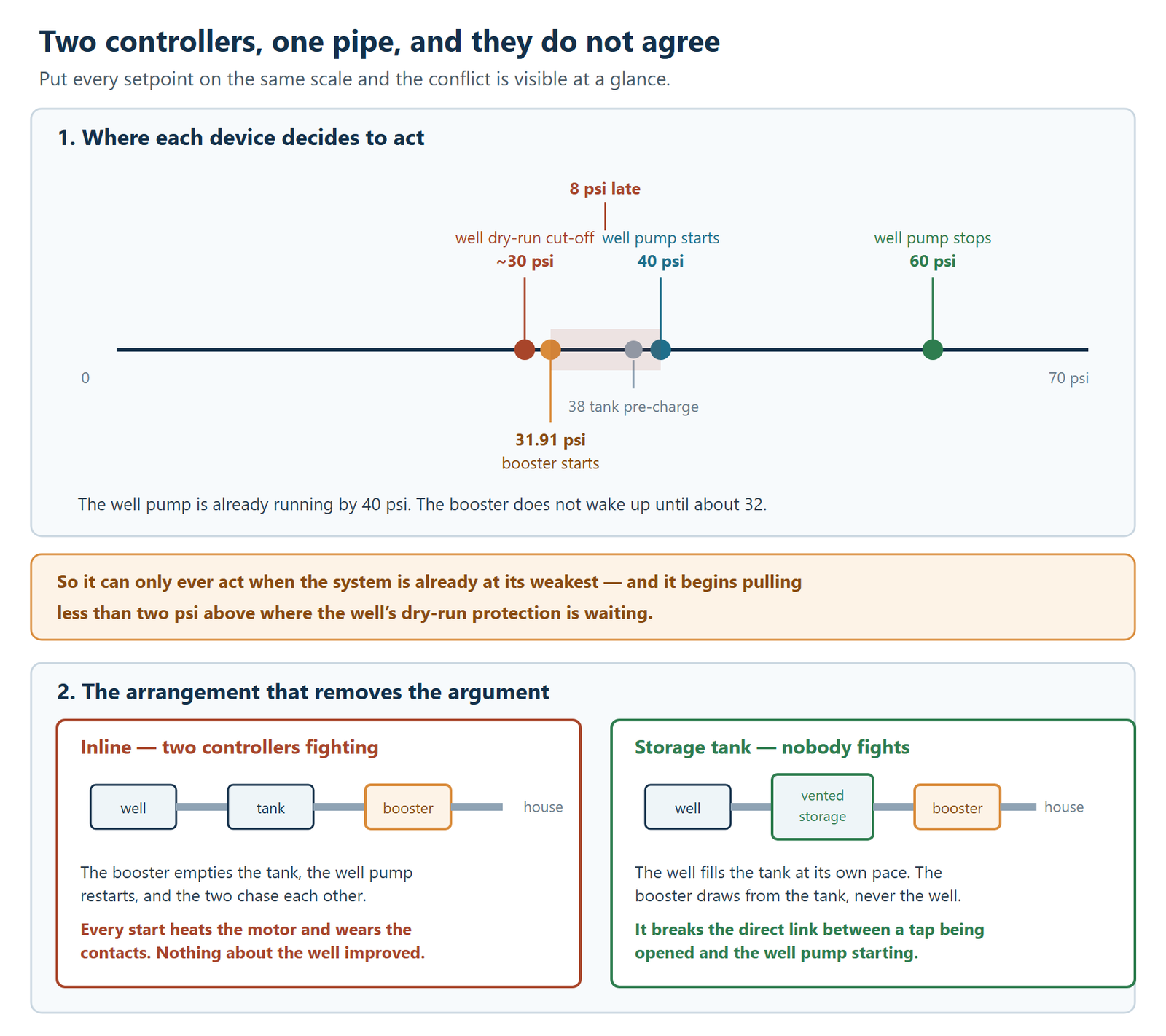
A standard well system runs on a 40/60 pressure switch: the pump starts at 40 psi and stops at 60. The tank is pre-charged to 38 psi, two below cut-in. Most switches also carry a low-pressure cut-off for dry-run protection, commonly set about 10 psi under cut-in — around 30 psi on a 40/60 system.
Now add the booster. Grundfos publishes the SCALA1 3-45’s start pressure as 31.91 psi.
Lay those out in order and the problem is obvious:
| psi | What happens |
|---|---|
| 60 | Well pump stops |
| 40 | Well pump starts |
| 38 | Tank pre-charge |
| 31.91 | Booster starts |
| ~30 | Well dry-run cut-off |
The well pump has already been running for eight psi of drawdown before the booster wakes up. And when it does wake up, it begins drawing hard less than two psi above the point where the well’s own protection shuts everything down.
Check your own switch before taking that last figure as read. The 10-psi-below-cut-in convention is consistent across switch vendors but varies, and a cut-off is not fitted to every system. The main problem does not depend on it — the 40 against 32 gap is enough on its own.
What actually happens after you fit one
A well-equipment specialist puts the conclusion bluntly:
“A booster pump does not harm a well pump by itself. Poor integration does.”
The mechanism, in their words:
“The booster drains the pressure tank quickly, which forces the well pump to start and stop in short bursts.”
That is the damage. The tank exists to give you a buffer of usable water so the pump is not started for every small draw. A booster downstream of it spends that buffer as fast as it can, because that is what it was built to do.
“Each start loads the motor with heat and beats up contacts, relays, and capacitors.”
Short cycling is the specific failure this causes, and it is well documented on well systems — you have simply added a device that guarantees it.
And the flow the well may not have
The Grundfos SCALA1 and SCALA2 are both rated 13.2 gpm.
If your well pump does not deliver 13.2 gpm at its working head, the booster cannot conjure it. It empties the tank, then runs on whatever arrives. The same specialist:
“The booster can demand more water than the aquifer can deliver in real time.”
On a submersible, running short of water costs it its cooling and its lubrication — both of which come from the water it is pumping.
This is the same starvation that happens to boosters on city water, with one important difference. On a municipal supply the code requires a low-pressure cutoff on the booster’s inlet precisely to stop this. On a well, nobody has mandated that device.
The arrangement that does work
If the house genuinely needs more pressure than the well system can hold, the answer is not a second controller in series. It is to stop the two talking to each other at all:
“Place an atmospheric storage tank between the well and the home… This breaks the direct link between faucet use and well pump operation.”
The well fills a vented tank at whatever rate it can manage. The booster draws from that tank. Neither controller can see the other, because there is an open surface of water between them.
It is a larger job than hanging a pump on a pipe, and it is a designed system rather than a product. But it is the arrangement that does what people hoped the booster would do.
Before any of this — the pressure is probably fixable upstream
On a well, low pressure usually has a cause the booster does not address.
The switch setting. A 40/60 switch can often be moved to 50/70 where the pump, tank and plumbing can take it. That is a setting, not a second pump — and it is live-voltage work, so it is something to ask about rather than attempt.
The tank. A waterlogged tank or a wrong pre-charge produces exactly the symptoms people buy boosters to solve.
The well itself, the pump, the pipe, a partly closed valve, or a clogged filter.
Work through the well-side causes first. A booster fitted to a system with a failing tank makes a failing tank fail faster.
Is there a case where it is right?
Yes, narrowly. A healthy well with good yield, a correctly sized and working pressure tank, a house that genuinely needs higher pressure than the switch can safely deliver, and someone who has matched the booster’s start pressure to the well system’s setpoints deliberately rather than by accident.
That is a coordination job, not a purchase. If you are choosing hardware, the published start pressures and inlet limits differ between models and are the first numbers to check against your switch.
When this needs a pro
All of it, realistically. Two pressure controllers in series on one water system is a design problem, and the failure mode is a burnt-out submersible several hundred feet down.
Anything involving the pressure switch. Line voltage, in a damp place, on a device protecting a pump that sits hundreds of feet down.
Any storage-tank system. Sizing, siting, the float control and the cross-connection protection are all part of one design.
What you can do yourself: read your pressure switch’s cut-in and cut-out — they are usually printed inside the cover — and find the published start pressure of any booster you are considering. If the booster’s figure is below the switch’s cut-in, you now know what it will actually do.
FAQ
Will a booster pump increase water pressure from a well?
Rarely in the way people expect. The well system already has a pump and tank maintaining pressure between two setpoints, and a booster placed after the tank drains it faster, which makes the well pump cycle more. The pressure problem on a well is usually upstream of anything a booster can reach.
Can a booster pump damage a well pump?
Not directly, but poor integration can. A booster empties the pressure tank quickly, which forces the well pump into short bursts, and every start heats the motor and wears the contacts. It can also demand more water than the well can deliver, which is a dry-run risk for a submersible.
Where should a booster pump be installed on a well system?
The arrangement that avoids the conflict is an atmospheric storage tank between the well and the house, with the booster drawing from the tank. That breaks the direct link between someone opening a tap and the well pump starting.
Why does my well pump cycle more after adding a booster?
Because the booster spends the pressure tank’s stored water as fast as it can, and an empty tank means the switch reaches cut-in sooner. The tank exists to stop the pump starting for every small draw, and the booster removes that buffer.
What pressure does a booster pump start at compared with a well switch?
Lower, which is the problem. A Grundfos SCALA1 3-45 starts at 31.91 psi, while a standard well switch has already called its pump at 40 psi. The booster only acts once the system is near the bottom of its cycle.
Should I raise my well pressure switch instead of adding a booster?
It is usually the first thing to ask a professional about. Moving a 40/60 switch to 50/70 is a setting change rather than another machine, though it depends on the pump, the tank and the plumbing tolerating the higher pressure, and it is live-voltage work.


