On this page
- Confirm it's a real power outage, not a tripped breaker
- The pump has no power, but the basin keeps filling
- Liberty's stuck-float advice doesn't apply tonight
- Stop sending water into anything that drains to that pit
- Nobody can give you a number for how many hours you have
- Does the pump come back on its own once the power does?
- Sewage on the basement floor is a plumber's call, not a mop job
- An outage doesn't mean the pump failed
Last Updated on October 13, 2026 by umar bwn
The pump isn’t broken. If the whole house has lost power — not just the circuit the pump happens to be on — there’s no breaker to find and nothing to reset. The usual troubleshooting for a sewage ejector alarm during a power outage assumes a local electrical fault exists somewhere to chase down. During a real outage, it doesn’t: the basin is filling because nothing is lifting it out, and the alarm sounding is correct, not malfunctioning. Confirm that’s actually what’s happening, then do three things before any of it reaches the floor: stop sending water into anything that drains to that pit, leave the panel alone, and find out roughly how long you’re likely to be without power.
Confirm it’s a real power outage, not a tripped breaker
Walk to a light switch somewhere else in the house — not the utility room, not near the pump. If it works, you don’t have a power outage, you have a dead circuit, and that’s a different, more fixable problem: check the breaker and the outlet the pump is plugged into the way this site’s own ejector pump alarm troubleshooting already walks through, because that advice is correct for exactly that situation.
If nothing in the house works, you’re dealing with a genuine outage. Check your phone for your utility’s outage map or a text alert, or look at a neighbor’s porch light. Knowing whether this is a whole-block, whole-town, or single-transformer event doesn’t change what you do right now, but it matters for the next step — a single blown transformer servicing a handful of houses is typically a much shorter wait than a storm that’s taken down lines across the county, even without a precise estimate from this article.
The pump has no power, but the basin keeps filling
Not every drain in the house depends on the pump, and that split is the part worth understanding before you do anything else. Fixtures that sit above the main sewer line’s elevation — most upstairs toilets, sinks, and tubs — drain by gravity straight to the street main, the same as always, outage or not. Nothing about that path involves the ejector pump at all.
Fixtures that sit below that line are a different story. A basement bathroom, a floor drain, a laundry standpipe — anything plumbed below grade — still drains by gravity into the sealed ejector basin, exactly as it would with the power on. What doesn’t happen is the second half of the trip: normally the pump lifts that water up and over the sewer line’s own elevation so it can keep flowing by gravity from there. With the pump off, that lift just isn’t happening, so the basin fills and has nowhere to go. The diagram below shows both paths side by side.
That basin and discharge line also aren’t just an open pipe waiting to be filled. Model plumbing code requires a check valve and a full-open valve on the discharge side, between the pump and the gravity line it ties into, and requires the sump itself to be vented (IRC Section P3007, “Sumps and Ejectors”). None of that changes with the power off — it’s a sealed, code-built system holding rising water, not a bucket that’s about to slosh sideways the moment it’s full.
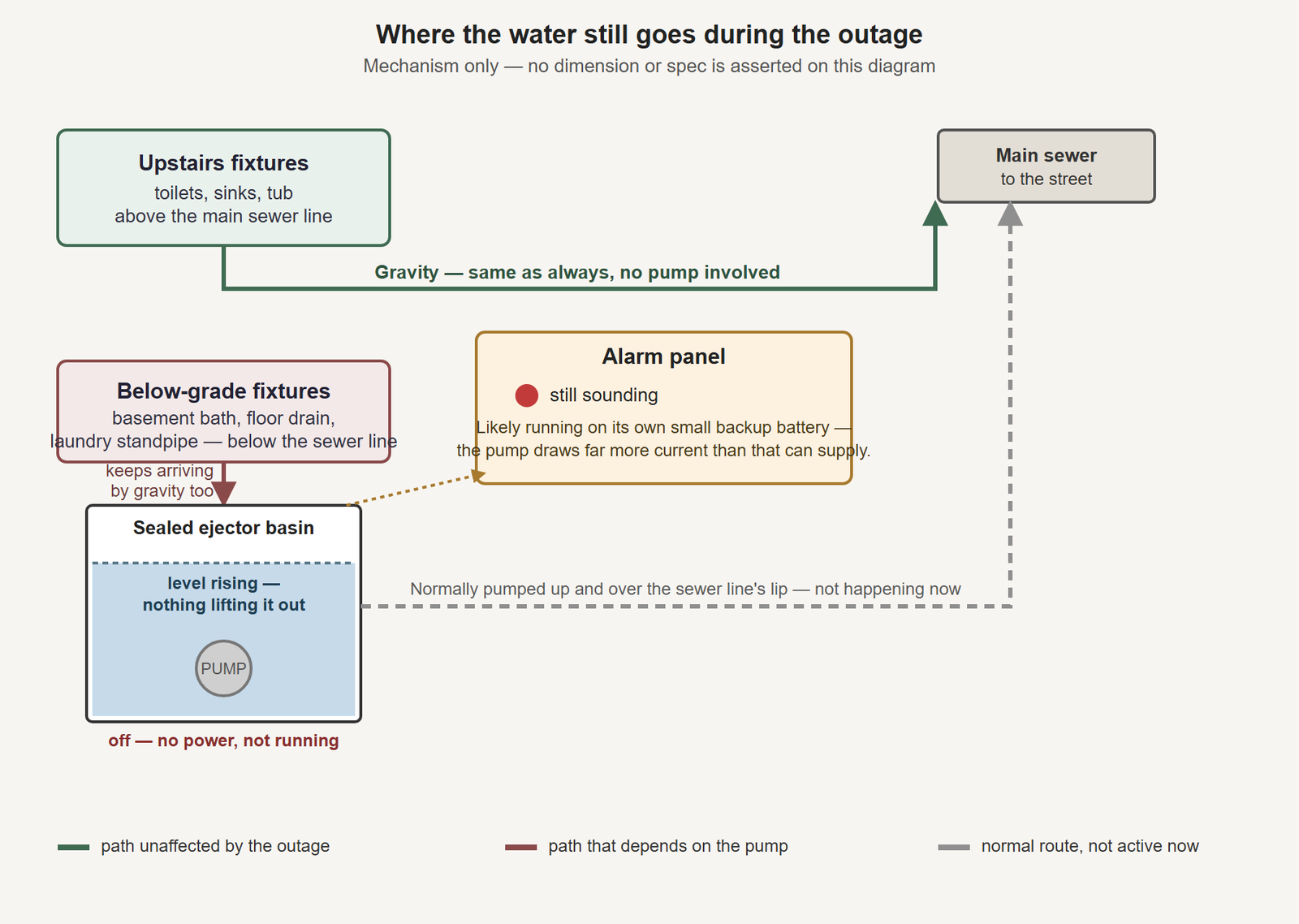
That’s also why the alarm isn’t lying to you. It has a float sitting in that same rising water, and it’s reporting a basin that is, in fact, filling with no pump running — which during a confirmed outage is simply true, not a fault to diagnose.
It’s worth asking, too, why the alarm can still be audible at all with the rest of the house dark. On its own household wiring, it couldn’t be — a true outage kills every ordinary outlet. The answer is a small internal backup battery. SJE Rhombus’s Tank Alert AB — one of the more common standalone high-water alarms installed on ejector systems — specs a secondary 9VDC battery for exactly this situation: “if primary power fails, the alarm system continues to operate on the battery backup” (Tank Alert AB spec page). Not every household has this exact model, but the backup-battery design is standard across this class of alarm, and SJE Rhombus publishes the full installation and wiring reference for it if you want to see what’s actually inside the box (Tank Alert AB installation instructions, PDF). The same spec page is also why pressing a horn-silence or test button on one of these panels quiets the noise without fixing anything: the alarm light is specified to stay lit “until the condition is remedied,” not until someone presses a button. None of this extends to the pump itself — a pump motor draws far more current than a 9V backup battery sized for an alarm board is built to supply, so a sounding alarm is never a sign the pump has power from anywhere.
Liberty’s stuck-float advice doesn’t apply tonight
This site’s own alarm article walks through a genuinely useful diagnostic for the normal case: is the pit actually high, or is the alarm’s own float stuck on debris — something Liberty’s troubleshooting documentation covers directly? That question exists because, with power present, you don’t yet know whether the pump is working. You test the fork to find out.
During a confirmed outage, there’s nothing to test. You already know the pump is off, because the whole house is off. A sounding alarm can’t be the stuck-float case in the way that article describes it, because the stuck-float case assumes a working pump is quietly failing to respond — here, no pump anywhere in the house is running on anything. The fork becomes relevant again only once power is back: if the alarm keeps sounding after the lights return and the pump has had a few minutes to catch up, that’s the moment to go run that test, not before.
Stop sending water into anything that drains to that pit
This is the one thing actually inside your control right now. Hold off on basement laundry, a basement shower or toilet, and anything else that drains below grade, until power’s back or you’ve confirmed the basin has room. None of that water is dangerous to delay for a few hours — it just has nowhere productive to go while the pump is off, and every gallon you add is a gallon closer to the basin’s lid.
Upstairs fixtures are a different matter. A toilet flush or a sink on the main or upper floor reaches the street main by gravity, the same as it would on a normal Tuesday, and doesn’t touch the ejector basin at all — so there’s no reason to ration water use for the whole house, only for what’s plumbed below grade.
Nobody can give you a number for how many hours you have
How long a given basin takes to fill depends on its size, how full it already was, and how much water the household is actually sending into it — and those vary enough pump to pump that a single hours-until-overflow figure, the kind a lot of outage advice likes to quote, isn’t something this article is going to invent. What’s actually useful is finding out your own number instead of borrowing someone else’s.
If you can safely check, a strip of tape at the current water line on the outside of a clear cleanout or a quick look through the basin’s inspection port (where the lid allows it) tells you more in thirty seconds than any generic estimate would. Check again in an hour. If the level’s barely moved, you likely have longer than you think, because most of what’s reaching the basin right now is incidental — nobody’s running water on purpose. If it’s climbed noticeably, that’s your household’s actual rate, not a number off the internet, and it’s worth planning around.
Does the pump come back on its own once the power does?
Once the lights are back on, give the pump a minute or two — a full basin after an extended outage often means the pump runs long and hard to catch up, cycling more than usual as it works through the backlog. That’s expected, not a new fault, and it’s a different situation from a pump that runs constantly with no apparent reason, which is worth reading only if the long run doesn’t taper off once the basin’s clearly caught up.
If the pump doesn’t start at all once power is restored, now the circuit-level diagnosis actually applies, and it’s worth running properly: the piggyback switch test, the breaker, the GFCI, the outlet, in that order, the way this site’s ejector pump not turning on guide covers. That diagnosis was never the wrong advice — it just wasn’t the right question to ask while the whole house had no power to begin with.
Sewage on the basement floor is a plumber’s call, not a mop job
If the basin does overflow before power returns, treat the water on the floor as a sewage spill, not spilled rainwater — it’s been sitting in a basin that handles blackwater, and that’s a real exposure risk for anyone who wades into it, especially kids or pets. Don’t step into standing water near an outlet, a power strip, or anything still plugged in to unplug it by hand; if you can safely reach the main panel, cut power to that circuit first, and if you can’t, leave it for an electrician rather than guessing.
And if this is the second or third time an outage has put your basement at risk, that’s a question for a licensed plumber about your specific setup — whether a backwater valve, a taller basin riser, or simply replacing an aging pump makes sense — not something to resolve from an article written for every house at once. If a replacement does turn out to be the right call, Best Sewage Ejector Pumps is where this site keeps that comparison current.
An outage doesn’t mean the pump failed
Nothing about a sewage ejector alarm sounding during a power outage means the pump, the float, or the alarm is defective. The pump has no power, the basin is filling because gravity doesn’t stop for a blackout, and the alarm telling you that is the system working as designed, not breaking down. The job right now is restricting what drains below grade, leaving the electrical system alone until there’s power to test it against, and keeping an eye on the basin yourself rather than hunting for a local fault that was never there to begin with.