On this page
Last Updated on October 13, 2026 by umar bwn
Well water sediment clogging booster pump components doesn’t damage them evenly. It fouls one of two specific spots first: the inlet strainer, which cuts pressure, or the non-return valve, which weeps and makes the pump short-cycle. Same grit, two different symptoms, depending on which one it reaches first — and a one-minute test tells you which.
A booster pump fed from a well doesn’t just “wear out faster” with sediment in the water the way most pages warn. It fails at one of two specific points, and which one determines what you’re looking at.
There’s no “a little sand is fine” line on the Grundfos SCALA
Every generic booster-pump page says sediment is bad for pumps and leaves it there. What they don’t say is that the Grundfos SCALA installation and operating instructions — the booster this site’s other articles are built from — publish the pump’s entire water-quality spec as one sentence: “The pump is designed for clean fresh water and chlorinated water < 300 ppm.” That’s it. No turbidity number, no “trace sediment acceptable” allowance, nothing to compare a cloudy sample against. Clean, or not clean. If you can feel grit in a glass of water from the tap, the pump is already running outside what the manufacturer documented.
That absolute spec is also why the maker doesn’t treat a well as an edge case. Its own installation diagram for suction from a well — not city water, not a storage tank — labels a filter at the inlet and says plainly: install one “if the water can contain sand, gravel or other debris.” A well-fed booster is exactly the installation Grundfos anticipated needing protection, which is a different claim than “sediment is bad,” and it’s the one nobody repeats.
Weak pressure means the inlet side got there first
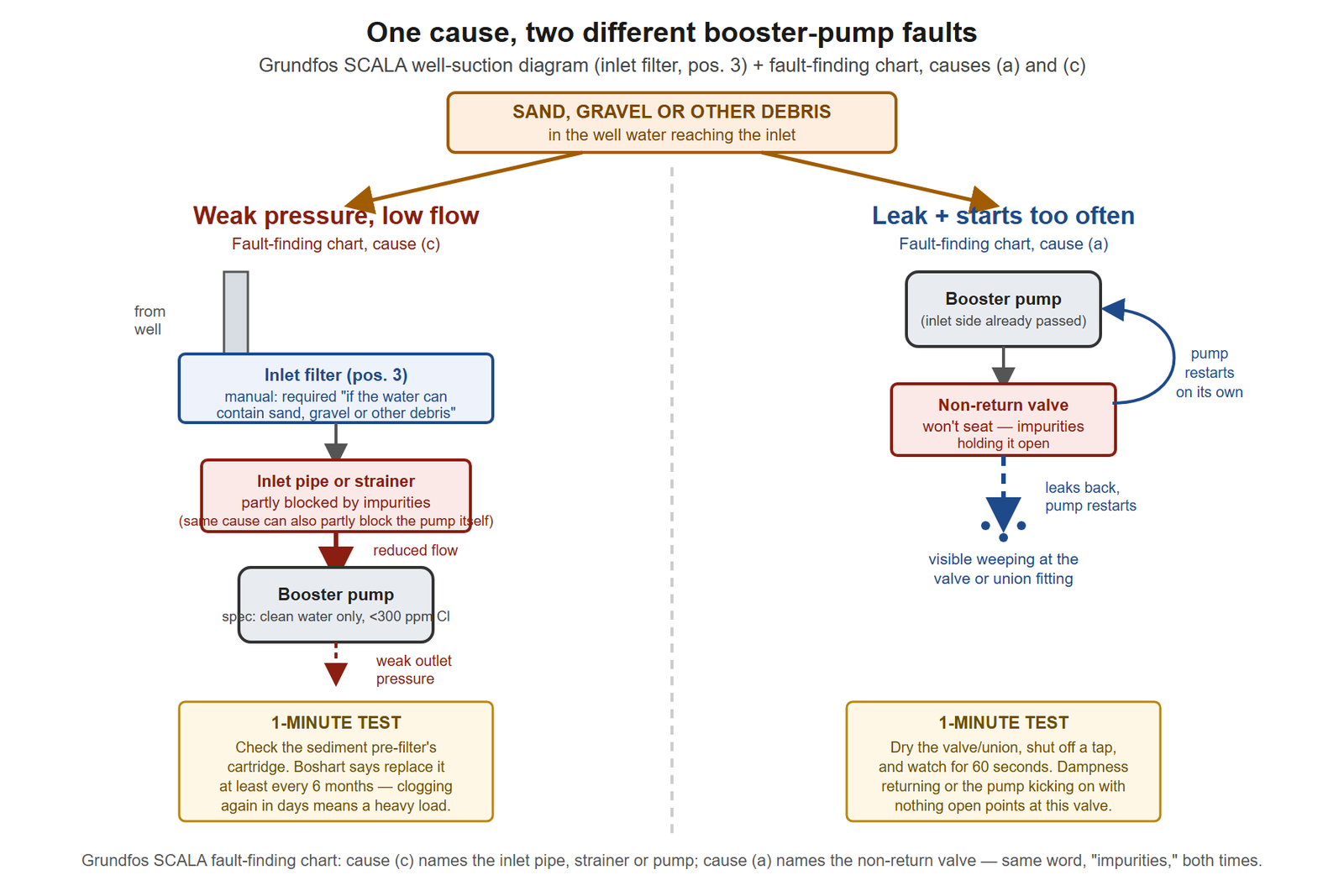
Grundfos’s own fault-finding chart lists this under insufficient pressure, cause (c): “The inlet pipe, the inlet strainer or the pump is partly blocked by impurities.” Remedy, equally plain: “Clean the inlet pipe or the pump.” That’s the whole official answer, and it’s accurate as far as it goes — it just doesn’t tell you how to catch it before the pump itself is the thing that’s partly blocked.
One-minute test: pull the sediment pre-filter cartridge if there is one upstream, and look at it rather than guessing. Boshart Industries’ own guidance is to change a cartridge at least every six months regardless of how it looks — a cartridge that’s visibly loaded or needs replacing again within days of its last change is nowhere near that baseline, and that gap means the load reaching everything downstream, including the booster, is heavy. If there’s no pre-filter at all, pull the booster’s own inlet strainer (same remedy the chart names) and check it for grit before assuming the pump itself needs work.
If pressure has dropped gradually over weeks rather than failed all at once, that pattern matches accumulation at the inlet more than a sudden mechanical fault — a motor or impeller failure tends to show up as no pressure increase at all rather than a slow fade. Booster Pump Running But No Pressure Increase covers the other causes behind a flat or capped outlet, including the 58 psi inlet-to-outlet ceiling, if the slow-fade pattern doesn’t match what you’re seeing.
Check the non-return valve if it’s leaking and short-cycling
The same word, “impurities,” shows up again under a completely different fault. Cause (a) on the starting-too-often and leakage side of the chart: “Leakage from the pipework, or the non-return valve is not properly closed due to impurities.” Grit or scale sitting on the valve seat holds it a hair open, water weeps back past it after the pump stops, the pressure drops just enough at the switch, and the pump kicks back on to make it up — repeating every few minutes with no tap running anywhere in the house.
This is the fault people chase with a wrench. Re-seating a union, tightening a fitting, swapping a gasket — none of it holds, because the leak isn’t the fitting, it’s grit sitting in the valve. Booster Pump Leaking covers the valve’s normal, expected weep during run-in; this is the other kind, the one that doesn’t stop and comes with restarts.
One-minute test: dry the area around the non-return valve and the nearest union completely, shut off every tap in the house, and watch for sixty seconds. Water reappearing, or the pump kicking on with nothing drawing anywhere, points straight at the valve — not the pipework, not a bad gasket.
Well Water Sediment Clogging Booster Pump? One Filter Stops Both Faults
Both failures trace back to the same unfiltered inlet, so stopping either one comes down to the same part: a sediment pre-filter sized for what’s actually coming out of the well. Boshart’s own mesh guidance ties the rating to particle size rather than selling one filter for everything — the company’s example contrasts a coarser 24-mesh element for scale against sand, which it says “is smaller and would require a mesh element with a 100 rating or even higher.” Silt runs finer than sand, so it calls for a tighter mesh than 100, though Boshart doesn’t publish one exact number for it — worth confirming against your own water test rather than guessing. A Boshart Spin-Out Filter — a separator with its own sediment-holding chamber ahead of a standard cartridge, which is the two-stage setup Boshart recommends specifically for wells producing large amounts of sand or sediment — is the specific product built for keeping that load off whatever sits downstream, which on a well-fed house is the booster.
Annual maintenance helps too, but it’s not the whole fix on its own. How to Maintain a Booster Pump covers cleaning the pump’s own non-return valve once a year — worth doing regardless, but a filter that stops the grit from arriving in the first place saves the annual teardown to clear it back out.
When this is a job for a pro
Installing a pre-filter means cutting into a pressurized line between the pressure tank and the booster — shut off and drain that section first, and if you haven’t sweated or threaded a fitting into live water supply before, this is a plumber’s afternoon, not a first DIY project, because a fitting that weeps under 50-plus psi soaks a wall before anyone notices. The booster itself runs on mains voltage; unplug it or kill its breaker before opening anything on it, and if the unit is hardwired rather than cord-connected, that disconnection is an electrician’s step, not a guess.
Is this already permanent damage?
Catch it at the “filter’s clogging fast” stage and you’ve lost nothing but a cartridge. Let it run for months with grit already past the strainer, and the fault-finding chart’s valve and strainer language stops being the whole story — a valve seat that’s been sitting on sand for a season can pit rather than just foul, and at that point cleaning doesn’t restore the seal the way it would on a valve that’s simply dirty. If you’ve already cleaned the strainer and the non-return valve and the same two symptoms come straight back within days rather than months, that’s wear, not fouling, and Best Booster Pumps for Low City Pressure is where to look once the fix is a new pump rather than a filter.
This is also where well water earns its own caution that a city-fed booster never needs: a sewer line or city main doesn’t carry the sand or well-development debris that a well can, which is the same reason this site’s well-on-a-booster installation article treats a well-fed system as its own case for the inlet side. And if the sediment itself is unexplained — new, or worse than it used to be — that’s a well question first, not a booster one; the mechanism that gets grit into the pressure tank at all lives upstream of anything the booster’s own documentation covers, the same way Iron Bacteria Clogging a Well Pump treats confirming the well-water cause before treating the symptom downstream of it.
FAQ
What mesh size filter stops well water sediment from clogging a booster pump?
Boshart’s own guidance ties mesh rating to particle size rather than naming one number for everything: the company’s example says sand needs a mesh element “rated 100 or even higher,” finer than the 24-mesh element it names for coarser scale. Silt is finer than sand, so it needs a tighter mesh still, though Boshart doesn’t publish one exact figure for it. If you don’t know which you have, a clogged-in-days pre-filter cartridge is the sign to get the water tested rather than guessing at mesh size.
Does any sediment void the booster pump’s warranty?
No manufacturer warranty language is being quoted here, so this isn’t a confirmed answer either way — but the pump’s published operating spec is “clean fresh water” with no sediment tolerance stated at all, which means any detectable grit already falls outside the documented envelope the pump is rated for, warranty question aside.
How often should a sediment pre-filter be changed on a well-fed booster setup?
Boshart’s own stated baseline is to change the cartridge at least every six months regardless of how it looks. A cartridge that needs replacing again within days instead — nowhere near that six-month mark — isn’t a filter problem on its own; it’s the signal that the sediment load is heavy enough to also be reaching the booster pump downstream of it.
Can sand permanently damage a booster pump, or does it just clog things temporarily?
Caught early — at the clogging-fast-filter stage — it’s a cleaning job, not a repair. Left running for months with grit already past the inlet, a valve seat sitting on sand can pit rather than just foul, and a pitted seat doesn’t reseal the way a dirty one does once it’s cleaned. The practical test is whether the same symptom returns within days of cleaning (wear) or holds for months (it was just fouling).