On this page
Last Updated on November 5, 2026 by Muhammad Toqeer
The usual advice is to buy the pump, then do the job. Do it the other way round.
Replacing a sewage ejector is not a difficult sequence. Isolate, open, disconnect, lift, fit, reconnect, test. Any competent set of instructions will get you through that, and this page does too.
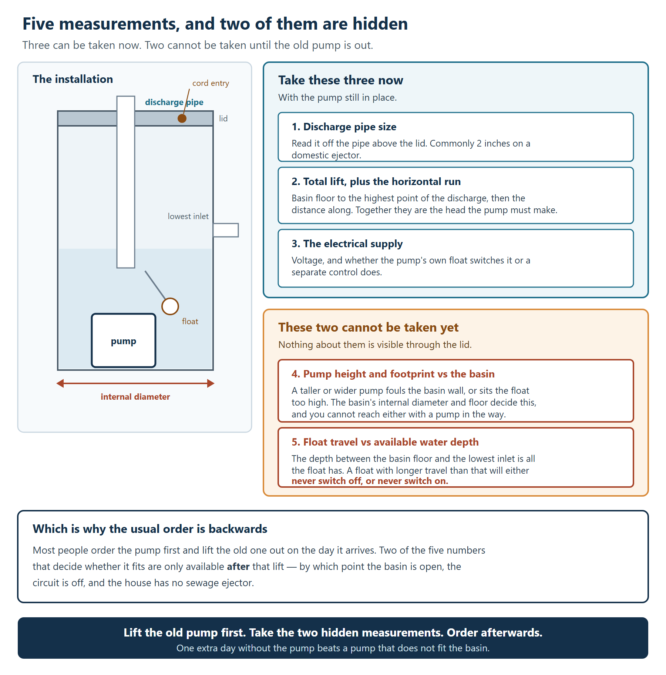
What those instructions skip is the part that goes wrong: ordering the pump. Five things on the replacement have to match the installation it is going into, and two of them cannot be measured while the old pump is still in the basin. Order first and you have a reasonable chance of standing in an open sewage basin holding a pump that does not fit.
So the sequence on this page puts the lift before the purchase.
What has to match?
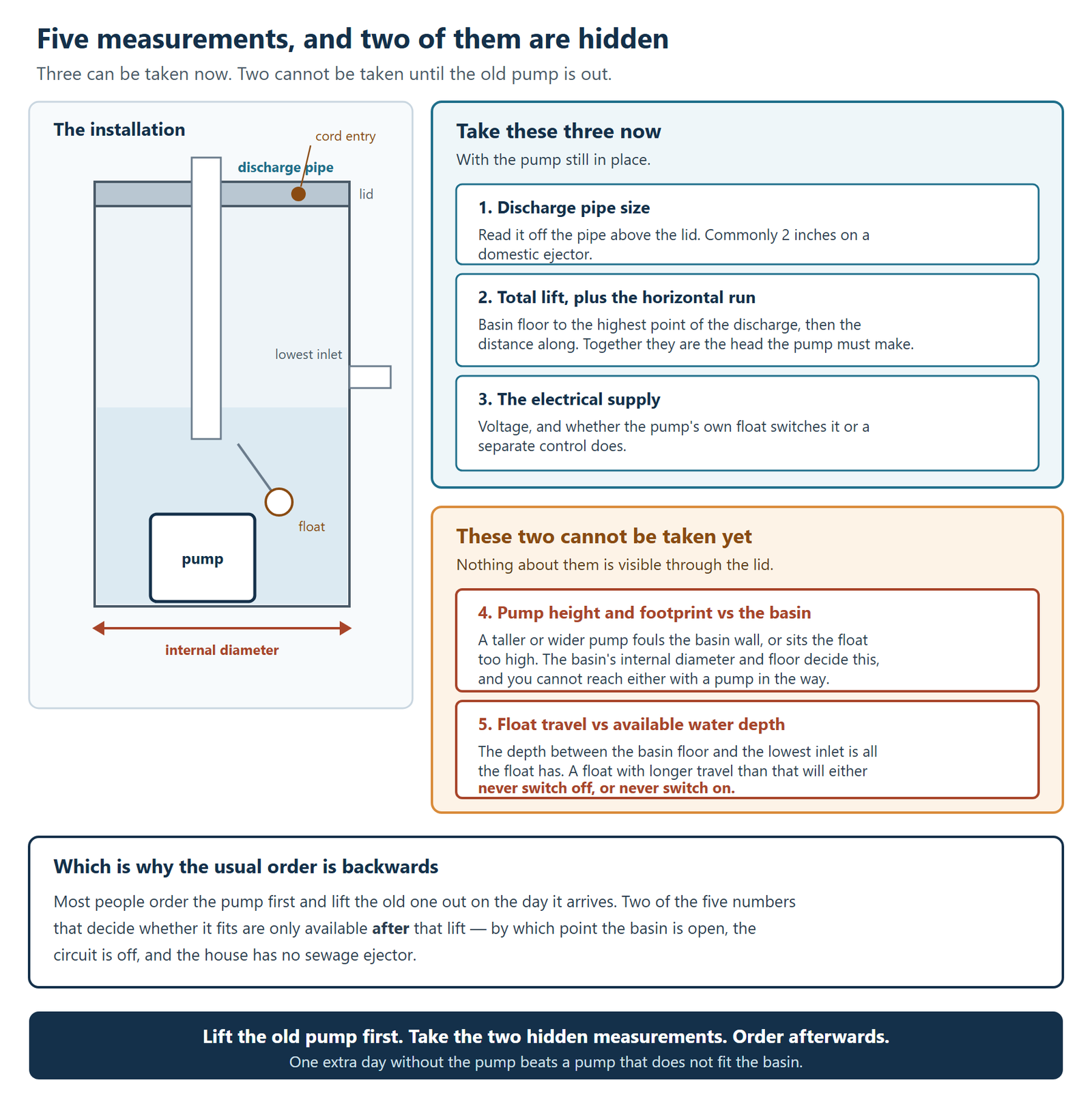
Three you can check now, with everything still assembled:
- Discharge size. Read it off the pipe above the lid. A domestic sewage ejector discharge is commonly 2 inches, and a pump built for a smaller discharge is a different class of machine.
- The lift and the run. Measure from the basin floor to the highest point the discharge reaches, then the horizontal distance after that. Those two numbers are what the pump has to work against, and together they are the only honest basis for choosing capacity.
- The electrical supply. Voltage, and whether the pump’s own float switches the circuit or a separate control panel does. These are not interchangeable — a pump with an integral float plugged into a controlled circuit gives you two switches fighting each other.
Two you cannot check until the pump is out:
- The pump’s height and footprint against the basin. A replacement that is taller or wider can foul the basin wall, or sit the float higher than the inlet allows. Basin internal diameter and floor clearance are only measurable with the basin empty and the pump gone.
- The float’s switching range against the available depth. The water depth you actually have is between the basin floor and the lowest inlet. A float whose travel is longer than that depth will either never switch off or never switch on. You cannot measure that distance past an installed pump.
If the basin itself looks marginal, basin size has its own requirements and they are worth checking before you assume the problem is the pump.
How do you take the old pump out?
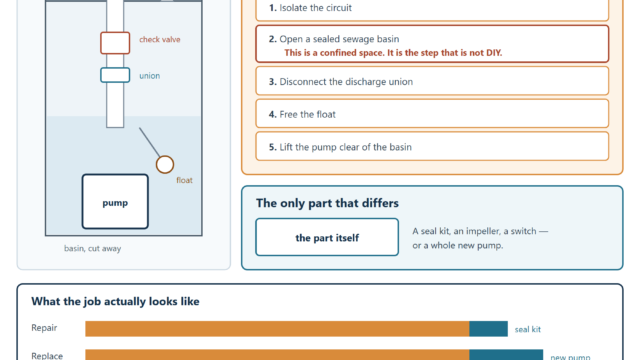
Before anything else: a sewage basin is a confined space. It contains hydrogen sulphide and can be oxygen-deficient. Do not put your head into it, do not work alone, and if the basin is deep enough to need you to lean in, this is a job for someone with gas detection and ventilation. That warning is the reason the rest of this section is short.
With that understood:
- Isolate the circuit at the breaker and confirm it is dead. If there is a control panel, isolate that too.
- Run a load through the basin, then let the pump finish so it leaves with the level down. Then isolate.
- Unbolt the lid and lift it clear. Note how the cord and vent pass through it — the grommets have to seal again afterwards.
- Break the discharge union above the check valve. Expect the pipe above the valve to hold water; have something under it.
- Free the float from whatever it is clipped or tethered to, noting the height it was set at.
- Lift the pump out by its handle or lifting lug. Never by the cord.
What do you measure before ordering?
With the pump on the floor beside you and the basin open:
- Basin internal diameter, and whether anything intrudes on the floor
- Floor to the lowest inlet — this is the usable depth, and it caps the float travel
- Pump height, so you know what will fit back under the lid
- Float travel as it was set, so the new one can be matched rather than guessed
Now choose the pump. Which pumps are worth considering, and on what basis, is a separate question — the point here is that you are answering it with numbers instead of with the old pump’s model number, which may itself have been the wrong choice.
Cover the open basin while you wait. Not with a cloth. With something solid and weighted, because an open sewage basin is both a gas source and a fall hazard.
How does the new pump go in?
- Set the float to the travel you recorded, not to the longest travel the clip allows.
- Lower the pump squarely onto the basin floor. It should sit flat. A pump on a tilt runs its float against the wall.
- Remake the discharge union. Fit a new check valve while the pipe is open — it has done the same hours as the pump, and it is the commonest cause of a pump that runs and runs.
- Dress the cord so it cannot drop into the float’s path. This is the single most common self-inflicted fault on a new installation.
- Replace the lid gasket and the cord grommets. Leaks around the lid come from reusing a compressed gasket, and they are a gas leak as much as a water leak.
- Check the vent is clear and reconnected. An ejector pit needs its vent for the pump to prime and for the basin not to pressurise.
- Bolt the lid down to an even pattern, like a wheel, not one side at a time.
How do you test it?
Restore power, then run water in and watch two full cycles.
| What to watch | Why |
|---|---|
| The pump starts before the level reaches the lowest inlet | Proves the float is set inside the usable depth |
| The pump stops with water still over the housing | A pump run dry has no cooling |
| The level does not creep back up after shut-off | The new check valve is holding |
| No water or smell at the lid under load | Gasket and grommets seated |
| Two consecutive cycles behave the same | Rules out a cord or float fouling intermittently |
Row three is the one people skip. A level that creeps up after shut-off means the discharge is draining back, and the pump will cycle on its own water until something is done about it.
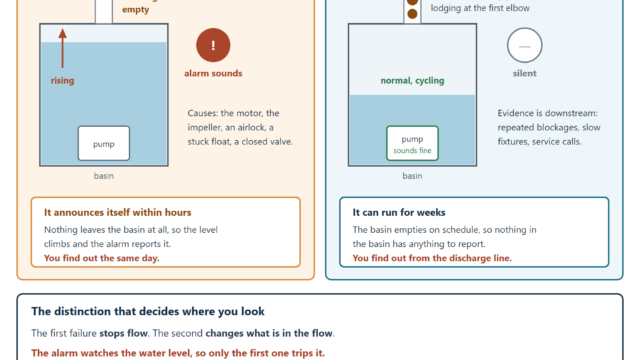
If the new pump does not start at all, it is usually the switching arrangement rather than the pump — a pump that will not turn on is most often a circuit, a float or a control conflict.
When does this need a pro?
- Always, if the basin needs entering rather than reaching into from above. Confined space, sewer gas, and no amount of care substitutes for detection and ventilation.
- If the discharge is hard-piped with no union. Cutting and rebuilding sewage discharge is plumbing work with code requirements.
- If the pump is on a control panel rather than its own float, or on a shared or municipal low-pressure sewer, where the utility sets the requirements.
- If the basin is cracked, undersized, or unvented. You would be fitting a good pump to a bad installation.
- If the existing pump failed early. Something caused that, and repeating the installation repeats the cause.
FAQ
Can I replace a sewage ejector pump myself?
The mechanical sequence is within reach of a competent DIYer, but the basin is the limiting factor. A sewage basin is a confined space containing hydrogen sulphide and possibly short of oxygen, so any version of this job that requires leaning into the basin is not a DIY job regardless of skill with pipework.
What size replacement sewage ejector pump do I need?
It is set by three numbers rather than by the old pump’s model: the discharge pipe size, the total lift from basin floor to the highest point of the run, and the horizontal distance after that. Match the discharge size exactly and choose capacity against the lift and run, because the pump that was there may itself have been wrong.
Why should I order the pump after lifting the old one out?
Because two of the five things that have to match are not measurable with the old pump installed: the basin’s internal dimensions and floor clearance, and the usable water depth between the basin floor and the lowest inlet. The second one caps how much float travel you can use, and getting it wrong leaves a pump that never switches off or never switches on.
What should I replace at the same time as the pump?
The check valve, the lid gasket and the cord grommets. All three have done the same hours as the pump, the discharge is already open, and the lid is already off — so the labour is free at that moment and expensive later.
Do I need to replace the float with the pump?
Most domestic ejector pumps come with their own integral float, so it arrives as part of the pump. What matters is setting the new float to the travel the old one was set at rather than to the maximum the clip allows, because the usable depth is fixed by the basin and the inlet height.
Why does my new ejector pump keep running?
The most likely cause is the check valve. If the discharge column drains back into the basin after each cycle, the pump refills its own basin and cycles on its own water. This is why fitting a new check valve while the discharge union is open is worth doing every time.