On this page
Last Updated on November 5, 2026 by Muhammad Toqeer
Nobody replaces an ejector pump because of its birthday. They replace it because something happened.
Ask this question anywhere and you get a number — seven years, ten years, fifteen. Those numbers are averages of populations, and your pump is not a population. An ejector running three cycles a day in a half-bath has barely started at ten years. One running thirty cycles a day under a basement apartment may be finished at five.
So age is the weakest input available, and it is the one every answer leads with.
Two things actually decide this, and both are knowable. Which part of the pump failed, and whether the pump has to come out of the basin regardless. The second one is the reason this decision is not the same as it would be for an appliance sitting in a cupboard.
Why does getting the pump out change the answer?
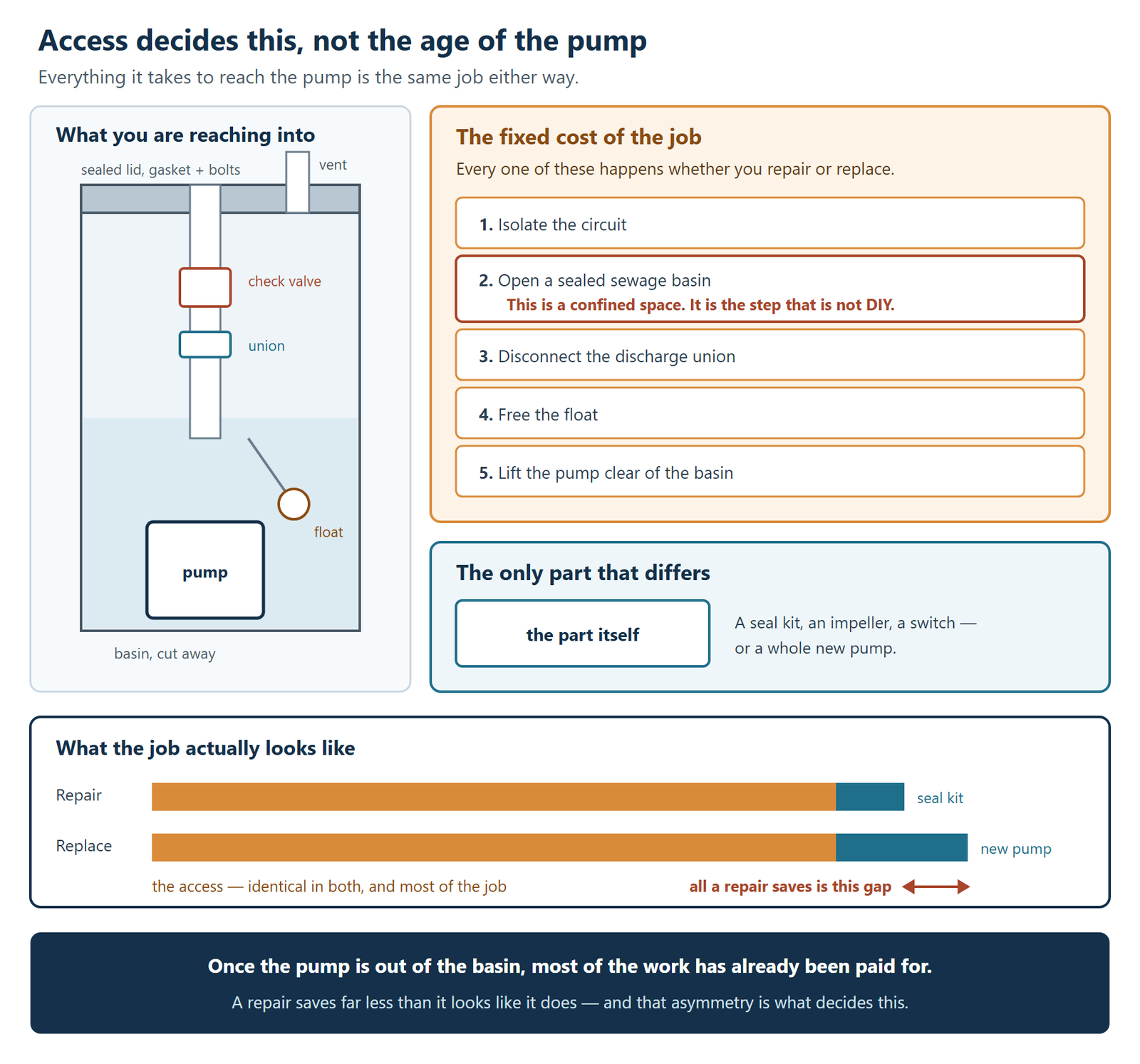
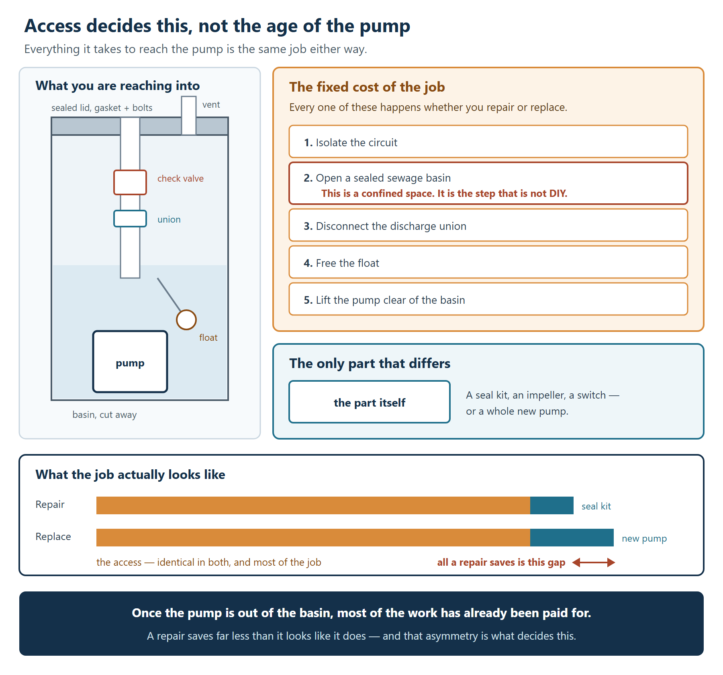
An ejector pump sits at the bottom of a sealed basin, under a gasketed lid, connected to hard-piped discharge through a check valve and union, with a vent and a float assembly in the way.
Every step needed to reach it is identical whether you intend to repair it or replace it. Isolate the circuit. Open the basin — which is a confined space containing sewer gas. Break the discharge union. Free the float. Lift the pump clear.
That block of work does not get smaller because you only wanted to change a seal.
So the real comparison is not “repair versus replace.” It is “the part, versus the part” — because the access is already spent. A repair that saves a little on the component but commits you to doing the whole extraction again in two years is usually the more expensive choice, not the cheaper one.
This is why an ejector pump is treated differently from, say, a utility pump you can pick up with one hand.
Which failures mean the pump is finished?
Some faults are the pump telling you it has reached the end. Others are repairs that genuinely stand on their own.
Replace the pump:
- Water has got into the motor. Once the shaft seal has let go and the motor has been flooded, the winding insulation has been compromised whether or not it still runs today. There is no repair for this on a domestic unit.
- The motor has failed. The motor is most of the pump. Replacing it is replacing the pump with extra steps.
- The impeller or volute is worn enough to lose head. If the pump is still running but no longer lifting what it used to, the hydraulic end is tired, and on a sewage pump the hydraulic end is not a bolt-on consumable.
- It has been flooded above the motor housing in a basement flood event.
- The pump is at the end of its service life and it is already out of the basin for another reason. Do not put a tired pump back down a hole you have just opened.
Repairing is reasonable:
- The float or switch has failed. This is a genuine stand-alone part, it is the most common fault on the whole assembly, and on many installations the switch is reachable without pulling the pump.
- The check valve has failed. That is a pipe component, not a pump component. A pump running constantly is very often a check valve letting the discharge drain back into the basin.
- The discharge union or lid gasket is leaking. Leaking around the lid or basin is a seal-and-fastener job and says nothing about the pump’s condition.
- It is not turning on at all and you have not yet checked why. A pump that will not turn on is frequently a circuit, a switch or a float — not a dead motor.
The distinction that matters: a float, a check valve and a gasket are parts of the installation. The motor and the wet end are the pump.
What should you look at instead of age?
Four things, in order of how much they tell you.
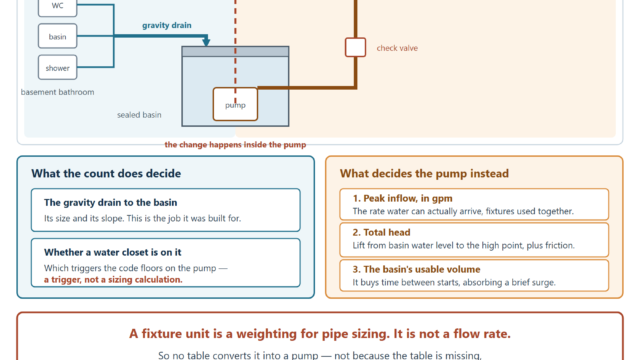
1. What the pump has actually done. Cycles, not years. You can estimate this better than you think — count the fixtures draining into the basin, and whether the basin serves a bathroom in daily use or one used twice a week. A pump’s wear is the number of starts it has survived.
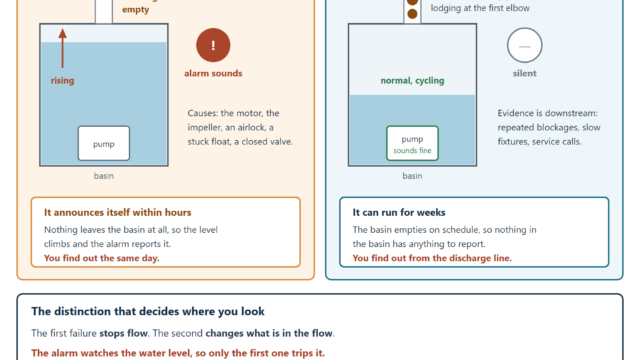
2. Whether anything has changed in how it runs. A pump that has started running constantly, or that has become noisy when it was not, is reporting a specific fault. Diagnose the change rather than reading it as general old age — most of these have a cause that is cheaper than a pump.
3. What the consequence of failure is. This is the input people leave out, and it is the one that most deserves to drive the decision. An ejector serving a basement bathroom that fails while you are away does not inconvenience you — it backs up into the lowest fixtures in the house. If the downside of an unplanned failure is sewage in the basement, planning the replacement is worth more than squeezing the last year out of the pump.
4. Whether you would be pulling it anyway. If the basin is open for any other reason, the calculation from the section above applies.
Is a pump that still works worth replacing on purpose?
Sometimes, and this is the one case where a planned replacement beats waiting.
It is worth it when all of the following are true:
- The pump is old relative to its duty — heavy use, many years
- Failure would back up into the house rather than merely stop working
- The basin is being opened anyway, or access is difficult enough that you do not want to do it in an emergency
- Nobody is home for stretches long enough for a failure to go unnoticed
It is not worth it when the pump is simply old and nothing else on that list is true. A lightly used ejector in a house with someone in it is allowed to run until it gives you a reason.
And if you are replacing it, replace the parts around it in the same visit. The check valve, the float and the lid gasket have all done the same hours as the pump, and they are the three things that would otherwise send you back into the basin.
When does this need a pro?
- Opening the basin. A sewage basin is a confined space containing hydrogen sulphide and can be oxygen-deficient. This is the single hardest rule on this page and it is not negotiable for a cost saving.
- Any decision that needs the pump lifted to inspect the wet end or the seal.
- Working out whether a worn pump still meets the head the discharge needs. That is a measurement against the installed pipe run, not a guess.
- Anything backing up into the house, which is urgent and not a planning question.
- A pump on a shared or municipal low-pressure sewer, where the discharge requirements are set by the utility and not by you.
FAQ
How long does a sewage ejector pump last?
There is no figure that applies to a particular pump, because the wear is in cycles rather than years. A pump serving a half-bath used twice a week and one serving a basement apartment can differ by a factor of ten in starts per year while being the same age. Count what the basin actually serves rather than reading an average.
Should I repair or replace a sewage ejector pump?
It depends on which part failed. A float, a check valve or a lid gasket are parts of the installation and are worth repairing on their own. The motor and the wet end are the pump itself, and replacing either is close to replacing the pump. The deciding factor is that the work to reach the pump is the same either way, so a repair saves less than it looks like it does.
Is it worth replacing a sewage ejector pump before it fails?
Only if failure would back up into the house, access is difficult, and the pump is old relative to how hard it has worked. If the pump is simply old and someone is home to notice a problem, there is no advantage in replacing it early.
Can water in the motor of an ejector pump be repaired?
No. Once the shaft seal has let go and the motor has taken water, the winding insulation has been compromised even if the pump still runs. There is no domestic repair for this, and a pump in that condition should be replaced rather than returned to the basin.
What should I replace at the same time as the ejector pump?
The check valve, the float or switch assembly, and the lid gasket. All three have done the same hours as the pump, all three are common failure points, and all three are the reason people end up reopening a basin they only just closed.
Does a noisy ejector pump mean it needs replacing?
Not by itself. A change in noise is a specific fault reporting itself, and several of the causes are in the discharge pipe or the mounting rather than the pump. Diagnose the noise before treating it as a sign of age.