On this page
Last Updated on November 5, 2026 by Muhammad Toqeer
A drainage fixture unit is not a flow rate, and no table converts one into a pump.
If you have landed here with a fixture count and you are looking for the column that turns it into gallons per minute, the honest answer is that the column does not exist — and the reason it does not exist is worth two minutes of your time, because it changes what you go looking for.
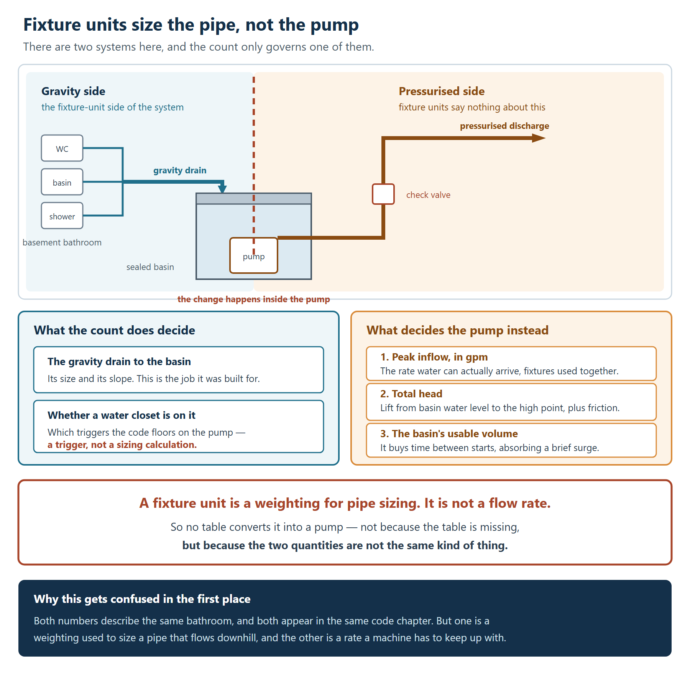
Drainage fixture units size gravity pipe. The DFU is a weighting system: it expresses how much load a fixture places on a drain relative to other fixtures, taking account of how much it discharges, how fast, and how often. That weighting is designed for one job — picking the diameter and slope of a pipe that water falls down.
A pump is not a pipe. It is sized on a flow rate against a specific resistance. Those are different quantities, measured in different units, derived from different things.
So fixture units do two real jobs in an ejector installation, and neither of them is choosing the pump.
What do fixture units actually decide here?
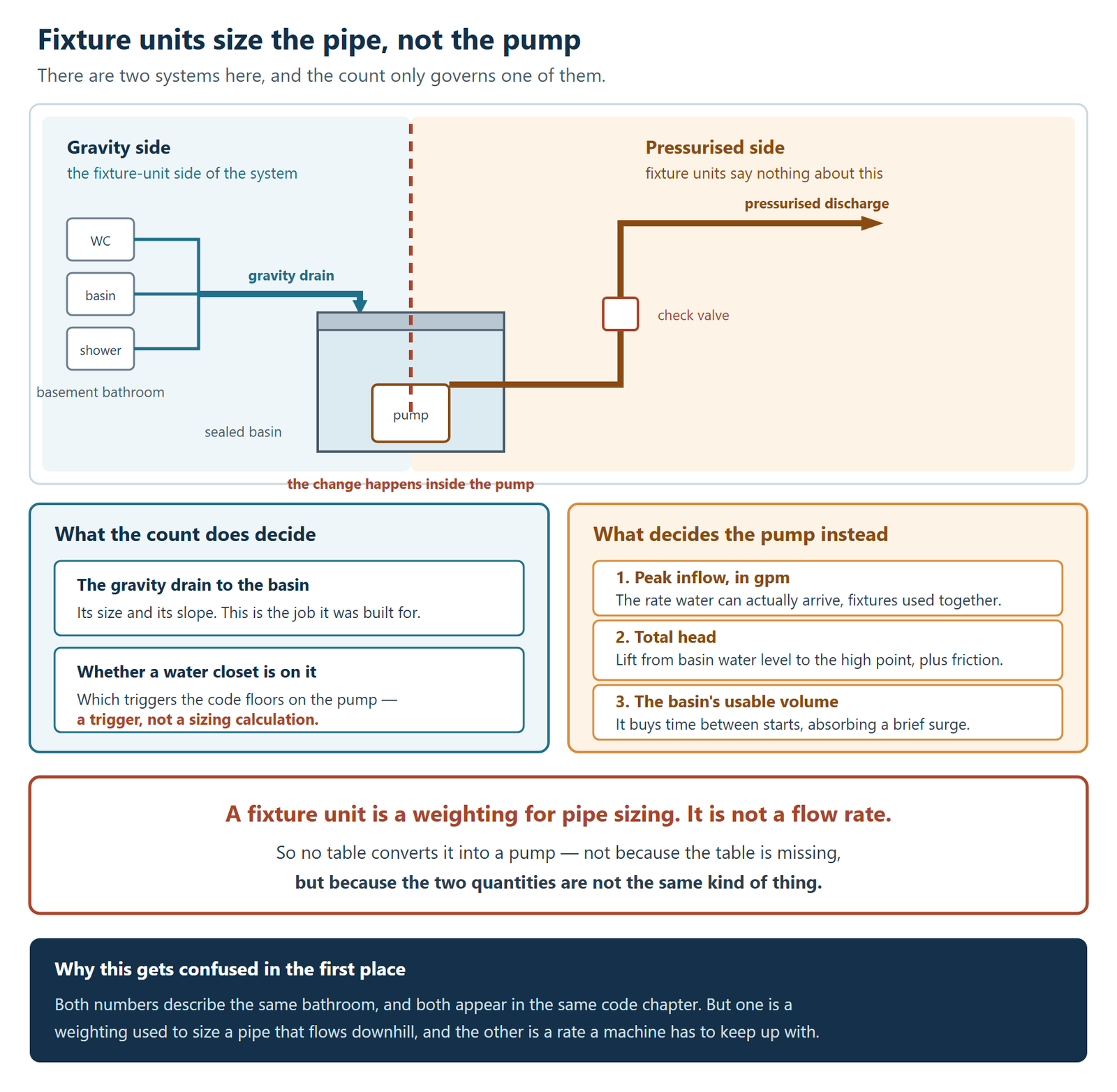
Job one: the gravity drain into the basin. Everything upstream of the basin falls under gravity, and that pipe is sized from the fixture unit count in the ordinary way. This is the part of the installation where a DFU table belongs.
Job two: whether a water closet is connected. This is the important one, and it is a yes-or-no question rather than a calculation. An ejector receiving water closet discharge is subject to minimum requirements that do not apply to one handling only a sink and a shower — a larger minimum discharge size, and the ability to pass larger solids.
Those are floors, not sizes. They tell you what the pump must be capable of before anything else is considered. They do not tell you whether it is big enough for your house.
What actually sizes the pump?
Three numbers, none of which is a fixture unit.
Peak inflow, in gallons per minute. Not the total the fixtures could deliver in a day — the rate at which water can arrive when the things people actually use together are used together. A basement bathroom’s worst case is a shower running while a toilet is flushed, and that is a far smaller number than a fixture unit count implies, because the DFU weighting is built for a different purpose.
Total head. The vertical lift from the basin’s water level to the highest point of the discharge run, plus the friction of the pipe and every fitting in it. A pump’s capacity figure means nothing without the head it was measured at, and this is where most undersizing happens.
The basin’s usable volume. This is the one that gets forgotten, and it is the one that makes the arithmetic survivable. Volume buys time. A basin with real storage between the pump’s start level and the lowest inlet turns a brief surge into something a modest pump can absorb over the following minutes. Basin size has its own requirements, and they interact directly with the pump you need.
Peak inflow and basin volume trade against each other. More storage means less pump. That trade is the actual sizing exercise, and no fixture unit table can express it.
Why do the code minimums disagree with each other?
This is worth knowing before you go looking for a number, because you will find more than one.
The minimum capacity a sewage ejector must have is set by whichever code your jurisdiction has adopted, and the two major model codes do not agree:
- Under the IPC, the minimum capacity is tabulated against discharge size, and the figure given for a 2-inch discharge is 21 gpm.
- California’s plumbing code sets 20 gpm for an ejector serving water closets or urinals.
Secondary sources repeat both figures interchangeably, and some exam guides give 20 gpm while citing the IPC. They are different numbers from different codes, not a rounding.
On solids, the sources are more consistent: a pump receiving water closet discharge must pass 2-inch spherical solids under the IPC, while one that does not need only handle 1/2-inch. California’s requirement for a single dwelling is stated as 1-1/2 inches, which is again not the same number.
The practical consequence: do not take a capacity or solids figure from an article, including this one. Find the edition your jurisdiction has adopted, and check for local amendments — which exist, and which override the model code. Every figure above is reported from secondary sources that disagree with each other, which is precisely why it should not be the basis of your installation.
And remember what these numbers are. Even the correct one is a minimum the pump must clear. It is not an answer to “what size pump do I need.”
How do you get to peak inflow?
You estimate it from what the fixtures can actually deliver at once, not from a weighting table.
- Count the fixtures draining into the basin, and identify which ones are realistically used simultaneously. In a basement bathroom that is usually one shower plus one other thing.
- Use the fixtures’ own flow rates. A shower head and a tap have a rated flow in gallons per minute, which is a real flow rate rather than a weighting. A toilet discharges a known tank volume over a few seconds.
- Treat a toilet as a surge, not a rate. A flush delivers its tank volume quickly and then stops. That is exactly what basin volume is for.
- Then check it against the basin. If the basin can hold the surge, the pump only has to clear it before the next one.
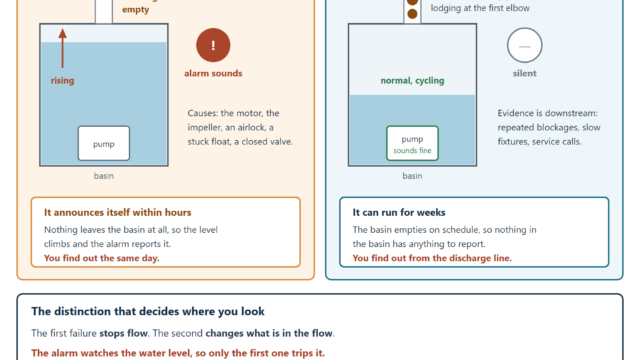
This is also why an ejector that is running constantly is usually not undersized — a pump running without pause is far more often a check valve returning the discharge to the basin than a capacity problem.
Does any of this change for a grinder or a macerating system?
Yes, and in a way that matters for the discharge rather than the pump’s flow.
A grinder reduces solids so they can travel a smaller discharge line, which changes the pipe size the installation needs. A macerating system does something similar for a fixture that has no gravity drain at all. Both change the discharge requirement, and therefore which code minimum applies.
What they do not change is the method: peak inflow, total head, basin or reservoir volume. The ejector pumps guide covers how these classes differ, and the basin still needs its vent regardless of which one you fit.
When does this need a pro?
- Always, for the code question. Which edition applies, which local amendments exist, and whether your installation needs a permit are not things to establish from an article.
- When total head has to be calculated rather than estimated. Friction in fittings is where estimates go wrong, and the consequence is a pump that cannot clear the basin.
- When the discharge ties into a shared or municipal low-pressure sewer, where the utility sets requirements that are not in any model code.
- When the basin is existing and you cannot change it. Then the volume is fixed and the pump has to absorb the whole surge, which is a tighter calculation.
- When fixtures might be added later. Sizing for today and discovering the limit in two years is the common and avoidable mistake.
Which pumps are worth considering, and on what basis, follows once you have the three numbers — not before.
FAQ
How do I convert drainage fixture units to gallons per minute for a pump?
You do not, because they are not the same kind of quantity. A fixture unit is a relative weighting used to size gravity drain pipe, accounting for how much a fixture discharges, how fast and how often. A pump is sized on a flow rate against a specific total head. No table bridges the two, and any that claims to is answering a different question.
What size sewage ejector pump do I need?
It is set by three numbers: the peak rate at which water can arrive in gallons per minute, the total head made up of vertical lift plus pipe and fitting friction, and the basin’s usable volume between the start level and the lowest inlet. Basin volume and pump capacity trade against each other, so more storage means a smaller pump will do.
What is the minimum capacity for a sewage ejector pump?
It depends on the code your jurisdiction has adopted, and the model codes differ. The IPC tabulates minimum capacity against discharge size and gives 21 gpm for a 2-inch discharge, while California’s plumbing code sets 20 gpm for an ejector serving water closets. Check the edition adopted where you are, along with any local amendments, rather than relying on a figure from an article.
Do fixture units matter at all for an ejector installation?
Yes, for two things. They size the gravity drain that carries waste to the basin, which is ordinary pipe sizing. And the fixture count tells you whether a water closet is connected, which determines whether the stricter minimum discharge size and solids-passing requirements apply to the pump.
What solids does a sewage ejector have to pass?
Under the IPC, a pump receiving water closet discharge must pass 2-inch spherical solids, and one that does not need only pass 1/2-inch. California states 1-1/2 inches for a single dwelling, so this is another figure that varies by code and should be read from the adopted edition.
Is my ejector pump undersized if it runs constantly?
Usually not. A pump running without pause is far more often returning its own discharge to the basin through a failed check valve than struggling with inflow. Rule that out before concluding the pump is too small, because replacing it will not stop the behaviour.