On this page
Last Updated on November 5, 2026 by Muhammad Toqeer
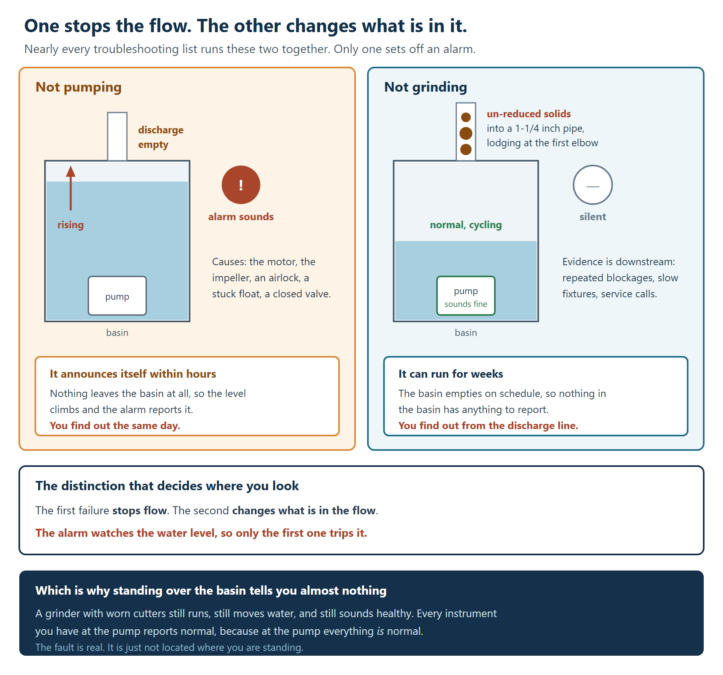
A grinder pump that has stopped grinding does not stop pumping. That is the whole problem.
If the pump had seized, you would know within a day — the alarm would sound, the basin would fill, and nothing would leave. Worn cutters produce no such moment. The motor runs, the impeller moves water, the basin empties on schedule, and the pump sounds fine.
What changes is what leaves the basin. A grinder exists to reduce solids small enough to travel a 1-1/4 or 2-inch discharge line, often uphill and often for a long way. Once it stops doing that, the solids still leave — they just leave intact, into a pipe sized on the assumption that they would not be.
So the first place this fault appears is downstream, not at the pump. That is the single most useful thing to know about it, and it is why standing over the basin listening to the motor tells you almost nothing.
How is this different from a pump that is not pumping?
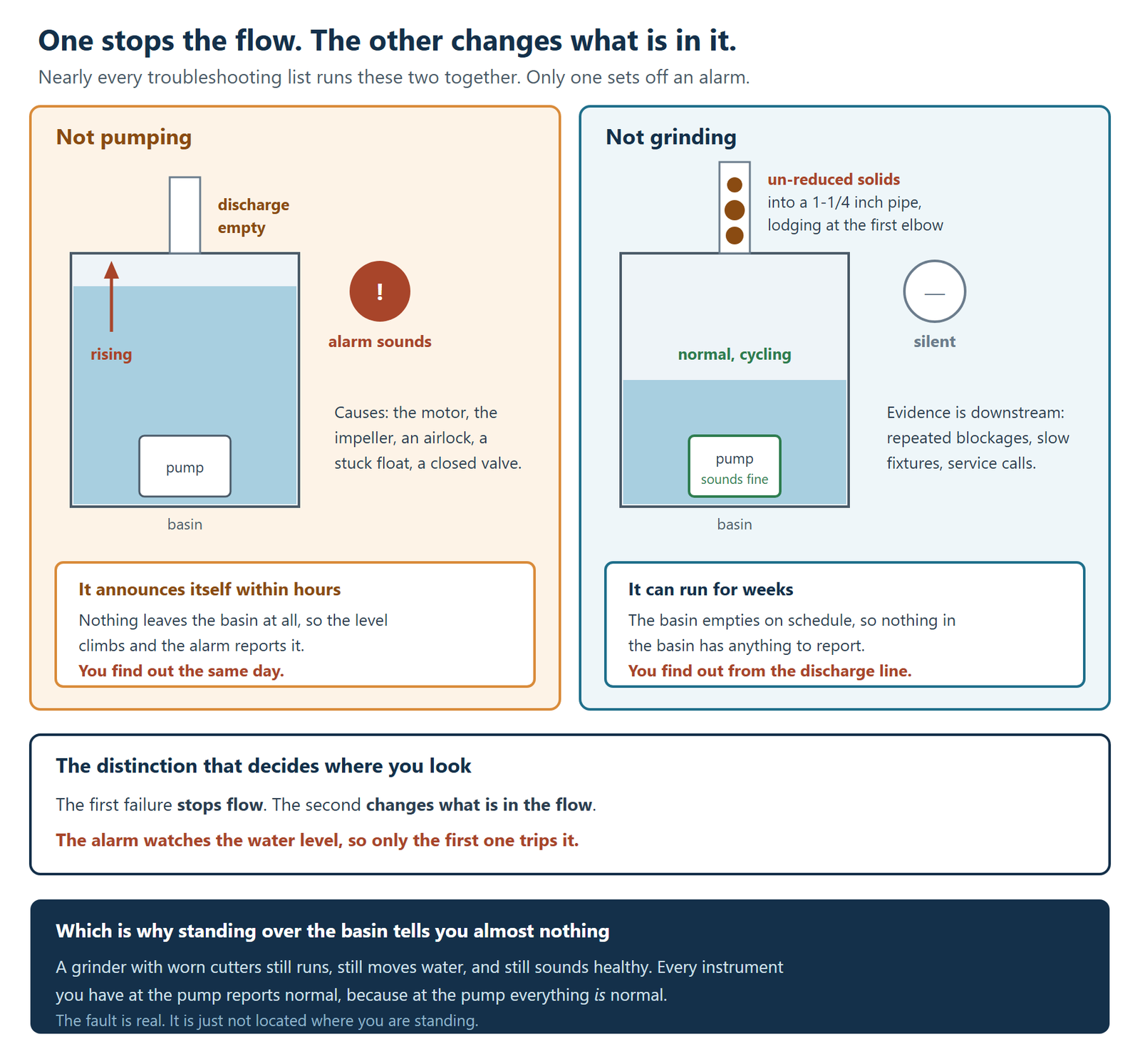
These are two separate faults with two separate timelines, and nearly every troubleshooting list runs them together.
| Not pumping | Not grinding | |
|---|---|---|
| Basin level | High and rising | Normal, cycles correctly |
| Alarm | Sounds | Silent |
| Motor | Silent, humming, or tripping | Runs and sounds healthy |
| How fast you notice | Hours | Weeks or months |
| Where the evidence is | In the basin | In the discharge line |
If your basin is filling and nothing is leaving, you are on the wrong page — a pump that runs but does not empty the pit is a flow problem, and it has a different list.
What tells you the cutters are worn?
There is no gauge for this, so the diagnosis is built from indirect evidence. Any one of these alone is weak. Two or three together are strong.
Repeated blockages in the same discharge line. This is the strongest signal. A grinder’s discharge is too narrow to pass anything the pump has not reduced, so a line that blocks twice in a season is reporting on the cutters, not on the household.
Run time has crept up. A worn cutter set shears less cleanly, so the pump works against a load it did not used to have. If you know roughly how long a cycle took when the pump was new, a noticeably longer cycle on the same inflow is meaningful.
The sound has become smooth. A healthy grinder changes note audibly when it meets solids — it loads up and recovers. A pump that sounds identical on every cycle is often a pump that is no longer cutting anything. This is subjective, so treat it as supporting evidence.
The pump is old and has been working hard. Cutters are a wear part. Their life is governed by how much they have cut, which is cycles and solids, not years on a calendar.
Nothing is tripping. If the breaker is going, stop here — a grinder tripping its breaker is an electrical fault with protective devices involved, and it is not cutter wear.
What else makes a grinder appear to stop grinding?
Three things mimic it, and all three are cheaper to find out about than a wet end.
The material is not grindable. Wipes marketed as flushable, dental floss, hair, and fibrous sanitary products do not shear — they wrap. A grinder does not fail against them; it is simply not a machine for them. If blockages began when household habits changed, the cutters may be fine.
The pump has been sitting. A grinder that has been idle builds a hardened crust on the cutters and in the volute. It can run and move water while the cutting faces are effectively packed. A grinder pump sitting unused has its own recovery routine and it is worth trying before you condemn the pump.
Something is jammed in the cutter, not worn off it. A fragment of hard plastic or a metal object lodged against the cutting face stops reduction without stopping rotation. This usually comes with a noise, and it is recoverable.
Can worn cutters be sharpened or adjusted?
No, and this is the part that decides what the job costs.
A grinder’s cutting action depends on a clearance between a rotating cutter and a stationary ring, set at the factory to a tolerance measured in thousandths of an inch. Grinding works because that gap is small. As both faces wear, the gap opens, and nothing you can do in the basin closes it again.
- Sharpening the cutter does not help — it removes material, which widens the gap further.
- There is no field adjustment on domestic grinder pumps for this clearance.
- The repair is a new cutter assembly or a new wet end, fitted to the maker’s clearance spec, or a new pump.
Whether a cutter kit is available at all, and whether it costs enough to make a new pump the better buy, depends entirely on the model. That is a question for the maker’s parts list for your exact model number — it is not something a general article can answer, and anyone who gives you a figure without knowing your model is guessing.
Does this mean the pump has to be replaced?
Not necessarily, and the honest answer depends on three things you can check:
- Is a cutter or wet-end kit listed for your model? Some are supported for years; some are not supported at all.
- How is the pump mounted? On a rail system the pump lifts out and a wet end can be swapped. On a pump sitting on the basin floor with hard-piped discharge, the labour to get it out is most of the job either way.
- What else is worn? The seal and bearings have done the same hours as the cutters. A wet end on a tired motor buys less time than it looks like it does.
If the pump is near the end of its service life and the cutters are gone, the replacement conversation is the right one. If it is a young pump, the wear is worth understanding before you spend — cutters that failed early were being asked to cut something they should not have been.
When does this need a pro?
- You are considering opening the basin. Sewage basins contain hydrogen sulphide and can be oxygen-deficient. This is a confined space. It is not a DIY inspection.
- The discharge line has blocked more than once. Clearing it is one job; working out whether the pump or the household caused it is another, and it needs the line inspected.
- Anything is backing up into the house. Sewage backing up into a shower or tub is an urgent fault and not a wear problem.
- The alarm is sounding. An ejector alarm going off means the basin is not keeping up, which is the other failure entirely.
- You need to know whether a cutter kit exists. That means a model number, the maker’s parts documentation, and someone who can price the labour against a new unit.
FAQ
How do I know if my grinder pump cutters are worn?
There is no direct test you can run from outside the basin. The diagnosis is built from indirect evidence: repeated blockages in the same discharge line, cycles that take longer than they used to on the same inflow, and a pump that no longer changes note when it meets solids. Any one of those alone is weak, but two or three together are a strong case.
Why is my grinder pump running but not grinding?
Because grinding and pumping are two separate jobs done by two separate parts. The impeller moves water and the cutter reduces solids. When the cutter clearance opens up through wear, the impeller carries on working normally, so the basin still empties and the motor still sounds healthy while nothing is being reduced.
Can you sharpen grinder pump cutters?
No. The cutting action depends on a tight clearance between a rotating cutter and a stationary ring, and sharpening removes material, which widens that clearance and makes the problem worse. The repair is a new cutter assembly or wet end fitted to the manufacturer’s clearance specification, if a kit is available for your model.
What should never go into a grinder pump?
Anything fibrous or film-like, because those wrap rather than shear: wipes of any kind including ones labelled flushable, dental floss, hair, and fibrous sanitary products. Hard objects such as plastic fragments are also a problem, but they tend to jam and announce themselves rather than cause gradual wear.
Does a grinder pump alarm go off when the cutters wear out?
No, and that is why this failure can run for months. The alarm watches the water level in the basin. Worn cutters do not raise the level, because the pump is still moving water normally. The alarm only sounds when flow stops, which is a different fault.
How long do grinder pump cutters last?
There is no useful years figure, because the wear depends entirely on how much material has been cut and what it was. A grinder on a household that sends only normal waste through it can run for many years, while one handling wipes can lose its cutters far sooner. If cutters failed early, what went into the pump is the thing to investigate.